



Indian Hindu Sculpture: Chola Bronze to Rajasthani Stone
Indian Hindu Sculpture: Chola Bronze to Rajasthani Stone
Most collectors who pursue Indian Hindu sculpture start with a single striking piece and quickly realise they have wandered into one of the most geographically and stylistically complex art traditions on earth.
The same deity, say Shiva or Vishnu, can look completely different depending on whether it was cast in bronze in Tamil Nadu under Chola patronage, carved from sandstone in Rajasthan under Pratihara kings, or chiselled from schist in Kashmir. Understanding those regional differences is not an academic exercise. It is the difference between making an informed, meaningful acquisition and simply buying whatever looks impressive on a shelf.
Table of Contents
Quick Takeaways
|
Key Insight |
Explanation |
|---|---|
|
Chola bronzes are cast, not carved |
The lost-wax method (Madhuchista Vidhan) gives Chola bronzes their fluid, three-dimensional quality that stone carvings cannot replicate. This matters enormously when choosing a piece for a home altar or a collection. |
|
Rajasthani sandstone has a warm, golden palette |
The local pink and buff sandstone of Rajasthan produces a distinctly warm, sun-baked appearance that suits outdoor niches and large interior spaces far better than dark bronzes do. |
|
Iconographic accuracy varies sharply by region |
A Chola Nataraja follows strict Agamic rules for the position of all four arms. A folk Rajasthani Ganesha may take considerable liberties. Knowing which you are buying changes its spiritual and monetary value. |
|
Imperial Chola output runs roughly 850 CE to 1250 CE |
This is the benchmark period for authentic Chola-style bronzes. Contemporary reproductions reference this era directly, and quality varies widely between workshops. |
|
Pala bronzes from Bengal/Bihar look different from Chola bronzes |
Both traditions use lost-wax casting, but Pala pieces tend to be tighter, more jewel-like, and set against an elaborate pointed aureole. Confusing the two is a common collecting mistake. |
|
Stone provenance affects surface colour and texture |
Mathura red sandstone, Karnataka schist, and Odisha chlorite each weather differently. A darkened patina on the wrong stone type is a red flag for artificially aged pieces. |
|
Deity type often dictates region |
Certain deities are closely linked to specific regional traditions. Murugan/Kartikeya as a tall, elegant warrior bronze is almost exclusively a South Indian and specifically Tamil idiom. |
Why Regional Style Matters for Collectors and Practitioners
The temptation when starting a collection is to group all Indian Hindu sculpture under one umbrella. That approach leads to poorly matched pieces and, more critically, to misreading the spiritual meaning embedded in each work. A Shaivite practitioner setting up a home altar around a Nataraja needs a piece that follows the South Indian canonical form, not a hybrid workshop interpretation that blends Chola posture with North Indian facial types.
Regional style in Indian sculpture is not merely aesthetic. It encodes the theological school, the dynasty that commissioned it, the local stone or alloy tradition, and the specific temple canon that governed proportions. The Shilpa Shastra texts prescribing iconometric rules were interpreted differently across regions, which is exactly why a Chola Parvati looks nothing like a Rajasthani Parvati, even though both are made to represent the same goddess.
For collectors, this knowledge prevents costly errors. Mixing styles is not inherently wrong, but doing it unknowingly produces a collection with no coherent story. For spiritual practitioners, regional accuracy connects the piece back to a living tradition, which matters when the sculpture is the focal point of daily practice.
Pro tip: Before purchasing any Indian Hindu sculpture, identify the dynasty or regional tradition the seller is referencing. If the listing says simply "Hindu statue, India," that is not enough information to assess quality, authenticity of style, or appropriate use context.
The Chola Bronze Tradition: South India's Greatest Export
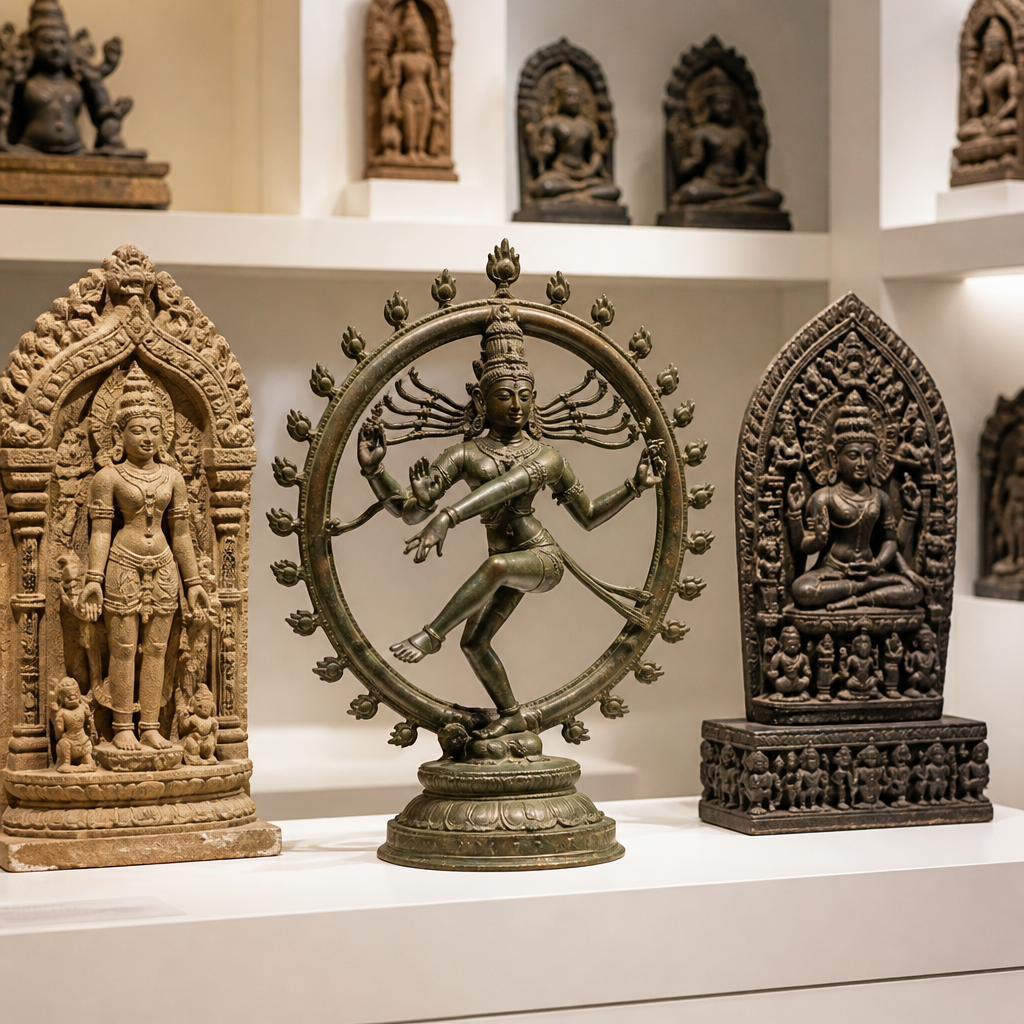
The imperial Chola period, running approximately from 850 CE to 1250 CE across South India, produced what many art historians consider the finest metal sculptures in the world. Chola kings and emperors used the wealth from their extensive conquests to build lasting stone temples and to commission exquisite bronze sculptures, working almost exclusively within a Dravidian cultural setting. The Brihadisvara Temple at Thanjavur, completed around 1010 CE under Rajaraja I, stands as the single most celebrated monument of this tradition.
The Lost-Wax Process and Why It Produces Superior Results
A Chola bronze statue begins not with metal but with wax. The lost-wax method, known in Sanskrit as Madhuchista Vidhan, involves sculpting the image in beeswax with extraordinary detail, encasing it in clay, then heating the mould until the wax melts out and molten bronze is poured in to replace it. The clay mould is broken to reveal the finished piece, which is then hand-chiselled and polished. Because every mould is destroyed in the process, every genuine lost-wax bronze is unique.
This process gives Chola bronzes qualities that carved stone simply cannot achieve: undercut details, limbs that extend freely from the body, a surface that invites touch, and a weight that feels alive in the hand. The Nataraja, Shiva dancing within a ring of fire, is the form most associated with this tradition precisely because its four arms, flying locks, and supporting leg required a casting method that freed the sculptor from the constraints of a stone block.
Iconographic Rules of the Chola Canon
Chola bronzes follow Agamic texts with a precision that separates masterwork pieces from workshop approximations. In a correctly rendered Nataraja, the raised left foot represents liberation (moksha), the lower right foot crushes the demon of ignorance (Apasmara), the upper right hand holds the damaru drum of creation, and the upper left hand holds fire representing destruction. Deviating from these rules does not just produce an aesthetically imperfect piece. It produces a ritually incorrect one.
The same level of specificity applies to Chola representations of Parvati, Murugan, and the Shaivite saints (Nayanmars). Each posture, hand gesture (mudra), attribute held, and proportion follows a codified system. Contemporary South Indian workshops in the Thanjavur district and Swamimalai still practice this tradition, producing pieces that collectors worldwide seek out.
Pro tip: When evaluating a contemporary Chola-style bronze, look at the surface of the face. Genuine lost-wax casting produces a slightly varied, warm surface texture. Machine-cast or sand-cast reproductions have a uniform, slightly porous surface that loses fine detail around the eyes and lips.
Rajasthani Stone Sculpture: Sandstone, Marble, and the Northern Idiom
Northern India produced a completely different sculptural tradition, shaped by the available stone, the theological schools dominant in each region, and the dynastic patrons who commissioned temple programmes. Rajasthani stone sculpture is not a single unified style. It encompasses the buff sandstone carvings associated with early medieval temple programmes at sites like Osian, the white marble work associated with Jain temple complexes at Ranakpur and Mount Abu, and the broad Nagara-style temple sculpture that covers much of western and central India.
Sandstone as a Medium: Advantages and Limitations
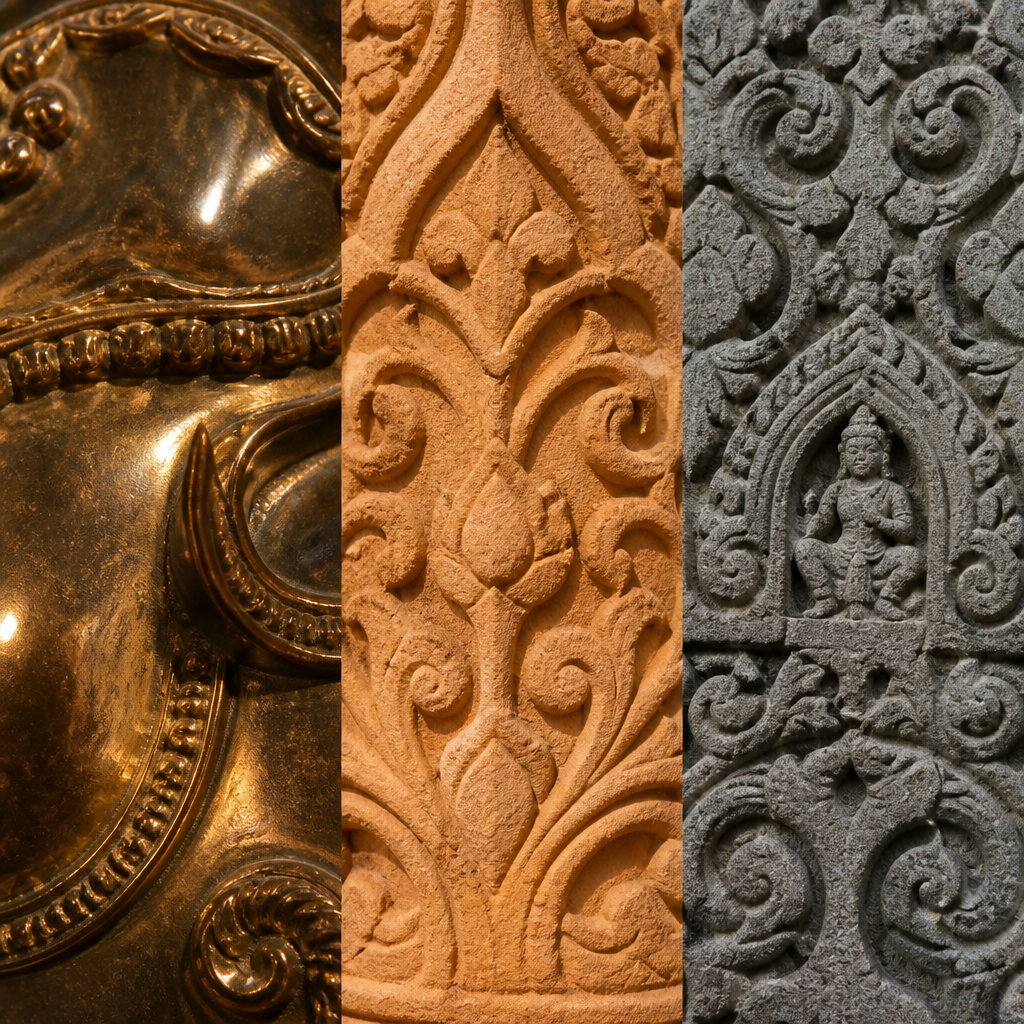
The local sandstone of Rajasthan, quarried in shades ranging from pale buff to deep pink to terracotta red, is softer and more tractable than granite but weathers beautifully over time. Sculptors working in this medium could achieve flowing, deeply carved surfaces with jewellery, textile patterns, and intricate hairstyles that rival anything in stone anywhere in the world. The erotic and celestial sculptures of sites in this region exemplify what the medium allows at its most ambitious.
The limitation is structural. Sandstone does not allow for fully extended limbs the way bronze does. A sandstone Shiva with four arms will typically retain stone webbing between the arms and the torso, or the arms will be kept close to the body. This shapes the entire visual vocabulary of northern stone sculpture, making figures look more massive, more rooted, and more architecturally integrated than their South Indian bronze counterparts.
White Marble and the Jain-Hindu Overlap
Rajasthan's white marble tradition, centred on the Makrana quarries that also supplied stone for the Taj Mahal, produces a luminous, almost translucent quality in finished sculpture. This material is closely associated with both Jain and Hindu devotional images in the region. A marble Saraswati or Lakshmi from Rajasthan has a softness and light-diffusing quality that sandstone cannot match, which is why the medium became the prestige choice for deity images meant for interior shrines.
The stylistic overlap between Jain and Hindu iconography in this region means collectors sometimes acquire pieces without being certain of the deity's identity. The key distinguishing features are the attributes held, the vahana (vehicle) present or absent, and the specific posture. A four-armed female figure in white marble holding a book and a vina is Saraswati. The same figure holding a lotus and a water pot is more likely a yakshi or a Jain goddess.
Other Major Regional Styles Worth Knowing
Restricting the conversation to Chola bronze and Rajasthani stone gives a useful contrast but leaves out several traditions that serious collectors and practitioners will encounter. These styles appear regularly in the market and in temple contexts, and confusing them with either of the two main traditions discussed above is a common and avoidable mistake.
Pala Bronze from Bengal and Bihar
The Pala dynasty of eastern India, active roughly from the 8th to the 12th century CE, produced a bronze tradition that is visually distinct from Chola work despite using the same lost-wax method. Pala bronzes are typically smaller, more finely detailed, and frequently set against a pointed or flame-shaped aureole (prabhamandala) that frames the entire figure. The faces are more linear, with elongated eyes and a precise, almost jewel-cut quality. Pala bronzes represent Buddhist and Hindu deities in equal measure, reflecting the syncretic devotional environment of Bengal and Bihar during this period.
The mistake collectors make is attributing Pala bronzes to the Chola tradition because both use lost-wax casting. The aureole is the most reliable visual diagnostic. A Chola piece typically stands without one, or with a simple halo, while a Pala piece is almost always integrated into an elaborate backdrop.
Orissan Stone: Chlorite and the Odisha Temple Tradition
The Odisha or Orissa school of temple sculpture, associated with sites like the Konark Sun Temple and the Lingaraja temple at Bhubaneswar, uses a dark green-black chlorite stone that immediately distinguishes it from anything produced in Rajasthan or Tamil Nadu. The figures in this tradition are rounder and more sensuous in proportion, with exaggerated hip curves (tribhanga posture taken to its most pronounced) and extraordinarily detailed surface ornamentation. A well-preserved Orissan sculpture in chlorite has an almost metallic sheen that can confuse buyers into thinking they are looking at bronze.
Kashmir Schist and the Gandhara Influence
Kashmir produced a tradition of grey schist sculpture heavily influenced by the earlier Gandhara school, which itself blended Hellenistic and Indian elements. Hindu deities in Kashmiri schist tend to be more upright, less dramatically contrapposto than South Indian figures, and the treatment of drapery and facial features shows a distinctly different classical influence. This is a less commonly traded tradition in the collector market but appears in specialist offerings and is worth identifying correctly.
Comparing Regional Styles: A Practical Reference Table
The table below is designed for practical use when evaluating a piece or briefing a specialist. It covers the three most frequently encountered traditions in the collector and devotional market for Indian Hindu sculpture.
|
Feature |
Chola Bronze (South India) |
Rajasthani Sandstone (North India) |
Pala Bronze (East India) |
|---|---|---|---|
|
Primary medium |
Copper alloy bronze, lost-wax cast |
Sandstone or white marble, carved |
Copper or brass bronze, lost-wax cast |
|
Peak period |
c. 850 CE to 1250 CE |
c. 8th to 13th century CE |
c. 8th to 12th century CE |
|
Typical surface colour |
Dark reddish-brown to black patina |
Warm buff, pink, or terracotta; white for marble |
Deep golden-brown to dark bronze |
|
Characteristic posture |
Dynamic, extended limbs, energetic movement |
More static, limbs close to body, architecturally integrated |
Frontal and upright, set against pointed aureole |
|
Most iconic deity form |
Nataraja (Dancing Shiva) |
Multi-armed Durga, Ganesha, Surya |
Vishnu, Tara, Manjushri |
|
Surface detail |
Fine, tactile, hand-chiselled post-casting |
Deeply carved, high relief, rich textile and jewellery patterns |
Extremely fine, jewel-like, intricate prabhamandala |
|
Scale range |
From small processional figures to life-size temple bronzes |
From small votive tablets to large architectural panels |
Mostly small to medium; portable devotional scale |
Choosing the Right Piece for Your Collection or Altar
The regional style question resolves differently depending on why you are acquiring the piece. For a practitioner building a Shaivite home altar, a Chola-style Nataraja is not just the aesthetically appropriate choice, it is the theologically correct one. The South Indian Agamic tradition that governs Shaiva worship is inseparable from the iconographic canon the Chola bronze encodes. Buying a North Indian stone Shiva for this purpose is not wrong, but it is a different theological conversation.
For collectors whose interest is primarily art-historical, the most important principle is coherence within a chosen tradition rather than representational breadth. A focused collection of South Indian bronzes tells a richer, more legible story than an eclectic mix of five regional traditions with two pieces each. That said, contrast pieces, one Chola bronze and one Pala bronze of the same deity, can be extremely instructive and visually powerful when displayed together deliberately.
The regional tradition encoded in an Indian Hindu sculpture is not a label added after the fact. It is part of the object's meaning from the first stroke of the sculptor's tool.
For home decorators working with Indian religious sculpture as a design element, the practical considerations are scale, surface colour, and material. A large Rajasthani sandstone panel with warm buff tones integrates into a wider range of interior palettes than a dark Chola bronze does. The bronze, however, works better as a freestanding focal object on an altar table or plinth because it reads from all angles, while a stone relief is fundamentally a frontal work.
At HD Asian Art, the Hindu deity sculptures on offer span multiple regional traditions from across India. That range makes it possible to find the specific regional idiom that matches your devotional practice, aesthetic sensibility, or existing collection, rather than settling for a generic piece that belongs to no coherent tradition. Browsing the Hindu sculptures collection gives you a clear sense of the range available at museum-quality standard, including pieces that reflect the South Indian bronze tradition and the broader North Indian carved-stone aesthetic.
Pro tip: If you are purchasing a Chola-style bronze as a devotional object rather than purely as a collectible, verify that the sculptor's workshop follows the traditional iconometric proportions (tala measurements). A workshop that cannot describe the canonical measurement system it follows is likely producing decorative approximations, not devotional-quality bronzes.
Frequently Asked Questions
What makes a Chola bronze statue different from other Indian bronze sculptures?
A Chola bronze statue is distinguished by three things working together: the lost-wax casting method that allows fully extended limbs and fine surface detail, the strict Agamic iconographic canon governing every posture and attribute, and the alloy composition typical of South Indian workshops from the imperial Chola period.
Pala, Vijayanagara, and later Deccan bronzes may use the same casting method but follow different iconographic rules and produce visually distinct results. The Nataraja form is so closely associated with the Chola tradition that it functions almost as a signature of the school.
Is Rajasthani stone sculpture less valuable than South Indian bronze?
Not as a general rule. The two traditions are valued differently by different segments of the market. A fine Rajasthani sandstone panel with intact surface detail and good provenance commands serious prices in the auction market.
What does tend to lower value in any regional tradition is poor condition, especially for stone: spalling, deep erosion, or repaired breaks reduce value more significantly than in bronze, where a good patina can survive damage to the surface beneath. The quality of carving and the rarity of the iconographic programme matter more than the material or region alone.
How can I tell if an Indian Hindu sculpture is following regional iconographic rules correctly?
Start with the deity's attributes (objects held in each hand), the vahana (animal vehicle) present at the base, and the mudras (hand gestures). For South Indian bronzes, the hand positions follow Agamic texts very precisely, and deviations are immediately visible to a trained eye.
For North Indian stone sculpture, the Shilpa Shastra tradition provides a framework, but regional workshops interpreted it with more flexibility. The safest approach is to cross-reference the piece against a well-documented museum example from the same tradition before assuming iconographic accuracy.
Can Indian Hindu sculptures be used for active devotional practice, or are they purely decorative?
This depends entirely on the tradition of the practitioner, not on the object. In Hindu practice, a murti (image) becomes the locus of a deity's presence through consecration (prana pratishtha), a ritual that can be performed by a qualified priest. Without consecration, the object functions as a devotional focus or a representation, not as a ritually installed deity.
Many practitioners use high-quality sculptures as altar focal points without formal consecration, which is entirely consistent with bhakti devotional traditions that emphasise the sincere orientation of the devotee. The regional style of the sculpture should ideally match the practitioner's own tradition for reasons of theological coherence.
What regional Indian art styles are most commonly available to collectors outside India?
The South Indian Chola and post-Chola bronze tradition is the most internationally traded, partly because workshops in the Thanjavur district and Swamimalai continue producing high-quality pieces in the traditional manner. Rajasthani and broader North Indian stone work appears regularly in specialist galleries and online retailers, particularly in sandstone and marble.
Pala-style bronzes, both genuinely old pieces and quality reproductions, circulate in the Buddhist and Hindu art collector market. Orissan chlorite and Kashmiri schist are rarer in the international market and more commonly encountered at specialist auction houses or in focused collection sales.
What should I look for when buying an Indian Hindu sculpture from an online retailer?
Four things matter above all else: clarity about the regional tradition being referenced, specificity about the material and casting or carving method, quality of photography that shows the surface from multiple angles, and the retailer's willingness to answer detailed iconographic questions.
A retailer who can tell you the specific deity form, the canonical tradition it follows, and the technical process used to produce it is operating at a different level from one who lists only "Hindu statue, India." HD Asian Art provides detailed information about their sculptures precisely because the collectors and practitioners they serve make better decisions with that context available.
Have you collected Indian Hindu sculptures from a specific regional tradition, or are you in the process of building an altar with a particular deity in mind? Share your experience or questions below, as your perspective helps others navigating the same choices.
References
-
Overview of Chola art, architecture, and bronze sculpture tradition on Wikipedia
-
Indian stone sculpture collection and regional styles presented by Google Arts and Culture
