



Display Buddhist Art in Your Living Room: A Guide
Display Buddhist Art in Your Living Room: A Guide
Table of Contents
Displaying Buddhist art in your living room requires balancing aesthetic appeal with cultural respect and spiritual intentionality. At HD Asian Art, we understand that Buddhist art isn't merely decoration, it's a representation of profound spiritual traditions that deserve thoughtful placement and care. Whether you're drawn to Buddha statues, intricate murals, or traditional paintings, the way you position these pieces shapes both the energy of your space and your relationship with the art itself.
The challenge most people face isn't finding beautiful Buddhist art, it's knowing where and how to display it respectfully. Many homeowners treat Buddhist statues and paintings like any other decor, positioning them arbitrarily based on furniture layout. This approach misses the spiritual dimension entirely. Understanding the principles behind Buddhist art placement transforms your living room into a genuine sanctuary.
Understanding How to Display Buddhist Art Respectfully
Cultural appreciation means engaging with Buddhist art as a living tradition, not a historical artifact or trendy aesthetic. Appreciation involves learning why certain placements are preferred, understanding the iconography you're displaying, and maintaining your pieces with intention.
When you display Buddhist art in your living room, you're inviting spiritual symbolism into your daily environment. Buddha statues represent enlightenment and inner peace, not simply exotic decorative objects. Paintings and murals often depict specific deities, mudras (hand gestures), or scenes from Buddhist texts. Each element carries meaning. A statue facing toward your meditation area signals different intentionality than one turned toward a television.
The most respectful approach combines three elements: education about the tradition, intentional placement that honors the art's spiritual purpose, and consistent care that signals reverence.
Buddhist Art Placement Rules and Guidelines
Several foundational principles guide respectful Buddhist art placement. These emerge from centuries of Buddhist practice and reflect how these traditions understand sacred space.
Eye-Level Positioning and Elevated Surfaces
Buddha statues should generally be positioned at or slightly above eye level when seated. An elevated surface, a shelf, pedestal, or altar table, signals that the statue holds special significance. Elevation distinguishes sacred objects from everyday items scattered throughout your room.
For wall-mounted art, the center of the piece should align with eye level when standing or sitting in your primary viewing position. This creates visual balance and ensures the art functions as a focal point.
Directional Alignment and Room Layout
In many Buddhist traditions, east-facing positions are often preferred, as they align with the direction of enlightenment in Buddhist cosmology. If east-facing is impossible, south-facing is the next preference. The specific direction matters less than intentional placement, showing through your positioning choices that you've considered the art's spiritual dimension.
Position Buddhist art so it's one of the first things you see when entering the space. This creates a psychological anchor that reminds you of the room's purpose as a place for calm and reflection. Avoid positioning statues or paintings where they face walls, point toward chaotic areas, or sit in direct conflict with the room's primary focal point.
If you have multiple Buddha statues or pieces of Buddhist art, arrange them so they create a visual conversation rather than competing for attention. A statue on a shelf might face toward a painting on the opposite wall, creating a visual dialogue across your space.
Feng Shui Buddha Placement in Your Living Room
Feng Shui principles offer a complementary framework for Buddhist art placement. While Feng Shui isn't strictly Buddhist, it shares the philosophy that spatial arrangement affects energy flow and personal wellbeing. In Feng Shui, Buddha statues are placed to enhance specific areas of your living room based on the Bagua map, a nine-section grid that corresponds to different life areas.
The wealth corner (far left from the room's entrance) benefits from a Buddha statue that symbolizes abundance and generosity. The health area (center of your space) supports a statue representing healing and wholeness. The wisdom corner (far right) pairs well with statues depicting meditation or enlightenment.
Feng Shui also emphasizes balance and flow. Buddhist art should never block doorways, windows, or natural pathways through your room. The most practical Feng Shui principle is "command position": place your most important piece where you can see it from your primary seating area without searching for it. This creates a sense of calm awareness.
Meaning of Buddha Statues and Poses for Display
Different Buddha statues and poses carry distinct meanings. Understanding these nuances helps you choose pieces that align with your intentions.
Choosing Between Statues, Murals, and Wall Art
Buddha statues in meditation pose (seated, hands in lap or touching the earth) represent inner peace and enlightenment. Laughing Buddha statues (actually Hotei in Japanese tradition) represent joy, contentment, and abundance. Standing Buddha statues often depict specific moments: Buddha teaching (hand raised in blessing), Buddha protected by a serpent (resilience), or Buddha in walking meditation (mindful movement).
Wall art offers different possibilities. Buddhist murals create immersive environments, while paintings and prints allow for more subtle integration. Mandalas, geometric representations of the universe, work beautifully in living rooms as focal points above meditation cushions. Thangkas (Tibetan scroll paintings) depicting specific deities add depth and visual richness.
For small living rooms, wall art often works better than statues. A single well-chosen painting creates impact without consuming floor or shelf space. Murals can make a room feel larger by creating visual depth.
Creating a Sacred Space: Buddhist Home Decor Ideas
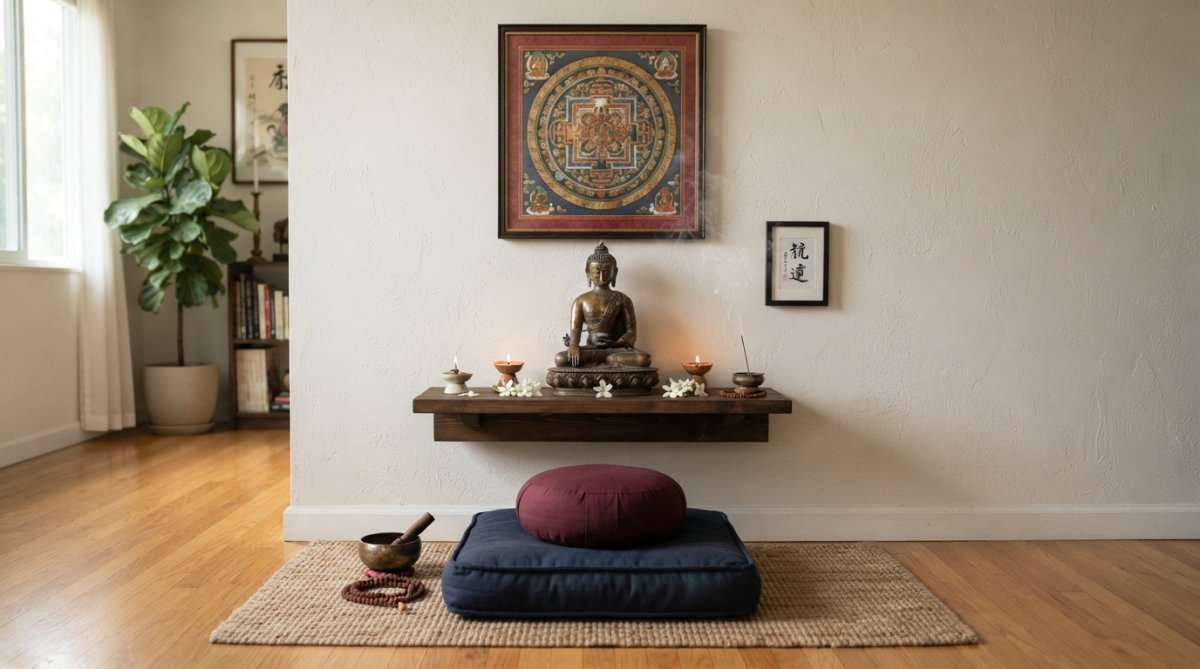
A sacred space is integrated into your living room. You don't need a dedicated shrine room to honor Buddhist art respectfully.
Lighting, Ambient Atmosphere, and Cleanliness
Lighting dramatically affects how Buddhist art is perceived. Natural light is ideal, revealing details while creating openness and clarity. Position your Buddha statue or artwork where it catches morning or afternoon light naturally.
For evening lighting, warm-toned bulbs (2700K color temperature) create a contemplative atmosphere. Candlelight near a Buddha statue enhances the sense of sacred space. If you use candles, place them safely away from curtains and never leave them unattended.
Ambient atmosphere extends beyond lighting. Buddhist art displays benefit from quiet environments or gentle background sounds. Avoid placing statues or paintings in rooms where loud televisions or music dominate.
Cleanliness is non-negotiable. Dust accumulation on Buddhist statues or artwork signals neglect. Establish a simple cleaning routine: weekly dusting for statues using a soft cloth, monthly deeper cleaning for paintings. This maintenance becomes part of your spiritual practice.
Small Space and Apartment Solutions
Limited square footage doesn't prevent respectful Buddhist art display. Strategic placement becomes even more important. A single well-chosen piece often creates more impact than multiple scattered items.
Wall-mounted art works beautifully in compact spaces. A medium-sized Buddha painting above a meditation cushion creates a dedicated spiritual zone without consuming floor space. Floating shelves at eye level can hold a small statue. Vertical arrangements maximize limited space while drawing the eye upward.
Corner placements work well in apartments. Position a statue in a corner where it becomes a visual anchor without interfering with traffic flow. For renters, freestanding solutions work effectively: a tall wooden stand with a Buddha statue requires no installation.
The key in small spaces is intentionality over quantity. One beautiful, well-placed Buddha statue creates more spiritual atmosphere than three mediocre pieces scattered throughout.
Integrating Buddhist Art Into Modern Living Spaces
Modern interiors integrate Buddhist art beautifully when approached thoughtfully.
Visual Balance and Focal Point Design
In modern living rooms, Buddhist art often serves as a counterbalance to technology and entertainment systems. If your television dominates one wall, position a Buddha statue or painting on an opposite wall to create visual equilibrium.
The focal point principle applies to Buddhist art. If you're creating a meditation corner, make the Buddha statue or painting the clear focal point. Everything else, cushions, plants, lighting, should support and frame this central element.
Modern design often emphasizes clean lines and neutral palettes. Buddhist art adapts well to these aesthetics. A black-and-white Buddha painting on a white wall feels contemporary. A minimalist bronze statue on a natural wood shelf blends seamlessly with modern furnishings.
Color coordination matters. If your living room uses warm, earthy tones, choose Buddhist art in similar tones. Intentional contrast can work, but random color clashes undermine the sense of intentional sacred space.
Negative space is your ally. Give your Buddha statue or painting breathing room. A single statue on a shelf with empty space around it feels intentional and peaceful.
Maintenance and Care Rituals for Your Buddhist Art
How you care for Buddhist art reflects your relationship with the tradition. Maintenance becomes a spiritual practice when approached with mindfulness.
Dust statues weekly with a soft, dry cloth. For wooden pieces, occasional conditioning with appropriate wood oil preserves the material. Stone or ceramic statues benefit from gentle cleaning with a barely damp cloth. Metal statues can be polished gently to maintain their luster.
Paintings and murals require different care. Protect them from direct sunlight, which fades colors. Dust frames and glass gently with a microfiber cloth. If your painting is valuable or antique, consider professional conservation.
Environmental conditions matter. Avoid placing statues near heating vents, air conditioning units, or windows where temperature fluctuations cause damage. Maintain moderate humidity levels in your living room.
Some practitioners make offerings as part of their practice, fresh flowers, water, or incense placed near their statue. These deepen the sense of sacred space and become daily reminders of your intention to honor the art and tradition.
Common Mistakes to Avoid When Displaying Buddhist Art
Understanding what not to do prevents damage to your pieces and ensures respectful display.
Avoid placing Buddha statues in bathrooms or bedrooms. These spaces are associated with bodily functions and sleep, contexts that many traditions consider disrespectful for sacred imagery. Living rooms and meditation spaces are appropriate.
Never position a Buddha statue lower than eye level as your primary display. Elevation signals that the piece holds special significance.
Avoid combining Buddhist art with conflicting religious imagery in ways that feel incoherent. Displaying a Buddha statue alongside Christian crosses can work beautifully if done intentionally, but random mixing suggests appropriation rather than appreciation.
Don't position Buddhist art where it faces away from your living space. A painting on a wall facing a closet wastes the piece's potential to create sacred atmosphere.
Avoid excessive decoration around your Buddhist art. A statue surrounded by numerous candles, plants, and offerings becomes visually overwhelming. Simple, clean display with intentional spacing creates more powerful effect.
Never display damaged or broken Buddhist art. A chipped statue or torn painting loses its ability to inspire reverence. Either repair it professionally or retire it respectfully.
| Mistake | Impact | Solution |
|---|---|---|
| Placing statues below eye level | Signals disrespect; reduces contemplative effect | Elevate on shelf or pedestal at or above eye level |
| Displaying in bedrooms or bathrooms | Violates traditional respectfulness | Reserve Buddhist art for living rooms or meditation spaces |
| Surrounding with clutter | Creates visual chaos; undermines sacred atmosphere | Display with breathing room and minimal additional objects |
| Positioning facing away from space | Wastes the piece's potential impact | Orient art toward main living areas where you naturally view it |
| Neglecting cleanliness | Signals abandonment; dust accumulates | Establish weekly cleaning routine as spiritual practice |
| Mixing traditions incoherently | Reads as appropriation rather than appreciation | Either honor multiple traditions intentionally or focus on one |
Displaying Buddhist art in your living room is an opportunity to create a space that honors both aesthetic beauty and spiritual depth. The principles we've covered, respectful placement, appropriate elevation, intentional lighting, and consistent care, transform your living room from simply decorated to genuinely sacred. At HD Asian Art, we curate Buddhist and Hindu statues, Khmer sculptures, and temple-inspired decor specifically designed to enhance meditation spaces and refined spiritual home interiors. Our carefully selected pieces bring authenticity and artistry to your sanctuary. Explore our collection and discover how thoughtfully chosen Buddhist art can anchor your home in peace and intention. Buddhist art traditions and symbolism guide Home sanctuary design principles Sacred space creation in modern homes.
Frequently Asked Questions
What is the most respectful way to display a Buddha statue in a living room?
Display Buddhist art at eye level or on an elevated surface like a shelf or altar to show reverence. Ensure the space is clean, well-lit, and free from clutter. Avoid placing statues near the floor, in bathrooms, or below eye level. Position the statue facing into the room as a focal point. The statue should never be treated as mere decoration, approach the space with intentionality and mindfulness. Consider creating a dedicated meditation corner or shrine area if possible, even in small apartments.
Are there specific feng shui rules for Buddha statue placement in a living room?
Yes. In feng shui, Buddha statues should typically face the main entrance or be positioned in the wealth corner (far left from the entrance). Avoid placing statues directly opposite doors or windows, as this disrupts energy flow. Elevated placement is essential, never position a Buddha statue on the floor. Ensure the statue has a clear view into the room and is surrounded by calming elements like soft lighting and plants. Directional alignment matters: east represents health, southeast represents abundance, and north represents career, choose based on your intention.
What do different Buddha statue poses and meanings tell us about display choices?
Different Buddha statues embody specific meanings. The Laughing Buddha (Hotei) symbolizes happiness and abundance, ideal for living rooms seeking joy. Meditating Buddha represents peace and mindfulness, perfect for meditation spaces. Reclining Buddha signifies enlightenment and rest. Seated Buddha with hand gestures (mudras) each carry specific meanings: hands in prayer position suggest devotion, while open palms indicate generosity. Understanding these meanings helps you choose statues aligned with your living room's purpose. Select poses that resonate with your spiritual intention and complement your home's energy.
How do I display Buddhist art in a small apartment or meditation corner?
Small spaces benefit from wall-mounted Buddhist art like murals, paintings, or mandala tapestries rather than large statues. Use vertical space by hanging art at eye level on walls. A single small Buddha statue on a floating shelf or corner altar works well. Layer ambient lighting with a small candle or soft lamp to create intimacy without overwhelming the space. In apartments, a dedicated meditation corner, even just 2-3 square feet, can hold a statue, cushion, and calming decor. Keep the area uncluttered and intentional. Avoid spreading Buddhist art throughout multiple rooms; concentrate it in one sacred space.
How should I maintain and care for Buddhist statues as part of respectful display?
Regular cleaning is part of respectful practice. Gently dust statues with a soft cloth weekly to maintain cleanliness, which shows reverence. Avoid harsh chemicals; use only gentle, dry methods or slightly damp cloths for delicate pieces. Keep the surrounding space clean and organized, clutter diminishes the spiritual atmosphere. If your statue is antique or made from special materials, research proper care methods. Some traditions include mindful cleaning as a meditation practice. Never move statues carelessly or place them where they might be knocked over. Treat maintenance as a ritual that honors the art's spiritual significance.
