



How to Display Buddhist Art in Your Home: Our Guide
How to Display Buddhist Art in Your Home: Our Guide
Table of Contents
- Why Buddhist Art Belongs in Your Home
- Buddha Statue Placement Rules: Where to Position Your Piece
- Creating a Home Meditation Space Around Your Art
- Buddhist Altar Setup Ideas for a Sacred Corner
- Cultural Appropriation vs. Appreciation
- Caring for Your Buddhist Art: Maintenance and Mindfulness
- Frequently Asked Questions
Why Buddhist Art Belongs in Your Home
Learning how to display Buddhist art in your home starts with understanding what these pieces are for. A Buddha statue is not a decorative object with spiritual overtones; it is a support for practice, a reminder of wakefulness, and a focal point for attention. This guide from HD Asian Art covers the placement, orientation, and care decisions that keep a piece meaningful rather than merely ornamental.
The distinction matters more than most guides admit. A bronze Buddha on a bathroom shelf and the same bronze on a dedicated altar are the same object but not the same relationship. Placement is the practice.
Buddhist art also solves a design problem. A single well-placed statue anchors a room with calm and weight. The trick is knowing where it belongs, which is what we'll cover next.
Buddha Statue Placement Rules: Where to Position Your Piece
The core rule of Buddha statue placement is elevation and respect: place the figure at or above eye level on a stable, clean surface, facing the room's main seating or entry.
Ideal Locations and Orientation
The best positions share three qualities: elevation, stability, and low traffic.
- Living room on a console or shelf, facing the main seating area
- A dedicated meditation corner or alcove
- A home office shelf where the gaze falls during pauses
- An entryway niche as a greeting point, kept clear of shoes and bags
Orientation is a matter of tradition and preference. Many practitioners face a statue east, toward the sunrise, or toward the room's center so it can be seen (britannica.com). Compass directions carry symbolic weight in some lineages; in others, a clear sightline matters more than a compass reading.
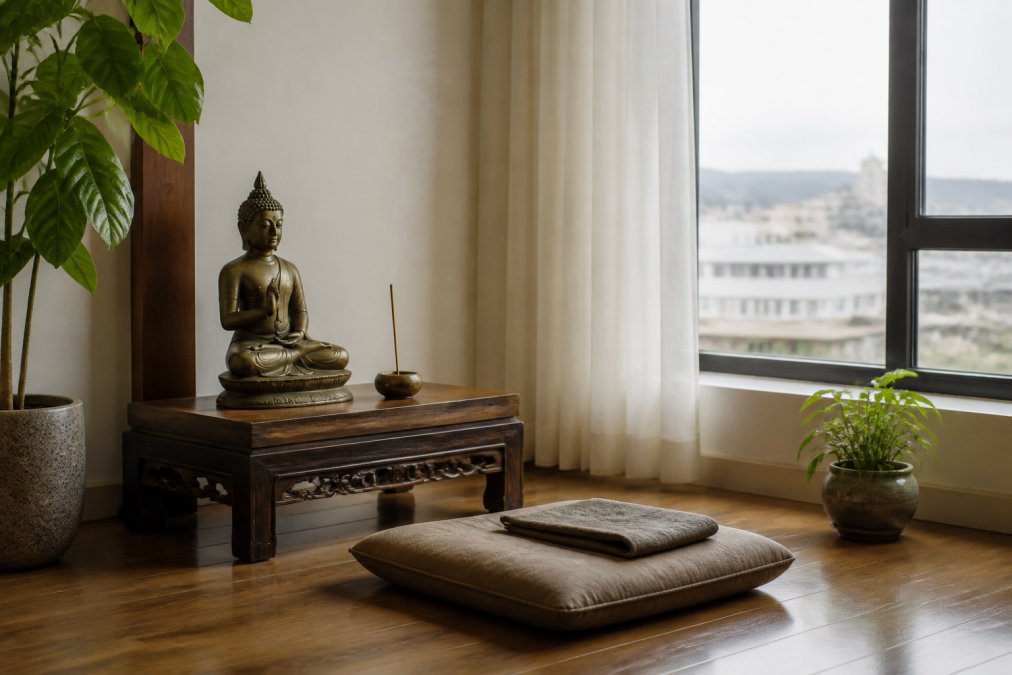
Locations to Avoid
Skip the bathroom, the kitchen, the floor, and anywhere feet point. These placements undercut the figure's role as a focal point and read as careless to anyone who practices. A hallway with constant foot traffic is also a poor choice; the piece becomes clutter rather than a sanctuary. Mindful placement requires intentionality, as the surrounding environment must support the stillness necessary to create a home sanctuary.
Creating a Home Meditation Space Around Your Art
Creating a home meditation space is the practice of arranging a small, intentional area around a single focal object, usually a statue or thangka, so the space signals calm the moment you enter it.
Start with the statue, then build outward. A low table or shelf at seated eye level, a cushion, and one or two supporting objects are enough. Resist filling the space; visual clutter works against the purpose.
Small-Space Solutions for Apartments
A studio or small apartment does not rule out a proper setup. A wall-mounted shelf, a windowsill, or the top of a low bookcase can hold a single figure and a small offering bowl. Scale the statue to the space: a smaller bronze or brass piece reads as deliberate in a compact corner, while an oversized figure crowds it.
Buddhist Altar Setup Ideas for a Sacred Corner
A home altar is a defined surface, kept clean and used regularly, that holds a Buddhist figure and a small set of offerings. The altar does not need to be large. It needs to be consistent.
A simple arrangement works well:
- Choose a stable surface at chest height or above.
- Place the central figure slightly back from the front edge.
- Add a small offering bowl, a candle or lamp, and an incense holder.
- Keep a small cloth for dusting nearby.
- Clear anything unrelated from the surface.
Choosing Iconography and Mudras
Iconography determines what a piece means, so choose it deliberately. A seated Buddha with hands in the earth-touching mudra signals steadfastness; a medicine Buddha carries a different association; a bodhisattva figure points to compassion rather than awakening. If you are buying for a specific practice, match the figure to that practice. If you are buying for atmosphere, a serene seated Buddha is the safest choice.
HD Asian Art curates Buddhist and Hindu statues alongside Khmer and Southeast Asian sculptures, which makes it easier to match a figure to a purpose rather than picking whatever is available.
Cultural Appropriation vs. Appreciation
The line between appropriation and appreciation comes down to intent, knowledge, and use. Appreciation means you understand what the figure represents, treat it with care, and can explain its role in Buddhist practice. Appropriation means the piece functions as a mood prop with no relationship to its meaning.
A few practical markers separate the two. Learn the figure's name and what it depicts. Avoid placing sacred figures in bars, bathrooms, or as novelty decor. If you are not Buddhist, you can still keep a statue respectfully; you simply hold it as a guest rather than an owner of the tradition. Buying from a source that can tell you where a piece came from is part of that respect, not a separate concern.
Caring for Your Buddhist Art: Maintenance and Mindfulness
Maintenance is simple and should be gentle, but the right method depends on what the piece is made of.
Bronze and brass. Dust with a soft, dry cloth on a weekly schedule. A slightly damp cloth is fine for fingerprints, but dry the surface immediately afterward. Metal figures develop patina over time; that is age, not damage, and most practitioners leave it alone because the surface tone is part of the piece's character (si.edu). Avoid abrasive pads and household cleaners, which scratch the surface and strip detail from fine casting.
Wood. Dust with a dry, soft cloth and keep the piece out of direct sun, which dries and cracks the grain over time. Avoid water altogether; moisture raises the grain and can lift a finish. A dry room is better than a humid one.
Stone and cast resin. Dust with a dry or barely damp cloth. Stone is heavier and more stable but can chip at thin edges, so lift rather than drag when you move it. Resin is light and forgiving but can discolor in prolonged direct sun, so keep it out of a bright window.
Thangka and painted works. Keep out of direct sun, which fades pigments faster than anything else (Effects of Light on Materials in Collections: Data on Photoflash and Related Sources). Dust with a soft brush rather than a cloth, and never spray cleaner onto the surface.
A few rules apply across every material:
- Handle with two hands, supporting the base rather than the head or arms.
- Move it as little as possible once it is placed.
The mindfulness part is the routine. A short weekly dusting becomes a moment of attention rather than a chore. Many practitioners treat cleaning the altar as part of practice itself, which is why the maintenance ritual belongs in any serious guide to displaying these pieces.
Frequently Asked Questions
Which way should a Buddha statue face in your house?
Most traditions recommend facing the statue east or toward the room's entrance so it greets visitors with calm. Avoid facing a bathroom, kitchen, or staircase. In a meditation space, position it so you face the statue when seated. Orientation matters less than intention, so choose a direction that supports your practice and feels respectful within the room's layout.
Where should you not place a Buddha statue?
Avoid bathrooms, kitchens, floors, and hallways with heavy foot traffic. Placing a statue directly on the ground reads as disrespectful in most Buddhist cultures. Skip spots near trash bins, under stairs, or beside televisions where visual clutter competes for attention. An elevated surface at or above waist height, in a quiet area, is the respectful default.
Is it okay to have a Buddha statue in the house if you're not Buddhist?
Yes, many non-Buddhists display Buddhist art as a design element or mindfulness reminder. The key is intentionality: learn the iconography, avoid using sacred pieces as novelty decor, and treat the statue with care. Cultural appreciation means understanding the symbol's meaning, not just its aesthetic. If you're unsure, choose a piece whose mudra and expression you can explain to guests.
How do you create a meditation space with Buddhist art in a small apartment?
Use a corner, shelf, or windowsill as your anchor. A single statue on an elevated surface, one candle, and a cushion define the space without crowding it. Vertical arrangements work well: hang a thangka above a small table holding the statue. Keep the area free of unrelated clutter and treat it as a sanctuary even at two square feet.
Choosing how to display Buddhist art in your home is really a question of intention: what the piece is for, and how you want to meet it each day.
HD Asian Art offers a curated collection of Buddhist and Hindu statues, including handpicked antique and contemporary Khmer and Southeast Asian sculptures, with free shipping. Browse the collection and find a piece that earns its place in your sanctuary.
