



How to Authenticate an Asian Antique: Collector Guide
How to Authenticate an Asian Antique: Collector Guide
Every year, private collectors spend serious money on Asian antiques that turn out to be reproductions, artificially aged fakes, or genuine old objects misrepresented as something far rarer and more valuable. The problem is not that good authentication methods do not exist.
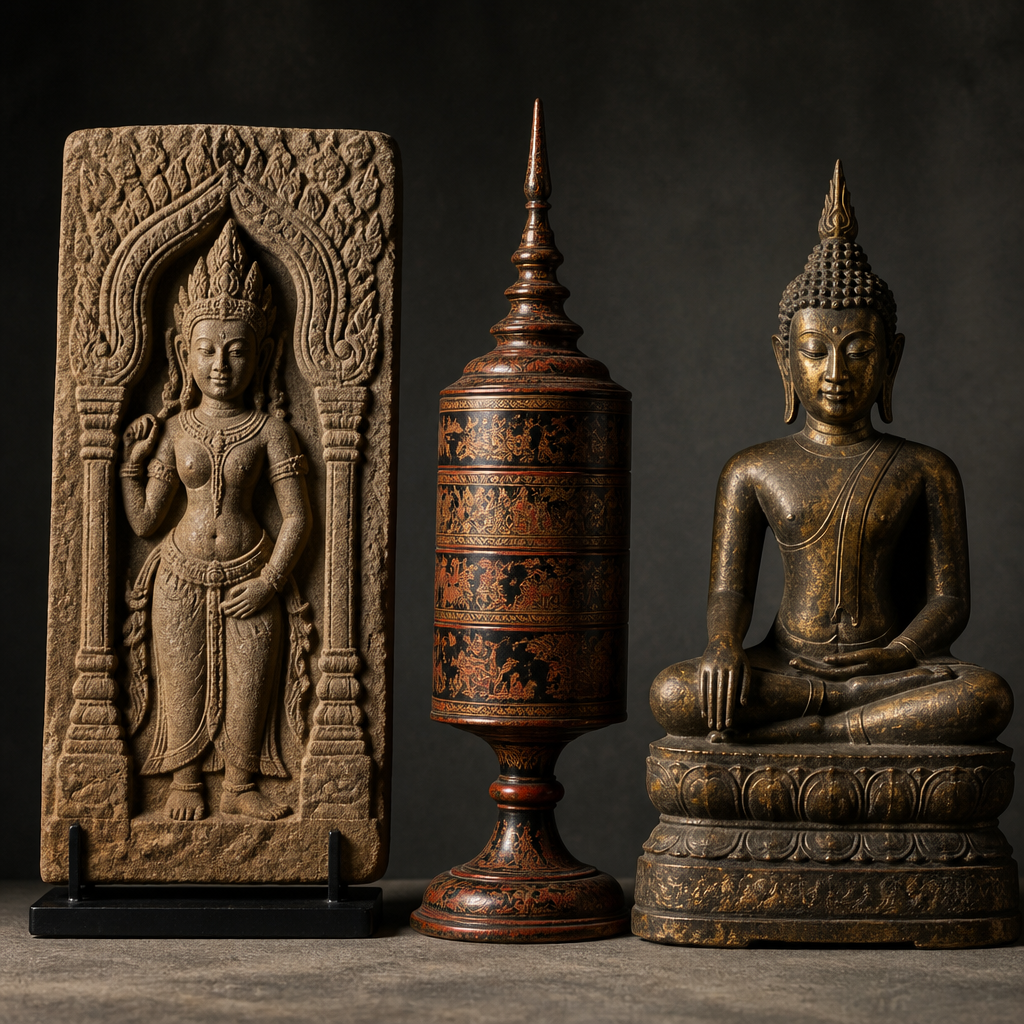
The problem is that most buyers skip the process entirely, or stop at the first reassuring sign and call it done. Knowing how to properly authenticate an Asian antique is not optional for collectors who want to build a meaningful collection. It is the foundation of every smart acquisition, from a Thai bronze Buddha to a Khmer sandstone relief to a piece of Burmese lacquerware. This guide walks you through each step, in the order you should actually use them.
Table of Contents
- Quick Takeaways
- Why Authentication Fails for Most Private Collectors
- Step 1: Visual Inspection and Material Verification
- Step 2: Iconographic and Stylistic Analysis
- Step 3: Provenance Documentation and Legal Standing
- Step 4: Scientific Testing Methods Compared
- Step 5: When to Bring in a Specialist
- Red Flags That Signal a Fake Asian Sculpture
- Authentication Method Comparison
- Frequently Asked Questions
- References
Quick Takeaways
|
Key Insight |
Explanation |
|---|---|
|
No single test authenticates a piece |
Each method, visual, scientific, or documentary, rules out a specific class of fake. Use them in combination, not isolation. |
|
Patina consistency is the first visual tell |
Genuine antique patina develops unevenly over centuries. A uniformly aged surface across all faces of a bronze is a red flag, not a reassurance. |
|
The 1970 UNESCO Convention is the legal benchmark |
Any Asian antique without documented provenance predating 1970 requires heightened legal and ethical scrutiny before purchase. |
|
XRF is a screening tool, not a verdict |
X-ray fluorescence identifies alloy composition but only penetrates 5 to 20 micrometers of surface. It rules out material anachronisms; it does not confirm age. |
|
Provenance multiplies value significantly |
Properly documented Himalayan sacred art fetches up to five times more than undocumented equivalents, reflecting reduced legal risk and confirmed cultural authenticity. |
|
Iconography must match claimed region and period |
Hand positions, attributes, base types, and proportional canons are period-specific. A piece with anachronistic iconography is either misattributed or a reproduction. |
|
Specialist appraisal is cheaper than most people think |
An independent written appraisal from a credentialed Asian art specialist typically costs around $150 to $400 for pieces above $2,000, far less than a lab test and more useful for insurance and resale. |
Why Authentication Fails for Most Private Collectors
The most common authentication failure is not ignorance. It is selective attention. A collector falls in love with a bronze Buddha, notices the convincing green patina, and stops looking. The seller produces a short written statement describing the piece as "antique Thai, 18th century," and that becomes the provenance record. This is how fakes move through the market year after year.
Authentication requires a structured process applied in a fixed order. Each stage either confirms or challenges the previous one. Skipping stages does not save time. It simply transfers the cost of the mistake to a later date, usually when you try to resell, insure, or donate the piece and a specialist examines it properly for the first time.
The secondary problem is over-reliance on a single method. A seller who offers one test result is showing you the answer they want you to see. A credible authentication package covers material, iconography, provenance, and condition together. Any gap in that coverage is a gap in your confidence about what you actually own.
Step 1: Visual Inspection and Material Verification
Start with your eyes and strong, raking light. Raking light, positioned at a low angle to the surface, reveals tool marks, repairs, filled seams, and surface treatments invisible under flat overhead lighting. This is not optional. It is the first filter.
What to Look for in Bronze
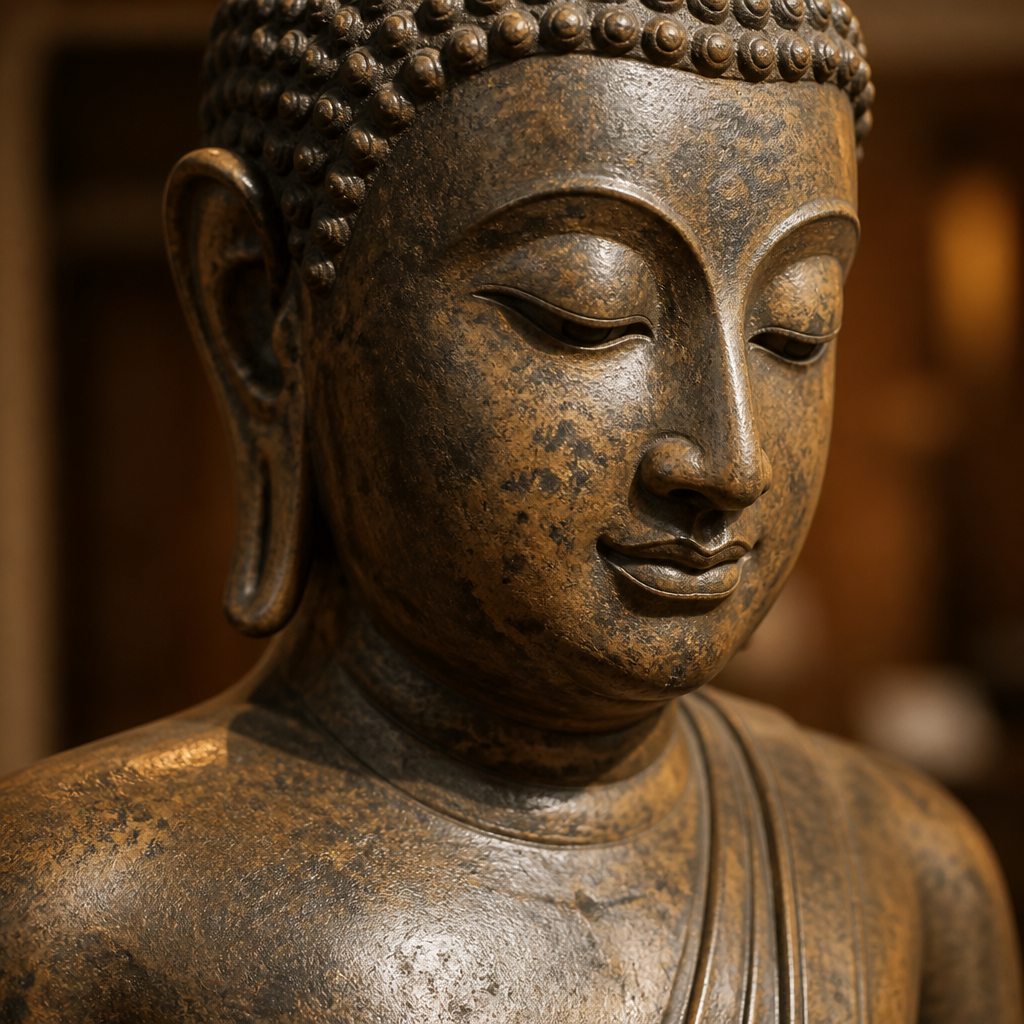
Bronze is the dominant material for Southeast Asian and Himalayan sculpture because it survives burial, humidity, and centuries of handling. The key checks are casting quality, patina consistency, and seam position. Genuine antique bronzes made by lost-wax casting show fine surface detail, thin walls, and irregular interior texture. Modern cast pieces show mold lines in positions inconsistent with traditional methods.
Run a strong magnet over the surface. A strong magnetic pull suggests an iron core or a modern cast with reinforcement materials not used in traditional bronze work. Then weigh the piece and compare it against known examples of similar size and declared alloy. A piece that is too light or too heavy for its stated composition is worth investigating further before spending anything significant.
What to Look for in Stone and Wood
Stone sculptures, particularly Khmer sandstone and Indian schist, show wear patterns that follow the natural grain of the material. Centuries of handling soften edges organically. Fresh carving produces sharp, consistent tool marks. Artificial distressing leaves marks in illogical patterns that do not reflect where handling actually occurs on a worshipped object.
Aging wood develops deep cracks and insect channels that are nearly impossible to fake convincingly without leaving tool marks at the channel edges. Check the interior of any hollow wooden figure. Genuine age produces cracking along the grain with natural shrinkage. Artificially distressed wood shows uniform surface treatment applied after carving.
Examining the Base and Interior
The base of any sculpture is the area forgers pay least attention to. Request high-resolution photographs of the base, interior, and underside before purchasing any piece online. Casting residue, lotus petal modeling quality, sealed underside markings, and the presence or absence of a dedicatory cavity all provide period-specific evidence that a polished display surface cannot tell you.
Pro tip: Review photographs taken with raking light across the base and back surface. Repairs, filled cracks, and artificial patina application almost always show up in those angles when they are invisible from standard frontal views.
Step 2: Iconographic and Stylistic Analysis
Iconography is one of the most reliable authentication tools a private collector can apply without specialist equipment. Buddhist and Hindu sculpture follows precise canonical systems that vary by region, period, and tradition. A piece claiming to be a 12th-century Cambodian Avalokiteshvara has to look exactly like a 12th-century Cambodian Avalokiteshvara, in mudra, facial canon, crown type, and base form. Anachronisms here are not subtle. They are decisive.
Reading Mudras and Attributes
The hand positions of any Buddhist figure are not decorative choices. They identify the deity, the tradition, and frequently the period. A Thai Sukhothai-period Buddha walking in the abhaya mudra has specific proportions, flame ushnisha height, and robe treatment that differ from a later Ayutthaya piece. A forger working from a photograph often gets the gesture right and the proportions wrong.
Likewise, the attributes held by Hindu deities, the weapons, flowers, vessels, and animals, follow strict iconometric rules. The number of arms, the arrangement of those arms, and the posture together identify the specific form of the deity and the regional tradition from which the piece comes. A mismatch between any of these elements and the claimed attribution is not a minor inconsistency. It means the attribution is wrong.
Comparing Against Documented Museum Examples
The Metropolitan Museum, the British Museum, and the Asian Art Museum of San Francisco all maintain online collections with detailed provenance information and scholarly notes. These are your reference libraries. Spend time with authenticated examples from your piece's claimed region and period before you evaluate anything under serious consideration. A collector who can compare their piece against thirty documented examples from the same tradition has a far stronger basis for assessment than one relying on the seller's description.
Study auction catalogs from major houses that specialize in Asian art. These catalogs provide documented comparanda with condition reports and scholarly commentary that are genuinely useful calibration tools for private collectors building their visual knowledge.
Pro tip: The most useful comparison is not with the most famous examples. Find documented pieces of ordinary quality from the same region and period. Forgers study the masterpieces. They rarely nail the ordinary production quality of a given workshop tradition.
Step 3: Provenance Documentation and Legal Standing
Provenance is the documented ownership history of an object from its creation to the present day. In the Asian antique market, strong provenance is simultaneously an authentication tool and a value multiplier. A piece with clear, independently verifiable ownership records traceable to before 1970 occupies a fundamentally different legal and ethical position than one with a vague oral history.
The 1970 UNESCO Benchmark
The 1970 UNESCO Convention on the Means of Prohibiting and Preventing the Illicit Import, Export and Transfer of Ownership of Cultural Property is the international legal benchmark for cultural property transactions. Any Asian antique sculpture without documentation predating 1970 requires heightened legal and ethical scrutiny before acquisition. This is not a bureaucratic formality. It is the minimum standard that museums, insurers, and serious auction houses apply to acquisitions.
Authentic provenance includes specific, independently verifiable information: where the piece was acquired, when, from whom, and ideally why it changed hands. The best provenance includes photographs of the piece in its previous locations, correspondence between buyers and sellers, auction catalog entries, dealer labels, original invoices, or published references in exhibition catalogs. Demand these documents, not a summary of them.
What Weak Provenance Looks Like
Weak provenance is not always fabricated. Often it is simply thin. "Acquired in Bangkok in the 1990s from a private collector" is a story, not a provenance record. It cannot be verified, it names no one, and it does nothing to confirm the piece's legal status under either Thai cultural heritage law or international conventions.
When a seller resists specific documentation requests, that resistance is informative. Authentic Buddhist sculpture provenance verification means matching the object against independent records, not trusting the seller's summary. Dealers who survive professional scrutiny expect this process. Dealers who resist it are communicating something important about what they actually have to sell.
Provenance does more than decorate a file. It connects dates, owners, places, and legal movement in a chain that can be independently verified. Without that chain, you are not buying confirmed history. You are buying a story.
Mapping Collector Networks When Documents Are Absent
For pieces where written documentation is sparse but the piece appears genuinely old, reconstructing the social and family networks of mid-20th-century collectors can surface unpublished provenance evidence. This approach is particularly relevant for Chinese ink paintings and mid-century Southeast Asian sculpture that passed through colonial-era private collections before formal documentation practices existed. Consulting museum provenance research departments directly often surfaces correspondence and file notes not available in public databases.
Step 4: Scientific Testing Methods Compared
Scientific testing is not the first step. It is the step you take when visual inspection, iconographic analysis, and provenance review have produced either a strong candidate or a piece with mixed signals that warrants deeper investigation. Ordering tests before completing the earlier stages is an inefficient use of money and time.
X-Ray Fluorescence (XRF)
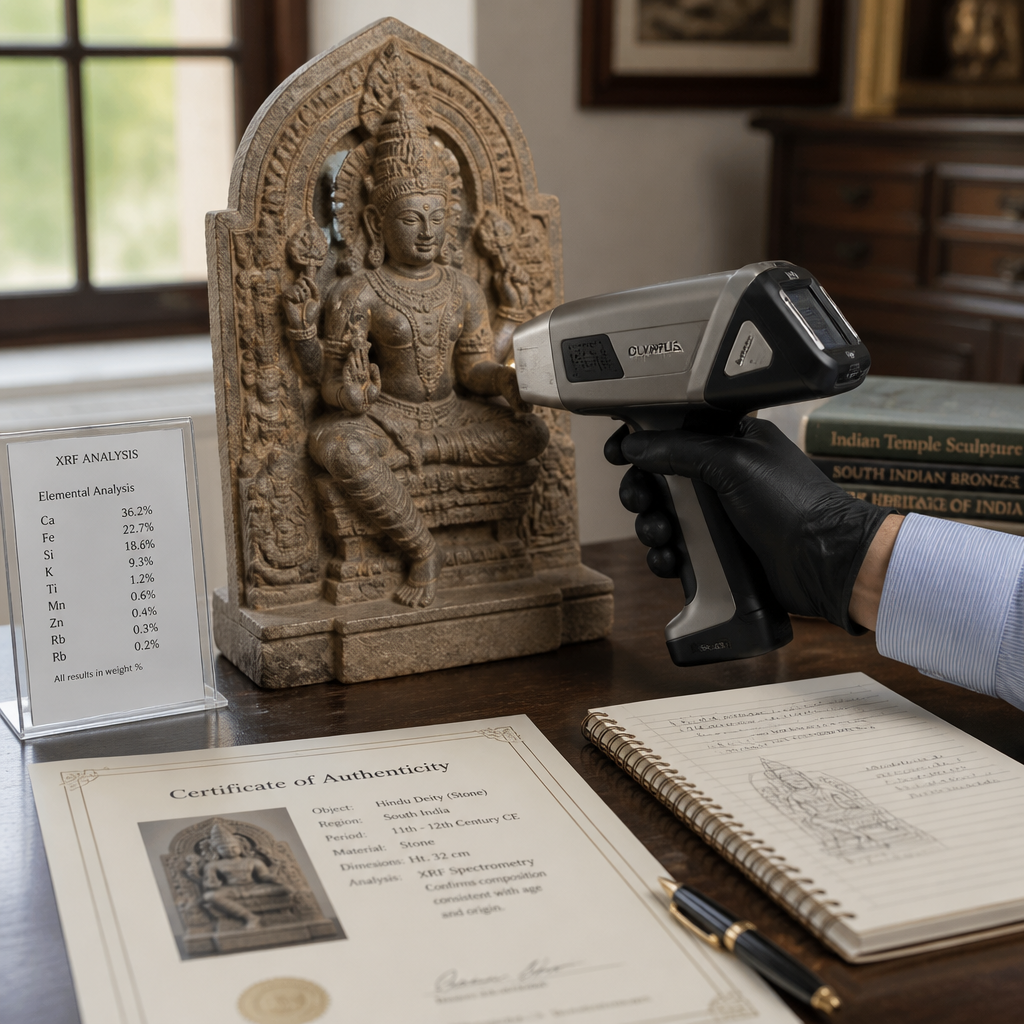
XRF is a non-destructive test that identifies the elemental composition of a metal surface, revealing the ratio of copper, tin, lead, zinc, and other elements in a bronze alloy. Copper-tin-lead ratios differ significantly between Thai, Tibetan, and Cambodian bronzes. The presence of high zinc levels in a piece claimed to be ancient Southeast Asian bronze is a material red flag, since traditional alloys were primarily copper-tin with trace arsenic or lead, not zinc-dominant brass formulations associated with modern casting.
The limitation of XRF is significant: it only penetrates approximately 5 to 20 micrometers of the metal surface. That shallow reach means it can miss subsurface corrosion and cannot detect artificially applied patinas designed to mimic genuine aging. XRF rules out material anachronisms. It does not confirm age. Treat it as a first screening tool, not a final verdict.
Thermoluminescence (TL) Testing
TL testing is the appropriate scientific method for terracotta and ceramic Buddhist figures. It measures the accumulated radiation dose trapped in ceramic materials since the object was last fired, providing a scientifically verifiable age range. If a bronze statue contains a ceramic core, as some lost-wax cast pieces do, TL testing can determine when that ceramic was last fired. For terracotta and earthenware pieces, TL testing from an accredited laboratory provides age data that eliminates uncertainty about whether a piece is genuinely old. The cost is approximately £200 to £400 from specialist laboratories, and that cost should be weighed against the purchase price.
Corrosion Stratigraphy and Deeper Analysis
For high-value bronze acquisitions, corrosion depth analysis examines the layered structure of the surface to distinguish natural aging from chemical treatment. Genuine antique bronzes develop complex, multi-layer patinas over centuries that are extremely difficult to replicate artificially. A lab cross-sections a micro-sample from an inconspicuous area and examines the corrosion stratigraphy under a microscope. Patina analysis under scanning electron microscopy reveals the crystalline structure and layering of genuine verdigris, which shows characteristic crystal formations that artificial patinas cannot replicate.
For very high-value acquisitions, neutron imaging or CT scanning examines internal structure, casting residues, and any relic fillings that indicate ritual use. This is not a standard step for most purchases, but for significant acquisitions at the upper end of the market, access to a facility offering this service is worth arranging.
Step 5: When to Bring in a Specialist
The honest answer is: earlier than most collectors think. An independent written appraisal from a credentialed specialist in Asian art typically costs in the range of $150 to $400 for pieces above $2,000. That is almost always less expensive than laboratory testing, and for provenance and insurance purposes, more immediately useful.
The right specialist for a Burmese lacquerware piece is not the same specialist as for a Chinese bronze. The market for South and Southeast Asian religious sculpture is specific enough that a generalist appraiser can miss regional or period-specific signals that an expert in that tradition would catch immediately. When engaging a specialist, ask for a written report that names the method of assessment, the comparanda used, and the expert's specific qualifications in the relevant tradition. A one-paragraph email opinion is not sufficient documentation.
Buying an authentic Buddha statue, or any other piece of Asian religious sculpture, from a specialist gallery that has already completed material verification, iconographic research, and provenance documentation transfers a meaningful share of that verification burden off your shoulders. That is not a passive choice. It is a considered one that reflects how the best collections are built: through trusted relationships with specialists who have already done the work.
Pro tip: When consulting a specialist, bring your own research. Presenting your iconographic notes, your provenance questions, and the results of your visual inspection shows the specialist where to focus and produces a more useful appraisal than simply handing over the piece and waiting. Specialists give better opinions when the collector has done their homework.
Red Flags That Signal a Fake Asian Sculpture
Experience teaches collectors to read the small signals that sellers hope go unnoticed. These are not rare edge cases. They appear regularly across the Asian antiques market, and recognizing them quickly saves money and frustration.
Be wary of sculptures that show uniform aging across all surfaces. Genuine antiques age unevenly based on exposure, handling, and environmental conditions. A piece that looks consistently ancient from every angle, including areas that would have been protected or rarely touched, is often a modern replica that has been artificially distressed. The uniformity itself is the tell.
Watch for inconsistent style or material claims that do not align with regional or period-specific characteristics. A "Cambodian" piece with Thai Ayutthaya-period iconographic conventions is not simply an unusual example. It is either misattributed or manufactured as a composite to appeal to buyers who know enough to look for regional features but not enough to spot the inconsistencies.
Seller behavior is itself evidence. A seller who pressures for a quick decision, resists documentation requests, or provides only summary provenance rather than primary documents is communicating that the piece cannot survive proper scrutiny. The sellers who welcome questions are the ones with pieces that hold up to them.
A quality reproduction sold honestly, at a price that reflects what it actually is, is a legitimate product. The problem is misrepresentation: a reproduction priced and described as an antique original. Knowing how to distinguish the two protects your collection and your budget.
Authentication Method Comparison
|
Method |
What It Confirms |
Key Limitation |
|---|---|---|
|
Visual and Material Inspection (raking light, magnet, weight) |
Casting method, surface treatment, obvious anachronisms, repair evidence |
Requires trained eye; skilled fakes can pass visual inspection without deeper analysis |
|
X-Ray Fluorescence (XRF) |
Elemental alloy composition; rules out modern brass or zinc-heavy alloys in claimed ancient bronzes |
Only penetrates 5 to 20 micrometers; does not confirm age; a forger can use old-style alloy composition in a new casting |
|
Thermoluminescence (TL) Testing |
When ceramic or terracotta material was last fired; most reliable age-dating method for earthenwares |
Requires physical sample; primarily applicable to ceramics and terracotta, not metalwork or stone |
Frequently Asked Questions
How do I start authenticating an Asian antique if I have no specialist training?
Start with documented museum examples. The Metropolitan Museum, the British Museum, and the Asian Art Museum of San Francisco all maintain free online collections with scholarly notes and provenance information. Spend significant time comparing authenticated pieces from your piece's claimed region and period before evaluating anything you intend to purchase. Visual familiarity with genuine examples is the foundation on which all other authentication work rests.
What does provenance for an Asian antique actually need to include?
Genuine provenance documentation includes specific, independently verifiable details: acquisition date, acquisition location, the name of the seller or donor, and ideally photographic evidence of the piece in its previous locations. Original invoices, dealer labels, auction catalog entries with lot references, and published exhibition records all count. A verbal description or a seller-written summary does not. The 1970 UNESCO Convention is the international benchmark. Documented ownership predating 1970 significantly strengthens both the authentication case and the legal standing of the acquisition.
Is XRF testing enough to authenticate an antique bronze Buddha statue?
No. XRF identifies the elemental composition of a bronze surface and can rule out modern alloy formulations that would not have been available in the claimed period. However, it only penetrates approximately 5 to 20 micrometers of the surface and cannot determine the age of the object. A forger can cast a piece using an alloy composition consistent with historical production. XRF is a useful first screening tool when used alongside visual inspection, iconographic analysis, and provenance documentation, not a standalone authentication method.
How can I tell if a bronze patina is genuine or artificial?
Genuine bronze patina forms in irregular, organic layers that penetrate the metal surface. It develops unevenly based on exposure, handling patterns, and environmental conditions over decades and centuries. Artificial patina is typically applied chemically or mechanically and sits on top of the metal rather than penetrating it. It often pools unevenly, appears in locations inconsistent with actual environmental exposure, or shows a uniform coloration across areas that would have aged differently. For high-value pieces, scanning electron microscopy of a micro-sample can reveal the layered crystalline structure of genuine verdigris versus the surface-applied character of artificial treatments.
What happens if a piece has no provenance documentation at all?
A total absence of provenance documentation does not automatically mean a piece is fake, but it does mean you cannot confirm its legal status, its claimed attribution, or its authentication through documentary means. For any piece above a modest price threshold, proceeding without any provenance research significantly increases your legal and financial exposure. Any Asian antique without pre-1970 documentation requires heightened scrutiny under international cultural property conventions. In practice, this means investing in scientific testing and specialist consultation before purchase, and being prepared for the possibility that the piece's history cannot be confirmed to a standard that satisfies future buyers, insurers, or institutions.
How much should I budget for authentication costs on a significant purchase?
The appropriate budget depends on the purchase price. A credentialed written appraisal from a specialist in Asian art typically costs in the range of $150 to $400 and is the most cost-effective starting point for pieces above $2,000. TL testing for ceramic or terracotta pieces costs approximately £200 to £400 from specialist laboratories. XRF testing varies by provider but is generally the quickest and least invasive option. For very high-value acquisitions, budget for at least two independent tests and treat the authentication cost as part of the purchase price, not an optional extra.
Have you encountered a piece that turned out to be different from what was claimed, or do you have an authentication approach that has served your collecting practice well? Share your experience in the comments.
References
-
How to spot fake antique Buddha statues: patina, alloy composition, and testing methods explained
-
Asian Art Museum provenance policy: acquisition standards and cultural property compliance
