



Hindu Goddess Statue Identifying Features: A Collector's Guide
Hindu Goddess Statue Identifying Features: A Collector's Guide
Hindu goddess statues are identified primarily by four categories of iconographic features: mudras (hand gestures), ayudhas (held objects or weapons), vahanas (animal mounts), and ornamentation. These elements form what scholars of Hindu iconography call an “iconographic grammar,” a visual system codified in ancient texts such as the Shilpa Shastra and Agamic literature.
Mastering these identifying features gives collectors, students, and enthusiasts a reliable method for recognizing any goddess statue, regardless of regional style or material. Each feature functions as a specific identifier, not decoration.
1. Mudras: Sacred hand gestures that reveal divine identity
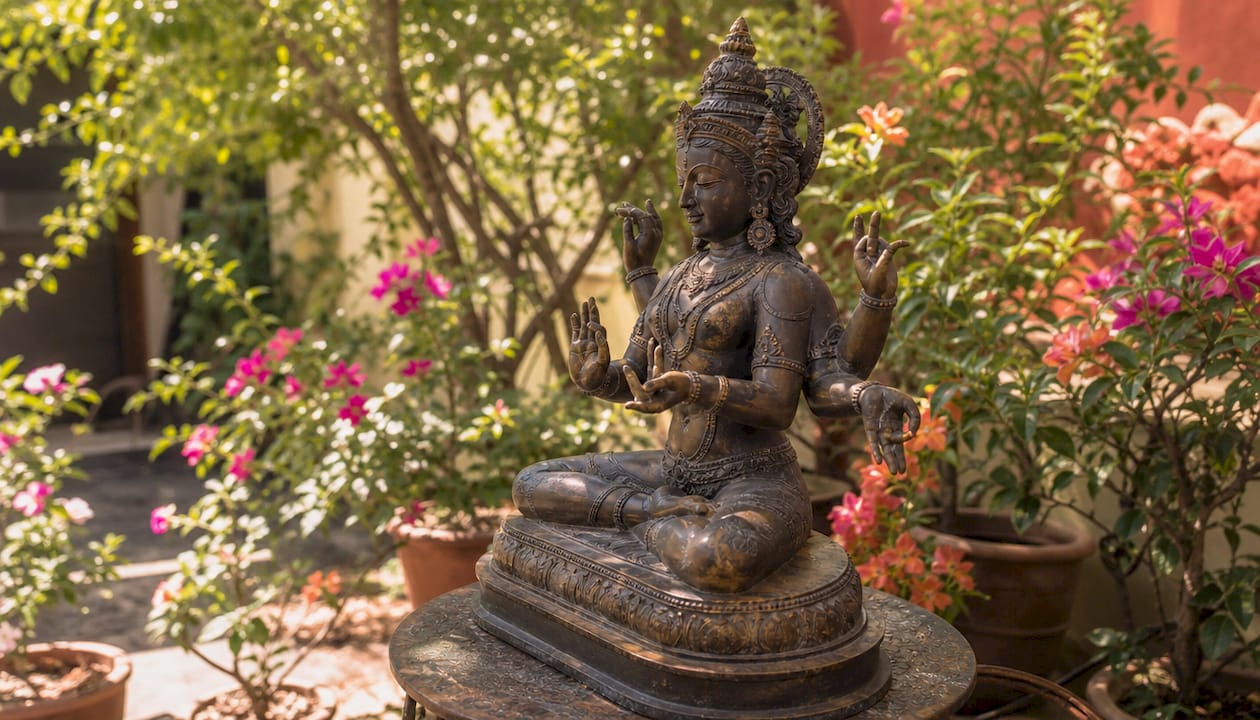
Mudras are the single most expressive feature on any Hindu goddess statue. They convey divine attributes such as fearlessness, generosity, and wisdom through precise finger and palm positions. No other feature communicates the goddess’s spiritual state as directly.
The two most common mudras you will encounter are:
- Abhaya Mudra: The right hand raised with palm facing outward. This gesture signals protection and reassurance. Statues of Durga and Parvati frequently display it.
- Varada Mudra: The hand lowered with palm facing outward and fingers pointing down. This signals the granting of boons or gifts. Lakshmi statues almost always include this gesture.
- Dhyana Mudra: Both hands resting in the lap, palms upward. This indicates meditation and inner stillness. It appears most often on seated goddess forms.
- Tarjani Mudra: The index finger extended upward as a warning gesture. This appears on fierce goddess forms such as Kali.
- Kataka Mudra: A curved hand position used to hold a flower or attribute. Common in dance-related goddess imagery.
Pro Tip: When examining a statue, photograph each hand separately before looking at the full figure. Hand position is the fastest single identifier, and close-up images reveal details that the eye misses at a distance.
The Shilpa Shastra prescribes specific mudras for each goddess form, so a correctly cast statue will never show a random gesture. If a mudra does not match a known category, the statue may be a regional variant or a later reproduction. Learning to read mudra positions is the most efficient skill a collector can develop.
2. Ayudhas: Weapons and attributes that signal cosmic function
Ayudhas are the objects, weapons, and tools a goddess holds in her hands. They are the second most reliable category of Hindu deity statue characteristics for identification. Each ayudha connects directly to the goddess’s mythological role and cosmic power.
Common ayudhas and their associated goddesses include:
- Trident (Trishula): Held by Durga, signaling her power over the three qualities of nature (tamas, rajas, sattva).
- Lotus (Padma): Held by Lakshmi and Saraswati, representing purity and spiritual awakening.
- Veena (lute): Specific to Saraswati, indicating her domain over music, arts, and learning.
- Sword and shield: Held by Durga in battle forms, representing the destruction of ignorance.
- Conch (Shankha): Associated with Lakshmi, signaling prosperity and the primordial sound of creation.
- Noose (Pasha) and goad (Ankusha): Appear on tantric goddess forms, representing control over the mind and senses.
The number of arms on a statue directly relates to the number of ayudhas displayed. Durga in her Mahishasuramardini form typically has eight or ten arms, each holding a distinct weapon. A statue with multiple arms but no clearly defined ayudhas is either damaged or incorrectly cast. Ayudhas should always be cross-referenced with the mudras to confirm identification, since some objects appear across multiple goddesses.
3. Vahanas: Animal mounts that confirm goddess identity
A vahana is the animal mount or companion associated with a specific goddess. Vahanas like lions, peacocks and elephants are among the most reliable single identifiers in Hindu goddess iconography. They appear at the base of the statue, beneath the goddess’s feet, or as a companion figure beside her.
| Goddess | Vahana | Symbolic meaning |
|---|---|---|
| Durga | Lion or tiger | Courage, royal power, and the conquest of ego |
| Saraswati | Peacock or swan | Beauty, discernment, and the arts |
| Lakshmi | Elephant or owl | Abundance, wealth, and wisdom |
| Kali | Corpse of Shiva | Transcendence over death and time |
| Parvati | Bull (Nandi) | Dharma, strength, and devotion |
Regional iconographic traditions sometimes substitute or add vahanas. In South Indian temple art, Saraswati’s swan is more prominent than her peacock. In Balinese Hindu sculpture, Durga’s lion takes a more stylized form than in North Indian bronzes. These regional differences do not change the core identification method. They simply require you to know the local tradition.
Pro Tip: On damaged or partial statues, look at the base first. Vahana carvings survive breakage more often than upper-body details because they sit at the thickest part of the stone or bronze casting.
4. Ornamentation and headdress styles: Decorative features that carry meaning
Ornamentation is not purely aesthetic. Jewelry, crowns, and clothing patterns vary systematically by goddess form and convey spiritual status, regional origin, and the deity’s temperament.
Key ornamentation features to examine:
- Mukuta (crown): The shape and height of the crown identify both the goddess and the regional tradition. A tall, cylindrical crown (kirita mukuta) signals royal or Vaishnava associations. A crescent-shaped crown links to Shaivite goddess forms.
- Necklaces and chest ornaments: Lakshmi statues typically display elaborate multi-strand necklaces. Kali, by contrast, wears a garland of severed heads, which is a direct identifier of her fierce form.
- Armlets and anklets: Present on most goddess forms, but their intricacy signals the statue’s origin period. Finely detailed armlets suggest Chola-period bronzes or Khmer stone work.
- Clothing style: Benevolent goddess forms wear full garments with detailed folds. Fierce forms like Chamunda are often depicted with minimal clothing, emphasizing their raw power.
- Halo (Prabhamandala): A flame or lotus-petal halo behind the head indicates divine radiance. Its shape and complexity vary by region and period.
Fierce goddess forms (ugra) and benevolent goddess forms (saumya) follow opposite ornamentation conventions. This distinction is one of the clearest ways to separate, for example, a Durga statue from a Parvati statue when ayudhas are missing or damaged. Collectors who select Hindu statues for home altars benefit from understanding this distinction before purchase.
5. Posture and stance: What the body position communicates
A goddess statue’s posture, called its asana or sthana, carries specific theological meaning. Standing, seated, and dancing postures each indicate a different divine state or narrative moment.
- Samabhanga (straight stance): The figure stands erect with equal weight on both feet. This signals authority and formal divine presence. Common in temple entrance guardian goddess figures.
- Tribhanga (triple-bend stance): The body curves at the neck, waist, and knee in an S-shape. This is the most common posture for benevolent goddess forms and signals grace and approachability.
- Seated on a lotus (Padmasana): Indicates meditation, peace, and spiritual authority. Saraswati and Lakshmi appear frequently in this posture.
- Dancing posture (Nritta): Indicates the goddess’s role in cosmic creation or destruction. Kali’s dancing form is the most recognized example.
Posture also interacts with vahana placement. A goddess standing on her vahana signals active power. A goddess seated beside her vahana signals a more contemplative state. These combinations are not accidental. They follow the prescriptions of the Agamic texts precisely.
6. Facial expression: Ugra vs. saumya conventions
Facial expressions in goddess statues follow regional stylistic conventions rather than serving as unique identifiers. This is a critical point that many collectors misunderstand. Two statues from different workshops can depict the same goddess with noticeably different facial features, yet both are iconographically correct.
The reliable distinction is between ugra (fierce) and saumya (benevolent) expression types. Fierce forms display wide eyes, protruding fangs, and an open mouth. Benevolent forms show half-closed eyes, a slight smile, and a serene brow. Kali and Chamunda always appear in ugra form. Lakshmi and Saraswati always appear in saumya form. Durga can appear in either, depending on the specific narrative depicted.
Facial features alone cannot confirm a goddess’s identity. The most reliable identification method combines hand-held objects and animal mounts with expression type as a secondary confirmation. Relying on the face first is the most common identification error among new collectors.
7. Material and construction: How medium shapes meaning
Material choice directly influences a statue’s liturgical role and its identification context. Stone, bronze, and terracotta each carry distinct associations in Hindu practice.
Stone statues signal permanence. They were made for fixed temple installation and rarely moved. A stone goddess statue with a flat back and a tenon at the base was designed to be set into a wall niche. Bronze statues signal ritual mobility. They were carried in processions, bathed, and dressed. A bronze goddess with ring attachments at the base was made for processional use. Terracotta statues reflect local and intimate traditions, often made for seasonal festivals or household shrines.
Material also affects surface detail. Bronze casting allows finer detail in jewelry and mudras than stone carving at the same scale. This means a bronze statue may show more iconographic information per square inch than a comparable stone piece. Terracotta pieces often simplify attributes, which can make identification harder. When attributes are ambiguous on a terracotta figure, vahana and posture become the primary identifiers.
Key Takeaways
Identifying a Hindu goddess statue requires reading its full iconographic grammar, not just one feature in isolation.
| Point | Details |
|---|---|
| Mudras are the fastest identifier | Start with hand gesture position to narrow down the goddess form immediately. |
| Ayudhas confirm the mudra reading | Cross-reference held objects with hand gestures for accurate identification. |
| Vahanas survive damage better | Check the statue base first on partial or damaged pieces for the animal mount. |
| Ornamentation signals temperament | Fierce and benevolent goddess forms follow opposite decoration conventions. |
| Material reveals liturgical purpose | Stone indicates temple use; bronze indicates ritual procession; terracotta indicates local tradition. |
What I’ve learned from years of reading goddess statues
The most common mistake I see from collectors and enthusiasts is treating identification as a checklist exercise. They look for one feature, find a match, and stop there. That approach fails regularly.
Hindu iconographic symbolism operates as a complete system. Every element on a correctly made statue reinforces every other element. When a feature seems contradictory, that contradiction is itself information. It may indicate a regional variant, a transitional period in art history, or a syncretic tradition that merged two goddess forms into one image.
The second mistake is treating the face as the primary identifier. Facial features are the least standardized element across regional traditions. A Durga from Tamil Nadu and a Durga from Rajasthan can look like different people. Their ayudhas and vahana will be identical. Train your eye on the hands and the base before you look at the face.
The deeper skill is understanding that these statues are not static art objects. They are records of living theological traditions. A Chola bronze Lakshmi and a Khmer stone Lakshmi carry the same iconographic logic because both traditions drew from the same textual sources. That consistency across geography and centuries is what makes the system learnable. Start with the Shilpa Shastra’s core categories, study regional examples, and the patterns become clear quickly.
— James, HDAsianArt.com
Authentic Hindu goddess statues at HDAsianArt
HDAsianArt offers a curated selection of antique and traditional Hindu goddess statues in bronze, stone, and temple-quality materials sourced from across South and Southeast Asia. Each piece is individually researched and documented by specialists who apply the same iconographic framework covered in this guide.
Collectors and students will find pieces from Cambodia, Thailand, Indonesia, Sri Lanka, and beyond, with detailed descriptions of mudras, ayudhas, and vahanas for every statue listed. Worldwide insured DHL shipping and museum-quality documentation make HDAsianArt a reliable source for both serious collectors and first-time buyers.
FAQ
What are the primary features used to identify Hindu goddess statues?
Experts identify Hindu goddess statues primarily by mudras, ayudhas, vahanas, and ornamentation. These four categories form the core of Hindu iconographic grammar and provide reliable identification across regional styles.
How do I tell Durga apart from Lakshmi in statue form?
Durga typically displays a trident, sword, or battle weapons and stands on or beside a lion. Lakshmi holds a lotus and conch, displays the Varada Mudra, and is associated with elephants or an owl.
Can facial features alone identify a Hindu goddess statue?
Facial features follow regional stylistic conventions and are not reliable primary identifiers. Hand-held objects and animal mounts provide far more consistent identification data across traditions.
What does the material of a statue tell me about its purpose?
Stone indicates temple permanence, bronze indicates ritual procession use, and terracotta reflects local or household traditions. Material choice is a direct indicator of the statue’s original liturgical function.
Why do some goddess statues have multiple arms?
Multiple arms allow the sculptor to display multiple ayudhas simultaneously, each representing a different aspect of the goddess’s power. Durga in her Mahishasuramardini form carries eight or ten weapons at once, one per arm, to show her complete cosmic authority.
