



Hindu God with Elephant Head Explained
Hindu God with Elephant Head Explained
Ganesha is the Hindu god with an elephant head and a human body, the Lord of all Beginnings who both places and removes obstacles. But if you recognise his face, can you explain what he's holding, why a small animal sits beside him, or what makes one statue different from another?
Those details matter. A sacred image is not just an illustration of a familiar story, and recognising Ganesha is only the beginning of understanding how worshippers and sculptors represent him.
Table of Contents
- The Hindu God with an Elephant Head
- Symbols You Can Identify on a Statue
- From Threshold Spirit to Lord of Beginnings
- Stories Behind the Head and a Silk Road Image
- Ganesh Chaturthi and the First Invocation
- Placing Ganesha by a Door or an Altar
- Choosing a Ganesha You Can Explain
The Hindu God with an Elephant Head
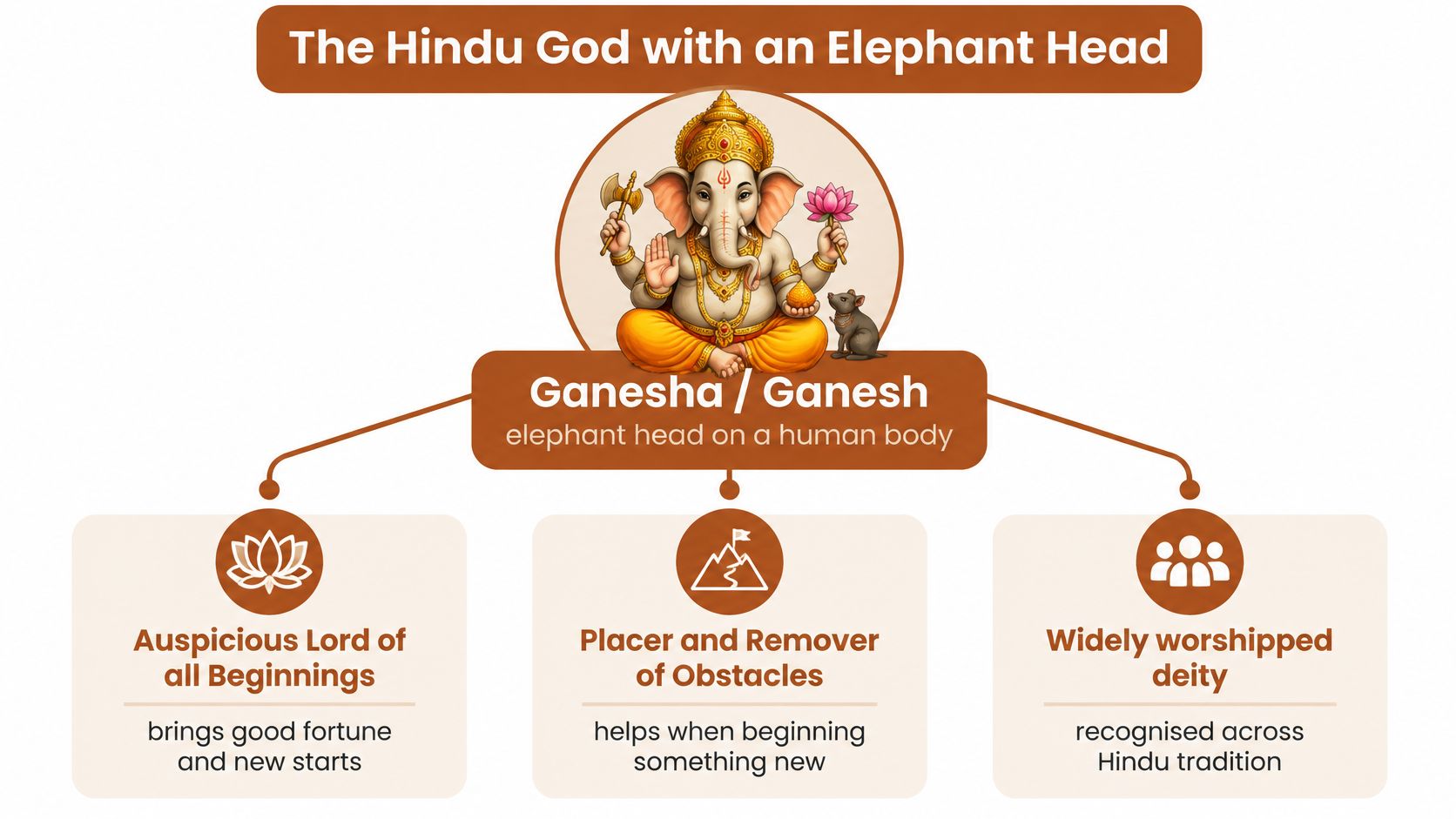
Ganesha, also called Ganesh, is a deity whose distinctive appearance communicates a religious role. The British Museum identifies him as elephant-headed and human-bodied, the auspicious “Lord of all Beginnings”, and both the placer and remover of obstacles.
That last distinction is easy to miss. He isn't a supernatural problem-solver who makes every undertaking effortless. His authority concerns obstacles themselves, including the difficulties that make someone pause, reconsider or approach a beginning more thoughtfully.
Devotees may honour him before study, a journey, entering a new home, opening a business or beginning worship. These aren't unrelated activities. Each involves crossing from an established situation into something not yet known.
Recognising a deity rather than a mascot
A newcomer can begin with the broad silhouette: an elephant head, a rounded human torso, several arms and objects held close to the body. Look towards the base, too, where a small animal may appear beside the much larger deity.
The combination can feel approachable, but approachable doesn't mean merely decorative. For a worshipper, this is a sacred form through which divine presence can be honoured, not an elephant character given an attractive setting.
Ganesha's religious reach also extends beyond a single community. The British Museum's guide to living Indian traditions notes that some Buddhists and Jains also worship him, alongside his extensive Hindu following.
- Names: Ganesh and Ganesha refer to the same deity, not separate figures.
- Context: A museum object, a household shrine image and a festival image may share an identity without serving the same purpose.
- Interpretation: Recognising the head establishes a starting point. The hands, seat and surrounding figures make the reading more specific.
The useful question isn't only “Who is this?” It's also “What does this particular representation show?”
Symbols You Can Identify on a Statue
Ganesha features and what they signal
| Feature | What you usually see | Usual reading |
|---|---|---|
| Elephant head | Large ears, trunk, often one broken tusk | Wisdom, attentive listening and strength that clears a path |
| Human body and belly | Rounded belly on a human torso | Approachable prosperity; a link to older nature-spirit forms |
| Four arms | The familiar count, though other counts exist | Power to act in more than one way at once |
| Noose (pasha) | Often in an upper hand | Drawing the devotee near and binding what blocks them |
| Goad (ankusha) | Often in an upper hand | Urging the mind past hesitation |
| Broken tusk | Held in a lower hand | A sacrifice turned into a tool; also a pen in one famous telling |
| Sweets or modak | A bowl or sweet in a lower hand | The reward of steady effort |
| Blessing hand | Open palm when a hand is free | Protection or the granting of a wish |
| Rat or bandicoot | At the feet as the vehicle | A quick mind that still needs a guiding rider |
| Trunk curve | Left, right or nearly straight | Left is the common home form; right is rarer and sometimes more ritually demanding |
| Posture and seat | Seated, standing, dancing or lalitasana, often on a lotus | Ease, authority or celebration on a pure, stable base |
Treat these as usual readings, not a universal dictionary. A devotional explanation can help someone reflect on an image without proving what every sculptor intended.
The V&A's Ganesha collection entry supports identifying the familiar four-armed form through characteristic attributes such as the noose, goad, sweets and broken tusk. Their combination matters more than expecting every statue to reproduce an identical arrangement.
Record what's visible before interpreting it
Work systematically: head, arms, hand-held objects, trunk, vehicle, posture, seat and material. In a photograph, distinguish the deity's right from the viewer's right, especially when describing trunk direction.
An upper hand partly hidden behind a crown shouldn't be recorded as absent. Likewise, a worn projection may be a damaged attribute rather than an object you can confidently name.
- Describe the shape: Write “curved implement with a hooked end” before deciding it's a goad.
- Check the base: A small rat can disappear against a dark pedestal or be cropped out of a photograph.
- Record uncertainty: “Hand-held object unclear” is more useful than a confident but unsupported identification.
Regional and historical differences are expected. A missing goad doesn't automatically disprove an identification, and a broken tusk may be deliberately represented, physically damaged or both.
For a closer comparison of the implements, use our guide to what Ganesha holds in his hands. Compare the visible outline first, then consider the symbolic explanation.
Read posture as carefully as the hands
The British Museum's Kashmir relief, dated to the first half of the ninth century, shows Ganesha enthroned in lalitasana, a relaxed seated posture, carved in smooth green chlorite. Here, composure and a raised seat communicate dignity, not just comfort.
Trunk customs need similar care. Some South Indian traditions give right-curving forms stricter ritual requirements, but that isn't a rule every household follows.
Try a brief photograph test: identify the head, name a couple of attributes, locate the vehicle if visible, and describe the posture. Leave age and price until you can explain what you're looking at.
From Threshold Spirit to Lord of Beginnings
Consider a visitor who encounters Ganesha on a museum pedestal. Without historical context, the rounded belly and animal head might seem like the invention of an individual artist. They belong instead to a much longer visual and religious development.
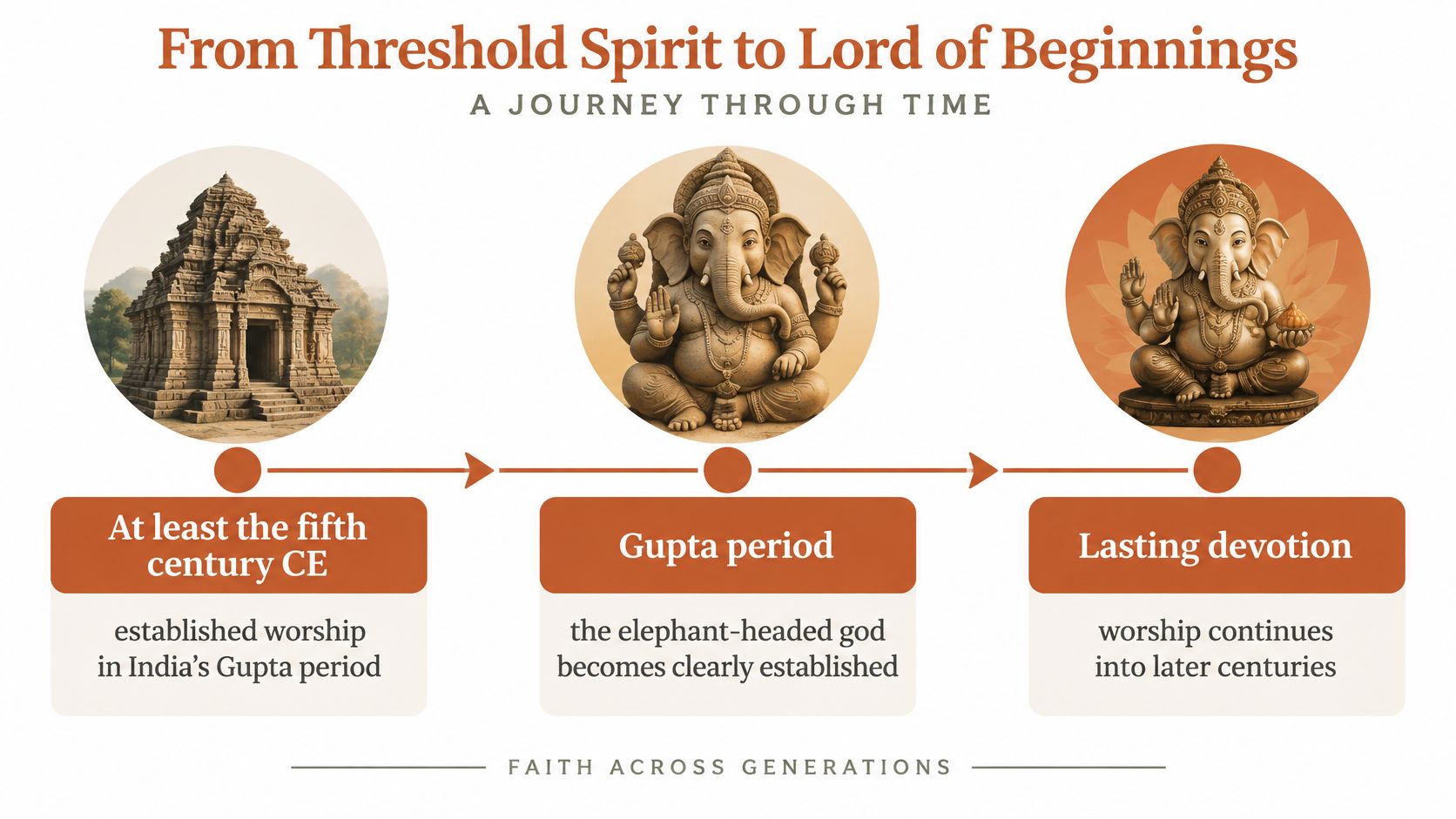
The museum interpretation published in Celebrating Ganesha places established worship at least as far back as the fifth century CE, during India's Gupta period, giving Ganesha approximately 1,500 years of documented worship. It also connects his origins with earlier yaksha, or nature-spirit, traditions.
Earlier forms and familiar places
Yakshas were associated with the natural world, and their imagery could include animal heads and prominent bellies. That visual background helps explain why Ganesha's body shouldn't be read only through modern ideas about an elephant's personality.
His associations with crossroads and thresholds are equally important. A threshold is where someone enters, leaves or asks permission to pass. At a crossroads, a traveller chooses a direction.
These are ordinary places with significant consequences. Linking a deity to them connects religious protection with the uncertainties people encounter in daily life.
A change in religious status
The important development isn't that an elephant-headed figure appeared. It's that a deity associated with boundary spaces became the deity invoked first at the beginning of Hindu ritual.
That movement gives familiar imagery a wider significance. A doorway guardian concerns a particular entrance; the Lord of Beginnings concerns the act of beginning itself.
Historical caution: The earliest surviving evidence doesn't necessarily mark the moment a religious practice began.
For a collector, this distinction encourages humility. A modern carving can participate in an old iconographic tradition without being an old object. Equally, a sculpture's resemblance to an early form doesn't establish its date.
- Religious history: Ask how worship and interpretation developed.
- Object history: Ask when, where and for what purpose this particular sculpture was made.
- Ownership history: Ask what documentation establishes its movement between owners.
Those questions are related, but they aren't interchangeable. A convincing account of Ganesha's antiquity cannot replace evidence about the age or provenance of a statue offered for sale.
Stories Behind the Head and a Silk Road Image
In a well-known telling, Parvati fashions a boy and asks him to guard her doorway while she bathes. When Shiva arrives, the boy refuses him entry, faithfully carrying out his mother's instruction.
A conflict follows, and Shiva severs the boy's head. Confronted by Parvati's grief, he restores the child to life with an elephant's head and grants him a place of honour.
The story makes a striking connection between obedience, a guarded entrance and divine recognition. The child who prevents passage becomes the deity people honour when asking for a clear way forward.
A sacred story with more than one telling
The Puranas differ, so this account shouldn't be presented as the single authorised explanation of every Ganesha image. Hindu communities preserve different narratives and theological emphases rather than requiring every representation to illustrate one fixed plot.
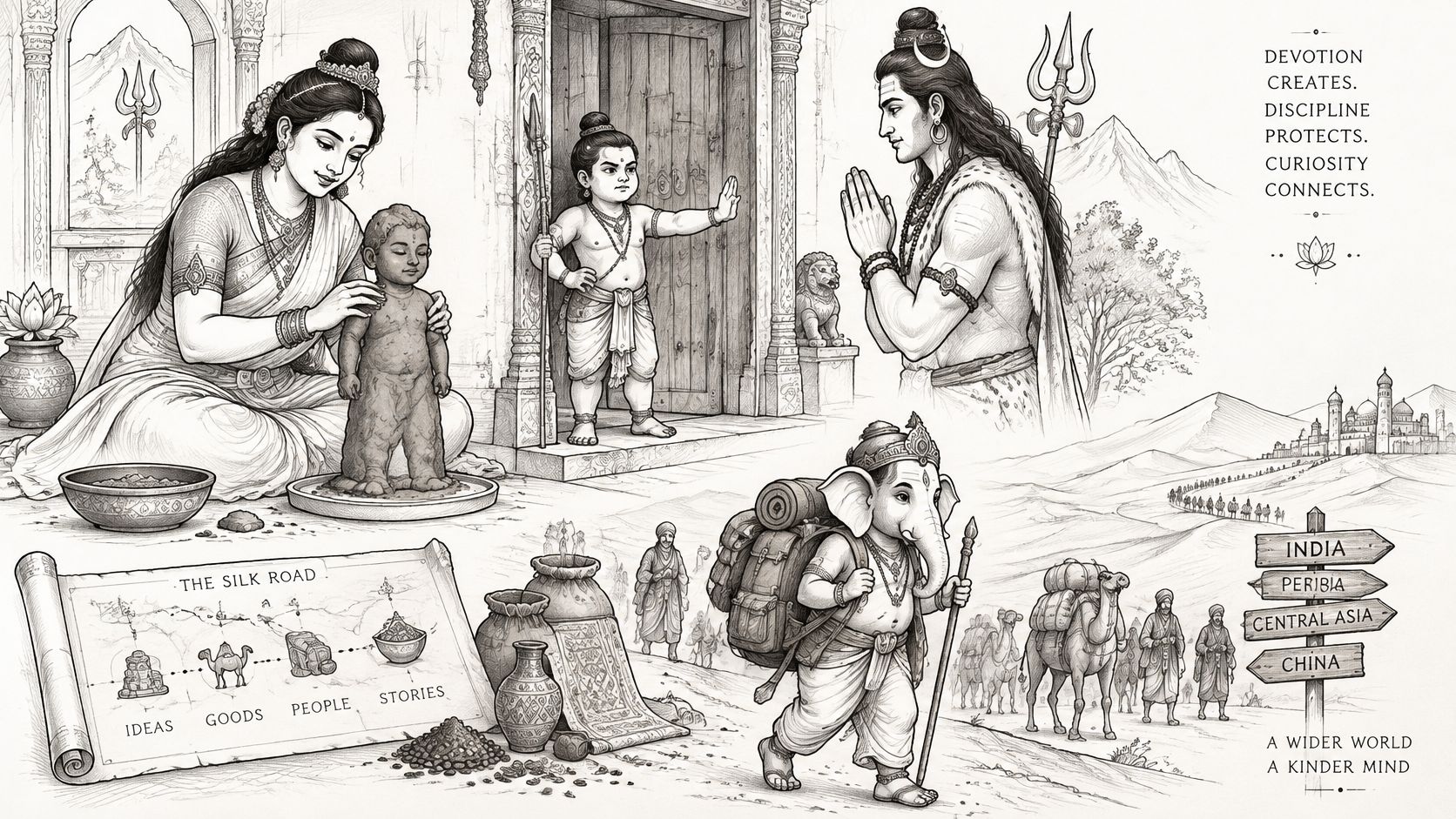
The tusk introduces another narrative. In a famous telling, Ganesha uses it as a pen while the sage Vyasa dictates the Mahabharata, making the attribute especially resonant with learning and determined work.
A separate museum interpretation considers whether the tusk's shape preserves an older association with a plough and agricultural patronage. That's a scholarly proposal about the history of an attribute, not another episode to insert into the doorway story.
A sculpture can bring several associations together without depicting a single moment in a narrative.
An image that travelled beyond India
The British Museum's Silk Roads guide describes a Ganesha image from the Tarim Basin, probably dating to the sixth or seventh century AD, with four arms holding an axe, a goad or spiked stick, a broken tusk and a bowl of sweets.
This is a useful object-reading exercise. The elephant head establishes recognition, while the particular implements allow a more precise description of the representation.
- What the object shows: A recognisable deity with a distinct set of attributes.
- What its location supports: Ganesha imagery circulated beyond the Indian subcontinent through connections associated with the Silk Roads.
- What it doesn't establish alone: The exact origin story every historical viewer understood or the ritual every community performed.
Travel didn't require every image to remain identical. Recognisable attributes could persist while sculptors adapted materials, proportions and styles to different settings.
Ganesh Chaturthi and the First Invocation
Ganesh Chaturthi celebrates Ganesha's birth in the month of Bhadrapada, usually falling in August or September. The festival begins on the fourth lunar day and commonly extends over about ten days, although household observances differ.
In Maharashtra and many diaspora communities, worshippers install a murti, a sacred image, in a public pandal, or temporary pavilion. Offerings can include modak, durva grass, red flowers and lamps, accompanied by prayers and the recitation of Ganesha's names.
For the changing calendar date, consult our guide to when Ganesh Chaturthi takes place, and confirm arrangements with the temple or community hosting the celebration.
Understanding the closing immersion
The concluding visarjan, or immersion, returns a temporary image to the elements. Worshippers aren't discarding the god. They're bringing a particular period of invited presence and communal worship to its close, with the expectation of welcoming Ganesha again.
A clay festival murti and a permanent bronze or wooden sculpture therefore require different care. Don't assume that an image belongs in water because it represents Ganesha, and follow local organisers' environmental arrangements for immersion.
- For a festival image: Establish the intended material, ritual use and immersion arrangements before installation.
- For a permanent shrine image: Keep it in place and renew the offerings according to household practice.
- For a visitor: Ask before touching the image, photographing worship or joining a ritual action.
A simple observance at home
Daily worship doesn't have to reproduce the scale of a public festival. A practitioner may clean the prayer space, place a sweet before the image, light a lamp safely and offer a short prayer before beginning work or travel.
Follow your family or temple's practice where one exists. A beginner needn't invent elaborate requirements or treat every online ritual checklist as compulsory.
If incense forms part of your observance, the incense ritual tips from Aroma Warehouse offer a practical starting point. Use a heatproof holder, allow ventilation and avoid smoke where someone has breathing sensitivities.
Ganesha's visibility in Britain extends beyond worship spaces: the British Museum's annual review records that a touring thirteenth-century sculpture was seen by more than 620,000 people across Britain. Public familiarity, however, shouldn't obscure the image's continuing sacred significance.
Placing Ganesha by a Door or an Altar
A suitable location begins with a practical question: will this be a place of prayer, a threshold setting or a respectful art display? The answer determines how much space, access and protection the sculpture needs.
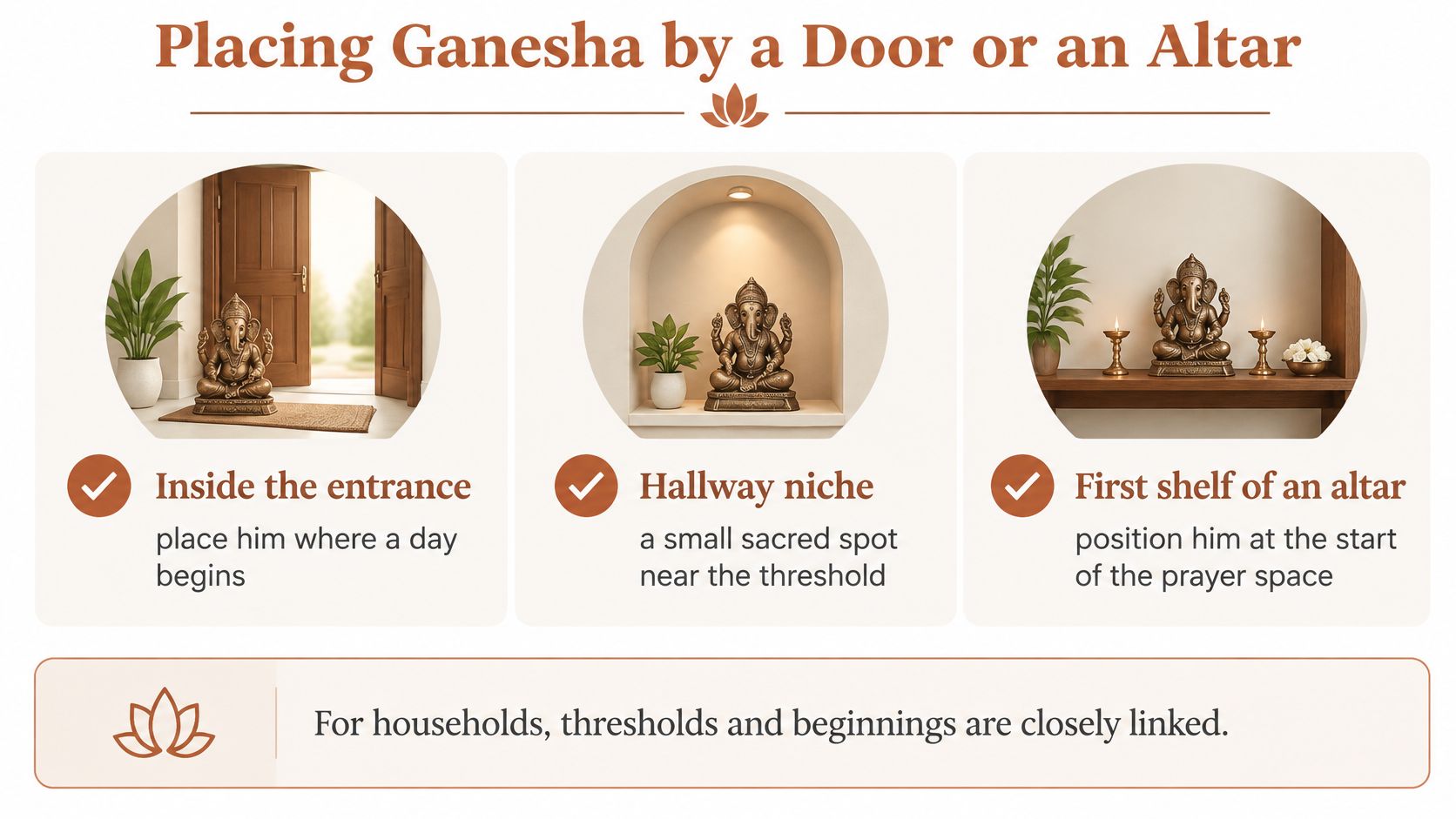
Inside an entrance, Ganesha can mark the point where the household day begins. A hallway niche or secure shelf can work well, provided coats, bags and opening doors won't strike the figure.
Check the setting before the compass
Popular Vastu advice often favours a north or east aspect. Households interpret placement differently, so don't turn a small UK flat into a contest between compass directions and everyday usability.
A clean, stable location that allows respectful attention is a more useful starting point than an awkward ledge selected only for its orientation. Our guide to where a Ganesh statue should be placed explores the relationship between entrances, prayer spaces and household practice.
- Height and stability: Keep the image above floor level on furniture that won't wobble. Check that the whole base rests securely.
- Surroundings: Avoid bathrooms, rubbish, shoe piles and surfaces used for miscellaneous clutter.
- Access: Leave room to dust the sculpture and, where appropriate, place an offering without reaching across a flame.
- Traffic: Keep projecting hands and delicate attributes away from passing sleeves, pets and children.
Make room for the intended use
An altar needs more working space than a display shelf. A lamp requires a heatproof surface and clearance from curtains, woodwork and flowers; the flame shouldn't sit beneath the sculpture's projecting arms.
For a study, choose a position where the figure won't become a bookend or support for headphones. In a hallway, test the sightline from the doorway and make sure the setting feels intentional rather than squeezed into leftover space.
Placement rule: Choose a surface you're willing to keep clear, not merely a surface that happens to be empty today.
Dust gently with a soft brush appropriate to the material. Avoid water, polish or household sprays unless you know they're safe for the surface, finish and any applied decoration.
A consecrated family image deserves particular care. Consult the person responsible for its worship before relocating it, and don't store it face down among household belongings.
Choose an entrance for a threshold setting or an altar for regular prayer. Either can be appropriate; neither should be treated as casual storage.
Choosing a Ganesha You Can Explain
A sound choice is a sculpture you can describe without relying on the seller's title. Before buying, write a short account of its head, body, visible attributes, posture, base and material.
If a vehicle is absent, check whether the design omits it, the base is incomplete or the photograph doesn't show it. An honest unresolved detail is preferable to a story invented to make the piece seem complete.
Match the object to your purpose
Regional style matters as much as the deity's name. A Khmer-style seated figure, a Thai bronze and an Indian stone representation can all depict Ganesha while differing in proportions, ornament and treatment of the body.
Wood can bring visual warmth to a shelf, bronze can preserve sharply modelled detail, and stone can complement an architectural setting. Material alone, however, doesn't establish quality or age.
- For worship: Consider the recipient's established practice, including preferences about posture and trunk form.
- For collecting: Request clear views of the back, underside, hands and any repairs, together with available provenance.
- For a gift: A modest seated figure may be easier to accommodate than a large or ritually specialised form. Confirm that a sacred image would be welcome.
Condition needs careful interpretation. A worn tusk may be compatible with age, but wear alone isn't proof of antiquity; equally, crisp detail doesn't automatically mean a sculpture is recent.
Ask questions that improve the decision
At HD Asian Art, we associate Ganesha with new beginnings and wisdom. That makes the intended meaning a useful starting point, but the individual object still needs to suit the recipient and the room.
We can help narrow a choice when you share photographs, measurements of the space and preferences such as deity, material or regional style. Include the shelf depth and the clearance around the proposed position, not just its overall appearance.
A customer in Bristol described their Ganesha as magnificent, praised the beautiful detailing and said delivery was straightforward. Those are valuable aspects of receiving a sculpture, but your own selection should also rest on a clear understanding of the figure.
Choose something you can explain: what it shows, what remains uncertain and why it belongs in the setting you've prepared.
HD Asian Art offers Hindu and Buddhist sculptures, including Ganesha representations for thoughtful display, collecting and worship. Visit HD Asian Art to explore the selection, and share photographs, space measurements and your preferred material or style for help choosing a Ganesha whose imagery you understand.
