



Ganesha with Shiva: Iconography and Meaning
Ganesha with Shiva: Iconography and Meaning
If you've ever looked at a sculpture group and wondered why Ganesha is standing near Shiva instead of appearing alone, you've already noticed a gap that many quick guides miss. Ganesha with Shiva isn't just a decorative pairing. It's a family image, an iconographic clue, and often the key that tells you how to read the whole work.
In a museum gallery, this matters immediately. Once you understand that Ganesha is traditionally regarded as the son of Shiva and Parvati, the composition stops looking crowded and starts looking organised. A central divine parent, a subsidiary child, a set of shared symbols, and a precise arrangement of bodies all begin to speak.
Table of Contents
- Why Ganesha Appears Beside Shiva in Sacred Art
- The Mythological Bond Between Shiva and Ganesha
- Reading a Ganesha with Shiva Composition
- Regional Styles of Shiva and Ganesha Ensembles
- Temple Reliefs, Processional Figures and Domestic Statues
- Placing a Ganesha with Shiva Statue in Your Home
- Choosing and Caring for a Paired Sculpture
Why Ganesha Appears Beside Shiva in Sacred Art
The first thing to see is the parent-child relationship. In many sacred images, Shiva anchors the composition as the dominant figure, while Ganesha appears lower, smaller, or slightly to one side. That hierarchy isn't a sign of lesser importance. It's how sculptors show kinship, order, and auspicious presence all at once.
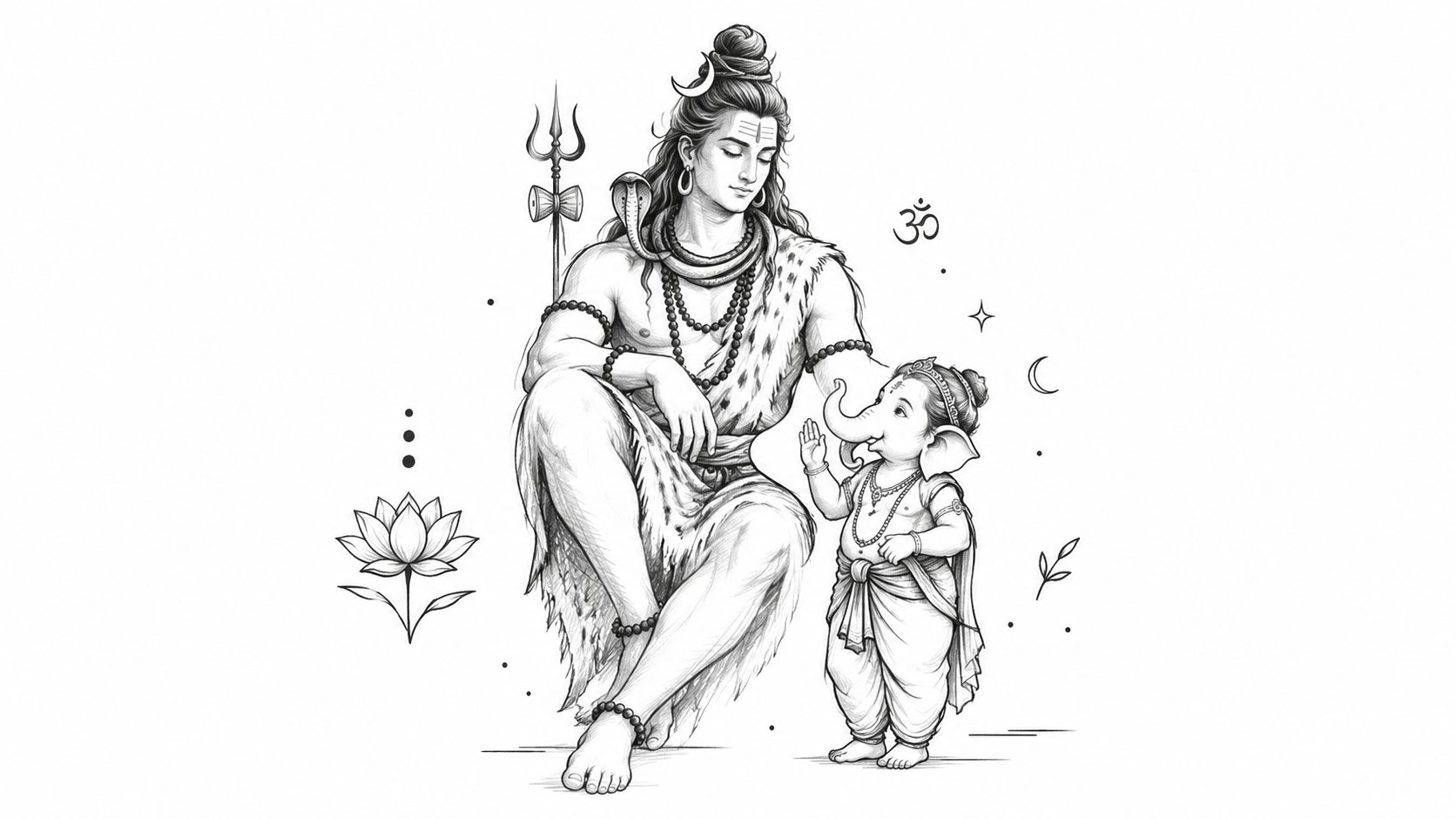
A paired image of Ganesha and Shiva usually tells you that the artist wanted more than a portrait of one deity. The work may be showing the Shaivite family, marking a shrine entrance with protective symbolism, or presenting a complete devotional setting rather than an isolated god. The British Museum offers a clear UK example. Its collection includes a red sandstone model of a Shiva temple or shrine in which a small figure of Ganesha appears above the doorway, and the museum notes that Ganesha's image is often placed above doorways as an auspicious protector in its Ancient India large print guide.
Three reasons the pair appears together
Artists commonly join them for three overlapping reasons:
- Family completeness. Shiva, Parvati, and their children form a recognisable devotional unit.
- Narrative memory. The grouping recalls the stories that explain how Ganesha becomes part of Shiva's household.
- Auspicious protection. Ganesha's presence can guard a threshold, shrine, or sacred image.
One helpful modern reference point is the kind of grouped sculpture seen in a bronze Uma-Maheshvara ensemble with attendants. In that sort of object, the viewer learns to read relationships first, then attributes. If you want a concise grounding in Shiva before studying the pair, HD Asian Art has a useful overview in Who is Lord Shiva.
Practical rule: When Ganesha appears with Shiva, ask first, “What relationship is the sculptor showing?” That question is often more useful than asking only, “Which god is this?”
The strongest readings begin there. Once you recognise the family unit, mythology, placement, regional style, and even home display start to make sense.
The Mythological Bond Between Shiva and Ganesha
Think of Ganesha in Shiva's world not as a random attendant, but as a beloved son in the household of an immense and powerful father. That image helps more than a dictionary definition does. Sacred art often preserves emotion through form, and the emotional core here is family.
The story most viewers already half know
The familiar story begins with Parvati creating a boy and setting him to guard her privacy. Shiva arrives, doesn't recognise the child, and a conflict follows. The boy is beheaded, then restored when Shiva gives him an elephant head. The result is not merely a transformed child. It is a child publicly acknowledged and reintegrated into the divine household.
That sequence explains why Ganesha can appear both intimate and formal in art. He is close to the family, yet his role is ceremonial. He belongs at the doorway, near the throne, or below the seated parents because he is both son and guardian.
How story becomes sculpture
Artists turn those narrative beats into visual cues:
- Elephant head points to the restored child.
- Broken tusk signals a distinctive identity and invites viewers to recall stories of sacrifice, duty, or authorship.
- Round belly and sweets can suggest abundance, pleasure, and the warmth of household devotion rather than austere isolation.
- Subsidiary placement near Shiva or Parvati shows belonging within the family group.
A common point of confusion comes from titles. Ganesha is also linked to Shiva through the idea of the ganas, the retinue or host associated with Shiva. UK-facing educational material summarises the relationship clearly by noting that Ganesha is traditionally regarded as the son of Shiva and Parvati, while many commercial listings flatten that nuance into a general deity category on Shiva Online's deity statues page.
Some traditions stress family tenderness. Others stress rank and guardianship. In sculpture, those two ideas often meet in the same image.
Why paired images stress guardianship
If Shiva is the cosmic force and Ganesha is the son, why does Ganesha so often seem immediately approachable? Because paired compositions usually favour household and threshold meanings over abstract hierarchy. The family image invites reverence, but it also invites nearness.
Texts and local traditions don't always emphasise the same detail in the same way. Some strands of storytelling focus on Ganesha's birth and restoration. Others highlight his later status as a protective, auspicious figure in Shiva's circle. A sculpture that places Ganesha beside Shiva often leans into that second function. It shows not “who outranks whom,” but “who belongs where in sacred order.”
Reading a Ganesha with Shiva Composition
When you stand in front of a paired sculpture, don't start with ornament. Start with structure. The eye should look for centre, scale, direction, and attributes before it worries about finer details.
Start with the main axis
In many Shiva-Ganesha ensembles, Shiva occupies the dominant position. He may be seated centrally, raised slightly higher, or marked by a stronger halo, crown, or bodily breadth. Ganesha usually appears in a lower register or to one side, often as a subsidiary figure who still matters ritually.
A British Museum chlorite relief gives a precise example. It depicts Shiva, Parvati, and their sons Ganesha and Karttikeya together, with Shiva shown as three-headed, haloed, and originally four-armed with a trident, while Ganesha stands on the proper right side as a subsidiary but important figure in the British Museum object record for the chlorite relief. That layout is especially useful because it teaches how composition itself carries theology.
Read the clues one by one
Look for these recurring signals:
- Shiva at the centre. He often holds the visual weight of the ensemble.
- Parvati stabilising the group. When present, she often balances Shiva and softens the composition into a family unit.
- Ganesha offset to one side. His placement often indicates filial status, not marginality.
- Shared framing devices. Halos, back-slabs, throne-backs, or lotus bases can unify the group.
- Gesture and orientation. If Ganesha turns toward Shiva, the sculptor may be reinforcing dependence or courtly attendance.
| Visual Grammar of a Shiva-Ganesha Ensemble | |||
|---|---|---|---|
| Figure | Typical Position | Identifying Attributes | Iconographic Clue |
| Shiva | Centre or upper register | Matted hair, trident, multiple heads or arms in some forms | Primary authority and compositional anchor |
| Parvati | Beside Shiva or sharing the seat | Feminine jewellery, calm seated pose | Makes the image familial rather than solitary |
| Ganesha | Lower register or proper side | Elephant head, tusk, sweet, rounded belly | Son, auspicious attendant, threshold power |
| Karttikeya or Skanda | Opposite side in family groups | Youthful figure, martial bearing | Completes the divine household |
For readers comparing sculptures in galleries or shops, a short attribute guide helps. HD Asian Art has a useful visual primer on Ganesha's objects and signs in Ganesha's iconography and the symbolic meanings of his attributes.
A museum habit worth borrowing
Curators often ask two simple questions. Who dominates the composition? Who completes its meaning? In a Ganesha with Shiva image, those answers are rarely the same figure. Shiva governs the visual centre. Ganesha often supplies the auspicious, relational, and protective charge that makes the image feel complete.
Regional Styles of Shiva and Ganesha Ensembles
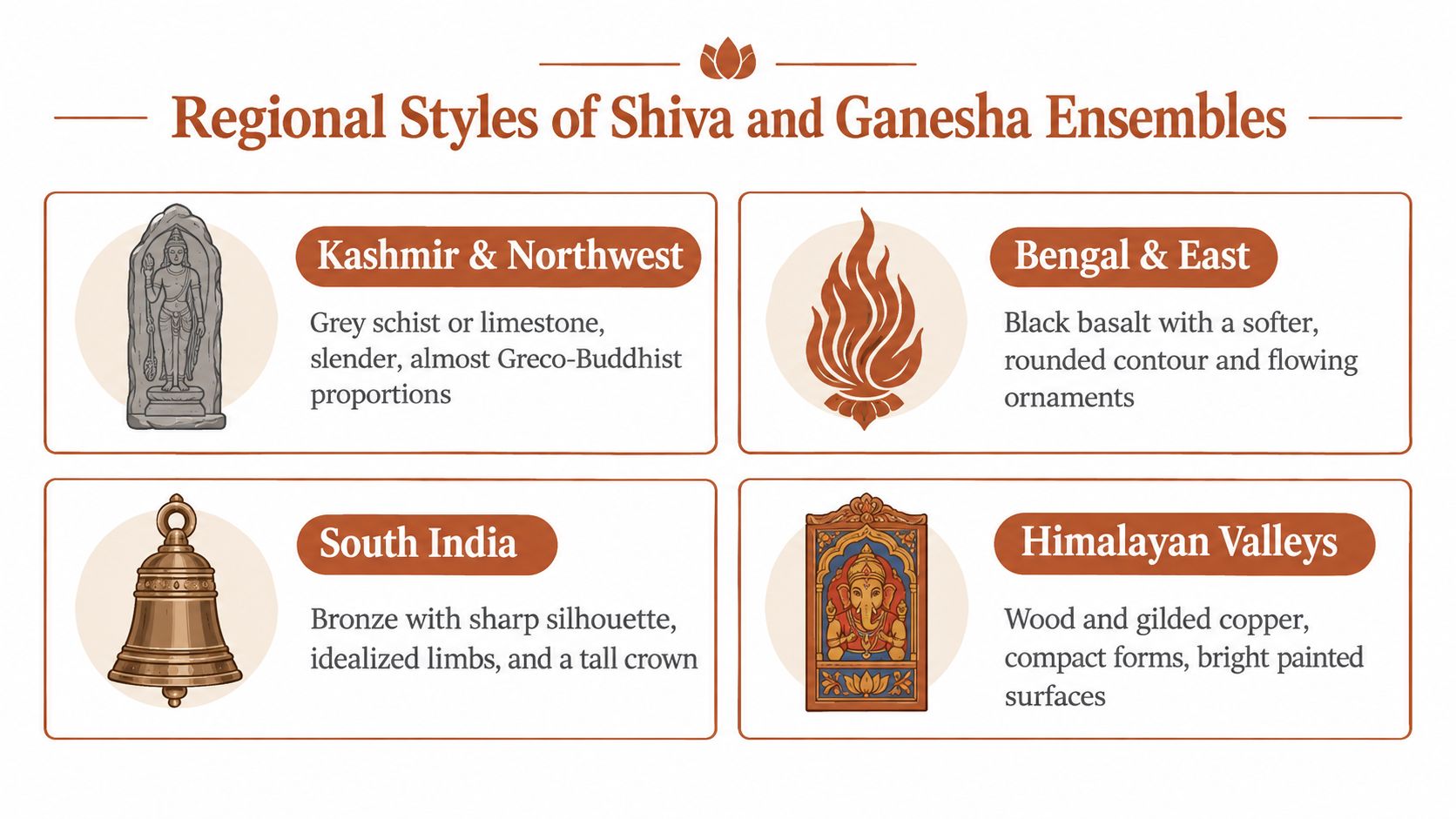
Regional style changes the mood of the pairing even when the family logic remains constant. Material, silhouette, and carving habits can make the same iconographic relationship feel courtly, monumental, intimate, or severe.
Kashmir and the Northwest
A northwestern relief often feels ordered and slender. Shiva may appear three-headed and haloed, with the family arranged in a disciplined grouping on a carved slab. Ganesha doesn't dominate. He occupies a proper place, subsidiary but legible.
This matters for attribution. The British Museum's chlorite family relief, with Shiva, Parvati, Ganesha, and Karttikeya, is a strong diagnostic example of a Kashmir-linked or northwestern convention because family grouping, directional placement, and shared ornamentation do so much of the iconographic work.
South India
In southern idioms, especially those associated with bronze traditions, the pair can become more fluid and processional. Forms are often cleaner in outline, crowns taller, and limbs more idealised. Ganesha may read less as a carved subsidiary child on a slab and more as part of a moving sacred ensemble.
That difference affects how we interpret wear and handling. The V&A notes a processional Ganesha carried with Shiva and Parvati during temple parades in the context summarised by the British Museum object discussion above. That tells a buyer or collector to expect different structural logic in portable images than in fixed stone reliefs.
Java and the wider cross-regional world
A Java-made Ganesha dated about AD 1000–1200 appeared in the British Museum's Ancient India exhibition, showing how UK display contexts present Ganesha imagery across regions rather than as a single Indian style in coverage of the exhibition object. In Javanese work, the surface often feels smooth and courtly, and the figure's calm mass can differ sharply from more densely carved Indian family slabs.
The British Museum's exhibition Ancient India: living traditions ran in London from 22 May to 19 October 2025 according to the museum's exhibition page. That recent UK context matters because it places these images before a broad public, not only before specialist scholars.
Cambodia and related Southeast Asian settings
In Khmer and Cambodian settings, the forms often become firmer and more block-like. The shared sacred authority of the group can feel architectural even when the figures are freestanding. Ganesha stands close, compact and deliberate, rather than playfully mobile.
For readers looking at bronzes from South India, HD Asian Art's article on Chola Ganesha is one useful reference for understanding how regional metal traditions shape divine form.
Regional style changes the accent, not the family grammar. The relationship still has to read clearly.
Temple Reliefs, Processional Figures and Domestic Statues
The same divine pair can appear in very different physical formats. A wall relief from a temple, a portable bronze used in procession, and a household brass figure may all show Ganesha with Shiva, but they weren't made for the same setting or use.
Temple reliefs
Temple reliefs are usually the most architectural form. They belong to walls, niches, lintels, shrine frames, and door zones. The British Museum's record of Ganesha positioned above a Shiva temple doorway is especially helpful because it preserves the original logic of placement. Ganesha there acts as an auspicious protector, not just as a family member in a narrative scene.
Stone reliefs tend to reward slow looking. Their surfaces often carry age, weathering, or compression of detail. In a home, they usually work best as wall-mounted objects or as study pieces rather than as statues meant for daily handling.
Processional figures
Portable bronzes belong to another world. They were made to move. Their engineering often reflects that fact through balance, casting method, and practical durability.
If you're examining a processional-style pair, ask different questions than you would of a relief. Does the base support movement? Do the limbs project outward in ways that suggest ceremonial display? Is the sculpture complete as a freestanding image rather than dependent on a carved backdrop?
| Temple Relief vs Processional Figure vs Domestic Statue | |||
|---|---|---|---|
| Format | Material & Size | Mobility | Best Use |
| Temple relief | Usually stone, often back-slab based | Fixed or effectively immobile | Wall display, study, architectural presence |
| Processional figure | Often bronze or brass, freestanding | Designed for carrying and ritual movement | Shrine room, ceremonial display, serious collection |
| Domestic statue | Usually lighter metal, stone, or wood | Easy to place and maintain | Home altar, shelf, study alcove |
Domestic statues
Domestic statues simplify the composition for household life. They may reduce the number of subsidiary figures, soften facial detail, or compress the hierarchy so the pair reads clearly on a smaller scale. That doesn't make them lesser. It means they answer different needs.
A household figure should fit the rhythm of daily life. A temple fragment asks for contemplation. A processional bronze asks you to think about movement even when it stands still.
For a small flat, a compact domestic pair usually makes the most sense. For a study or library, a relief can become an anchor object. For a display cabinet or a more formal shrine room, a processional-style bronze often carries the strongest sculptural presence.
Placing a Ganesha with Shiva Statue in Your Home
Once you know how the pair is structured, placement becomes easier. You're not just choosing a shelf. You're preserving the image's internal order.
Keep the hierarchy visible
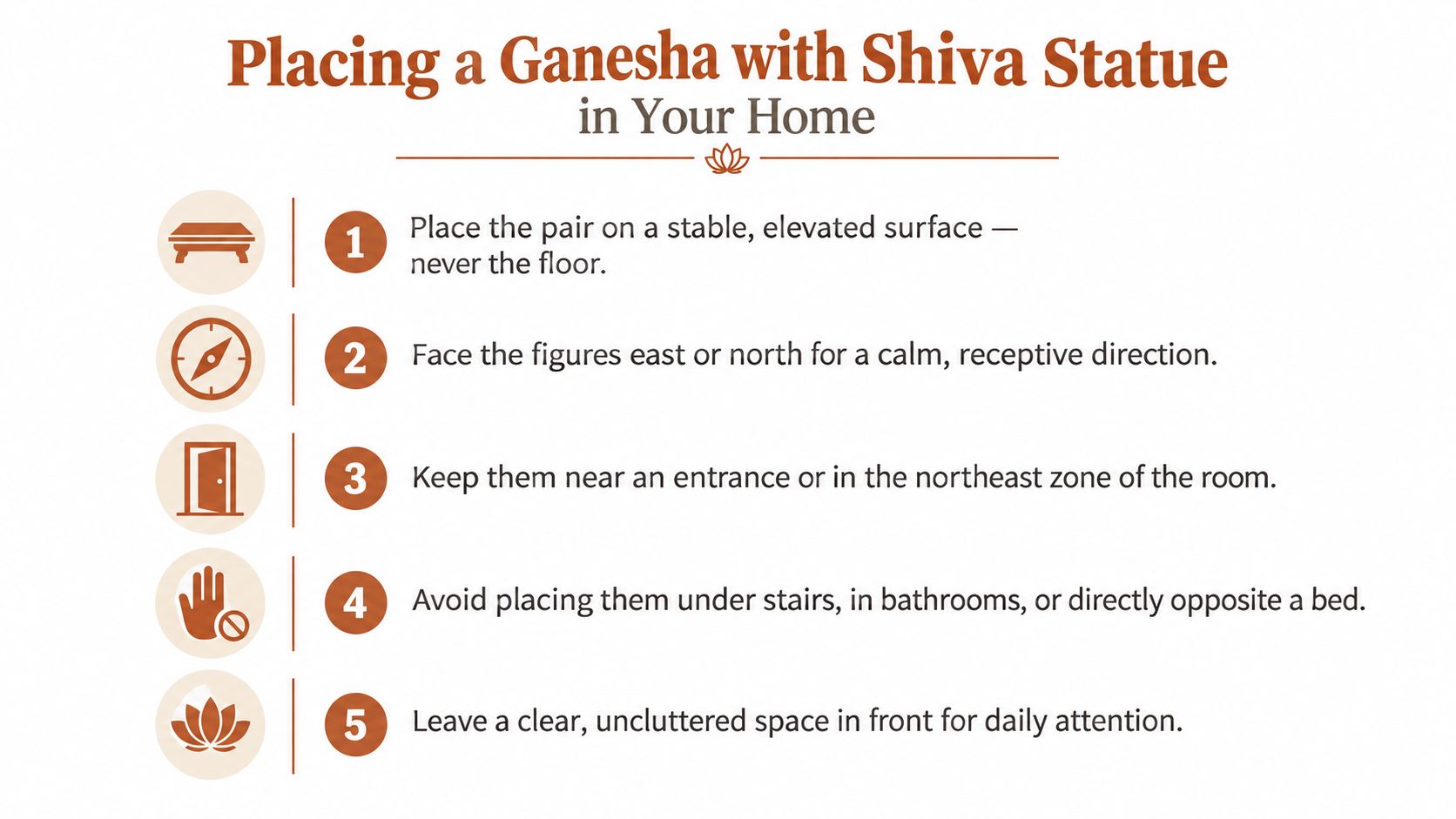
A Ganesha with Shiva statue usually benefits from an elevated, stable surface. Don't place it directly on the floor. If the ensemble is arranged frontally, Shiva should usually remain slightly back or central, with Ganesha nearer the front-right if the composition allows. That keeps the family hierarchy legible rather than flattening the pair into generic décor.
A dedicated puja corner works well. So does a quiet study alcove or a calm living-room niche. The aim is visual respect and practical stability.
Choose a room with care
Some spaces support attention better than others:
- A prayer or meditation corner suits the pair well because the area is already set aside for focus.
- A study can also work, especially if you value Ganesha's association with learning and beginnings.
- A quiet reception room is often suitable if the surface is stable and the area remains uncluttered.
Less suitable spaces usually have one thing in common. They interrupt reverence. Bathrooms, cramped passageways, or spots directly under stairs tend to diminish the image's presence. So do positions above a stove or areas where shoes, bags, or laundry constantly pass beneath.
Treat the ensemble as an image, not an ornament
Small courtesies change the entire effect:
- Raise it properly with a cloth, wooden stand, or low plinth.
- Keep the front clear so the figures aren't crowded by keys, chargers, or paperwork.
- Mind seated eye level. The faces should usually sit at or below eye level when you are seated nearby.
- Dust gently with a soft dry cloth rather than spraying cleaner onto the surface.
Place the pair where you can pause before it. Sacred sculpture loses force when it's tucked into a corner that only catches clutter.
Bedrooms are treated differently in different households, but many people prefer not to place active shrine images directly opposite or beside a bed. If the sculpture is devotional for you rather than purely decorative, that restraint often feels appropriate in modern interiors too.
Choosing and Caring for a Paired Sculpture
A good purchase begins with reading. Before you ask whether a sculpture is old, expensive, or decorative, ask whether it makes iconographic sense. If the relationship between the two figures is confused, the rest of the object usually won't recover it.
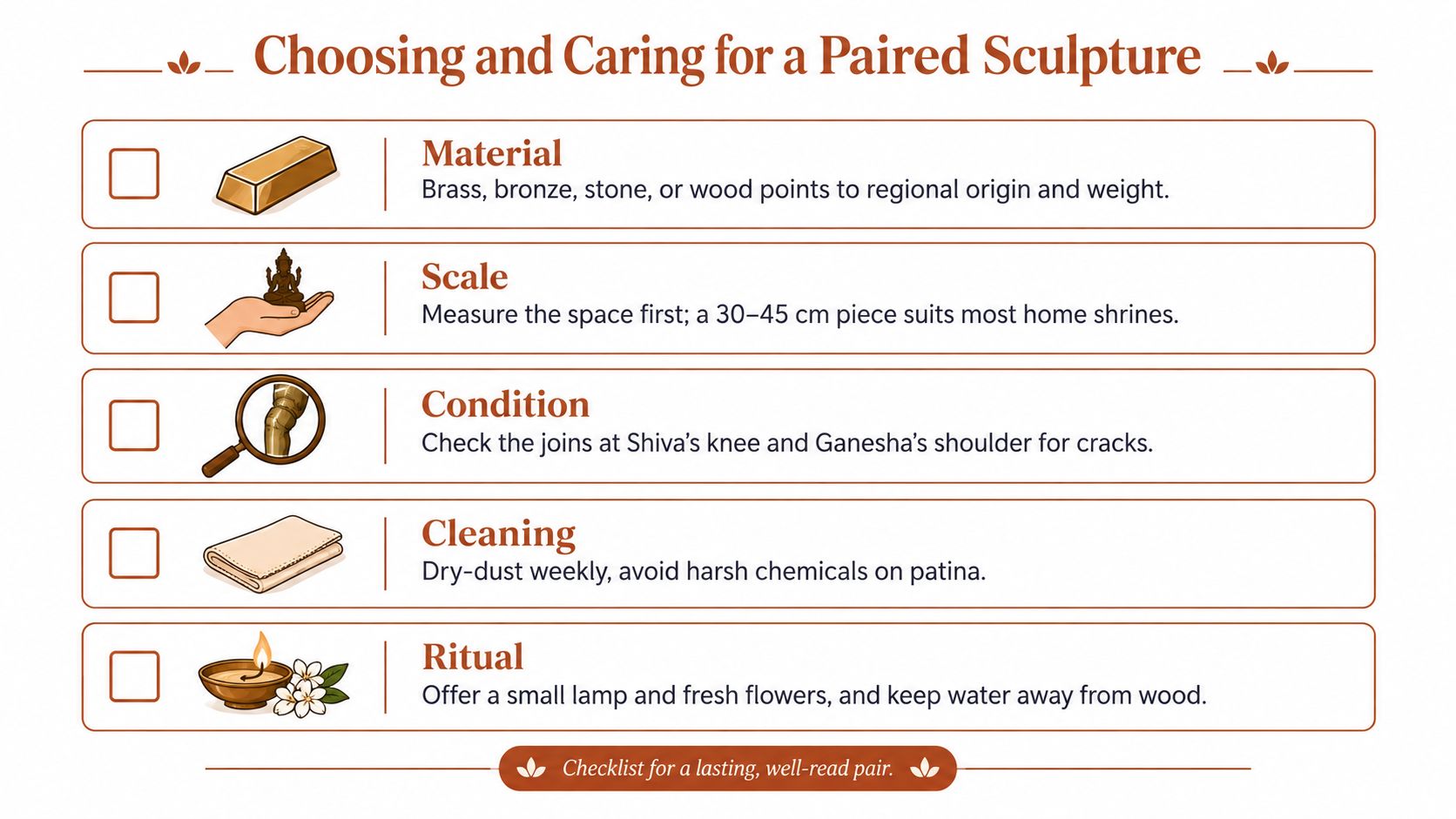
Read the object in four passes
Start with material. Bronze, brass, stone, and wood each suggest a different regional habit and domestic use. Stone often preserves architectural thinking. Metal often supports freestanding display and, in some traditions, ritual handling.
Then check proportion. Shiva should generally hold the compositional authority, while Ganesha should remain clearly identifiable and properly integrated. If Ganesha is too large, too detached, or oddly facing away with no clear logic, the pair may be a modern assembly rather than a coherent iconographic design.
Third, inspect attributes and condition. Shiva may show matted locks, a crescent, or trident-related symbolism. Ganesha should read clearly through his elephant head, tusk, and characteristic bodily form. Repairs aren't necessarily disqualifying, but crude recasting and mismatched attachments can distort the image.
Finally, think about setting. A heavy stone relief needs secure mounting. A brass domestic pair asks for less infrastructure. A wooden ensemble needs distance from radiators, damp, and direct heat.
A practical care routine
For most household settings, simple care is enough:
- Dust weekly with a soft dry brush or cloth.
- Avoid harsh chemical cleaners on bronze, brass, stone, and painted surfaces.
- Keep wooden pieces away from heat sources.
- Handle from the base when moving a freestanding image.
- Use light ritual contact if the piece is devotional, such as flowers or a lamp placed nearby rather than oily substances applied indiscriminately.
This is also the one stage where a specialist catalogue can help. A structured dealer catalogue such as HD Asian Art can be useful because it lets buyers compare Hindu deity sculptures by subject and region in one place, which helps when checking whether a paired Shiva-Ganesha composition looks iconographically coherent before purchase.
A confident final test
Ask yourself three questions before you bring a piece home:
- Does the relationship read clearly?
- Does the regional style feel internally consistent?
- Can I place and care for it respectfully in the space I have?
If the answer is yes to all three, you're not just choosing a statue. You're choosing an image you can keep reading over time.
HD Asian Art offers a UK-based selection of Hindu and Southeast Asian sculpture, including figures of Shiva, Ganesha, and related devotional forms that make these iconographic comparisons much easier to study in practice. If you'd like to explore paired compositions, regional styles, and home-display pieces in more depth, visit HD Asian Art.
