



Dramatic Asian Sculpture Vignettes: 10 Iconic Examples
Dramatic Asian Sculpture Vignettes: 10 Iconic Examples
What makes dramatic Asian sculpture vignettes so compelling?
Dramatic Asian sculpture vignettes are defined compositions that combine intense emotional expression, layered religious symbolism, and intricate craftsmanship within a specific spatial or narrative context. The most compelling examples do not simply depict deities or figures in isolation. They construct entire worlds: suspended celestial realms, cliff-carved narrative cycles, and rock-cut ensembles where setting and subject are inseparable.
The standout examples in 2026 include the 1,978 suspended sculptures of the Mahavira Hall at Xiao Xitian temple, the 46-foot-4-inch reclining Buddha at Gal Vihara in Sri Lanka, the Sixteen Arhats of Yanxia Cave, and the nine-deity Ushnishavijaya relief at Feilaifeng Cliff Niche 84. Each represents a distinct tradition of dramatic vignette-making across Asia.
Key characteristics shared across these works:
- Dynamic poses and gestures: Figures lean, reach, or contort in ways that imply movement and narrative.
- Symbolic iconography: Attributes such as the amrita vase, vajra, and multiple arms carry layered meaning.
- Spatial integration: Cliff walls, cave ceilings, and temple halls become active parts of the composition.
- Emotional contrast: Serene deities appear alongside wrathful protectors or grieving mourners.
- Material mastery: Granite carving, gilded clay, dry lacquer, and sandstone each demand distinct technical skill.
| Feature | Example |
|---|---|
| Suspended ensemble | Mahavira Hall, Xiao Xitian (thousands of sculptures) |
| Monumental rock-cut figure | Gal Vihara reclining Buddha (monumental scale) |
| Narrative cliff relief | Feilaifeng Niche 84, nine-deity Ushnishavijaya |
| Immersive cave cycle | Yanxia Cave Sixteen Arhats |
| Wrathful deity vignette | Fudo Myoo (Immovable Wisdom King) |
1. Mahavira Hall suspended sculptures at Xiao Xitian
The Mahavira Hall of Xiao Xitian temple in Shanxi province holds one of the most spatially dramatic sculptural ensembles in all of Chinese Buddhist art. 1,978 colored clay sculptures fill a 170-square-meter hall, ranging from a 3-meter central Buddha down to figures no larger than a fingernail. The effect is a three-dimensional Buddhist cosmos suspended overhead and across every wall surface.
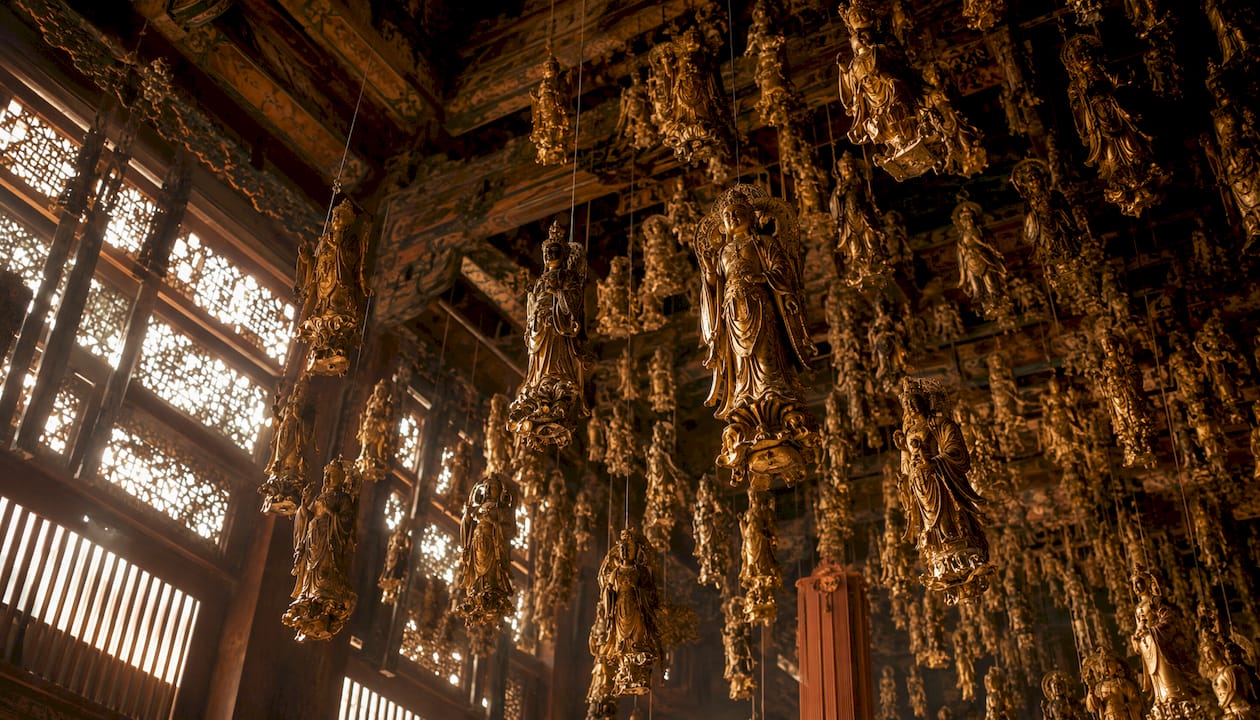
The technical achievement behind this ensemble is equally striking. Craftsmen used concealed wooden scaffolding and gilded clay made from local red clay mixed with glutinous rice paste, then applied gold leaf to produce the illusion of weightlessness. The sculptures appear to float, which was entirely intentional: the hall was designed to simulate a celestial realm made visible to worshippers below.
Dating to the Ming Dynasty, the ensemble reflects a period of social upheaval when patrons sought tangible, immersive representations of spiritual transcendence. The sheer density of figures, each individually modeled and gilded, creates a vignette of overwhelming celestial abundance.
Pro Tip: When studying suspended sculptural ensembles, pay attention to the structural logic hidden within architectural elements. At Xiao Xitian, the scaffolding is fully integrated into the hall’s beams, making the illusion of floating figures architecturally permanent.
2. Gal Vihara reclining Buddha, Sri Lanka
The reclining Buddha at Gal Vihara in Polonnaruwa, Sri Lanka, measures 46 feet 4 inches and was carved directly from a single face of granite gneiss. The left foot drawn back slightly distinguishes this figure from standard reclining poses, marking it specifically as the parinirvana posture: the Buddha’s final liberation from the cycle of rebirth.
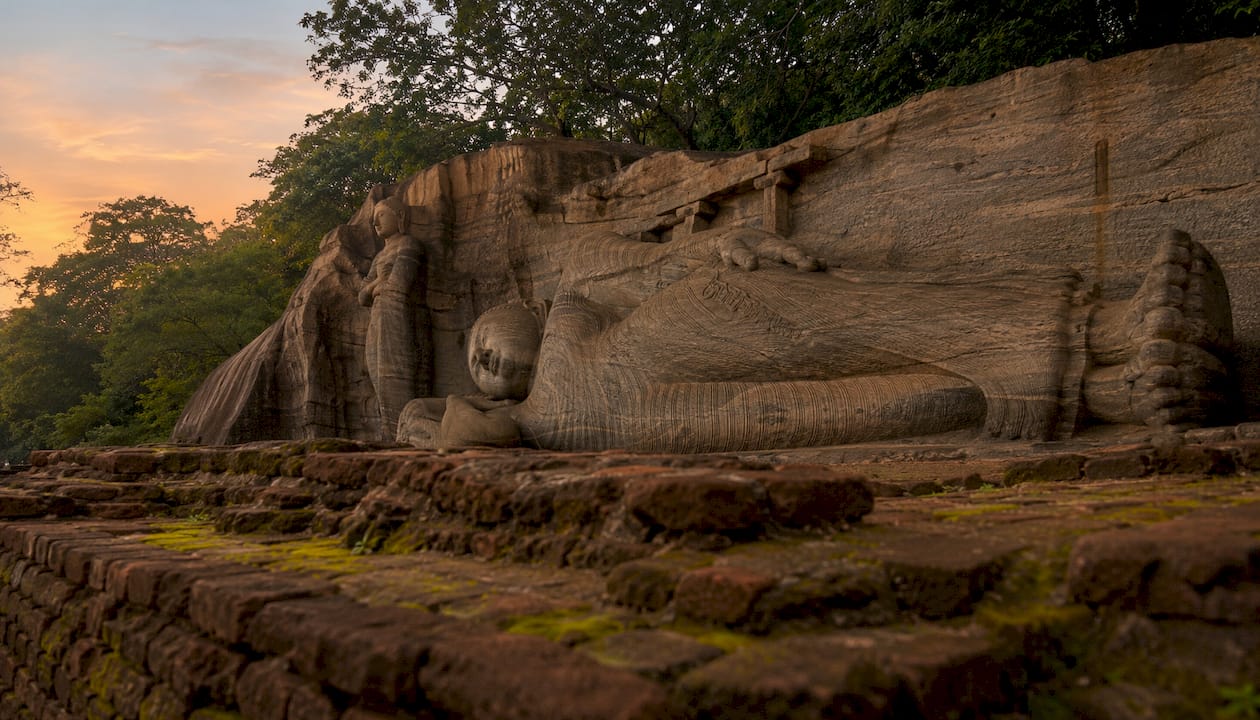
Carving at this scale into granite required knowledge of geological fissures to prevent fractures during and after the work. Sculptors carved up to 15 feet deep into the rock face, managing the stone’s natural stress lines with precision that modern engineers still study. The facial expression in Buddhist statues of this type communicates absolute serenity at the moment of ultimate release, a deliberate iconographic choice that defines the parinirvana vignette across Theravada traditions.
The site also includes a standing figure and a seated meditating Buddha, making Gal Vihara a complete vignette ensemble rather than a single monument. Each figure occupies a distinct spatial zone within the same cliff face, creating a narrative sequence readable from left to right.
3. Feilaifeng Cliff Niche 84: nine-deity Ushnishavijaya relief
Niche 84 at Feilaifeng Cliff near Lingyin Monastery in Hangzhou is the most complex Yuan-period composition at the site. The nine-deity Ushnishavijaya relief combines Nepalese, Tibetan, and Chinese iconographic styles into a single carved composition commissioned by a Tangut administrator working under the Mongol emperor Qubilai Khan.
The central deity, Ushnishavijaya, has three heads and eight arms. Her attributes include the amrita vase, a bow and arrow, a noose, gestures of reassurance and generosity, and a double vajra. Eight surrounding figures include Avalokiteshvara, Vajrapani, wrathful gate guardians, and heavenly beings offering additional vases of amrita. The composition approaches mandala structure, making it one of the most iconographically dense relief vignettes in East Asian Buddhist art.
Carved between approximately 1282 and 1292, the relief functioned as a personified prayer for the emperor’s long life and favorable rebirth. The cliff face setting is not incidental: the natural rock becomes the stupa’s body, integrating geology and theology into a single dramatic statement.
4. Yanxia Cave Sixteen Arhats, Hangzhou
Yanxia Cave in Hangzhou contains one of China’s earliest complete rock-cut sets of the Sixteen Arhats, dating to the Five Dynasties period. Carved directly into limestone walls, the ensemble creates a permanent immersive narrative cycle that differs fundamentally from freestanding sculpture: the cave itself is the frame, and the figures inhabit it as permanent residents rather than portable objects.
The Sixteen Arhats are depicted with individualized expressions and postures, each representing a distinct personality and spiritual attainment. This variety within a unified setting is what makes the Yanxia Cave ensemble a defining example of dramatic vignette-making in Chinese Buddhist sculpture. The white-robed Guanyin carving at the site later influenced iconographic traditions across East Asia, demonstrating how a single cave ensemble can generate lasting artistic legacies.
Rock-cut sites like Yanxia Cave transform natural features into a living canvas, creating permanent immersive narratives that differ from freestanding sculptures by integrating setting into storytelling. The limestone walls absorb and reflect light differently across the day, changing the visual character of the vignette without any alteration to the carvings themselves.
5. Fudo Myoo (Immovable Wisdom King) vignettes in Japanese art
Fudo Myoo, the Immovable Wisdom King, is one of the most dramatically rendered figures in Japanese Buddhist iconography. Typically shown with a fierce expression, a flaming halo, a sword in the right hand, and a rope in the left, Fudo Myoo embodies the protective wrath that destroys ignorance and compels practitioners toward enlightenment. The dramatic emotional contrast between the deity’s controlled fury and the chaos surrounding him defines the vignette type.
Kobayashi Kiyochika’s Meiji-period painting “The Fury of Monk Raigō” (ca. 1900) offers a particularly striking example. The composition shows Monk Raigō lurching away from a goma-e fire ritual altar in rage, ritual implements scattered, sutra books toppled, flames surging from the central hearth. At the center, the statue of Fudo Myoo appears to arise from the flames with an expression of surprised horror at the monk’s behavior. Kiyochika deliberately gave the deity a look of astonishment rather than the standard fearsome visage, injecting narrative tension and even dark humor into a traditionally solemn subject.
This approach reflects the influence of popular literature and theater on religious imagery during the Meiji period. Artists like Kiyochika broke from static iconography to engage viewers emotionally, treating the deity not as a fixed symbol but as a participant in a human drama.
6. Sixteen Arhats of Yanxia Cave: narrative power in stone
The Yanxia Cave ensemble deserves separate analysis for its narrative structure, distinct from its historical priority. Each of the Sixteen Arhats occupies a carved niche that functions as a self-contained vignette while contributing to the larger cycle. The spatial arrangement means a viewer moving through the cave experiences the arhats sequentially, as if reading a text.
The rock-cut arhat ensemble at Yanxia Cave represents a foundational model for immersive Buddhist narrative sculpture in China. By carving figures directly into the cave walls rather than placing portable statues within a space, the Five Dynasties sculptors created a permanent bond between the narrative and its setting. The cave is not a container for the vignette; it is the vignette.
The Guanyin carving at Yanxia, rendered in white robes against the limestone, became a reference point for subsequent depictions of the bodhisattva across East Asia. This single figure within the larger arhat cycle demonstrates how a dramatic vignette can generate iconographic influence far beyond its original site.
7. Bodhisattva Avalokiteshvara (Guanyin) in Northern Qi dynasty sculpture
The Northern Qi dynasty (550–577) produced some of the most ornately decorated bodhisattva figures in Chinese Buddhist sculpture. A sandstone Guanyin from this period, now at the Metropolitan Museum of Art, stands 13 feet 9 inches tall and wears a lavishly jeweled harness of pearl-like clusters and multifaceted beads. The combination of Chinese precedents (triangular pendants, monster mask) with Central Asian elements (pearl cabochons) creates a hybrid visual language that was new to Chinese Buddhist art at the time.
This figure exemplifies a key characteristic of dramatic sculptural vignettes: the use of surface elaboration to communicate divine abundance. The jewelry is not decorative in a secular sense. Each element carries symbolic weight, and the overall effect of the adorned body signals the bodhisattva’s unlimited capacity to assist suffering beings. The religious art tradition behind such figures connects gesture, attribute, and material into a unified statement about the deity’s nature and function.
8. Brahma and Indra guardian figures at Kofukuji
The eighth-century hollow dry-lacquer statues of Brahma (Bonten) and Indra (Taishakuten), originally from Kofukuji Temple in Nara, represent a distinct category of dramatic vignette: the paired guardian ensemble. Made using the dakkatsu kanshitsu method, these nearly life-sized figures were designed to flank a central Buddha or bodhisattva, creating a three-figure vignette of protection and hierarchy.
The hollow dry-lacquer technique, brought to Japan from the continent in the seventh century, allowed sculptors to produce lightweight, pest-resistant, and water-resistant icons. Only about 50 eighth-century hollow dry-lacquer statues survive today, making each one a rare document of Nara-period sculptural practice. The upright bearing and youthful quality of the Brahma and Indra figures at the Asian Art Museum convey focused protective attention rather than overt drama, yet their original context as flanking guardians within a temple hall created a vignette of considerable spatial and spiritual intensity.
9. Death of the Historical Buddha (Nehan-zu) in Japanese painting and sculpture
The Nehan-zu, or parinirvana composition, is one of the most emotionally complex vignette types in Japanese Buddhist art. A 15th-century hanging scroll at the Metropolitan Museum of Art depicts the reclining Buddha surrounded by mourners from every realm: bodhisattvas in serene composure, shaven-headed disciples weeping openly, multi-limbed Hindu deities converted to the Buddha’s teaching, animals, and even the sala trees changing color in grief. Queen Maya descends from the upper right, weeping.
The dramatic power of this vignette comes from the contrast between the Buddha’s absolute serenity and the cacophony of grief surrounding him. The composition encodes a theological argument: those who understand the nature of his passing show calm, while those still bound by attachment weep. The vignette is simultaneously a narrative scene and a doctrinal diagram. This dual function, emotional and instructional, characterizes the most sophisticated examples of dramatic Asian art across media and regions.
10. Eleven-headed Kannon (Jūichimen Kannon) in Japanese Buddhist sculpture
The Eleven-headed Kannon represents one of the most structurally dramatic forms in Japanese Buddhist iconography. The form derives from a literal reading of scripture: Kannon was so overwhelmed by the world’s suffering that his head exploded into fragments, then was reassembled by Amida Buddha. The resulting figure carries ten small heads arrayed above the main face, with an eleventh representing Amida himself.
Strict iconographic rules govern the arrangement: three heads of bodhisattvas, three with tusks, three displaying righteous anger, and one laughing. This combination of emotional registers within a single figure creates a vignette of compressed psychological complexity. A Kamakura-period example at the Smithsonian’s National Museum of Asian Art shows Kannon descending on a stylized cloud, an attitude associated with welcoming the dying into the next world. The spiritual energy conveyed by this posture and the layered heads above creates a dramatic presence that functions differently depending on the viewer’s circumstances: protective for the healthy, consoling for the dying.
How Chinese and Japanese dramatic sculptures differ in style and symbolism
Chinese and Japanese dramatic sculptural vignettes share Buddhist foundations but diverge significantly in material, spatial logic, and emotional register.
Chinese approaches
Chinese dramatic vignettes tend toward ensemble density and architectural integration. The Xiao Xitian Mahavira Hall and the Yanxia Cave cycle both prioritize the collective over the individual figure. The cliff-carving tradition at Feilaifeng reflects a Chinese preference for transforming natural geological features into permanent sacred spaces. Iconographic hybridity, as seen in the Yuan-period Ushnishavijaya relief, was actively cultivated under Mongol patronage, producing works that synthesize Nepalese, Tibetan, and Chinese visual languages.
Key motifs in Chinese dramatic vignettes:
- Dragons and celestial guardians framing central deities
- Bodhisattvas with elaborate jewelry and multiple attributes
- Wrathful protectors at compositional edges
- Cliff-face and cave-wall settings as integral narrative elements
Japanese approaches
Japanese dramatic vignettes more often focus on individual figures or small groups, with emotional tension concentrated in a single face or gesture. The Fudo Myoo tradition, the Nehan-zu composition, and the Eleven-headed Kannon all demonstrate this tendency toward psychological intensity within a contained format. The hollow dry-lacquer technique, used for the Kofukuji guardian figures, reflects a Japanese preference for lightweight, portable icons that could be moved and recontextualized within temple settings.
Key motifs in Japanese dramatic vignettes:
- Wrathful deities with flaming halos and weapons
- Narrative scenes from popular literature and theater adapted into religious imagery
- Multi-headed and multi-armed bodhisattvas encoding doctrinal complexity
- Paired guardian figures flanking central devotional images
Buddhist relief vignettes and their narrative power
The most technically demanding examples of dramatic sculptural vignettes in Asia are the large-scale Buddhist reliefs carved into cliff faces and cave walls. These works function differently from freestanding sculpture because the setting cannot be separated from the meaning.
| Relief Site | Date | Material | Key Deities | Primary Theme |
|---|---|---|---|---|
| Feilaifeng Niche 84 | ca. 1282–1292 | Stone | Ushnishavijaya, Avalokiteshvara, Vajrapani | Long-life prayer, dharma relic |
| Yanxia Cave | Five Dynasties period | Limestone | Sixteen Arhats, Guanyin | Narrative arhat cycle |
| Gal Vihara | — | Granite gneiss | Reclining Buddha, standing Buddha | Parinirvana, meditation |
The Feilaifeng Niche 84 relief acts as a personified prayer and dharma relic, animating the sanctuary space with layered symbolism through artistic hybridity reflecting multiethnic Mongol-era patronage. The composition is not merely decorative. It is a functional object: a carved prayer that continues to operate as long as the stone endures.
The Ushnishavijaya’s attributes at Feilaifeng, including the amrita vase, multiple arms, and the heart mantra carved into the composition’s border, transform the relief into a dharma relic in stone form. The Theravada sculptural tradition approaches the relationship between image and function differently, but the underlying principle, that a correctly made image carries active spiritual power, connects Buddhist sculptural vignettes across regional traditions.
What themes and symbols define dramatic Asian sculpture vignettes?
Dramatic Asian sculpture vignettes consistently organize around a small set of recurring themes, each carrying specific symbolic content.
Spiritual transcendence appears in compositions where a central deity rises above or is surrounded by lesser figures, as in the Xiao Xitian hall where the 3-meter central Buddha presides over nearly two thousand smaller forms. The scale differential is not aesthetic preference. It encodes theological hierarchy.
Wrathful protection defines vignettes featuring Fudo Myoo, gate guardians, and the wrathful protectors at Feilaifeng. These figures do not represent evil. They represent the force required to overcome ignorance and protect the dharma. Their fierce expressions and weapons are instruments of compassion, not aggression.
Death and liberation structures the parinirvana vignette type, from the Gal Vihara reclining Buddha to the Japanese Nehan-zu. The reclining posture, with its specific foot position and facial expression, communicates the distinction between ordinary sleep and final liberation. The symbolism of Sri Lankan Buddha statues in this tradition is particularly precise: posture, hand position, and facial expression each carry distinct iconographic meaning.
Long-life prayer motivates the Ushnishavijaya compositions, where the deity’s attributes and the carved mantras surrounding her function as a continuous petition for the patron’s extended life and favorable rebirth.
How dramatic Asian sculpture vignettes evolved historically
The history of dramatic sculptural vignettes in Asia follows a trajectory from single devotional figures toward complex multi-figure ensembles, then toward site-specific narrative cycles that integrate architecture and landscape.
Early Chinese Buddhist sculpture, from the Northern Wei through the Northern Qi dynasties (4th–6th centuries), focused on individual bodhisattva and Buddha figures with increasing iconographic elaboration. The lavishly jeweled Guanyin of the Northern Qi period marks a transition point: the figure itself becomes a vignette, its surface a compressed narrative of divine attributes.
The Tang dynasty (618–906 CE) saw the consolidation of multi-figure altar ensembles and the spread of cliff-carving traditions. The Ushnishavijaya dharani, popular in Tang China and Japan during this period, established the textual and iconographic foundation for later relief vignettes like Feilaifeng Niche 84.
The Five Dynasties period (907–960 CE) produced the Yanxia Cave arhat cycle, one of the earliest complete narrative rock-cut ensembles in China. The Ming Dynasty (1368–1644) brought the Xiao Xitian Mahavira Hall, where suspended gilded clay replaced stone carving as the primary medium for dramatic ensemble vignettes. Each shift in medium reflects changing patronage, available materials, and evolving ideas about how sacred space should be constructed.
Regional variations in dramatic sculptural vignettes across Asia
Beyond China and Japan, dramatic sculptural vignettes developed distinct regional characteristics across India, Southeast Asia, and Sri Lanka.
India produced the foundational grammar of Buddhist and Hindu sculptural vignettes. The multi-armed deity form, the narrative relief panel, and the hierarchical composition with a central figure flanked by attendants all originate in Indian sculptural traditions. The Dvaravati style of mainland Southeast Asia adapted Indian compositional principles to local stone and bronze-casting traditions, producing Buddha figures with distinctive facial features and hand gestures that differ from both Chinese and Sri Lankan conventions.
Cambodia and Indonesia developed Hindu dramatic vignettes of considerable complexity. Angkor Wat’s narrative relief galleries depict the churning of the cosmic ocean and the battle of Kurukshetra at a scale and density comparable to the Buddhist cliff-carving traditions of China. Javanese Hindu sculpture, as seen in the Prambanan temple complex, combines Indian iconographic models with local volcanic stone to produce figures of intense physical dynamism. The Indonesian Hindu sculptural tradition represents one of the most technically accomplished regional variations in dramatic Asian vignette-making.
Sri Lanka developed the Theravada parinirvana vignette to its largest scale at Gal Vihara, where the geological constraints of granite carving shaped the final composition as much as iconographic convention did.
How cultural and religious narratives shaped dramatic vignettes
Religious narrative is not background context for dramatic Asian sculpture vignettes. It is the structural logic that determines composition, scale, material, and placement.
The Ushnishavijaya relief at Feilaifeng was commissioned as part of long-life rituals for the Mongol emperor Qubilai Khan. The choice of deity, the specific attributes carved, the mantras inscribed in the border, and the location near Lingyin Monastery all reflect a precise religious program. The vignette is a functional document of political and spiritual intent, not a decorative commission.
The Xiao Xitian Mahavira Hall sculptures represent a cosmic model built during Ming-Qing social upheaval, when patrons sought visible, tangible assurance of spiritual protection. The density of figures, the gilding, and the suspended arrangement all communicate abundance and celestial presence to worshippers who lived through periods of considerable instability.
Japanese narrative vignettes like the Nehan-zu and the Fudo Myoo compositions drew on popular literature and theater as well as canonical scripture. Kiyochika’s painting of Monk Raigō demonstrates how a religious vignette could incorporate contemporary cultural references, the monk’s rage connected to legends elaborated in popular fiction, without losing its devotional function. The boundary between religious image and narrative art was deliberately permeable in Japanese Buddhist visual culture.
Notable workshops and traditions behind dramatic Asian sculpture vignettes
Individual artists are rarely documented in pre-modern Asian sculptural traditions, but specific workshops, patronage networks, and regional schools left identifiable marks on dramatic vignette production.
The Mongol-era sculptors working under Commissioner Yang Lianzhenjia at Feilaifeng were familiar with the hybrid Nepalese-Tibetan mode associated with the Newari artist Anige (1245–1306), who served as Supervisor-in-Chief of All Classes of Artisans under the Mongols. While no direct evidence links Anige to the Feilaifeng carvings, the stylistic vocabulary of the Niche 84 relief reflects the workshop traditions he advanced: puffy eyes and cheeks with high eyebrows blended with Tibetan and Nepalese iconographic conventions.
The Ming-period craftsmen responsible for the Xiao Xitian Mahavira Hall worked within a tradition of gilded clay sculpture specific to Shanxi province, using local red clay mixed with glutinous rice paste as a base for gold-leaf application. This material combination, documented in the hall’s preservation records, produced sculptures that have survived centuries with remarkable integrity.
Kobayashi Kiyochika (1847–1915) represents the named-artist end of this spectrum: a Meiji-period painter who applied the techniques of woodblock print composition to hanging scroll painting, injecting theatrical narrative tension into religious subjects. His Fudo Myoo composition is a deliberate departure from workshop convention, reflecting individual artistic choice rather than institutional commission.
HDAsianArt collection: authentic Asian Buddhist and Hindu sculpture
HDAsianArt offers museum-quality antique and traditional Asian Buddhist and Hindu sculptures for collectors and researchers seeking authentic works with documented provenance. The collection includes bronze, stone, and wood pieces from Cambodia, Thailand, Indonesia, Sri Lanka, Vietnam, and beyond, each individually researched and described by specialists.
For collectors interested in the Javanese bodhisattva tradition discussed in this article, the Javanese Avalokiteshvara statue in the HDAsianArt collection represents the regional sculptural vocabulary of Indonesian Buddhist art. Worldwide insured DHL shipping is available on all pieces.
Key Takeaways
Dramatic Asian sculpture vignettes achieve their power through the combination of precise iconographic programs, site-specific spatial logic, and material techniques that encode spiritual meaning at every scale.
| Point | Details |
|---|---|
| Scale encodes theology | At Xiao Xitian, thousands of sculptures vary markedly in size, making hierarchy visible. |
| Geology shapes composition | Gal Vihara sculptors carved deeply into granite, managing fissures to achieve monumental stability. |
| Hybridity defines Yuan-era reliefs | Feilaifeng Niche 84 combines Nepalese, Tibetan, and Chinese styles under Mongol patronage. |
| Setting is part of the vignette | Yanxia Cave’s limestone walls are integral to the narrative, not a neutral background. |
| Material choice reflects patronage | Xiao Xitian’s gilded clay, made from red clay and glutinous rice paste, enabled centuries of preservation. |
