



Erawan Elephant Statue: Sacred Symbol & Collectible
Erawan Elephant Statue: Sacred Symbol & Collectible
Few figures in Asian religious art carry as much layered meaning as the Erawan elephant statue. Known as Airavata in Sanskrit, this multi-headed white elephant sits at the intersection of Hindu cosmology, royal power, and living Buddhist culture across Thailand, Cambodia, Laos, and beyond. Collectors who encounter Erawan sculptures for the first time often assume they are looking at decorative curiosity. They are not.
They are looking at one of the oldest, most theologically dense symbols in Asian art, one that has shaped coronation rites, shrine architecture, and the visual language of Southeast Asian kingdoms for well over a thousand years. Understanding what you are holding changes what you choose to collect.

Table of Contents
- Quick Takeaways
- Origins in Hindu Mythology: Airavata and the Churning of the Ocean
- Erawan as Royal Emblem Across Southeast Asia
- Iconography and Sculptural Forms: What to Look For
- Erawan in Thai Religious Art and Living Shrine Culture
- Comparing Elephant Sculpture Traditions Across Asia
- Collecting Erawan and Asian Elephant Sculptures: A Practical Guide
- Frequently Asked Questions
- References
Quick Takeaways
|
Key Insight |
Explanation |
|---|---|
|
Erawan and Airavata are the same being |
Erawan is the Thai/Pali name for Airavata, the divine white elephant of Hindu mythology. The name change reflects how Indian religious ideas were absorbed and localised across Southeast Asia. |
|
The three heads carry specific meaning |
In Thai Buddhist cosmology, each head represents one of three realms: the underworld, the human world, and the heavens. A sculpture with three heads is not simply decorative; it is a cosmological map. |
|
Erawan is primarily the mount of Indra |
As the vahana (divine vehicle) of Indra, the king of the gods and lord of storms and rain, Erawan links royal authority directly to divine favour and celestial power. |
|
The white colour is non-negotiable in authentic iconography |
Whiteness signals purity and celestial origin. In Southeast Asian royal traditions, possession of a white elephant was itself a mark of legitimate kingship. |
|
Erawan appears as both Hindu and Buddhist symbol |
Thai and Lao art fused Brahmanical and Theravada Buddhist traditions, meaning Erawan sculptures can appear in overtly Buddhist temple contexts without contradiction. |
|
The six-tusked form has the deepest mythological roots |
Some Puranic texts describe Airavata with six tusks and three trunks, while others give ten. Sculptures that show multiple tusks are drawing on these ancient textual descriptions. |
|
Material and finish matter for collectors |
Museum-quality Erawan sculptures are typically cast in bronze or carved from stone. Gilded finishes reflect the Thai court tradition of gold as a marker of sacred status. |
Origins in Hindu Mythology: Airavata and the Churning of the Ocean
The story of Airavata begins at the most dramatic moment in Hindu cosmology: the Samudra Manthan, the churning of the cosmic Ocean of Milk. According to legend, Airavata emerged from the waters during this primordial event, born fully formed as a pristine white elephant of extraordinary power and beauty. His very name derives from the Sanskrit word Iravat, meaning one who is produced from water, which immediately connects him to rainfall, rivers, and the life-giving moisture that makes agriculture and civilisation possible.
Airavata became the mount, or vahana, of Indra, the king of the gods and the lord of the heavens and storms. This is not a minor role. In Hindu theology, a deity's vahana is an extension of that deity's own nature and power. To ride upon Airavata is to command the sky itself. One of Airavata's epithets means "the one who knits or binds the clouds," reflecting the belief that elephants could produce rain clouds, drawing water up from the underworld through their trunks and releasing it into the sky through Indra's command.
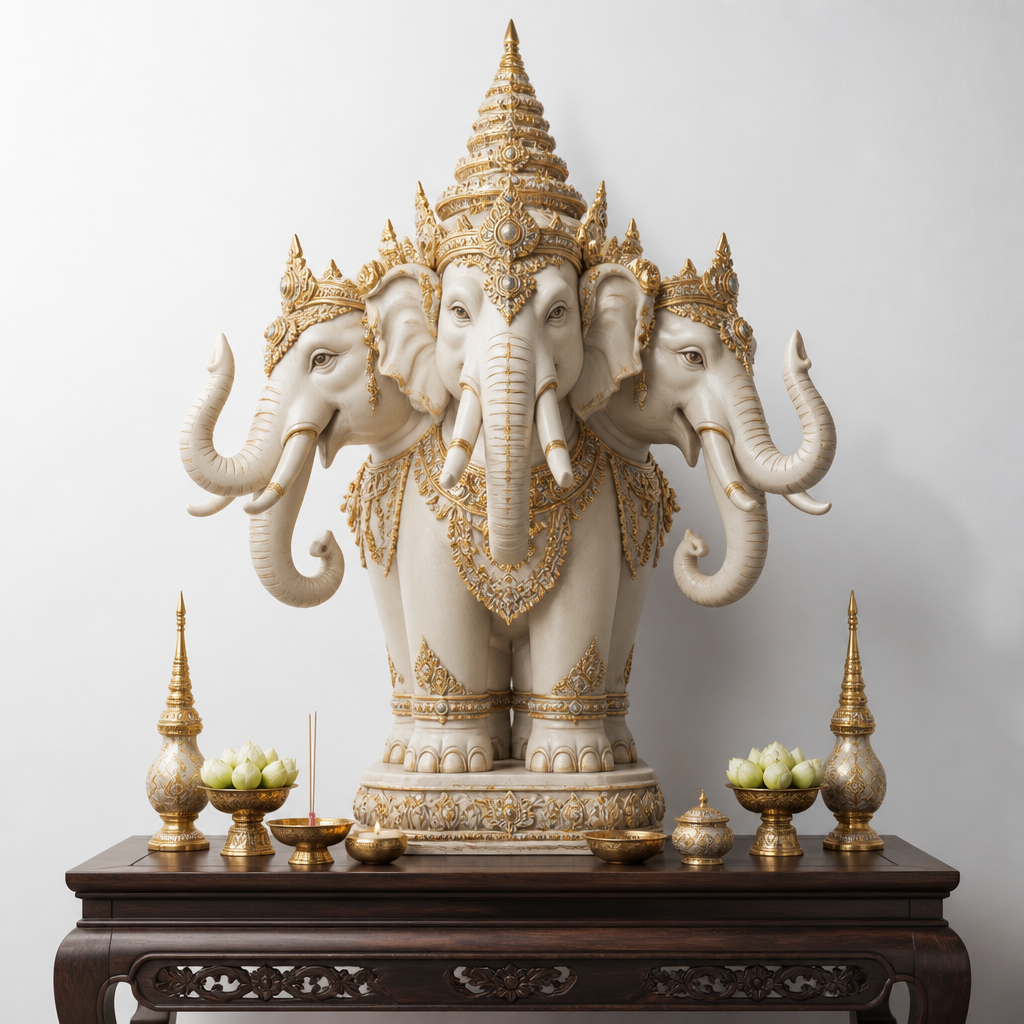
The Puranic texts vary in their description of Airavata's physical form. Some describe him with three heads, six tusks, and three trunks. Others give him ten tusks and five trunks, with each tusk representing one of the ten cardinal directions of Hindu cosmology. What remains constant across all textual traditions is the white colouring and the role as king of all elephants.
An elephant at the threshold of a temple does not merely decorate the entrance. It guards the boundary between the mundane world and sacred space, enacting in stone what the worshipper is asked to enact in spirit.
The figure of Airavata also appears in a famous episode involving the sage Durvasa. Indra, riding Airavata, received a sacred garland from Durvasa and placed it on the elephant's trunk. The elephant, irritated by bees attracted to the garland's scent, tossed it to the ground. Durvasa interpreted this as an act of disrespect and cursed Indra, causing the gods to lose their strength. This humiliation ultimately triggered the Samudra Manthan itself, making Airavata, in a roundabout way, the catalyst for the entire cosmic event from which he was born.
Erawan as Royal Emblem Across Southeast Asia
The journey of Airavata from Indian sacred text to Southeast Asian royal symbol is one of the most fascinating chapters in Asian art history. As Brahmanical and Hindu religious ideas spread eastward through trade, diplomacy, and the movement of scholars and priests, the concept of the divine elephant-king was adopted and reshaped by the courts of what are now Thailand, Cambodia, Laos, and beyond.
In Thailand, Erawan became directly associated with the Chakri dynasty, which still rules today. The three-headed elephant appears in Thai heraldic symbols as a representation of Siam itself, and the royal standard has incorporated the Erawan image as part of a broader visual language of divine kingship drawn from the Hindu-Buddhist repertoire. The association was never merely decorative. Possessing a white elephant was considered a direct sign of a king's righteous rule and divine favour, and the treatment of such animals in royal courts was governed by elaborate ceremony.
Cambodia's Angkor period offers equally powerful evidence of this symbolic system. The Bayon temple at Angkor Thom features elephant imagery integrated into its architectural fabric, and the concept of the divine elephant as a guardian of cardinal directions appears in temple iconography across the region. At Angkor, the three-headed Erawan figure can be found adorning temple structures, linking the king's earthly power to Indra's celestial authority.
Laos, under the kingdom of Lan Xang, took a different but related approach. The kingdom's very name, Lan Xang, means "Land of a Million Elephants," and the single white elephant became Laos's own royal symbol, appearing on the royal standard alongside the three-headed Erawan that represented Siam. This distinction, one head versus three, encoded an entire political and cosmological hierarchy into heraldic imagery that any educated observer of the period could read immediately.
Pro tip: When examining a Southeast Asian elephant sculpture, count the heads before anything else. A single-headed elephant and a three-headed Erawan carry entirely different symbolic weight and originate from different iconographic traditions, even when they appear superficially similar in material and finish.
Iconography and Sculptural Forms: What to Look For
Reading an Erawan or Airavata sculpture correctly requires knowing what each element signals. The visual vocabulary of these works is precise, and the differences between a well-executed, iconographically complete piece and a decorative approximation are visible once you know where to look.
The Number of Heads
The most immediately recognisable feature is the number of heads. Three-headed Erawan sculptures are the standard Southeast Asian form, particularly in Thai and Lao art. Each head in the Thai Buddhist reading represents a tier of the cosmos: the underworld, the human realm, and the heavens. In some Indian Puranic traditions, the number of heads rises to three, five, or even more, but the three-headed form is what you will encounter most consistently in collectible sculpture from Thailand, Cambodia, and Laos.
Tusks, Trunks, and Posture
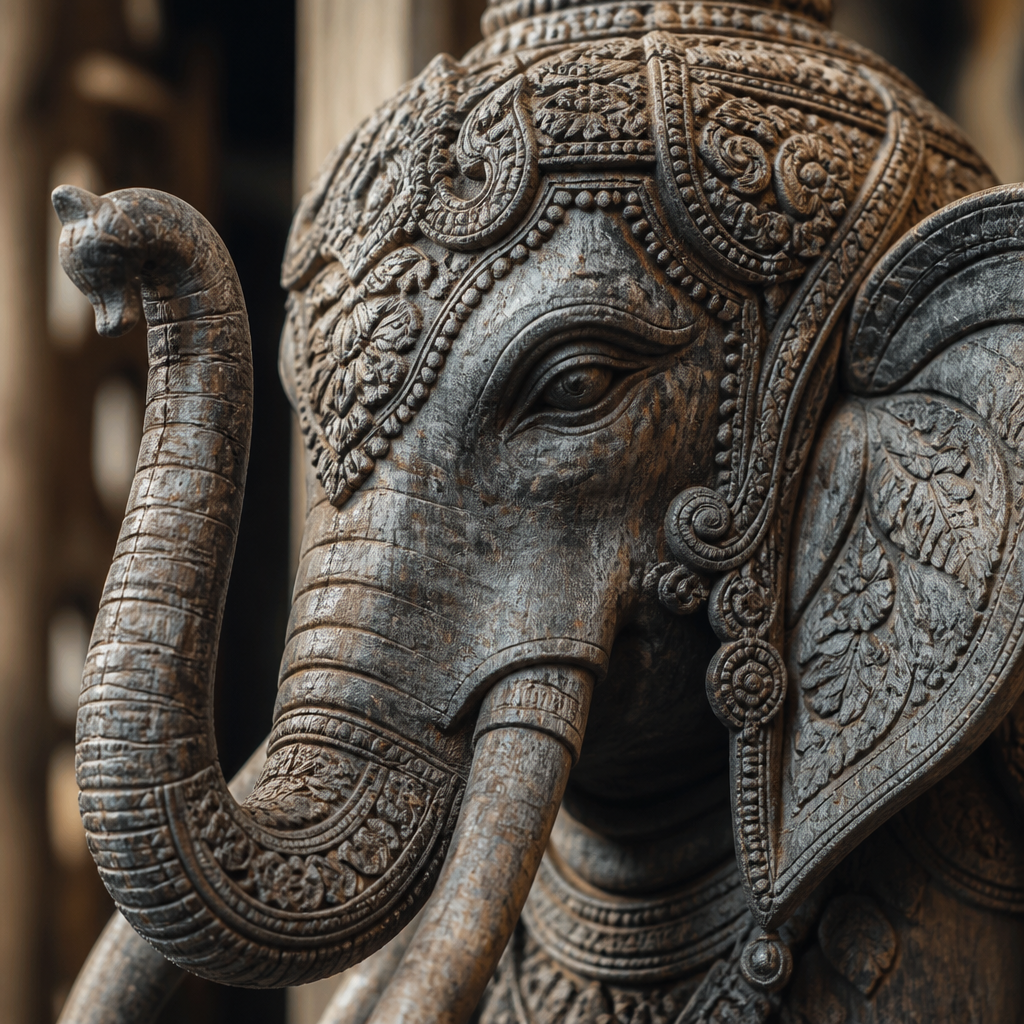
Tusks in Erawan iconography are not purely ornamental. The number and arrangement of tusks can reference specific textual traditions. Multiple long, curving tusks signal deliberate reference to the "king of elephants" described in the Puranas. The position of the trunk or trunks also carries meaning. A raised trunk is widely understood across Asian cultures as auspicious, associated with luck, abundance, and the drawing up of celestial waters. A downward-pointing trunk appears in some shrine contexts but is less commonly seen in collectible sculpture intended for altar or home use.
Rider Figures and Decorative Crowns
Many Erawan sculptures include a figure of Indra seated on the elephant's back, often depicted wearing the pointed crown associated with divine kingship in Thai and Khmer iconography. The presence of a rider transforms the sculpture from a standalone animal figure into a complete theological statement: divine power carried by divine vehicle. Gilded finishes, elaborate decorative caparisons (the cloth and jewelled adornments draped over the elephant's body), and the inclusion of multi-tiered parasols above the rider all indicate a piece made within or influenced by the Thai royal court tradition.
Erawan in Thai Religious Art and Living Shrine Culture
What makes Erawan different from many mythological figures is that this symbol did not remain confined to ancient texts and temple walls. It became, and remains, a living presence in Thai religious and popular culture in ways that directly inform how Erawan sculptures are commissioned, displayed, and venerated today.
The most famous modern example is the Erawan Shrine in Bangkok, located at the Ratchaprasong intersection. Built in 1956 after Brahmin priests recommended its construction to resolve a series of setbacks during the building of the nearby Erawan Hotel, the shrine houses a statue of Phra Phrom, the Thai name for the Hindu god Brahma. Miniature elephant figures are placed at the shrine because Brahma was associated in Thai popular belief with the three-headed Erawan elephant. The shrine was named Erawan after Indra's legendary three-headed elephant, and it became one of Bangkok's most visited religious sites, drawing worshippers seeking good fortune and the fulfilment of wishes.
The Erawan Museum, located in the Samut Prakan district near Bangkok, takes this veneration to a monumental scale. The museum is housed inside a colossal three-headed elephant sculpture that stands approximately 29 metres high and weighs roughly 250 tonnes, crafted from intricately attached copper plates. The three heads of this structure represent the three-tiered cosmology of Thai Theravada Buddhism: the underworld, the human world, and the heavens. Inside, the museum houses a significant private collection of antiques and sacred objects assembled to preserve Thai heritage.
Pro tip: For collectors seeking Erawan sculptures for altar or home display, the Thai tradition places small elephant figurines at the base of shrines as offerings and protective presences. A single well-crafted Erawan sculpture placed at an altar entrance follows this tradition directly and does not require an elaborate installation to be meaningful.
This living tradition matters to collectors because it confirms that Erawan sculptures are not archaeological curiosities. They participate in an ongoing devotional culture. A well-chosen Erawan or Asian elephant sculpture brought into a home or meditation space connects the collector to a tradition of veneration that runs from ancient India through medieval Cambodia to contemporary Bangkok.
Comparing Elephant Sculpture Traditions Across Asia
Not every Asian elephant sculpture is an Erawan, and not every buyer is seeking the same thing. Understanding the differences between the major sculptural traditions helps collectors make precise, satisfying choices rather than purchasing a piece that turns out to be iconographically misaligned with their intentions.
|
Tradition |
Key Characteristics |
Best Suited For |
|---|---|---|
|
Thai Erawan (Three-Headed) |
Three heads representing the three cosmic realms; elaborate gilded caparison; often carries a rider figure of Indra; rooted in both Hindu and Theravada Buddhist contexts; white or gilded finish |
Collectors focused on Thai religious art, altar displays seeking cosmological symbolism, those drawn to the intersection of Hindu and Buddhist traditions |
|
Ganesha Elephant Deity (Indian/Cambodian) |
Single elephant head on a human body; four arms carrying specific attributes; seated or standing postures; deep roots in Indian and Khmer Hindu traditions; commonly in sandstone, bronze, or brass |
Collectors of Hindu deity sculpture, those seeking a patron of new beginnings and wisdom, collectors of Khmer or South Indian religious art |
|
Decorative Royal Elephant (Burmese/Sri Lankan) |
Single-headed, naturalistically proportioned; often shown with ornate royal trappings; associated with the white elephant traditions of Burmese and Sri Lankan Buddhist kingship; lacquerware versions common in Burma |
Collectors of Burmese lacquerware and decorative arts, those drawn to Buddhist kingship symbolism, collectors seeking a less overtly mythological piece with strong cultural resonance |
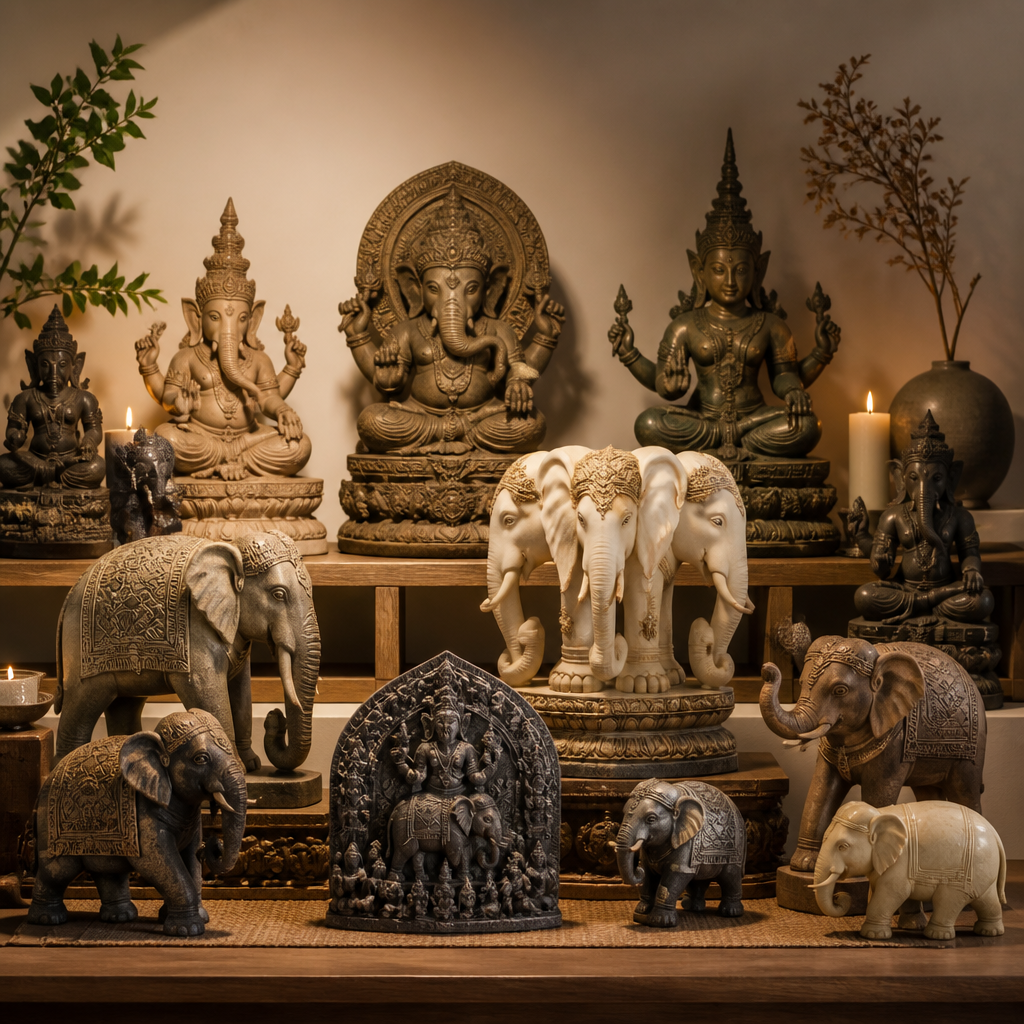
A common mistake among new collectors is treating these three traditions as interchangeable. They share the elephant form, but they address entirely different theological questions and connect to entirely different royal and devotional histories. Buying a Ganesha when you intended to acquire an Erawan is a meaningful error, not a stylistic footnote.
Collecting Erawan and Asian Elephant Sculptures: A Practical Guide
The decision to acquire an Erawan elephant statue or a related Asian elephant sculpture is worth approaching with the same seriousness you would bring to any significant addition to a collection of religious art. These are not objects where visual appeal alone should guide the decision.
Prioritise Iconographic Completeness
A museum-quality Erawan sculpture should demonstrate internal consistency. The number of heads, the treatment of the tusks, the finish, and the presence or absence of a rider figure should all cohere as a unified iconographic statement. Pieces that mix elements from different traditions without apparent intent are generally later commercial productions rather than works made within a living artistic and devotional tradition.
Material and Finish as Indicators of Quality
Bronze has been the dominant material for high-status Buddhist and Hindu sculpture across Southeast and South Asia for well over a millennium. The quality of the casting, the sharpness of surface detail, and the consistency of the patina are all readable indicators of craftsmanship. Gilded bronze or gilt-lacquer finishes place a piece within specific Thai and Burmese court traditions. Stone sculpture, particularly sandstone, connects more directly to the Khmer and Indian temple-sculpture tradition.
Provenance and Context
Understanding where a sculpture was made and for what purpose enriches the collecting experience considerably. A Thai Erawan made for a temple commission carries different associations than one made for domestic display, even if the iconography is similar. Reputable specialist retailers can provide this contextual information and will be transparent about the origins of the pieces they offer.
Placement and Display
In Thai and broader Southeast Asian tradition, elephant sculptures placed at the entrance to a space serve a protective function. Placed on an altar alongside Buddha or deity statues, an Erawan sculpture participates in the devotional arrangement of that space. Collectors should consider the relationship between pieces in their collection, not just individual works in isolation. An Erawan positioned near a statue of Indra or a Thai-style Buddha creates an iconographically coherent grouping that has real meaning within the tradition from which these works come.
HD Asian Art's collections span the full breadth of Buddhist and Hindu sculptural traditions across Asia, including pieces from Thailand, Cambodia, Burma, India, and Indonesia. For collectors building a focused collection around Thai religious art or Hindu mythology, exploring the range of Hindu deity statues and Buddha statues available allows you to make informed comparisons between iconographic traditions before committing to a piece. The depth of a collection comes from understanding how pieces relate to one another across tradition, material, and period.
Frequently Asked Questions
What is the difference between Erawan and Airavata?
Erawan is simply the Thai and Pali rendering of the Sanskrit name Airavata. They refer to the same mythological being: the divine white elephant who serves as the mount of Indra, king of the gods. The name shift from Airavata to Erawan reflects the broader process by which Indian religious concepts were absorbed into the cultures of mainland Southeast Asia, particularly Thailand and Laos, and given local linguistic and iconographic forms.
Why does the Erawan elephant have three heads?
In Thai Buddhist cosmology, the three heads of Erawan represent the three tiers of existence: the underworld, the human world, and the heavenly realm. This tripartite cosmological structure is central to Theravada Buddhist thought as it developed in mainland Southeast Asia, and the Erawan figure became one of its most visually striking expressions. Some Puranic Hindu texts describe Airavata with more heads and trunks, but the three-headed form became standard in Thai and Lao iconography.
Is an Erawan elephant statue appropriate for a home altar?
Yes, and there is a long tradition of doing exactly this. Small elephant figurines have been placed at Thai shrines and home altars as offerings and protective presences for centuries. A well-crafted Erawan sculpture placed at the entrance to a home or at the base of an altar participates in a living devotional tradition. For collectors who maintain a home altar with Buddhist or Hindu statues, an Erawan is a theologically coherent and historically grounded addition.
What materials are used in traditional Erawan elephant sculptures?
Bronze is the dominant material for high-status Erawan and elephant sculpture across Southeast and South Asia, a tradition with roots stretching back well over a millennium. Thai court tradition favoured gilded bronze or gilt-lacquer finishes. Stone, particularly sandstone, is associated more closely with the Khmer and South Indian temple-sculpture traditions. For collectors, the material of a piece locates it within a specific regional and historical tradition as much as the iconography does.
How do I distinguish an iconographically authentic Erawan sculpture from a purely decorative elephant figure?
The most reliable indicators are the number of heads, the treatment of the tusks and trunk, the presence of decorative royal caparison, and whether a rider figure appears. An authentic Erawan sculpture within the Thai tradition will show three heads, will often be white or gilded, and will reflect the cosmological symbolism of the tradition it comes from. A purely decorative piece will typically show a single-headed elephant without the markers of divine status: no elaborately decorated body cloth, no multiple tusks referencing textual descriptions, and no rider. If in doubt, consult a specialist retailer who can speak to the iconographic specifics of any individual piece.
What other Hindu deity sculptures pair well with an Erawan elephant statue in a collection?
Indra is the obvious pairing, since Erawan is his divine vehicle. A collection that includes an Erawan and a figure of Indra presents a complete theological statement about divine kingship and celestial authority. More broadly, sculptures of Vishnu or Lakshmi connect to the Samudra Manthan narrative from which Airavata emerged. Within a Theravada Buddhist context, pairing an Erawan with Thai-style Buddha figures or with a figure of Brahma, as seen at the Erawan Shrine, follows the syncretic Hindu-Buddhist devotional tradition of mainland Southeast Asia.
If you have experience collecting Asian elephant or Erawan sculptures, or if you have questions about how specific pieces fit into the iconographic traditions discussed here, please share your thoughts in the comments below.
References
-
Airavata: the divine white elephant in Hindu mythology, Wikipedia
-
Airavata the King of Elephants: origins, symbolism, and role as Indra's mount, Sanskriti Magazine
-
Erawan in Thai mythology: history, symbolism, and cultural significance, Mythlok
