



Durga Statue: The Warrior Goddess and Her Eight Arms
Durga Statue: The Warrior Goddess and Her Eight Arms
Most people who search for a Durga statue know she is powerful. Fewer understand exactly why her iconography is so deliberately constructed, or what each of her eight arms actually communicates about Hindu cosmology and the defeat of cosmic evil.
If you are a collector, a devotional practitioner, or someone furnishing a home altar with genuine intention, buying a Goddess Durga sculpture without understanding what you are acquiring is a missed opportunity. This article gives you the full picture: the mythology, the iconographic details, the regional sculptural traditions, and the practical guidance you need to choose the right piece.
Table of Contents
Quick Takeaways
|
Key Insight |
Explanation |
|---|---|
|
Durga's eight arms are not decorative |
Each arm holds a specific weapon or object given to her by a different deity, encoding a theological argument about unified divine power. |
|
Her lion mount is theologically significant |
The lion (or tiger in some traditions) represents courage, willpower, and the ferocity required to confront adharma. It is not merely ornamental. |
|
Mahishasura is almost always present |
Authentic Durga sculptures from most regional traditions show her trampling or spearing the buffalo demon Mahishasura. His absence changes the iconographic reading entirely. |
|
South Indian and North Indian styles differ sharply |
South Indian bronzes (Chola-influenced) tend toward elegant elongation; North Indian stone carvings favour denser, more voluminous forms. Both are historically valid. |
|
Material affects devotional use |
Bronze and brass sculptures are preferred for active puja use due to durability; stone and resin pieces are often chosen for display or meditation spaces. |
|
Size matters for altar coherence |
A Durga statue placed on a home altar should be the largest or most elevated figure if she is the primary deity, and should visually anchor the arrangement. |
|
Museum-quality sourcing preserves iconographic accuracy |
Mass-produced pieces frequently collapse or omit attribute details. Sourcing from a specialist retailer ensures the weapons, postures, and proportions are iconographically correct. |
Who Is Durga: Origin, Mythology, and Meaning
Durga's origin story is one of the most deliberately structured narratives in the entire Hindu canon. According to the Devi Mahatmya, a sixth-century Sanskrit text contained within the Markandeya Purana, the gods collectively failed to defeat the buffalo demon Mahishasura after a war lasting a hundred divine years. In response, each god channelled their shakti, their divine feminine energy, outward. Those combined energies coalesced into a single radiant female form: Durga.
This is not a story about a goddess being created. It is a story about concentrated power taking feminine form because only that form was capable of what the male deities could not accomplish alone. The Devi Mahatmya is explicit on this point: the gods did not make Durga subordinate to themselves. They transferred their power to her.
Her name derives from the Sanskrit root meaning "the one who is difficult to approach" or "the invincible fortress." She is also addressed as Mahishasuramardini, literally "she who slays Mahisha." Both names point to the same theological function: Durga exists at the boundary between cosmic order and chaos, and she holds that boundary.
"The Devi Mahatmya presents Durga not as a consort or dependent of the male gods but as the supreme reality from whom the gods themselves derive their power." - Wendy Doniger, The Hindus: An Alternative History, Penguin Press, 2009.
For collectors and practitioners at HD Asian Art, understanding this theological foundation changes how you relate to a Goddess Durga sculpture. This is not ambient decoration. It is a representation of unified cosmic authority in its most active, protective, and fierce mode.
The Eight Arms Explained: What Each Weapon Symbolises
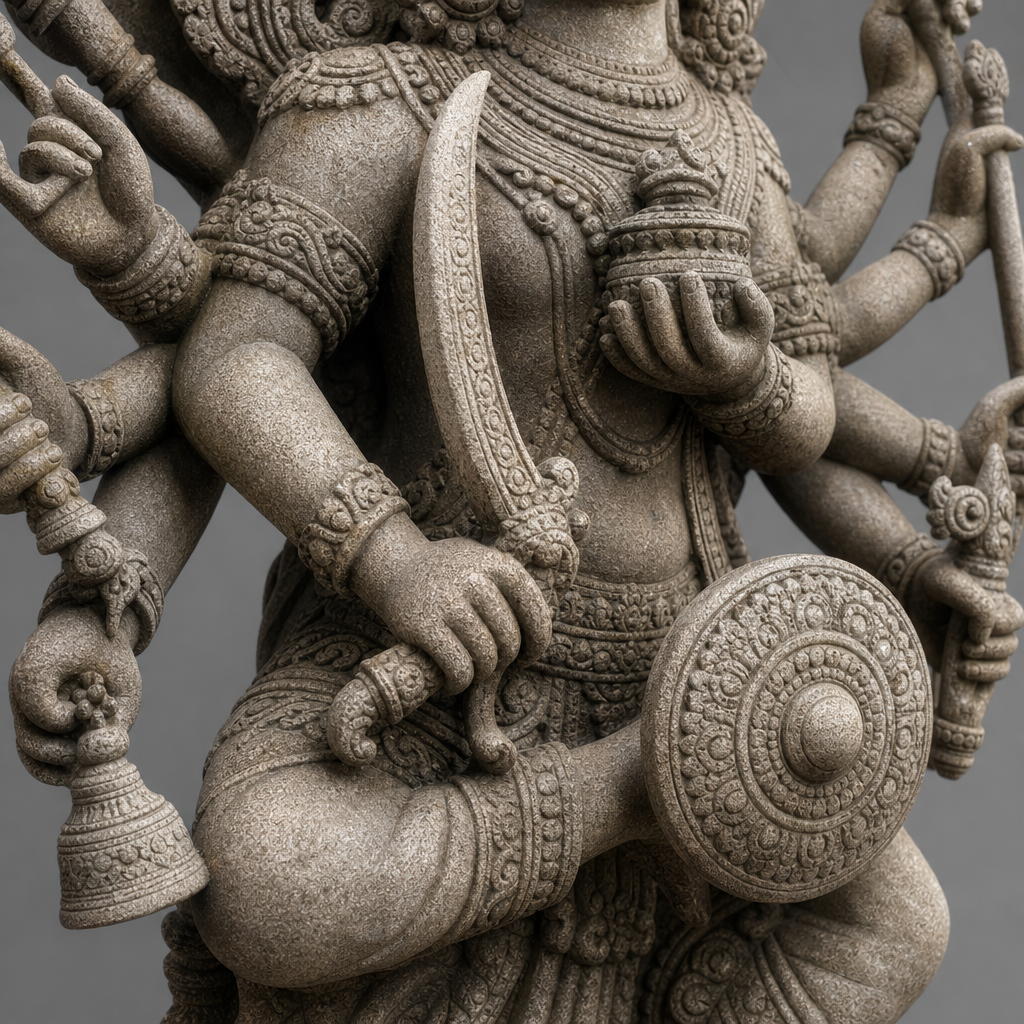
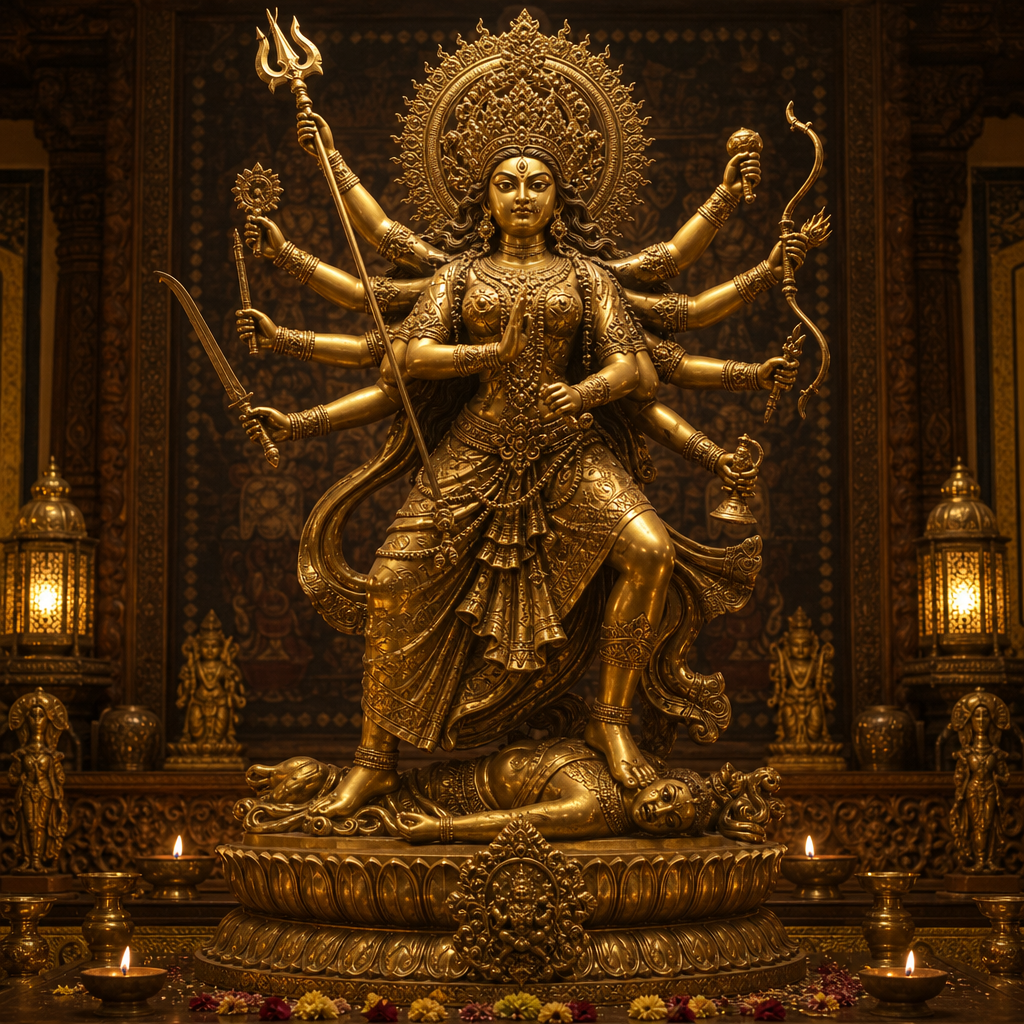
The number eight is not arbitrary. In Hindu cosmology, eight represents the eight directions of space and the totality of the cosmos. A Durga statue with eight arms is making a spatial claim: her authority extends in every direction simultaneously. Each weapon was gifted to her by a specific god, and each carries that god's divine function.
The Standard Weapon Inventory
The most widely observed arrangement across North and South Indian sculpture includes: a trident (trishula) from Shiva, representing the three gunas; a discus (chakra) from Vishnu, representing time and the cycle of existence; a sword from Kali, representing discrimination and the severing of ego; a bow and arrows from Vayu and Surya, representing speed and focus; a thunderbolt (vajra) from Indra, representing firmness of mind; a conch (shankha) from Varuna, representing the primordial sound; a snake from Shesha Naga, representing consciousness; and a lotus bud, representing liberation even within engagement with the world.
In practice, regional and period variations do occur. Pala period sculptures from Bengal sometimes substitute a bell, a pot of nectar, or a shield. Chola bronzes from Tamil Nadu occasionally reduce the arms to four or expand to ten or eighteen in the Mahishasuramardini form. None of these variations are errors. They represent legitimate theological emphases within specific traditions.
Why the Empty Hand Matters
Many Durga sculptures feature one hand raised in the abhaya mudra, the gesture of fearlessness and protection, even while other hands hold weapons. This is not a contradiction. The gesture communicates that even in her most fierce mode, Durga's orientation toward her devotees is protective rather than threatening. When selecting a Goddess Durga sculpture for a home altar, this mudra is particularly meaningful for practitioners who seek her in a protective role.
Pro tip: Before purchasing a Durga statue, count the arms and identify at least four of the weapons. If the seller cannot explain what is depicted or the attributes are clearly wrong (such as a trident held in a position inconsistent with the form's posture), the piece may be iconographically incoherent and less valuable to a serious collector.
Regional Sculptural Traditions of the Hindu Warrior Goddess
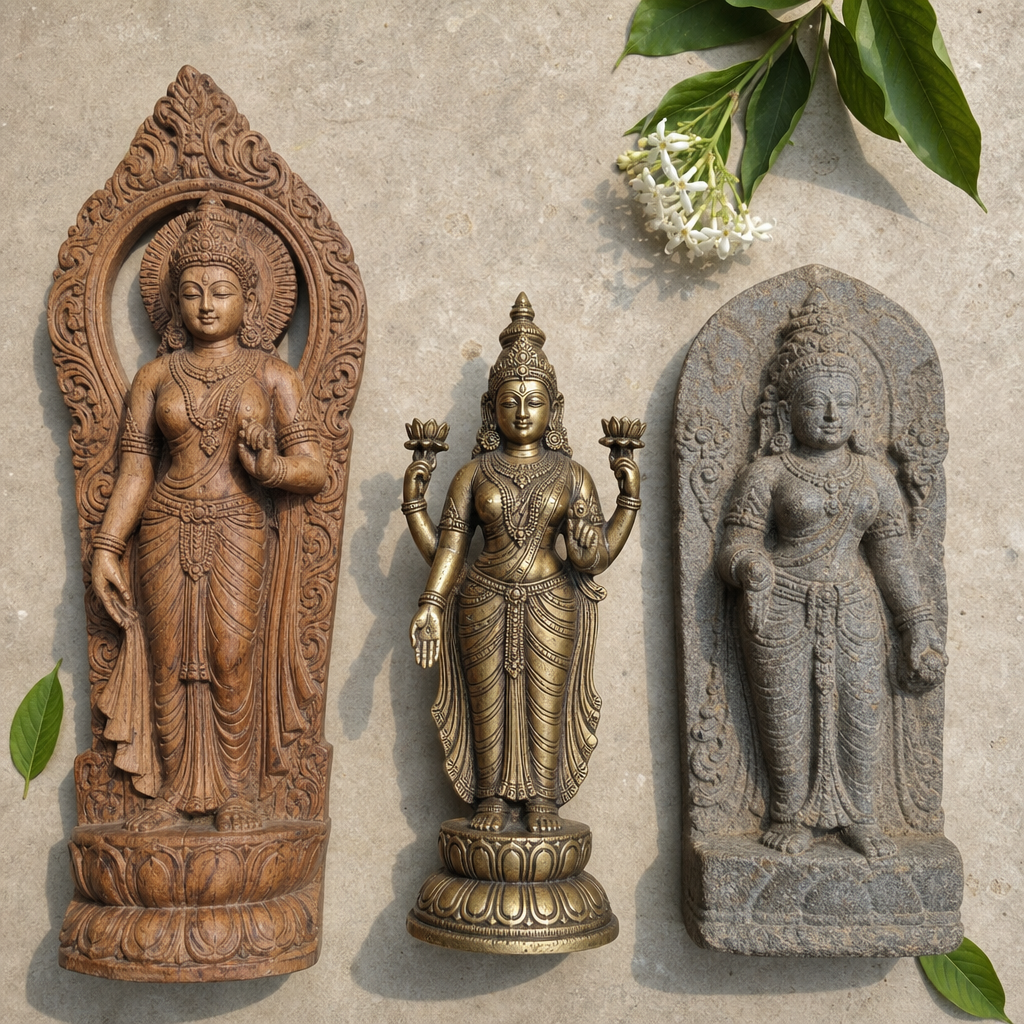
The Hindu warrior goddess has been sculpted continuously across the Indian subcontinent and into Southeast Asia for over 1,500 years. The regional traditions are distinct enough that an experienced collector can identify the source region of a piece before reading any label. Understanding these distinctions helps you know what you are looking at and what you are paying for.
North Indian Stone Carving: The Gupta and Pala Legacy
North Indian Durga sculpture reached its apogee during the Gupta period (fourth to sixth centuries CE) and was refined further in the Pala period (eighth to twelfth centuries CE). Gupta-era pieces are characterised by serene facial expressions, smooth stone surfaces, and a sense of contained power. The weapons are held with remarkable precision, and the lion mount is rendered with naturalistic confidence. Pala sculptures from Bengal show greater complexity in crown and jewellery, reflecting the elaborate tantric iconography that became central to Bengal's Shakta tradition. If you encounter a North Indian stone Durga statue, look for the treatment of the crown and the presence or absence of a kirttimukha (the face of glory) above the main figure.
South Indian Bronze: Chola Refinement
The Chola dynasty (ninth to thirteenth centuries CE) produced the finest bronze sculptures in the world by many measures, and their Mahishasuramardini bronzes are among their most powerful works. South Indian bronzes use the lost-wax (cire-perdue) casting technique, producing figures of extraordinary surface detail. The stance tends to be more dynamic than North Indian stone equivalents, with the tribhanga (triple-flexion posture) creating a sense of movement even in a static object. Contemporary South Indian craftspeople continue this tradition, and the best modern bronzes available through specialist retailers like HD Asian Art follow these proportional and technical standards directly.
Southeast Asian Durga Forms
Hinduism spread across Southeast Asia with significant momentum between the fifth and thirteenth centuries CE. Durga sculptures from Cambodia (Khmer tradition), Java (Javanese Hindu tradition), and Bali reflect this diffusion. Khmer Durga figures from the pre-Angkor period are among the most striking ever produced: the faces are flat-planed and serene in a manner quite unlike Indian prototypes, and the treatment of jewellery is more restrained. Balinese forms remain living tradition rather than historical artefact, with Durga identified with Rangda in local cosmology and represented in both sculpture and ritual masked drama.
Comparison of Durga Statue Styles
|
Style Tradition |
Key Visual Characteristics |
Best Suited For |
|---|---|---|
|
South Indian Bronze (Chola-Influenced) |
Lost-wax casting, dynamic tribhanga posture, fine jewellery detail, ten or eighteen arms common in Mahishasuramardini form, warm gold-bronze surface |
Active puja and altar use, serious collectors focused on devotional authenticity, placement as a focal object in a dedicated shrine room |
|
North Indian Stone or Resin Reproduction |
Denser, more frontal composition, voluminous form, elaborate crown typical of Pala influence, eight arms standard, darker stone palette |
Display in living or meditation spaces, collectors drawn to the Gupta-Pala aesthetic, practitioners who prefer the visual gravity of stone |
|
Balinese or Southeast Asian Form |
Flat facial planes, restrained jewellery, integration with local cosmological figures (Rangda), often polychrome or gilded, distinctive crown forms |
Collectors specialising in Southeast Asian Hindu art, practitioners connected to Balinese or Javanese traditions, eclectic altar arrangements |
The comparison above is not a ranking. Each tradition is internally coherent and historically grounded. The right choice depends on your devotional practice, your existing collection, and the visual language you want to work with. A common mistake is prioritising surface material ("I want bronze") without considering whether the proportions and iconographic programme of the specific piece align with the tradition you are drawing on.
Choosing a Goddess Durga Sculpture: What Collectors Get Wrong
There are three recurring errors that appear consistently among buyers of Goddess Durga sculptures, whether they are first-time purchasers or experienced collectors working from incomplete information.
Conflating Size with Quality
A large Durga statue is not inherently a better one. The critical variables are proportional accuracy, surface quality, and iconographic integrity. A twenty-centimetre bronze cast by a skilled South Indian artisan following traditional proportional canons (tala measurements) will outperform a sixty-centimetre mass-produced resin piece every time, both aesthetically and devotionally. HD Asian Art's museum-quality sourcing standard addresses this directly: pieces are selected for accuracy and craft, not simply for scale.
Ignoring the Demon Beneath Her Feet
Mahishasura, the buffalo demon, is not a supporting character in Durga's iconography. He is integral to the theological statement the sculpture makes. A Durga statue that omits him, or renders him as a vague decorative base element without the emerging human figure from the severed buffalo neck, loses a significant portion of its meaning. The Devi Mahatmya describes the moment of his defeat in precise terms: Mahisha begins to change from buffalo form to human form as Durga's foot pins him, and it is at that transitional moment that she spears him. An iconographically complete piece captures that moment.
We would love your feedback and any insights you would share with others. What perspective would you add?
Buying From Non-Specialist Sources
The global religious art market contains a significant volume of pieces with incorrect attributes, anachronistic stylistic combinations, and fabricated provenance. A retailer specialising exclusively in Asian religious and cultural artwork, with direct sourcing relationships across Burma, India, Indonesia, and the broader Asian region, operates with a level of curatorial accountability that general antique markets or non-specialist online platforms cannot match. The difference between a piece from a retailer like HD Asian Art and an unmarked piece from a general auction is often the difference between an iconographically coherent sculpture and a decorative object that merely resembles one.
Pro tip: Ask specifically whether the piece you are considering follows a named iconographic programme (Mahishasuramardini, Saptamatrika context, Navadurga series, etc.) before purchasing. A specialist retailer will answer this question readily. If the seller cannot, that tells you something important about the piece's authenticity and curatorial rigour.
Placement and Altar Practice: Getting It Right
Where and how you place a Durga statue matters practically as well as devotionally. The Agama Shastra texts, which govern Hindu temple construction and icon placement, establish principles that translate usefully to home altar design, even if you are approaching this as a collector rather than a strict Shaiva or Shakta practitioner.
Directional Placement
Durga is conventionally placed facing east or north. East-facing placement aligns with sunrise symbolism and is considered auspicious for active worship. North-facing placement is associated with the direction of Kubera and is common in households where the altar serves a more broadly protective function. Placing a Durga statue facing south is actively discouraged in Agamic tradition, as the south is associated with Yama, the god of death, and that directional association conflicts with Durga's protective role for the living.
Altar Hierarchy
If Durga is your primary deity, she should occupy the highest and most central position on the altar. Figures of other deities, including Lakshmi, Saraswati, or Ganesha, may be present but should be positioned lower or to the sides. This is not arbitrary aesthetic preference. It reflects the Shakta theological position that the divine feminine, particularly in her active-protective Durga form, is the supreme reality from whom other divine functions emanate.
For collectors who are building a broader Hindu sculpture collection rather than a devotional altar, the same principle of visual hierarchy applies for purely compositional reasons. A Durga statue with eight raised arms and a lion mount creates a strong vertical and horizontal visual axis. Surrounding pieces should complement rather than compete with that axis.
HD Asian Art's range of Hindu deity statues includes multiple figures that work coherently alongside a Durga sculpture in both devotional and display contexts, making it practical to build a compositionally and theologically coherent collection from a single trusted source.
Frequently Asked Questions
What does a Durga statue with eight arms specifically represent?
Each arm holds a weapon or object gifted by a different Hindu deity, representing the combined divine power of the entire pantheon concentrated into a single form. The eight arms also represent the eight directions of space, making a spatial claim that Durga's authority is total and all-encompassing. The specific weapons vary slightly by regional tradition, but the trident, discus, sword, conch, bow, thunderbolt, and lotus appear most consistently across North and South Indian sculptural traditions.
Is a Goddess Durga sculpture appropriate for a home that is not Hindu?
Yes. Many collectors, interior designers, and meditation practitioners from outside the Hindu tradition incorporate Durga sculptures into their spaces for their artistic quality, symbolic power, and aesthetic impact. The respectful treatment of the figure matters more than the religious affiliation of the owner. Placing the statue at an appropriate height, keeping the area clean, and engaging with the iconography with genuine curiosity rather than treating the piece as purely decorative are all signs of appropriate respect.
How do I identify a high-quality Durga statue versus a poorly made one?
Check the weapon attributes first. Each arm should hold a clearly identifiable object consistent with a named iconographic tradition. Check the proportions: the face should follow the tala system (the face length proportional to the body in a ratio consistent with classical Indian sculpture). Check the mount: the lion should be rendered with structural confidence, not as a flat or shapeless form. Finally, check the treatment of Mahishasura beneath her feet. An iconographically incomplete or anatomically inconsistent piece is a signal of low curatorial investment in production.
What is the difference between Durga and Kali in sculptural representation?
Durga and Kali are both fierce forms of the divine feminine, but their iconographic programmes differ significantly. Durga appears regal, fully adorned, and controlled even in combat. Her expression is typically serene or mildly fierce. Kali's iconography is deliberately transgressive: she is naked or minimally clothed, her tongue protrudes, she holds a severed head and a cleaver, and she dances on the body of Shiva. Theologically, Kali is sometimes described as emerging from Durga's anger during the battle with the demons Chanda and Munda. They are related but distinct forms requiring separate iconographic treatment.
Can a Durga statue be used in daily puja practice?
Yes, and bronze and brass are the preferred materials for active puja use because they withstand regular contact with water, milk, and oil during ritual bathing (abhisheka). Stone pieces are also suitable but heavier and less portable. Resin or painted pieces should be kept dry. Daily puja for Durga typically involves offerings of red flowers, particularly hibiscus, red cloth, and specific incense. Friday is traditionally associated with the goddess in her Shakti forms and is considered particularly auspicious for Durga worship.
What size Durga statue works best for a home altar?
For a primary altar figure, a height of 20 to 40 centimetres works well in most domestic settings. This size allows the iconographic details, including the weapon attributes and the figure of Mahishasura, to be rendered with sufficient precision while remaining proportionate to a standard altar shelf or table. Smaller figures (under 15 centimetres) often lose attribute detail. Larger figures (over 50 centimetres) are more appropriate as standalone sculptural statements in a dedicated room rather than as part of a composed altar arrangement.
We would genuinely like to hear from you: whether you are a long-time collector of Hindu sculpture or just beginning to build your first altar, share what drew you to the Durga tradition and what you look for when choosing a piece.
References
