



Burmese Buddha Statues: Mandalay Style Guide
Burmese Buddha Statues: Mandalay Style Guide
Most people shopping for a Burmese Buddha statue assume that "Burmese" is a single, uniform style. It is not. Myanmar's sculptural tradition spans multiple distinct regional schools, and confusing them leads collectors to buy pieces that do not align with the period, iconography, or craftsmanship they actually want.
The Mandalay style alone carries a set of specific visual signatures, robes, mudras, and materials that set it apart from everything produced in lower Burma or around Inle Lake. If you are serious about acquiring a piece that is genuinely what it claims to be, understanding these differences is not optional. It is the baseline.
Table of Contents
Quick Takeaways
|
Key Insight |
Explanation |
|---|---|
|
Mandalay style has a specific robe treatment |
The uttarasanga is worn in open mode with the sanghati folded decoratively on the left shoulder. This detail alone distinguishes Mandalay work from other Burmese periods. |
|
Mirror glass inlay is a Mandalay hallmark |
Elaborate robes decorated with inset mirror glass are one of the most recognizable features of authentic Mandalay period statues. |
|
Bhumisparsa mudra dominates seated pieces |
Most Mandalay seated Buddhas show the earth-touching gesture, left hand resting on the lap, right hand pointing downward to the earth. |
|
The broad forehead band is diagnostic |
Mandalay Buddhas often feature a broad band across the forehead, with tight hair curls and a wide, prominent ushnisha but no lotus finial above it. |
|
Lacquer and gilding extend to face and body |
Unlike some other Asian traditions that leave bronze or stone unfinished, Mandalay statues are frequently lacquered and gilded across the entire surface including the face. |
|
Standing images carry the myrobalan fruit |
Standing Mandalay Buddhas typically hold the medicinal myrobalan fruit in the right hand, a detail that places them within a specific iconographic program. |
|
Inle Lake work emphasizes different proportions |
Craftsmanship from the Inle Lake region tends toward a distinct regional sensibility in proportion and finish, reflecting the workshop traditions of that lakeside community rather than the royal court aesthetic of Mandalay. |
What Defines Mandalay Style Sculpture
The term Mandalay style sculpture refers to a clearly bounded aesthetic that emerged and matured between roughly 1853 and 1948, the period when Mandalay served as the royal capital of Burma. It is not simply a geographic label. It describes a set of iconographic conventions that became so dominant they came to represent the Burmese ideal of the Buddha to many observers worldwide.
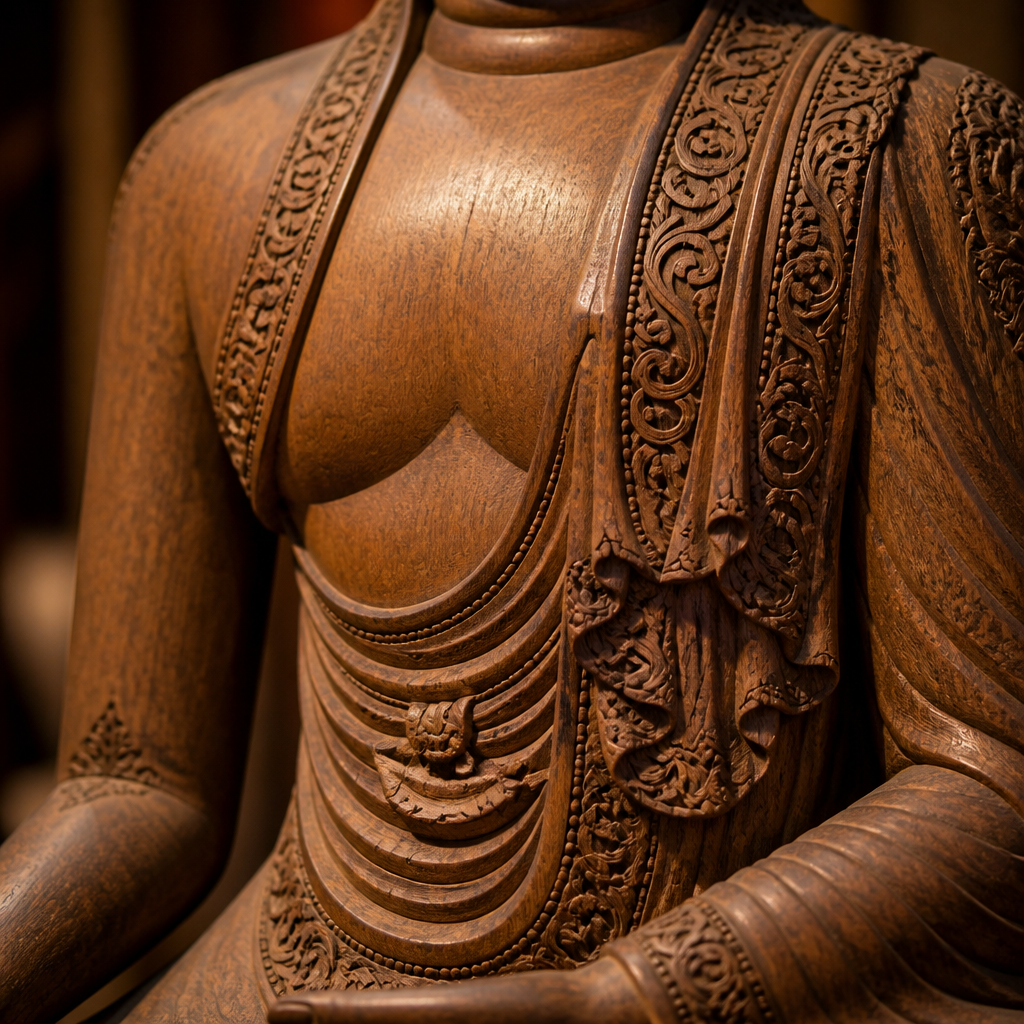
The face is the first thing most collectors notice: youthful, serene, and sweet-featured in a way that contrasts markedly with the more austere or hieratic expressions found in earlier Burmese periods or in neighboring traditions such as Khmer or Thai sculpture. The brow band is broad. The hair sits in tight curls that hug the skull closely, rising to a wide, prominent ushnisha. There is no lotus finial above the ushnisha, which is a small but useful distinguishing point when comparing Mandalay pieces to Sukhothai or northern Thai work.
Robe Treatment and Mudra
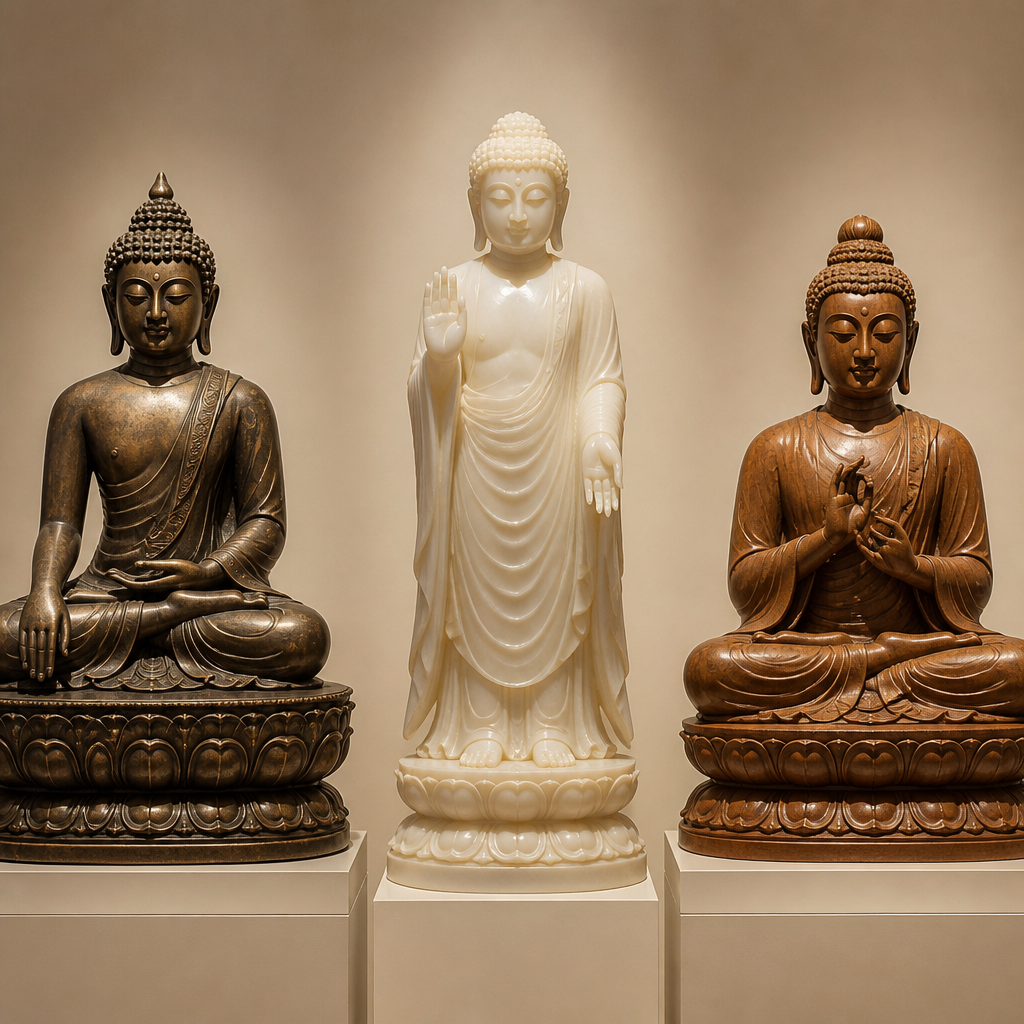
The robe is where Mandalay iconography becomes most precise. The uttarasanga, the outer monastic robe, is worn in what scholars call the open mode, leaving the right shoulder and arm exposed. The sanghati, the secondary robe, is folded decoratively and draped over the left shoulder. On well-made examples, this folding is intricate and handled with visible craft investment. Inset mirror glass decorates the robe surface on many Mandalay pieces, catching light in a way that is immediately distinctive.
Seated figures almost universally show the bhumisparsa mudra, the earth-touching gesture associated with the moment of enlightenment. The left hand rests palm-up on the lap. Standing figures follow a different convention: the uttarasanga is worn in closed mode, covering both arms and chest, with the hands held downward at each side of the lower body. The right hand holds the medicinal myrobalan fruit, a detail rooted in the healing aspect of the Buddha's teachings.
Pro tip: When evaluating a statue described as "Mandalay style," check the sanghati placement before anything else. If it is not folded on the left shoulder or if the robe is symmetrically closed on a seated figure, the attribution should be questioned.
The Historical Roots of Mandalay as a Buddhist Center
Mandalay was not merely a political capital. According to Buddhist tradition, Gautama Buddha himself visited the sacred peak of Mandalay Hill with his disciple Ananda and proclaimed that on the 2,400th anniversary of his death, a metropolis of Buddhist learning would be founded on the plain below. King Mindon moved the capital from Amarapura to this new site in 1857, giving the city a layout modeled on the geometric form of a Buddhist mandala. The city's very name reflects that spiritual design.
This context matters for collectors because the art produced in Mandalay was not decorative in a casual sense. It was devotional production at the center of a kingdom that understood itself as the guardian of Theravada Buddhism. King Mindon, himself a devout Buddhist, filled Mandalay with images and sponsored the craft guilds that produced them. Over time, the style those guilds developed became understood as the "pure art of Myanmar," a designation that carries weight when you encounter it in auction catalogues or dealer descriptions.
The Period's End and Its Legacy
The Mandalay period is conventionally presented as ending in 1948, when Burma gained independence from British rule. The British annexation of upper Burma in 1885 had disrupted royal patronage, but workshop traditions continued producing work in the established style well into the twentieth century. This means that "Mandalay style" and "Mandalay period" are not identical terms. Pieces made after 1885 in the Mandalay manner exist, and their status as period pieces versus later productions is a genuine concern for anyone buying at the collector level. Provenance documentation matters here in a way it does not for purely decorative purchases.
Inle Lake Craftsmanship: A Different Visual Language
Inle Lake, in Shan State, sits in a different geographic and cultural zone from Mandalay. The workshop traditions that developed around the lake reflect the ethnic and religious complexity of the Shan peoples rather than the Burman royal court aesthetic. The result is a sculptural sensibility that feels noticeably different in the hand and eye, even when the subject is identical: a seated Buddha in bhumisparsa mudra.
Inle Lake craftspeople have long worked with local materials and developed proportional conventions that differ from Mandalay norms. Figures from this region tend to have a quality of handmade directness. The finishing, whether lacquer, gilding, or painted surface, follows local practice rather than the highly standardized court workshop approach of Mandalay. For collectors, this means that Inle Lake pieces occupy a different category: they are regional craft objects with their own integrity, not inferior Mandalay work.
What to Look For in Inle Lake Pieces
The proportions of the head relative to the body and the handling of the robe folds are the most reliable guides. Inle Lake work frequently shows a slightly broader face, and the robe treatment is often less elaborate than the multi-layered, mirror-glass-inlaid approach of Mandalay court workshops. The lacquerwork tradition of the broader Shan region also influences surface treatment, and you may find pieces where the lacquer application is the primary artistic investment rather than the carving beneath it.
Pro tip: Do not assume that simpler finishing means lower quality in Inle Lake work. The lacquer application on good Inle Lake pieces requires real skill and is a distinct craft tradition. Evaluate it on its own terms rather than measuring it against Mandalay court standards.
Regional craft objects carry the integrity of the communities that made them. Judging a Shan-region piece by Mandalay court conventions is like judging a folk instrument by orchestral standards. Both can be excellent. Neither is the other.
Materials: Lacquer, Alabaster, Bronze, and Wood
The choice of material in Myanmar Buddhist art is not arbitrary. It reflects regional resources, workshop specializations, and the intended context of the finished piece. Understanding material choices is one of the most practical ways to date and locate a statue.
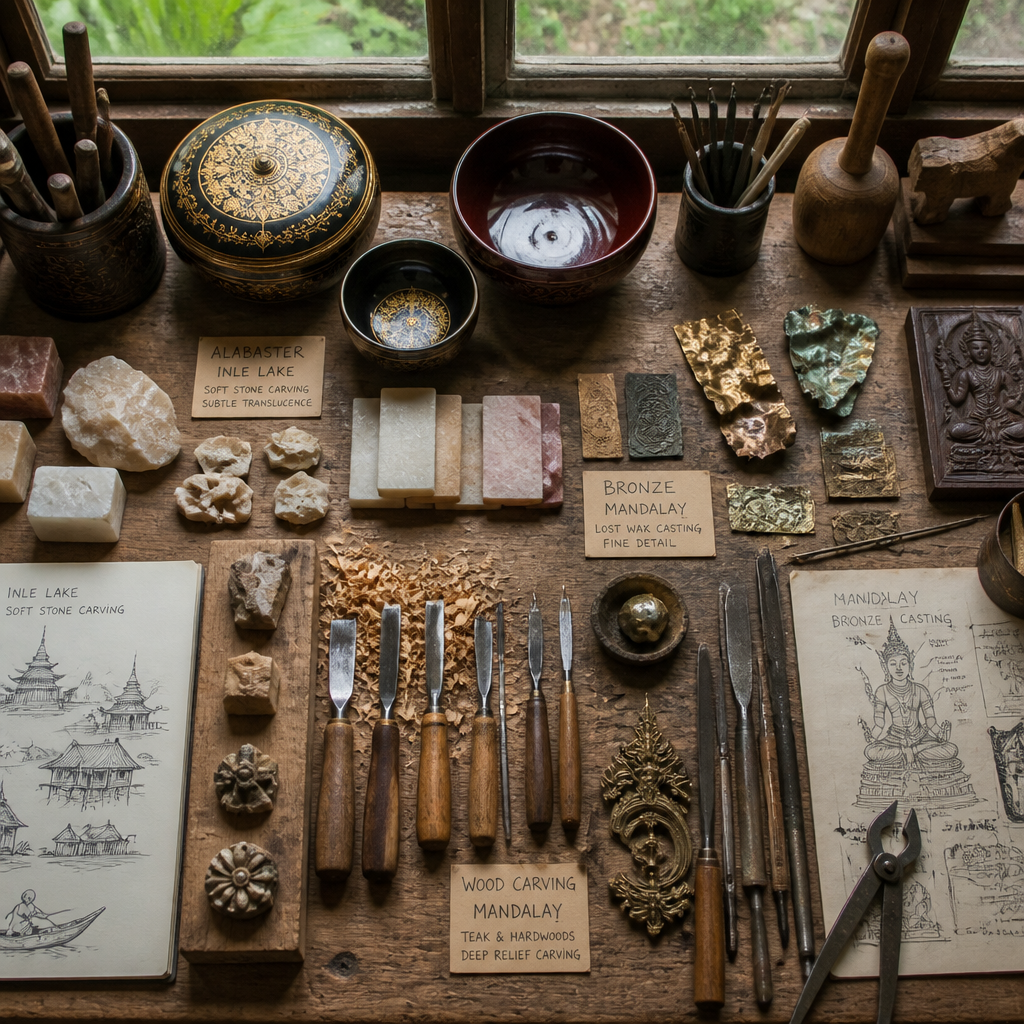
Wood, alabaster, and bronze are the three materials most associated with Mandalay period production. Wood was the most accessible and allowed the elaborate carving of robe folds and decorative borders that define the style. Alabaster, quarried from deposits in central Myanmar, produces a distinctive whitish translucency and was used for pieces intended to convey purity and luminosity. Bronze casting was reserved for more substantial commissions and produces pieces with greater durability and presence.
Lacquer as a Finishing Tradition
Lacquer in Burmese Buddhist statuary serves both protective and aesthetic functions. Many Mandalay statues are lacquered and gilded across the entire surface, including the face and body. This is a deliberate iconographic choice: the gold surface connects the image visually to descriptions of the Buddha's golden-hued skin in Pali textual sources. The lacquer beneath the gilding seals the wood or other substrate against humidity and insects, which is practically important in Myanmar's climate.
Traditional Burmese lacquerware as a craft tradition, separate from statue production, also originates in this region. HD Asian Art's collection of traditional Burmese lacquerware reflects this same craft lineage, where the technical discipline of lacquer application developed alongside the sculptural tradition rather than as a separate industry. The two inform each other in ways that become visible once you have handled enough pieces from both categories.
Comparing Burmese Regional Styles
The table below compares the three most significant Burmese sculptural traditions that collectors and practitioners are likely to encounter. It focuses on the specific visual and material characteristics that allow attribution, not on vague stylistic impressions.
|
Feature |
Mandalay Style |
Inle Lake / Shan Region |
Earlier Burmese Periods (pre-Mandalay) |
|---|---|---|---|
|
Facial type |
Youthful, sweet-faced, broad forehead band |
Broader face, more regional proportions |
Varies by period; often more stylized or archaic |
|
Robe treatment |
Uttarasanga open mode, sanghati folded on left shoulder, mirror glass inlay common |
Simpler robe treatment, lacquer finish primary |
Varies; often more schematic folding |
|
Ushnisha |
Wide and prominent, tight curls, no lotus finial |
Proportionally variable, often less pronounced |
Can include flame finial or lotus finial depending on period |
|
Primary materials |
Wood, alabaster, bronze, lacquered and gilded |
Wood, lacquer, local materials |
Stone, bronze, brick and stucco in temple contexts |
|
Standing figure convention |
Closed robe mode, myrobalan fruit in right hand |
Less standardized |
Various depending on period and workshop |
|
Surface finish |
Lacquered and gilded including face |
Lacquer focus, gilding variable |
Gilding common on metal; stone often unfinished |
Myanmar Buddhist Art in a Wider Asian Context
Placing Myanmar Buddhist art within a wider Asian frame clarifies what makes it distinctive rather than simply "one of many." Buddhism spread through mainland Southeast Asia via Theravada traditions, and Myanmar shares that doctrinal inheritance with Thailand, Laos, Cambodia, and Sri Lanka. But the visual language each country developed from that shared foundation diverges significantly.
Thai sculpture from the Sukhothai and Ayutthaya periods tends toward flame-topped ushnishas, elongated proportions, and a walking Buddha form that is essentially absent in Burmese work. Cambodian Khmer sculpture emphasizes the regal, with towering crowns and a formal hieratic presence very different from the youthful sweetness of Mandalay work. Sri Lankan sculpture has its own conventions shaped by continuous island traditions. Within this wider field, the Mandalay Buddha occupies a specific and identifiable position: intimate in scale and expression, elaborate in surface treatment, and rooted in a royal court's explicit project of centering Buddhist civilization.
Why Burmese Pieces Appeal to Collectors Specifically
Collectors drawn to HD Asian Art's Burmese Buddha statues often cite the accessibility of the Mandalay aesthetic. The sweet-faced expression is approachable in a way that some other Asian traditions are not. The elaborate surface decoration, particularly the gilded and lacquered robes, gives pieces a visual richness that works in both devotional and collector contexts. And the range of available materials, from small carved wood pieces to substantial alabaster figures, means there is a Burmese Buddha at almost every scale and price point.
Spiritual practitioners who maintain home altars frequently prefer Burmese pieces for a related reason: the Mandalay expression reads as gentle and accessible rather than remote. That is not an accident of aesthetic preference. It reflects a deliberate iconographic tradition that the Mandalay workshops cultivated and refined over nearly a century of royal patronage.
How to Assess Quality and Authenticity
Assessing quality in a Burmese Buddha statue requires looking at the piece in a specific sequence. Start with the robe carving on wood pieces or the casting quality on bronze ones. The folds should show confident, consistent movement, not hesitant or mechanical repetition. On Mandalay style wood pieces, the transition between the body of the sanghati and its decorative border edge is where workshop skill becomes most visible. Poor work blurs this transition. Good work keeps it crisp.
Surface finish comes next. Gilding applied over lacquer should have an even, warm tonality without obvious brush marks or areas of thin coverage. Mirror glass inlay, where present, should be set flush and level rather than proud of the surface or recessed into messy adhesive beds. On alabaster pieces, look at the back of the figure: rushed or low-quality work often shows dramatically less attention on surfaces not visible from the front.
A Common Mistake When Buying Burmese Statues
The most common error is conflating age with quality. Older does not automatically mean better in Burmese Buddhist sculpture, and condition issues on genuinely old pieces, including lacquer flaking, gilding loss, and structural damage from wood movement, can substantially reduce both aesthetic and monetary value. A well-made twentieth-century Mandalay style piece in excellent condition is frequently more satisfying to live with than a genuine nineteenth-century example in poor condition.
For collectors buying from a specialist retailer like HD Asian Art, the relevant question is whether the piece accurately represents the style, period, and quality claimed. Museum-quality does not mean "museum old." It means the standards of craft and the integrity of the iconography meet a level that serious collections and institutions would recognize. That is the threshold worth holding to.
Pro tip: When examining lacquerwork, hold the piece at an oblique angle to a light source rather than looking at it straight on. Repairs, regilding, and inconsistencies in surface quality become immediately visible in raking light in a way they do not under direct examination.
Frequently Asked Questions
What is the difference between a Mandalay Buddha and other Burmese Buddha statues?
The Mandalay Buddha is defined by a specific set of iconographic conventions: the open-mode uttarasanga robe, the sanghati folded on the left shoulder, a broad forehead band, tight hair curls on a wide ushnisha with no lotus finial above, and frequent use of mirror glass inlay on the robe. Other Burmese periods and regions follow different conventions, and earlier periods often use more stylized or archaic facial and robe treatments. Mandalay work is also particularly associated with lacquered and gilded surfaces covering the entire figure including the face.
What does the myrobalan fruit mean in a standing Burmese Buddha statue?
The myrobalan fruit held in the right hand of standing Mandalay Buddhas connects the image to the healing aspect of Buddhist practice. The myrobalan is associated in Buddhist texts with medicine and the removal of suffering. Its presence in standing Mandalay figures is a standard iconographic feature of that style, not an unusual variant, and it helps confirm a Mandalay attribution when combined with the other stylistic markers.
Is alabaster or bronze better for a Burmese Buddha statue?
Neither is inherently superior. The choice depends on what you want from the piece. Alabaster Burmese Buddhas carry a translucent, luminous quality that makes them visually striking in natural light, and they connect to the purity symbolism embedded in whitish stone. Bronze pieces are more durable over the long term and carry more physical presence and weight. Wood pieces, including lacquered and gilded examples, are the most common and offer the widest range of scale and carving quality. The right material is the one that fits your context and the specific quality of the piece in question.
How does Inle Lake craftsmanship differ from Mandalay workshop production?
Inle Lake and the broader Shan region produced sculpture from workshop traditions that reflect Shan ethnic and cultural identity rather than the Burman royal court aesthetic of Mandalay. The proportions, surface treatment, and robe conventions differ. Inle Lake work often shows a more handmade directness and a stronger emphasis on lacquer as the primary surface finish rather than the elaborate multi-layered gilded approach of Mandalay. These are not inferior Mandalay pieces. They are a distinct regional tradition with their own visual integrity.
What should I look for when buying a Burmese Buddha statue from a specialist retailer?
First, confirm that the stylistic claims made for the piece match the specific visual evidence: robe treatment, mudra, ushnisha form, and surface finish should all align with the stated period and region. Second, examine the quality of the carving or casting and the surface finish under raking light. Third, assess condition honestly, since lacquer flaking, gilding loss, and wood movement damage all affect long-term satisfaction. A specialist retailer like HD Asian Art with a curated collection of Burmese statues sourced directly from Myanmar can provide the provenance context that makes these assessments possible.
Why does the Mandalay style have such global recognition compared to other Burmese regional styles?
The Mandalay style became dominant for a specific historical reason: it was the art of the Burmese royal capital during the period when Burma had the most contact with the outside world through British colonial administration and trade. The pieces that entered Western collections in the late nineteenth and early twentieth centuries were disproportionately from Mandalay workshops, and museum acquisitions during that period shaped what became understood internationally as "Burmese Buddhist art." That historical filter explains the outsized recognition, not an inherent superiority of the style over other Burmese regional traditions.
If you have handled Burmese Buddhist sculpture firsthand, whether in a collection, a temple context, or through a purchase, we would genuinely like to hear what details caught your attention first and whether the iconographic framework described here matched your experience.
References
