



Burmese Buddha Statues: Mandalay, Shan & Pagan Guide
Burmese Buddha Statues: Mandalay, Shan & Pagan Guide
Most buyers walk into the Burmese Buddha statue market knowing they want something Burmese and leaving with something unattributed. The three great traditions, Pagan, Shan, and Mandalay, are genuinely distinct in facial type, body proportion, robe treatment, material, and period.
Knowing how to read those differences does not just satisfy curiosity. It turns a generic purchase into a datable, describable piece with real collector value, and it protects you from paying a Mandalay price for a later workshop reproduction. This guide works through each style in practical terms and gives you a working comparison you can apply in front of any piece.
Table of Contents
- Quick Takeaways
- Pagan Period: The Foundation of Burmese Buddhist Sculpture
- Shan Style: Introspective Elegance from the Eastern Plateau
- Mandalay Style: The Royal Ideal and Its Iconographic Precision
- Side-by-Side: Comparing the Three Styles
- What Collectors Should Examine Before Buying
- Frequently Asked Questions
- References
Quick Takeaways
|
Key Insight |
Explanation |
|---|---|
|
Start with the forehead, not the mudra |
Facial structure, forehead width, and eye shape are the most reliable style markers. The earth-touching mudra appears across all three traditions and cannot identify a regional style on its own. |
|
Pagan pieces show Mon and Indian influence directly |
Early Pagan Buddhas reflect eastern Indian Gupta and Pala influence as well as Mon artistic heritage. A broad forehead, tapering face, and high ushnisha are the useful visual sequence for Pagan attribution. |
|
The Shan smile is understated, not absent |
Shan figures use a soft, barely visible curve at the mouth. This restraint contrasts sharply with the fuller, more overt sweetness of Mandalay expressions. |
|
Mandalay style and Mandalay period are not the same thing |
The British annexation of upper Burma in 1885 disrupted royal patronage but did not stop workshop production. Pieces made in Mandalay style well into the twentieth century exist and are not period pieces. |
|
Robe treatment is a reliable secondary marker |
Pagan drapery is austere and controlled. Shan robes are simple with restrained surface detail. Mandalay robes are elaborate, often gilded, with the outer robe in the open mode leaving the right shoulder bare. |
|
Material supports attribution but does not confirm it |
Pagan bronzes often retain a cast surface with prominent modelling. Mandalay pieces may combine bronze or marble with lacquer, gilding, and mirror-glass inlay. Shan figures appear frequently in wood. |
|
Provenance documentation matters more for Mandalay than for decorative pieces |
Because later workshop production closely mimics period Mandalay work, documented provenance is genuinely important at the serious collector level, not just a nice addition. |
Pagan Period: The Foundation of Burmese Buddhist Sculpture
The Pagan state lasted from roughly the ninth century until 1297 CE, with its artistic peak concentrated in the eleventh through thirteenth centuries. This is the period during which Theravada Buddhism was established as the dominant religion across Burma, and the sheer volume of religious patronage produced thousands of temples, stupas, and sculptural images on the Bagan plain. Understanding Pagan art means understanding everything that came after it, because Shan and Mandalay styles both respond to, and depart from, this foundation.
Pagan sculpture drew from at least three sources simultaneously. The Mon artistic tradition, which had flourished in southern Burma since the fifth to eighth centuries, contributed a refined naturalism and a taste for smooth skin surfaces. Eastern Indian Gupta and Pala Buddhist art supplied the iconographic programme, including the ushnisha crown of the skull, the elongated earlobes, and the standard mudra vocabulary. Local Burman aesthetic preferences gradually pushed both inherited influences in a distinctly regional direction.
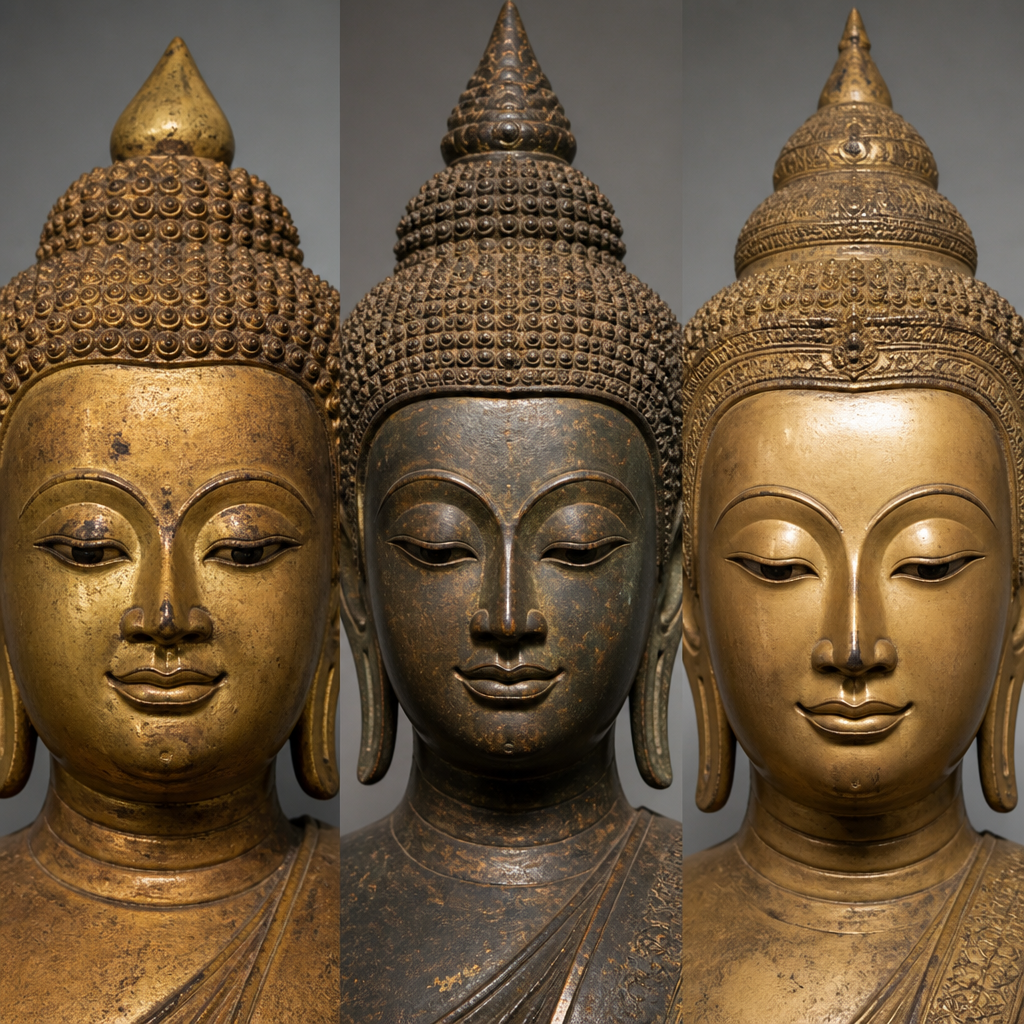
In practice, the most useful visual sequence for recognising Pagan style begins with the head. Look for a broad forehead, slightly Mongoloid eyes, a tapering face, and a high ushnisha. The face tends toward a restrained dignity rather than the warmth of later Mandalay work or the delicate introspection of Shan figures. Pagan bronzes were typically cast using the lost-wax method, and many surviving examples retain a restrained cast surface and patina that keeps the modelling prominent and readable. Large-scale images in brick and plaster, often adorned with gold leaf, were created for the interiors of the Bagan temples themselves.
The early Bagan period is where stylistic influences from the Pyu, Mon, and Indian artistic traditions coalesced to form a distinctly Burmese visual language, and reading that convergence is the key to dating what came next.
Materials used during the Pagan period included bronze, iron, sandstone, and wood. Sandstone images from temple contexts often show weathering consistent with outdoor or semi-outdoor installation. Bronze pieces cast in this period can be distinguished from later Mandalay bronzes partly by their relative austerity: less gilding, less surface embellishment, more emphasis on the sculptural form itself. A collector encountering a piece described as Pagan should look for that controlled, unadorned quality in the robe treatment and assess whether the facial features match the broad-forehead, tapering-face profile rather than the fuller Mandalay type.
Pro tip: If you see a Burmese bronze with elaborate mirror-glass inlay or heavy applied gilding, that is a strong indicator of Mandalay period or later production. Pagan pieces rely on the quality of the casting, not the decorative surface, to carry the visual weight.
Shan Style: Introspective Elegance from the Eastern Plateau
The Shan people are a Tai-speaking ethnic group of the Shan Plateau in eastern Myanmar, and their Buddhist sculpture developed a genuinely different visual language from the royal Burmese courts. This is not simply a provincial version of the central tradition. It is a distinct aesthetic shaped by geography, cross-border exchange, and the particular spiritual temperament of the Shan principalities.
Distinctive Facial Features and Body Proportions
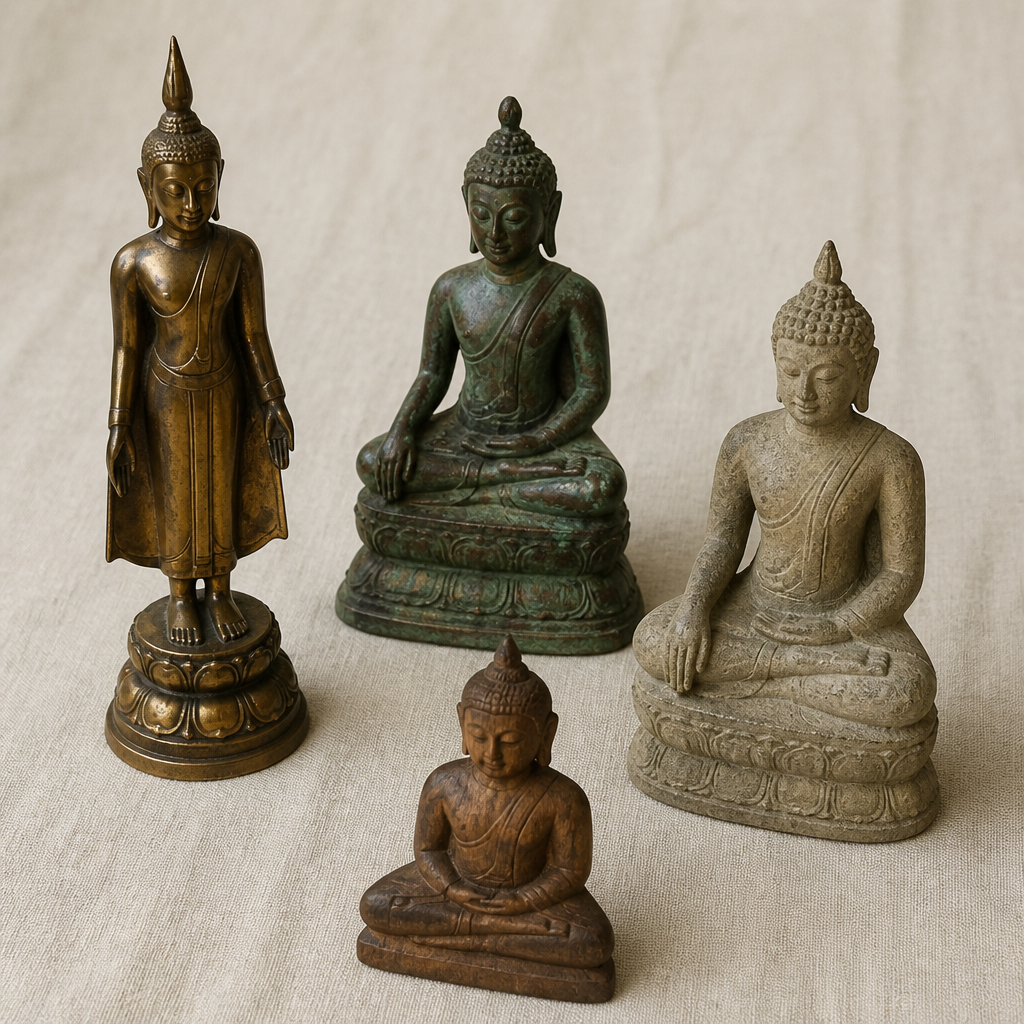
Where Pagan and Mandalay images lean toward grandeur and formal authority, Shan Buddhas favour introspective elegance. The body is slender and elongated, with a sense of weightless calm that contrasts with the more substantial physical presence of Mandalay figures. The face is oval or heart-shaped, with high arched eyebrows, downcast almond eyes, and a soft understated mouth often called the "Shan smile." That smile is barely there. It is a suggestion rather than an expression, and it gives Shan pieces a quality of inwardness that many collectors find more contemplative than the overt sweetness of Mandalay work.
The ushnisha on Shan figures frequently takes a flame shape, an influence traceable to the Lan Na kingdom of northern Thailand. During the fourteenth and fifteenth centuries, documented artistic exchange between the Shan plateau principalities and neighbouring Mon and Sukhothai traditions introduced this and other features that distinguish the Shan type from both Pagan and Mandalay conventions. The earlobes are elongated, as in all Buddhist iconography, but the overall effect is one of refinement rather than elaboration.
Robe Treatment and Materials
Shan robes are typically simple and lightly detailed. The surface is not embellished with the heavy gilding or lacquer work characteristic of Mandalay production. This restraint is deliberate. It keeps visual attention on the figure's proportions and facial expression rather than redirecting it to decorative surfaces. Wood is a common medium for Shan Buddhas, particularly smaller devotional images, though bronze examples exist. Inle Lake, situated in Shan State, developed its own workshop traditions that reflect this ethnic and religious complexity, producing a sculptural sensibility that feels noticeably different from central Burman court art even when the subject matter is identical.
A common collector mistake with Shan pieces is misidentifying them as Thai. The Lan Na influence on ushnisha shape and some facial proportions creates genuine visual overlap. The distinction usually comes down to the overall facial structure: Shan pieces tend toward a more angular face with a prominent nose, while Thai figures from the same period often display softer cheek volume and a different treatment of the hairline. Examining a range of confirmed examples from both traditions before purchasing is time well spent.
Pro tip: A downcast gaze combined with an elongated, slender torso and a barely-there smile is the reliable Shan signature. If the figure looks inward rather than outward, you are likely looking at Shan work rather than Mandalay.
Mandalay Style: The Royal Ideal and Its Iconographic Precision
Mandalay style describes a set of iconographic conventions that became so dominant they came to represent the Burmese ideal of the Buddha to many observers worldwide. These conventions emerged from the royal capital of Mandalay, established by King Mindon Min in 1857, and from the court patronage that made it a centre of Buddhist cultural production in the nineteenth century. The style is precise, recognisable, and in some respects the most codified of all Burmese sculptural traditions.
The Face: Youthful Sweetness and Formal Structure
The face is the first thing most collectors notice. It is youthful, serene, and sweet-featured in a way that contrasts markedly with the more austere expressions of Pagan work and the introverted restraint of Shan figures. The brow band is broad. The hair sits in tight curls hugging the skull closely, rising to a wide, prominent ushnisha. Critically, there is no lotus finial above the ushnisha, which is a small but practically useful distinguishing point when comparing Mandalay pieces to Sukhothai or northern Thai work where such finials do appear.
The eyes in Mandalay figures tend to be fuller and slightly slanted, with thicker lips than Shan or Pagan examples. The overall impression is of fleshy warmth rather than geometric severity. Slanted brows and a round hair bun are supporting markers. This facial type is so consistently reproduced across Mandalay workshop production that it functions almost as a formula, which is both its strength as a visual identifier and one of the reasons later workshop reproductions can be difficult to date.
Robe, Mudra, and Pedestal Conventions
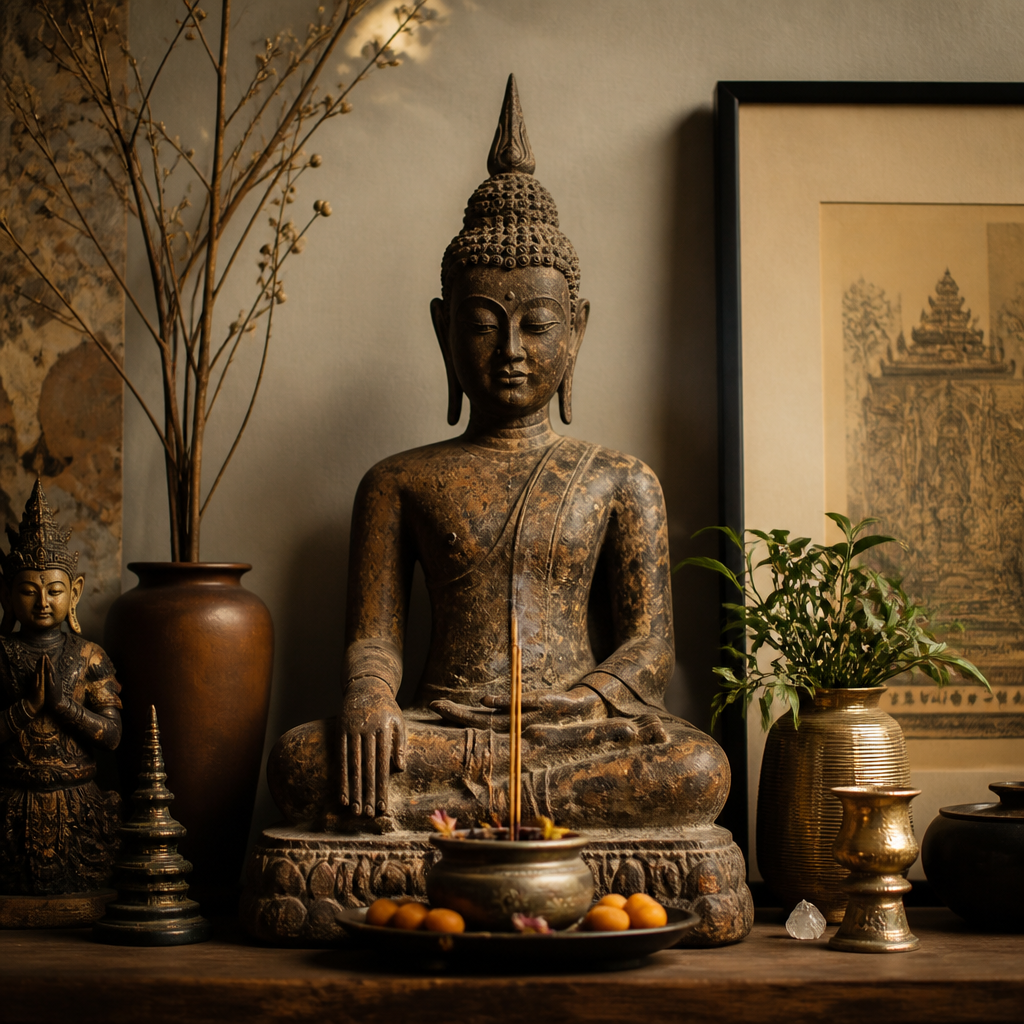
The robe is where Mandalay iconography becomes most precise. The uttarasanga, the outer monastic robe, is worn in what scholars call the open mode, leaving the right shoulder and arm exposed. This is a standard iconographic feature of Mandalay style, not an unusual variant, and its presence in a standing or seated figure strongly supports a Mandalay attribution. The robe surface is typically elaborately treated, often with gilding and occasionally with lacquer-inlaid detail. The combination of bronze or marble with applied gilding and mirror-glass inset work is characteristic of Mandalay production at its most elaborate.
Most Mandalay Buddhas are shown seated in bhumisparsha mudra (earth-touching), though standing figures with the abhaya gesture (fearlessness) also exist. Pedestals are generally single or double lotus bases, often finely worked. The Jambhupati type, the Buddha depicted in royal attire with a tiered crown and elaborate flanged headdress, also appears in Burmese production of this and the preceding Ava period, though it is not the standard Mandalay type.
The Period Question: 1885 and Later Production
The British annexation of upper Burma in 1885 disrupted royal patronage but did not stop workshop production. Skilled craftsmen continued producing work in the established Mandalay manner well into the twentieth century. This means that "Mandalay style" and "Mandalay period" are not the same thing, and the distinction matters significantly to collectors. A piece made in Mandalay style in 1920 is not a period piece, regardless of how faithfully it follows the iconographic conventions of the nineteenth century. Provenance documentation, construction details, and patina analysis all become important tools when assessing whether a Mandalay-style figure is a genuine period piece or a high-quality later production.
Side-by-Side: Comparing the Three Styles
The table below summarises the defining characteristics of each style across the most collector-relevant categories. Use it as a starting checklist, not a definitive verdict, since individual pieces often blend features or show transitional influences.
|
Feature |
Pagan Period (11th to 13th century) |
Shan Style (14th century onward) |
Mandalay Style (19th century, Konbaung era) |
|---|---|---|---|
|
Facial type |
Broad forehead, tapering face, restrained dignity, slightly Mongoloid eyes |
Oval or heart-shaped face, high arched brows, downcast almond eyes, "Shan smile" |
Full, fleshy face, youthful sweetness, slanted brows, rounder expression |
|
Ushnisha |
High, prominent, often conical |
Often flame-shaped (Lan Na influence) |
Wide, prominent, tight curled hair, no lotus finial |
|
Robe treatment |
Austere, controlled drapery, minimal embellishment |
Simple, lightly detailed, restrained surface |
Elaborate, open-mode uttarasanga, gilded, often lacquered |
|
Common materials |
Bronze (lost-wax), sandstone, brick and plaster, wood |
Wood, bronze |
Bronze, marble, gilded lacquer, mirror-glass inlay |
|
Body proportions |
Balanced, formal, sculptural authority |
Slender, elongated, weightless elegance |
Substantial, well-rounded, formally composed |
|
Primary artistic influences |
Mon, Indian Gupta and Pala traditions |
Lan Na (northern Thai), Mon, Sukhothai cross-border exchange |
Konbaung court patronage, established Burmese royal iconography |
|
Collector identification priority |
Forehead width, eye shape, patina, casting quality |
Body slenderness, eye direction, ushnisha shape, robe simplicity |
Facial sweetness, robe mode, hair curls, gilding, provenance |
What Collectors Should Examine Before Buying
Attributing a Burmese Buddha statue correctly requires examining several features in sequence, and the sequence matters. Starting with the mudra is a common mistake because the earth-touching gesture is widespread across all Burmese traditions and cannot distinguish a regional style on its own. Start with the head instead.
The Examination Sequence That Works
Begin with the forehead. Is it broad, as in the Pagan type, or more standard in width? Then look at the eyes: downcast and almond-shaped points toward Shan, fuller and slightly slanting toward Mandalay. Assess the face shape: tapering for Pagan, oval or heart-shaped for Shan, fuller and rounder for Mandalay. Only after reading the facial type should you move to the robe, the ushnisha, and the pedestal, confirming whether the secondary features agree with your initial facial reading.
Material analysis comes next. Bronze, wood, marble, and lacquer age in different ways, and surface condition should always be read in light of the medium. A Pagan bronze may retain a restrained cast surface and patina that keeps the sculptural modelling prominent. Mandalay work often combines bronze or marble with lacquer, gilding, and mirror-glass details that create a more elaborate, visually layered effect. Shan figures encountered in wood often show the natural aging patterns of the regional timber used, which can be a supporting indicator when the facial and robe features already suggest Shan attribution.
Authenticity Red Flags and Provenance
For pieces described as Mandalay period rather than merely Mandalay style, provenance documentation is genuinely important. The long continuity of workshop production in the Mandalay manner means that a confident period attribution requires more than style matching. Look for documentation of prior ownership, acquisition history, or any published exhibition record. For Pagan-attributed bronzes, construction details such as the casting method and any evidence of repair or restoration also inform the question of date.
Reproductions exist across all three categories. The honest position is that reproduction quality has improved significantly over time, and visual inspection alone is not always conclusive for a single feature. What protects collectors is examining multiple features together and insisting that they agree. A piece where the face, robe, material, and construction details all point consistently to the same tradition is far more securely attributed than one where only one feature matches.
When building a collection, it is worth acquiring at minimum one well-documented confirmed example of each tradition to use as a personal reference point. Auction house catalogues from reputable sales, museum collection records, and specialist dealers who can discuss attribution in detail are all part of the toolkit. Browsing museum-quality Burmese Buddha statues with style annotations helps train the eye in ways that description alone cannot replicate.
For collectors specifically interested in the ritual and devotional context of these pieces, understanding Buddhist iconography more broadly provides useful background for understanding how Burmese conventions both conform to and depart from the wider pan-Asian tradition.
Pro tip: When a seller attributes a piece to "Pagan period" based solely on the earth-touching mudra, treat that attribution with caution. Bhumisparsha appears in Shan and Mandalay work equally. The period attribution needs to rest on the facial structure, casting quality, and construction, not the hand gesture.
Frequently Asked Questions
What is the difference between Pagan style and Mandalay style in Burmese Buddha statues?
Pagan-style Buddhas reflect the eleventh to thirteenth century artistic tradition of the Bagan Empire, drawing on Mon and Indian Gupta and Pala influences. They tend toward a broad forehead, tapering face, restrained drapery, and austere casting. Mandalay-style Buddhas represent the nineteenth century Konbaung court aesthetic: a youthful, sweet-featured face, tight curled hair rising to a wide ushnisha, elaborately gilded robes in the open mode, and a heavier use of lacquer and mirror-glass detail. The two periods are separated by roughly seven centuries and are visually quite distinct once you know what to look for.
How can I tell if a Burmese Buddha statue is Shan style?
Look for a slender, elongated body, an oval or heart-shaped face, high arched eyebrows, and downcast almond eyes. The mouth should show a subtle, understated curve often described as the "Shan smile," which is noticeably quieter than the fuller expression of Mandalay figures. The ushnisha on Shan figures frequently takes a flame shape due to Lan Na influence. The robe surface is typically simple and lightly detailed. Wood is a common Shan medium. If all of these features agree, a Shan attribution is well-supported.
Is a Burmese Buddha statue made after 1885 still considered a period piece?
Not automatically. The British annexation of upper Burma in 1885 ended royal patronage but workshop production in the Mandalay style continued through the twentieth century. A piece made in Mandalay style in the early twentieth century is a later production, not a nineteenth century period piece, even if it perfectly replicates the iconographic conventions of the Konbaung era. For collectors buying at a level where period authenticity matters, provenance documentation and construction analysis are necessary rather than optional.
What materials are most common for each style of Burmese Buddha statue?
Pagan period pieces were made in bronze using the lost-wax method, sandstone, and brick and plaster for larger temple images. Shan figures appear most often in wood, though bronzes exist. Mandalay production favoured bronze and marble, frequently finished with applied gilding, lacquer, and mirror-glass inlay for a more elaborate visual effect. Material can support an attribution but should always agree with the facial and robe analysis before being treated as confirmatory.
Why does the earth-touching mudra appear so frequently across all Burmese styles?
Bhumisparsha mudra, the gesture in which the right hand touches the earth to call the ground as witness to the Buddha's enlightenment, holds central importance in Theravada Buddhist iconography. Burma's dominant religious tradition is Theravada, so this gesture appears persistently across all regional schools from Pagan to Mandalay. It identifies the subject of the sculpture iconographically but cannot on its own distinguish the regional style. Collectors who rely on it as a style marker will misattribute pieces regularly.
Are Shan Buddha statues less valuable than Mandalay or Pagan pieces?
Value depends on age, quality, rarity, condition, and provenance rather than on style category alone. A well-documented antique Shan Buddha in excellent condition with a refined facial treatment and clear provenance is a serious collector piece. The perception that Mandalay pieces command higher prices partly reflects their greater market familiarity and the prestige of the royal workshop context, not an inherent artistic hierarchy. Pagan bronzes, when genuinely attributable to the period, are relatively rare and correspondingly sought after by specialist collectors.
What should I look for in a Burmese Buddha statue to confirm it is museum quality?
Museum quality comes down to the precision and consistency of the iconographic features, the technical execution of the casting or carving, the integrity of the surface, and the coherence of the attribution. In Burmese terms, this means a facial type that is distinctly and confidently of its tradition, a robe treatment that follows the period conventions accurately, and a material finish that agrees with the style rather than contradicting it. Added gilding or lacquer on a supposed Pagan bronze, for instance, is worth scrutinising carefully. Documented provenance that traces a piece back through reputable prior ownership adds further assurance.
If you are currently building or refining a Burmese Buddha collection, share what style or period draws you most, and what questions the acquisition process has raised for you, in a message or enquiry.
References
-
How to identify Burmese Buddha statue styles: Ava, Shan, and Mandalay visual guide
-
Mandalay style Burmese Buddha statues: iconographic features and collector guide
-
How to recognise Mandalay, Shan, and Pagan style in Burmese Buddha statues
-
Grace in stillness: the Shan-style Buddha of Burma, history and characteristics
-
Burmese art overview: Pagan dynasty, Theravada Buddhism, and sculptural traditions
