



Buddhist Sculpture Provenance Archive Research
Buddhist Sculpture Provenance Archive Research
Table of Contents
- What Provenance Means for Buddhist Sculpture
- Building a Provenance Research Checklist for Asian Art
- Searching Museum Collection Databases for Buddhist Art
- Auction and Sales Archives: Tracing Ownership Records
- Buddhist Sculpture Exhibition Catalogs as Documentation
- Accessing Buddhist Art Digital Resources and Archives
- Evaluating Evidence and Resolving Provenance Gaps
- Frequently Asked Questions
What Provenance Means for Buddhist Sculpture
Provenance is the documented ownership and exhibition history of an artwork from its creation to the present day. For Buddhist sculpture, provenance archive research establishes authenticity, cultural significance, and ethical acquisition.
A sculpture with clear provenance commands trust. Without it, even exceptional pieces raise questions about their past.
The stakes matter. The Asian Art Museum's 2024 provenance research led to the return of four bronze Buddhist deity sculptures to their countries of origin. This demonstrates why provenance work is essential.
Provenance gaps require investigation. A missing decade might have a simple explanation or warrant deeper scrutiny.
Building a Provenance Research Checklist for Asian Art
A provenance research checklist for Asian art transforms scattered information into a structured workflow: object identification → archive search → evidence gathering → timeline construction.
Step 1: Document the Object Itself
Create a detailed object record before searching archives, this becomes your search anchor and reference point.
- Physical description: Material (bronze, stone, wood), dimensions (height in inches, weight if known), surface condition (patina, wear patterns, repairs)
- Iconographic markers: Deity or subject depicted, hand gestures (mudras), symbolic objects held, seated or standing posture, any inscriptions or marks
- Regional and stylistic clues: Geographic origin (Thai, Cambodian, Tibetan, Chinese, Japanese), estimated period (century or dynasty), artistic style or school
- Photographs: Multiple angles, detail shots of inscriptions or marks, overall composition
- Current documentation: Any existing labels, certificates, dealer descriptions, or family records
Step 2: Create a Provenance Timeline Template
Set up a simple chronological table with four columns:
| Date/Period | Owner or Location | Source of Information | Confidence Level |
|---|---|---|---|
| 1850-1920 | Unknown (presumed creation period) | Stylistic analysis, iconographic comparison | Medium |
| 1920-1950 | [Name if known] | Auction catalog, museum record, family account | High/Medium/Low |
| 1950-1980 | Unknown | Gap in documentation | , |
| 1980-2010 | [Name] | Dealer invoice, exhibition catalog | High |
| 2010-present | Current owner | Purchase receipt, insurance appraisal | High |
This template distinguishes between documented facts, educated guesses, and genuine gaps, showing where to focus searches.
Step 3: Develop a Source Log
Maintain a log of every source consulted:
- Source name and type: Museum database (e.g., Metropolitan Museum Open Access Collection), auction house archive (Christie's, Sotheby's), library catalog, scholarly publication
- Search terms used: "Thai bronze Buddha," "12th-century Khmer sculpture," specific deity names
- Results found: Number of matches, titles of relevant pieces, links or catalog numbers
- Relevance to your object: Does it match your sculpture's style, period, or iconography? Why or why not?
- Date accessed: When you searched, so you can return to the same results later
This log prevents duplicate work and reveals patterns, if multiple databases return similar pieces from the same region and period, that strengthens attribution.
Step 4: Identify and Search Key Archives
Prioritize archives based on your sculpture's likely origin:
- For Thai or Cambodian sculpture: Start with the Metropolitan Museum of Art's Asian Art collection, the Art Institute of Chicago's Southeast Asian holdings, and the Los Angeles County Museum of Art's Buddhist art database.
- For Tibetan bronze sculpture: The Rubin Museum of Art (New York) maintains a specialized collection; also search university collections at institutions with Tibetan studies programs.
- For Chinese Buddhist sculpture: The Palace Museum (Beijing) and major auction houses (Christie's Asian Art sales, Sotheby's Chinese Art auctions) maintain extensive catalogs.
- For Japanese sculpture: The Tokyo National Museum and major Japanese auction houses publish online records.
Step 5: Record Conflicting Information
When sources disagree, record:
- What each source claims
- The basis for each claim (stylistic analysis, inscription, previous scholarship)
- Which source appears more authoritative (museum catalog vs. dealer description)
- Whether the discrepancy might reflect a genuine uncertainty or a documented change in attribution over time
Searching Museum Collection Databases for Buddhist Art
Museum collection databases are your primary research tool.
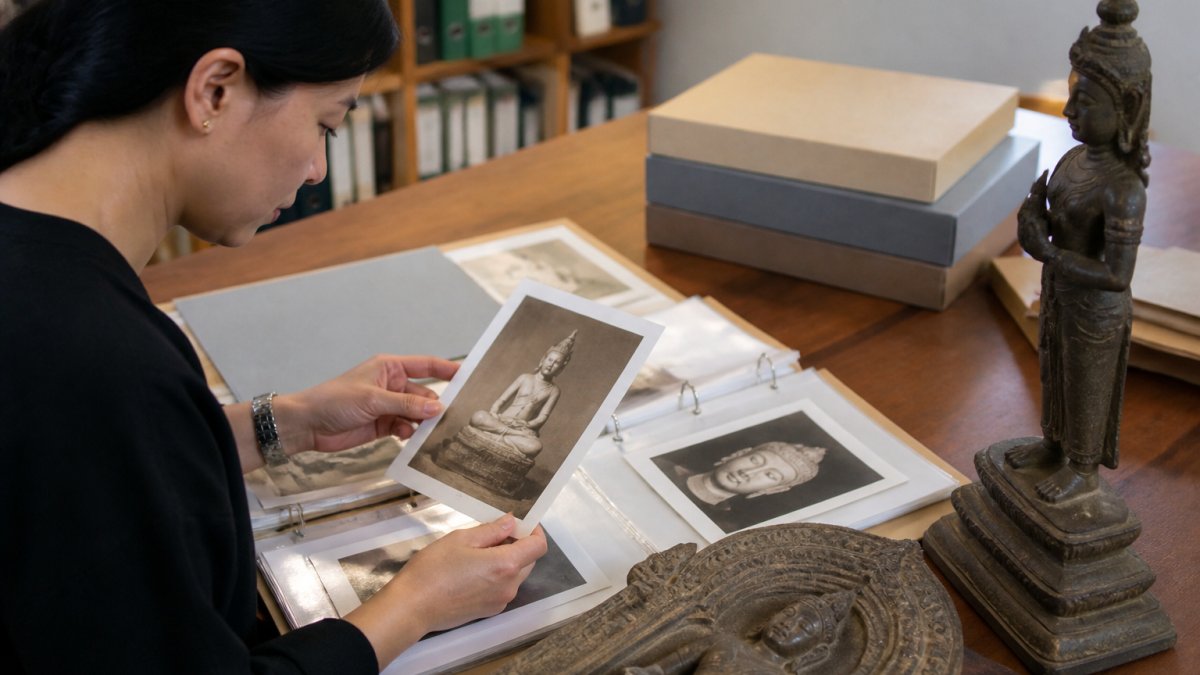
Search by object type, region, or deity, then refine by date range. Compare provenance statements of similar pieces, documented ownership may illuminate your object's history.
Note every match. Even pieces that aren't identical provide context. They show where similar sculptures have appeared, who collected them, and what institutions have studied them.
Thorough database entries cite previous exhibitions, sales, and scholarly publications, these citations become your next research leads.
Auction and Sales Archives: Tracing Ownership Records
Auction houses maintain records of sold objects with provenance statements and condition reports. Christie's, Sotheby's, and Bonhams publish online catalogs spanning decades.
Read provenance statements carefully, auction houses are legally required to disclose known ownership history, creating documented moments in ownership chains.
Multiple auction appearances suggest active collecting and documentation, with each sale providing catalog entries, photographs, and condition notes.
If your sculpture matches one sold previously, contact the auction house for additional documentation or owner information.
Buddhist Sculpture Exhibition Catalogs as Documentation
Museum exhibition catalogs are valuable provenance tools. Published entries document ownership, condition, and scholarly analysis at specific moments.
Exhibition catalogs often include:
- High-quality photographs from multiple angles
- Detailed physical descriptions and dimensions
- Iconographic analysis identifying the deity or subject
- Comparative references to similar sculptures
- Provenance statements as known at exhibition time
- Conservation notes
Search library catalogs and museum websites for exhibitions featuring Buddhist sculpture. Digitized catalogs provide dated, published reference points.
Catalogs reveal ownership changes, a sculpture exhibited under different owners at different times documents transfers and creates provenance chains.
Accessing Buddhist Art Digital Resources and Archives
Online repositories democratize provenance research:
- Museum collection databases (searchable by institution)
- Scholarly image archives (university collections and research centers)
- Auction house catalogs (Christie's, Sotheby's, Bonhams online archives)
- Conservation and condition reports (specialized research institutions)
- Photographic archives (historical documentation of known pieces)
The Digital Orientalist's 2022 resource guide identifies multiple digital repositories for Central Asian Buddhist art, including university collections and specialized research institutes. These resources span institutions worldwide and offer free or low-cost access.
Start with Google Arts & Culture, which aggregates collections from thousands of museums. Bookmark relevant results to build a visual database of comparable pieces.
Evaluating Evidence and Resolving Provenance Gaps
Provenance research often generates conflicting information.
Build an Evidence Hierarchy
Not all sources carry equal weight. Establish a ranking system:
- Primary documents (highest authority): Original purchase receipts, dated photographs with provenance notes, museum acquisition records with contemporaneous documentation, customs or import-export paperwork, dated letters or diaries from previous owners.
- Published institutional records (high authority): Museum exhibition catalogs with scholarly entries, peer-reviewed academic publications, auction house catalogs from reputable houses (Christie's, Sotheby's, Bonhams) with detailed provenance statements.
- Secondary sources (medium authority): Dealer descriptions, insurance appraisals, condition reports from conservators, family accounts or oral histories, online collection databases.
- Tertiary or unverified sources (low authority): Blog posts, social media claims, unattributed photographs, dealer websites without institutional backing, hearsay.
Weight evidence according to this hierarchy, a museum catalog entry from 1985 outweighs a recent dealer claim.
Apply the Corroboration Test
Corroboration strengthens evidence. If multiple independent sources agree on date and origin, that agreement is significant.
Common reasons for conflict:
- Misidentification over time: A sculpture cataloged as "Thai Buddha" in 1960 might be reattributed as "Cambodian Bodhisattva" in 2010 based on new iconographic analysis. Both records are legitimate; the later one typically reflects more current scholarship.
- Incomplete information: Early catalogs sometimes lacked detail. A 1970s auction entry might list only "Bronze Buddha, 12th century" without specifying region. Later research may narrow this to "Thai bronze Buddha, 13th century, Sukhothai period."
- Dealer inflation or error: A dealer might claim a sculpture is "rare" or "museum-quality" without evidence. Cross-reference dealer claims against museum records and scholarly publications.
- Inscription or mark misreading: If your sculpture bears an inscription or maker's mark, multiple experts may interpret it differently. Consult specialized scholars or conservation labs for authoritative readings.
Match Your Object to Archival Records
Connect your specific sculpture to documented pieces and ownership histories.
When you find a museum record or auction catalog entry for a similar piece, ask:
- Does it match iconographically? Does the deity, posture, and symbolic objects match your sculpture? Minor variations (different hand position, additional ornaments) are normal across regional styles and time periods.
- Does it match stylistically? Compare surface treatment, proportions, casting or carving technique. A bronze with similar patina and wear patterns suggests a similar age and provenance environment.
- Does it match dimensionally? Sculptures of the same type and period typically fall within a predictable size range. A "12th-century Thai Buddha" should be within a few inches of comparable museum examples.
- Does the provenance statement overlap with yours? If a museum piece was owned by the same collector or passed through the same auction house, that connection documents a moment in your sculpture's potential history.
Matching on all criteria provides a strong reference; partial matches warrant further investigation.
Resolve Gaps Honestly
Many authentic sculptures have missing decades. A gap does not invalidate the piece, but it requires honesty.
When encountering a provenance gap:
- Acknowledge it explicitly: State unknown periods rather than inventing history.
- Investigate plausible explanations: Private collecting, dealer records, or storage are common scenarios that don't indicate illicit activity.
- Look for indirect evidence: Photographs, scholarly mentions, or customs records can help bridge gaps.
- Document your reasoning: If you conclude that a gap is likely due to private collecting rather than illicit trade, explain which sources and comparative examples support that conclusion.
Create a Confidence Statement
Once you've evaluated all available evidence, write a brief provenance summary that reflects your findings:
Example: "This bronze Buddha is documented as Thai, likely 13th-century Sukhothai period, based on iconographic comparison with Metropolitan Museum examples and stylistic analysis. Ownership is documented from 1920-1950 (Christie's auction catalog, 1950) and from 1980-present (current owner). Ownership from 1950-1980 is unknown; no records have been located. The sculpture's condition and patina are consistent with age and outdoor exposure in a tropical climate, supporting the Thai origin attribution."
This statement is honest about what you know, what you don't know, and why you believe what you do.
Avoid speculation presented as fact. Phrases like "probably belonged to" or "likely passed through" should be clearly marked as inference, not documentation. Your provenance research is only as strong as your willingness to distinguish between verified evidence and educated guesses.
Frequently Asked Questions
What does provenance mean for a Buddhist sculpture?
Provenance is the documented ownership history of a Buddhist sculpture from creation to the present day. It includes acquisition records, exhibition details, previous owners, and any transfers between collections. Strong provenance establishes authenticity and cultural significance. Museums and collectors use provenance research to verify that a sculpture's origins and past ownership are legitimate and traceable. Museums and other institutions conduct extensive provenance research to ensure works in their collections have verified histories.
How do you research the provenance of a Buddhist sculpture?
Start by documenting the sculpture's physical characteristics: material, style, inscriptions, and iconography. Then search museum collection databases, auction archives, and digital resources like the Huntington Archive. Cross-reference exhibition catalogs and customs records. Check for acquisition documentation from previous owners. Compare findings across multiple sources to build a complete ownership chain. A documented ownership history should not be treated as automatically reliable; assess records critically, as fraudulent provenance can serve as reassurance and misinformation.
Which archives and museum databases can help with Buddhist art research?
The Huntington Archive functions as a major photographic archive of Buddhist art and is a key digital resource for Central Asian Buddhist sculpture research. Museum collection databases allow keyword searches by object type, material, and origin. Scholarly organizations provide access to photographs and documentation. These digital resources support both initial object identification and cross-referencing to verify provenance claims across collections.
What should I record when I find a possible archival match for a sculpture?
Document the source (museum, archive, or catalog name and date), the object record number or catalog entry, any photographs or descriptions, acquisition details, previous owners listed, exhibition history, and material or conservation notes. Record the exact URL or reference location if the resource is digital. Note any gaps or inconsistencies between the archival record and the sculpture you are researching. Keep detailed notes on how the match was found and which search terms or databases yielded results. This documentation forms the foundation of your provenance chain.
