



Benefits of Using Mudras in Daily Mindfulness
Benefits of Using Mudras in Daily Mindfulness
Table of Contents
- What Mudras Are and Why They Fit Into Daily Mindfulness
- The Science Behind Mudras: How Hand Gestures Affect the Brain and Body
- How to Practice Mudras for Beginners: A Step-by-Step Guide
- Best Mudras for Focus and Concentration
- Duration of Mudra Practice for Mindfulness: Time-Based Protocols
- Mudras for Stress Relief and Emotional Balance
- When to Avoid Mudras: Contraindications and Safety
- Conclusion: Making Mudras a Daily Ritual
- Frequently Asked Questions
What Mudras Are and Why They Fit Into Daily Mindfulness
Mudras are deliberate hand gestures used in yogic tradition to direct attention and shape the quality of a meditation session. This guide from HD Asian Art examines the benefits of using mudras in daily mindfulness, and why a practice this small fits so easily into an ordinary day.
The appeal is friction. A mudra needs no mat, no app, and no block of free time. You can hold one at a desk, on a train, or in the two minutes before a meeting starts. That low barrier is exactly why the practice survives in busy lives where longer routines collapse.
For anyone building a home meditation space, a statue or sculptural focal point gives the hands somewhere to rest and the eyes somewhere to settle. HD Asian Art curates Buddhist and Hindu statues made for precisely that role.
The Science Behind Mudras: How Hand Gestures Affect the Brain and Body
Most guides explain mudras with energy channels you cannot verify. A more useful explanation starts with anatomy you can.
The fingertips are among the most densely innervated areas of the body. The median, ulnar, and radial nerves fan across the hand and fingers, and the pads of the thumb and index finger carry a concentration of mechanoreceptors, the sensors that report pressure, stretch, and vibration, far higher than most other skin surfaces. When you press thumb and index finger together, you are not sending a mystical signal. You are delivering a steady, low-level stream of tactile input into the somatosensory cortex, the strip of brain that maps the body's surface.
That matters for two reasons.
First, it occupies attention. Mindfulness practice is largely a fight against mind-wandering, and the standard fix is to give attention something concrete to hold. Breath is the usual anchor. A mudra adds a second, tactile anchor that is available even when breathing feels automatic and easy to ignore. Two anchors are harder to lose than one.
Second, it pairs with the exhale. Slow breathing with a longer exhale than inhale is one of the better-studied ways to nudge the autonomic nervous system toward parasympathetic activity, the 'rest and digest' branch (The physiological effects of slow breathing in the healthy human). The vagus nerve, which carries much of that signaling, is also engaged by the kind of sustained, gentle pressure and slow movement used in many contemplative practices. A mudra does not stimulate the vagus nerve directly the way humming or cold exposure does, and no one should claim it does. What it does is reliably accompany slow breathing, and the pairing is what practitioners report as settling.
There is also a straightforward behavioral mechanism, and it may be the strongest one. A mudra is a cue. In habit terms, it is the trigger that precedes a routine and delivers a reward, a few minutes of relative calm. Repeated in the same seat, at the same time, with the same gesture, the cue becomes automatic. This is the same principle behind a specific chair meaning 'work' and a specific pillow meaning 'sleep.' The gesture is not the state; it is the doorway to it.
What the research does not support is mudras as a treatment for disease. There is no credible evidence that a hand position lowers blood pressure, cures illness, or replaces medical care. The defensible claims are narrower: tactile anchoring, breath pacing, and habit cueing. Those three are enough to explain why the practice works for so many people, and they are the parts worth building a routine around.
If you want to test the mechanism yourself, run a simple comparison. For one week, hold Gyan mudra with slow breathing. The next week, breathe the same way with your hands open in your lap. Most practitioners find the gesture week is easier to repeat, even when the felt difference during any single session is small. That repeatability is the point.
How to Practice Mudras for Beginners: A Step-by-Step Guide
Start with one mudra, one time of day, and two minutes. That is the whole beginner protocol, and it works better than a longer routine you abandon by Thursday.
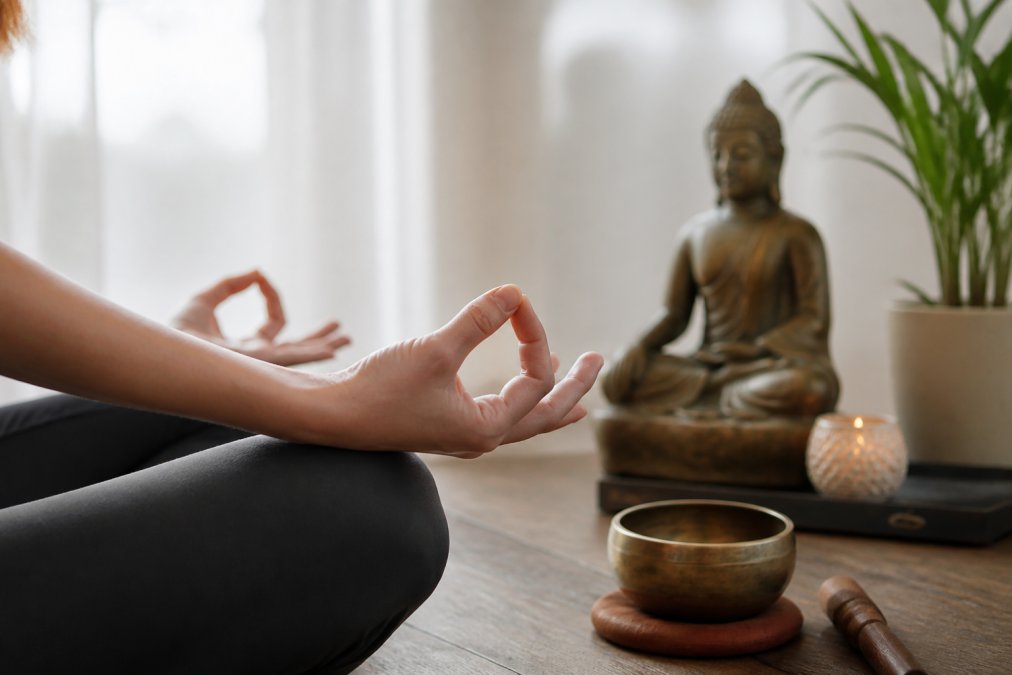
Total Time: 5 minutes to learn, 2-5 minutes per session Difficulty: Beginner
What You'll Need
- A quiet seat, ideally the same one each day
- Nothing else. No equipment is required
Step 1: Choose your seat and settle [Time: 1 minute] Sit upright with both feet flat and shoulders relaxed. Rest your hands on your knees or thighs, palms up.
Step 2: Form the gesture [Time: 30 seconds] Bring the tips of your thumb and index finger together with light pressure. The remaining three fingers stay relaxed and extended, not rigid.
Step 3: Add the breath [Time: 2-5 minutes] Breathe in through the nose for a count of four, out for a count of six. Let the hand stay still. If your attention drifts to the fingers, that is fine; the fingers are the anchor.
Step 4: Close deliberately [Time: 30 seconds] Release the gesture, sit for three breaths, then move on with your day.
Expected Result: A short, repeatable pause you can actually sustain. Most beginners notice it is easier to return to the practice the next day when the session is this short.
A common mistake is gripping too hard.
Best Mudras for Focus and Concentration
The best mudras for focus and concentration are the ones simple enough to hold without thinking about them. Complexity defeats the purpose.
- Gyan mudra (thumb and index finger touching): the default choice for study, reading, or any task needing sustained attention
- Prana mudra (thumb, ring finger, and little finger touching): used when fatigue is the real obstacle rather than distraction
- Vayu mudra (index finger folded to the base of the thumb): a quieter gesture for people who find the open-hand positions restless
Duration of Mudra Practice for Mindfulness: Time-Based Protocols
The right duration depends on what you are building, not on a fixed rule handed down from tradition. Traditional sources cite everything from a few minutes to long holds, and the honest answer is that consistency matters more than length. Here is a workable structure.
| Session Length | Best For | Frequency | What to Expect |
|---|---|---|---|
| 2-3 minutes | Building the habit | Daily | Easy to sustain, minimal disruption |
| 5-10 minutes | Focus before a task | Most days | Noticeable settling, clearer start |
| 15-20 minutes | Deeper meditation practice | 2-3 times weekly | Fuller integration with breathwork |
A Daily Schedule You Can Actually Keep
Most guides stop at the table. A schedule is more useful, because it removes the daily decision of when and what to practice.
How to Adjust the Schedule
If you already have an established meditation practice, layer the mudra onto it rather than adding a separate session. The gesture slots into what you are already doing, and the schedule above collapses into your existing routine.
Mudras for Stress Relief and Emotional Balance
For stress, the breath does most of the work and the mudra keeps your hands from fidgeting. That combination is what makes it useful in a genuinely stressful moment rather than only in a calm one.
When to Avoid Mudras: Contraindications and Safety
Skip mudras, or modify them, in a few specific situations. Anyone with hand arthritis, carpal tunnel syndrome, or a recent hand or wrist injury should avoid sustained finger pressure and check with a physician or physical therapist first.
Conclusion: Making Mudras a Daily Ritual
The reason this practice endures is that it asks so little and returns something reliable: a two-minute pause you can actually keep. Attach it to something you already do, the first coffee, the commute, the moment before you open your laptop, and it stops being a discipline and becomes a habit.
Frequently Asked Questions
What are the benefits of using mudras for meditation?
Mudras can improve focus, reduce stress, and support emotional balance. They give your hands a gentle anchor, which helps quiet mental chatter during daily mindfulness. Many practitioners find that combining mudras with conscious breathing deepens their meditation practice and promotes a sense of inner peace.
How many mudras can we do in a day?
You can practice several mudras daily, but it's best to start with one or two and gradually add more. A common approach is to choose a mudra for morning focus and another for evening relaxation. The duration of mudra practice for mindfulness can range from 5 to 20 minutes per session, depending on your schedule and experience.
Are mudras actually effective for stress relief?
Yes, many people find mudras effective for stress relief. The gentle pressure on nerve endings in the hands may help calm the nervous system. When combined with slow breathing, mudras can lower stress and promote relaxation. Consistency matters more than duration, so even a few minutes each day can make a difference.
Can mudras be used by beginners in daily mindfulness?
Absolutely. Beginners can easily learn how to practice mudras for beginners by starting with simple gestures like Gyan mudra (thumb and index finger touching). No special equipment is needed. Just find a comfortable seat, rest your hands on your knees, and focus on your breath while holding the mudra for a few minutes.
