



Amitabha Buddha vs Shakyamuni: How to Tell Them Apart
Amitabha Buddha vs Shakyamuni: How to Tell Them Apart
If a gilded seated Buddha has no label, can you really tell who it is from the face or pose? The useful question in Amitabha Buddha vs Shakyamuni isn't which looks more serene. It's what the image depicts the Buddha doing, who accompanies him, and what kind of devotion the image supports.
Table of Contents
- Why Amitabha and Shakyamuni Get Confused
- Side-by-Side Identity and Teaching Differences
- Identify Each Buddha and Avoid Common Mistakes
- Pure Land Practice Versus Teaching the Dharma
- Which Buddha Fits Your Altar, Memorial or Collection
- Confirm the Identity Before You Buy or Display
Why Amitabha and Shakyamuni Get Confused
A visitor stands before a gilded Buddha on a home altar and asks whether it's Shakyamuni or Amitabha. The crossed legs, robes and calm expression seem familiar, but none supplies a secure answer. Those features establish a Buddhist visual language more readily than an individual identity.
Shakyamuni is the historical Buddha of the Shakya clan, who awakened and taught in ancient India. Amitabha, the Buddha of Infinite Light, is associated especially with the Western Pure Land and the aspiration for rebirth there. They're distinct figures, but treating them as competitors misunderstands their relationship.
Different roles, not rival Buddhas
The practical distinction concerns how devotees understand their path. Shakyamuni connects practitioners with the historical Buddha's teaching; Amitabha devotion particularly concerns reliance on his vow and aspiration for rebirth in Sukhāvatī. As the discussion in Education About Asia explains, Pure Land belief needs to be understood through its devotional purpose, not merely through the appearance of its images.
Sukhāvatī shouldn't be equated with nirvana. It is understood as a favourable realm for continued progress towards final awakening, rather than a different name for the ultimate goal. That distinction helps explain why a household might honour both Buddhas without seeing any contradiction.
A shrine containing both figures can express complementary commitments, not a choice between opposing teachers.
For someone buying a statue, the first question is therefore about meaning: historical teaching, Pure Land devotion, or a broader appreciation of Buddhist art. Comparison provides a starting point; identification requires evidence, and placement requires an understanding of practice. A useful result isn't just a name on a label, but a name accompanied by an honest level of confidence.
Side-by-Side Identity and Teaching Differences
Shakyamuni and Amitabha compared on identity and devotion
| Criterion | Shakyamuni | Amitabha |
|---|---|---|
| Who the figure is | Historical Buddha of the Shakya clan who awakened and taught in ancient India | Buddha of Infinite Light and principal Buddha of Pure Land traditions |
| Main role | Teacher whose sermons transmit the Dharma | Welcoming Buddha who draws devotees to his paradise |
| Promised destination | Awakening through the teaching and discipline | Rebirth in Sukhāvatī, the Western Pure Land |
| Usual companions | Named disciples, bodhisattvas or a sermon assembly | Avalokiteśvara and Mahāsthāmaprāpta, forming the Pure Land triad |
| Typical scene | Preaching beneath a canopy | Welcoming souls to paradise, or descending at the deathbed |
| Devotional method | Study, meditation and ethical conduct | Recitation of the name, visualisation and aspiration for rebirth |
| Usual statue setting | Teaching halls and meditation altars | Memorial altars and Pure Land shrines |
These are interpretive starting points, not exclusive rules. The destination row, for example, compares a goal of practice with a realm of rebirth, not competing geographical destinations. Likewise, a statue's present location tells you how someone uses it today, but doesn't necessarily establish its original identity.
Scale doesn't separate the figures either. The British Museum's colossal Chinese Amitabha is 5.78 metres tall and dated to 585 CE, as described in the museum object feature reproduced by Museums.EU. Its monumental form shows how extensively devotees could invest in Amitabha imagery; it doesn't make size a diagnostic feature.
Use the clearest surviving evidence
Start with whichever row the object makes easiest to assess. A painting may preserve a complete welcoming scene, whereas an isolated bronze may retain only its hands and base. A group sculpture may offer stronger evidence through its attendants than through the central Buddha's face.
For the historical background behind the Shakyamuni column, our guide to the life and teachings of Siddhartha Gautama explains the teacher represented by the image. Keep biography separate from identification: knowing who Shakyamuni was doesn't establish that every unlabelled Buddha depicts him.
Try completing just the typical scene row for an object you're examining. Write what you can see, such as listeners gathered around a teacher, rather than immediately naming the Buddha. That small separation between observation and interpretation prevents a plausible impression from becoming an unsupported attribution.
Identify Each Buddha and Avoid Common Mistakes
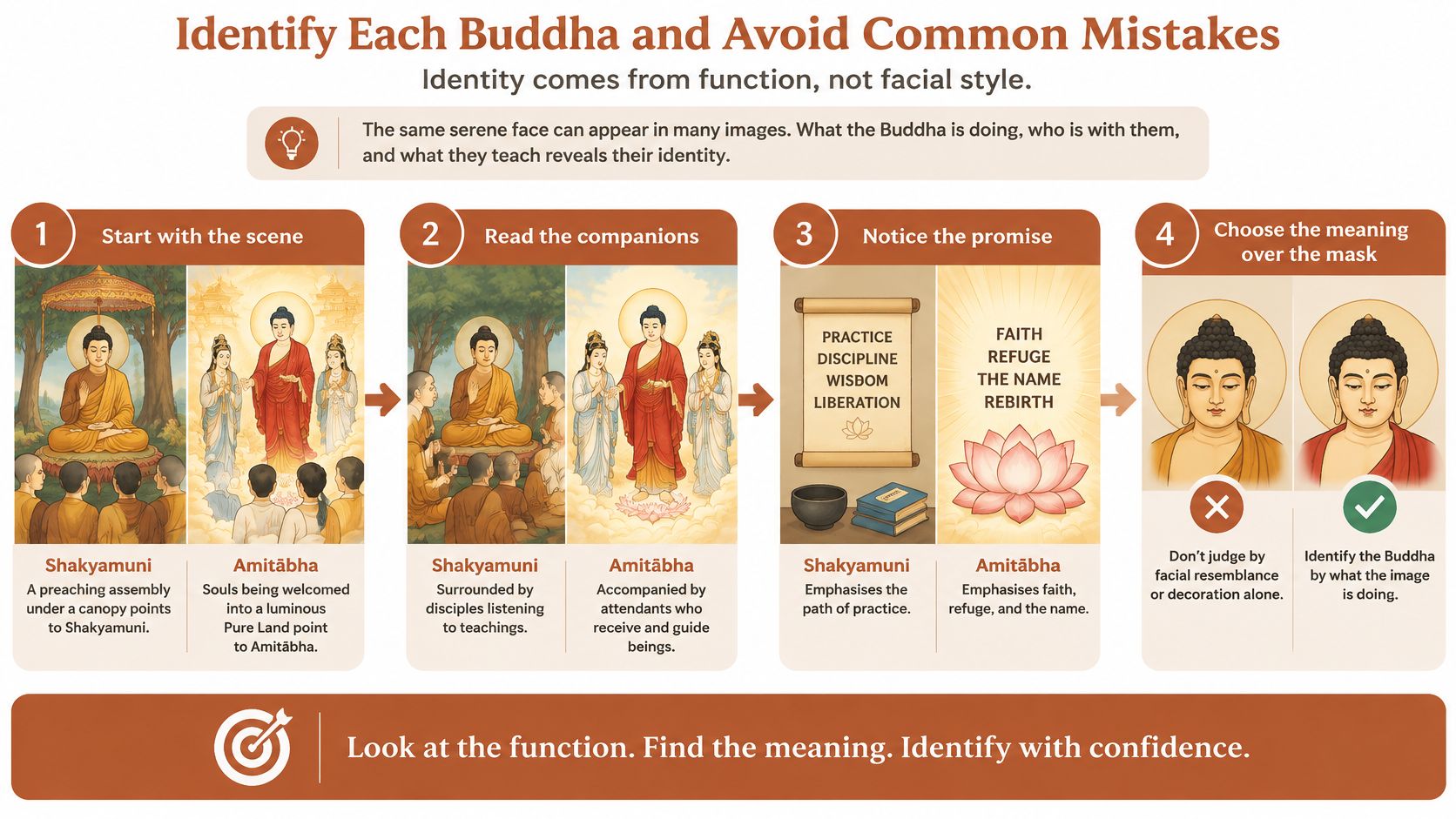
Identity comes from iconographic function, not facial style. The British Museum's Shakyamuni identification record provides a useful reference for the historical Buddha, while the distinction between sermon imagery and Pure Land imagery gives collectors a practical way to organise their observations.
Follow the evidence in order
- Start with the scene. A preaching assembly beneath a canopy points towards Shakyamuni; beings welcomed into paradise point towards Amitabha. Read the complete composition before isolating the central figure, because the surrounding narrative may carry the strongest evidence.
- Check the companions. Named disciples or a listening sermon assembly support a Shakyamuni identification. Amitabha's characteristic Pure Land companions are Avalokiteśvara and Mahāsthāmaprāpta; Avalokiteśvara presenting a lotus associated with rebirth is particularly useful evidence. Don't assume that any pair of bodhisattvas automatically forms this triad.
- Describe the hands before interpreting them. Amitabha examples include abhaya, fearlessness, and varada, wish-granting; seated figures may use dhyāna, meditation. The vitarka teaching gesture is shared by both Buddhas, so a teaching hand cannot decide the attribution alone. Record the actual finger and palm positions rather than writing only a general meaning.
- Read the documentation. Look for an inscription, an object-specific catalogue entry or a provenance note naming the figure. Check that the documentation describes the object in front of you, including its damage, material and attendants, rather than a superficially similar example.
- Assign a confidence level. As a practical recording rule, name the figure confidently when independent evidence agrees, such as a legible inscription supported by the scene. Use a provisional attribution when the evidence is incomplete, and retain an unidentified Buddha label when the surviving features cannot distinguish the candidates.
Our guide to Buddha statue mudras explains postures and gestures associated with meditation, teaching, protection and blessing. These meanings help you describe an image accurately, but they aren't substitutes for reading the full composition.
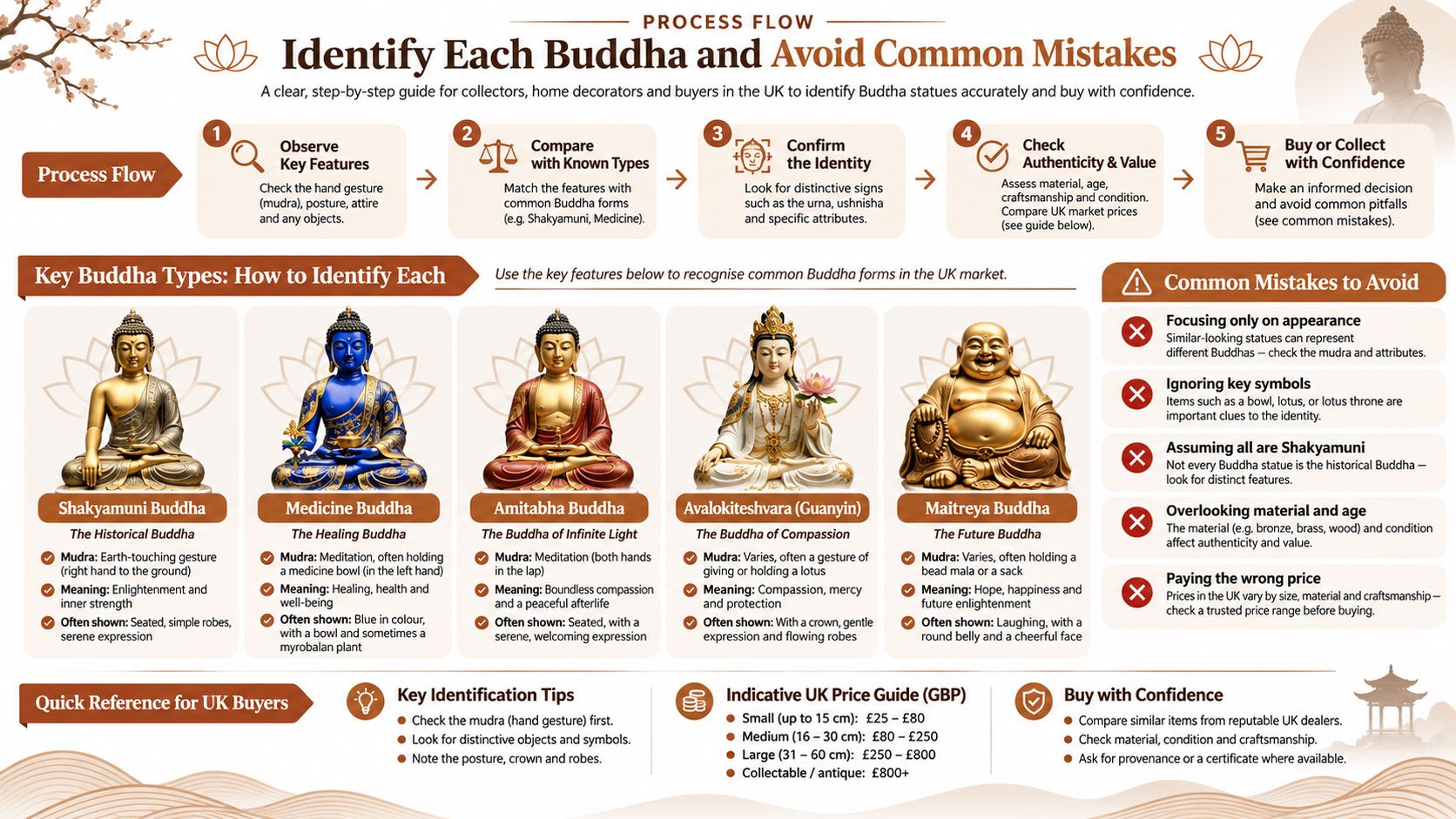
Diagnostic markers for identifying Shakyamuni and Amitabha
| Marker | Points to Amitabha | Points to Shakyamuni | Reliability |
|---|---|---|---|
| Pure Land companions | Avalokiteśvara and Mahāsthāmaprāpta, with Avalokiteśvara presenting a lotus | Named disciples, bodhisattvas or a sermon assembly | High when the companions are securely identified |
| Scene | Welcoming souls to paradise or descending at the deathbed | Preaching beneath a canopy | High when the narrative is clear |
| Inscription or catalogue record | Named as Amitābha or Amitabha | Named as Shakyamuni or as of the Shakya clan | High when legible or well supported |
| Mudra | Dhyāna, abhaya or varada in documented examples | Vitarka, the teaching gesture, which both figures share | Low on its own |
| Facial style or posture alone | Not a reliable marker | Not a reliable marker | Low |
Record uncertainty rather than concealing it
A useful record separates observation, interpretation and confidence. For example: seated Buddha; hands in meditation; attendants absent; inscription not found; identity uncertain. That description remains useful even if a specialist later revises the attribution.
Practical rule: A confidence label describes the strength of the evidence, not the quality, beauty or spiritual value of the statue.
Avoid the familiar shortcuts. A seated figure isn't automatically Shakyamuni, a meditating figure isn't automatically Amitabha, and shared shrine space doesn't imply rivalry. Before overlooking a small attendant, check whether that figure carries the lotus that makes the whole composition intelligible.
Damage requires the same discipline. Missing hands remove evidence; they don't authorise you to reconstruct a convenient gesture. Compare attachment points, dowels, brackets and surviving pigment with an object-specific catalogue record, and distinguish original features from later repairs.
Pure Land Practice Versus Teaching the Dharma
The Japanese teacher Hōnen encouraged followers to repeat “Namu Amida Butsu”, a practice known as nenbutsu; the Sainsbury Centre's Amida Buddha record also describes Chinese devotion involving voicing the Buddha's name, visualising Sukhāvatī and prostration. These are concrete activities, not ideas represented by a decorative object.
Khan Academy likewise describes the Pure Land belief that sincere utterance of Amitabha's name could lead to salvation and escort to the Western Paradise after death. Read this as an account of religious belief, not as a claim that an artwork itself guarantees an outcome.
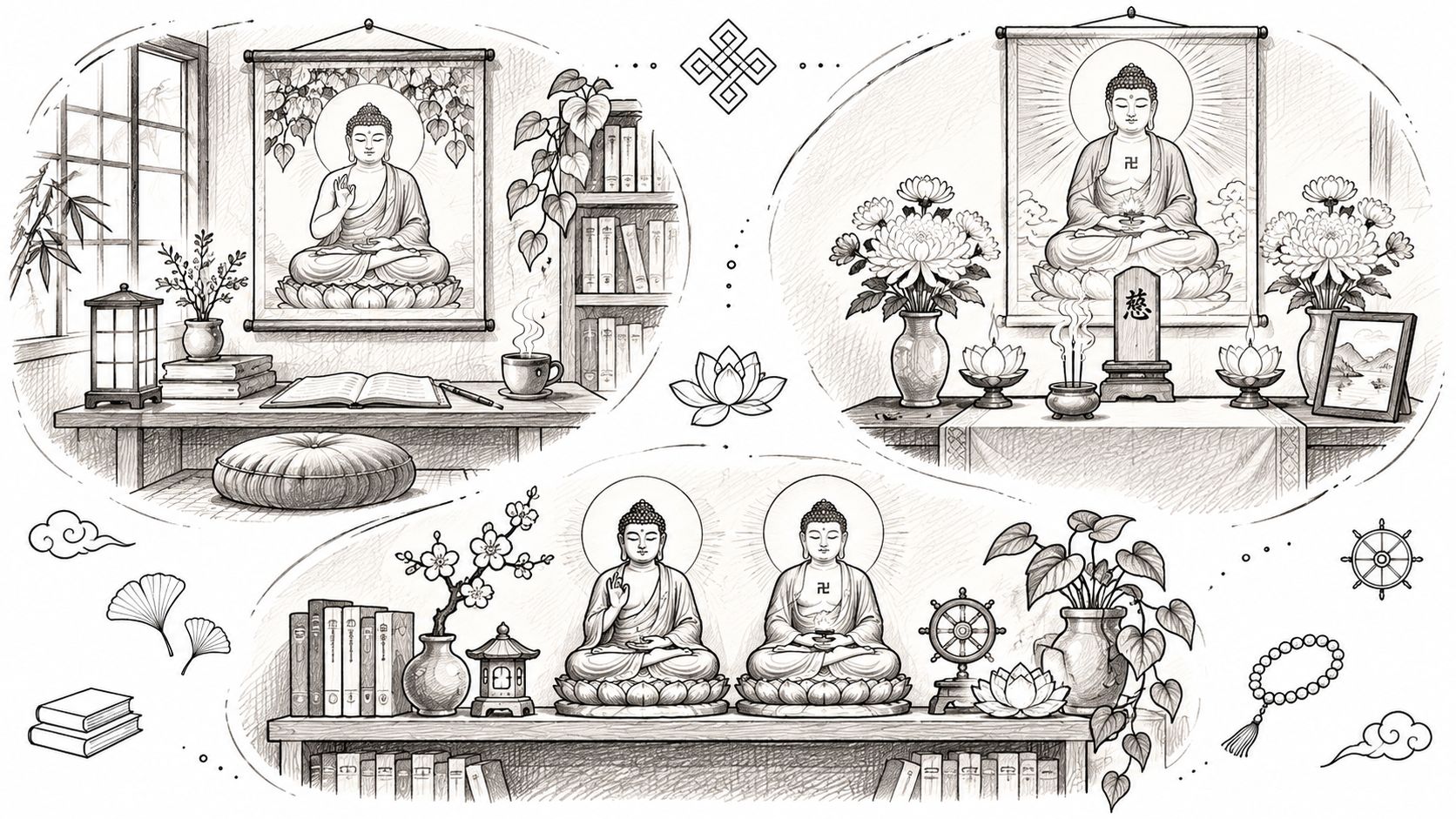
What practice looks like at home
A household using an Amitabha image might recite his name before it, incorporate it into memorial observances, or use it as a focus for aspiration towards rebirth. A household using a Shakyamuni image might sit before it for meditation or study a teaching associated with the historical Buddha. Neither example exhausts what practitioners do.
Pure Land devotion doesn't mean an absence of practice. Traditions differ in how they understand recitation alongside faith, vows, visualisation, ethical conduct and other disciplines. Our introduction to Amitabha and Pure Land Buddhism offers further context for those devotional associations.
- For a household altar: Ask which practice the image will support, rather than choosing solely by finish or expression.
- For a temple visit: Observe how worshippers approach the image and follow the temple's guidance on respectful behaviour.
- For cultural context in Japan: Jasumo's guide can help you plan to visit Tsukiji Hongwanji near the market, extending the comparison beyond isolated statues.
A plain explanation to a visitor is enough: Shakyamuni represents the Buddha who taught the Dharma; Amitabha is the focus of a particular Pure Land devotional relationship. Keep the explanation attached to what the household practises.
Which Buddha Fits Your Altar, Memorial or Collection
The best choice begins with the purpose of the space, not a contest between identities. Consider a quiet study, a memorial setting and a household shrine shared by people with different devotional commitments. Each calls for a different conversation about the image.
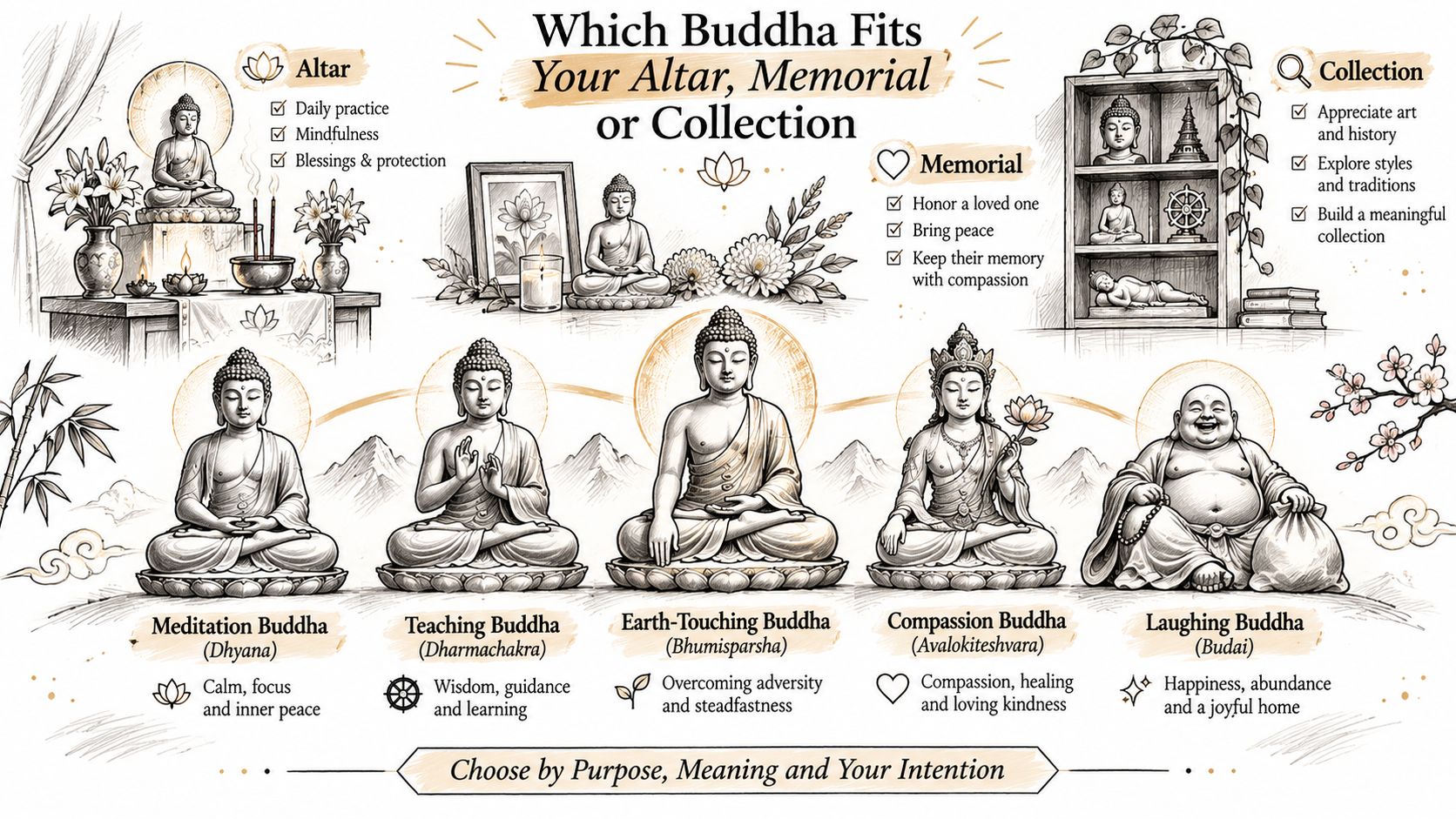
A quiet room for daily practice
Say you're arranging a meditation cushion beside a bookshelf of Buddhist texts. A securely identified Shakyamuni teaching image would connect naturally with that emphasis on instruction. A figure in dhyāna could also suit the room's meditative purpose, provided you don't mistake its usefulness for proof of identity.
We suggest a meditation Buddha for a calm room or altar. For a practising household, however, the relevant tradition and the practitioner's commitments should guide the choice more closely than an interior-design theme.
A memorial or end-of-life setting
Now consider a family preparing a small altar beside a relative's bed. Amitabha imagery has a specific historical relevance here: British Museum documentation describes descending-Amida paintings displayed beside the dying, expressing hope for a peaceful death and entry into paradise. The museum's discussion of an ambiguously identified Buddha painting also demonstrates why shared teaching gestures require caution in attribution.
The right object should support the person's beliefs, not impose a practice they haven't chosen. Ask what image is meaningful to them and, where appropriate, seek guidance from their Buddhist community.
A shrine containing both Buddhas
A shared shrine can express a coherent relationship. In a Goryeo-period Amitābha Sūtra manuscript held by the British Museum, Shakyamuni preaches while two bodhisattvas welcome souls to Amitabha's paradise; the monk-scribe made the manuscript for his mother, using gold and silver on indigo-dyed paper.
That composition supplies a powerful model of historical instruction and transcendent destination within the same devotional work. It isn't a universal prescription for altar arrangement, but it demonstrates that the figures needn't be separated as incompatible alternatives.
Choose the figure whose devotional role matches the space. Include both when the household understands and values their distinct roles.
For a collection rather than an active shrine, make that distinction explicit in the display label. Describe the object's likely original function separately from your reason for collecting it, and retain any uncertainty about attribution.
Confirm the Identity Before You Buy or Display
Confirm the identity before committing to a purchase or a definitive display label. The British Museum's colossal marble Amitabha bears a plinth inscription dating its dedication to AD 585 and connecting it with Chongguang Temple in Hebei Province. The identification rests on inscription, historical context and iconographic interpretation, not a generic resemblance to other Buddha statues.
Both hands are missing, wooden dowels and iron brackets remain at the arms, and traces of gilding and pigment survive. Those details matter because the present surface isn't the complete original appearance. Wear can remove identifying evidence without changing the identity established by stronger documentation.
Make a short object record
Use these checks before paying or preparing a label:
- Describe the evidence. Write down the scene, companions, mudra and inscription. Request clear views of the base, back and damaged areas when photographs leave these unresolved.
- Assign confidence. Use high confidence for converging evidence, provisional for a supported but incomplete attribution, and uncertain where the available features don't distinguish the figure.
- Compare the record. Check your observations against the seller's description or a museum catalogue. Resolve contradictions instead of treating a confident sales title as independent proof.
Our Buddha statues are organised by region and accompanied by detailed descriptions, including the symbolism of poses and mudras. Use those descriptions alongside your own observations; a regional style and a devotional identity answer different questions.
Prepare a respectful place
We recommend keeping a Buddha statue clean, raised from the floor, and away from bathrooms, cluttered areas or places where it may be treated casually. For an active altar, household practice and community guidance should also inform the arrangement.
Before choosing a shelf or pedestal, write a proposed label that names the figure and states your confidence. If you can't justify the name from the surviving evidence, keep the attribution open rather than forcing certainty.
HD Asian Art offers regionally organised Buddha statues with detailed descriptions to help you compare iconography, symbolism and intended use. Visit HD Asian Art with your identification notes, choose a piece whose meaning you understand, and decide where it belongs before you buy.
