



Dhyani Buddhas: The Five Cosmic Buddhas for Collectors
Dhyani Buddhas: The Five Cosmic Buddhas for Collectors
Walk into any serious collection of Buddhist sculpture and you will meet a set of seated Buddhas that look almost identical at first glance. The faces are serene, the robes are similar, and the bases are often lotus shaped. The differences sit in the hands, the colors, and the families each figure belongs to. These are the Dhyani Buddhas, and learning to read them is the fastest way to move from buying a pleasing statue to buying one that makes sense within its tradition. This guide covers who the five are, how they are grouped, what to check in the hands and seat, and where collectors most often go wrong.
Table of Contents
- Quick Takeaways
- What the Dhyani Buddhas Are
- The Five Buddhas and Their Families
- Reading Colors, Mudras, and Attributes
- Amitabha Buddha: The Figure Most Collectors Start With
- Authenticity and Sourcing: What to Check Before You Buy
- Comparing Three Ways to Collect the Five
- Placing Dhyani Buddhas on a Home Altar
- Common Mistakes Collectors Make
- Frequently Asked Questions
- References
Quick Takeaways
|
Key Insight |
Explanation |
|---|---|
|
The five form one map |
Vairocana, Akshobhya, Ratnasambhava, Amitabha, and Amoghasiddhi each stand for a different quality and a different position in the mandala. Buying one without knowing the others leaves you with a fragment of a system. |
|
Check the hand first |
The hand gesture identifies a figure faster than the face. A seller who cannot name the gesture usually cannot name the Buddha either. |
|
Families beat faces |
Tantric texts group the Buddhas into families with attributes such as the wheel, sword, and lotus. Use those attributes to confirm identity. |
|
Amitabha is the most common single figure |
Pure Land devotion keeps Amitabha in high demand, so expect the widest range of quality and the most copies on the market. |
|
Style reveals origin |
Pieces from India, Nepal, Tibet, China, and Japan differ in face, robe, and base. An attribution should match the regional style, not only the name. |
|
Buy a set with a plan |
A five-piece set needs a level display with room for each figure. Buying piece by piece often produces mismatched casting, patina, and scale. |
What the Dhyani Buddhas Are
The Dhyani Buddhas are five aspects of the Buddha in Vajrayana Buddhism, the tantric tradition that took shape in India and later spread across Tibet, Nepal, China, and Japan. Researchers describe them as "wisdom Buddhas," a term most often used in English. The same group also appears under the names Five Great Buddhas, Five Jinas, and Five Tathagatas.
The names are not interchangeable in every source. "Jina" means victor and carries a sense of champion or exemplar, while "Tathagata" is a term the Buddha used for himself in the Pali Canon. You will see all of these labels on listings, so a different name does not automatically mean a different figure. What matters is the set of traits attached to each name.
Each Buddha is linked to a cluster of colors, elements, senses, and virtues. Together they form what EBSCO's research overview calls a conceptual map, a way of organizing the dimensions of awakening so a practitioner can see how they connect. For a collector, the consequence is practical. The five are not interchangeable, and each one has its own gesture, mount, color, and place in a mandala. Those details are how you tell them apart on a dealer's table.
The Five Buddhas and Their Families
The five are Vairocana, Akshobhya, Ratnasambhava, Amitabha, and Amoghasiddhi. Texts do not always present them in the same order, and the way they are grouped changes from one tantra class to another. For that reason, the family system is more useful to a buyer than any single memorized list.
Vairocana at the center
Vairocana is the figure most often placed at the center of the mandala, and EBSCO's overview associates him with emptiness and the center. In Japan he is known as Dainichi, so a label with that name refers to the same figure. When a set has a clear central piece, that piece is usually Vairocana, and it should be the first one you check against the others.
Families in Yoga and Anuttarayoga tantra
Buddha-families are described as factors of Buddha-nature, inborn qualities that allow every person to become a Buddha. In Yoga tantra, the Tathagata family is headed by Vairocana, the vajra family by Akshobhya, the lotus family by Amitabha, and the jewel family by Ratnasambhava. Amoghasiddhi's karma family is folded into the jewel family in that system. Anuttarayoga tantra lists five separate families, so you will see a clearer set of attributes in that framework.
Where Amoghasiddhi fits
Amoghasiddhi is easy to misread because his family is merged with Ratnasambhava's in Yoga tantra and separated in Anuttarayoga. In the Anuttarayoga framework, the karma family is represented by a sword. A figure holding or accompanied by a sword is therefore a strong clue toward that family. Ask the seller which tantra class the piece is presented under, because a knowledgeable seller can answer that question without hesitation.
Reading Colors, Mudras, and Attributes
When you handle a statue, look at the hands before the face. Faces in Asian Buddhist sculpture follow shared conventions across centuries and regions, so the face narrows the identification less than the gesture does. The hand position is the quickest check you can make in a shop or from a photograph.
The hand gestures that identify each figure
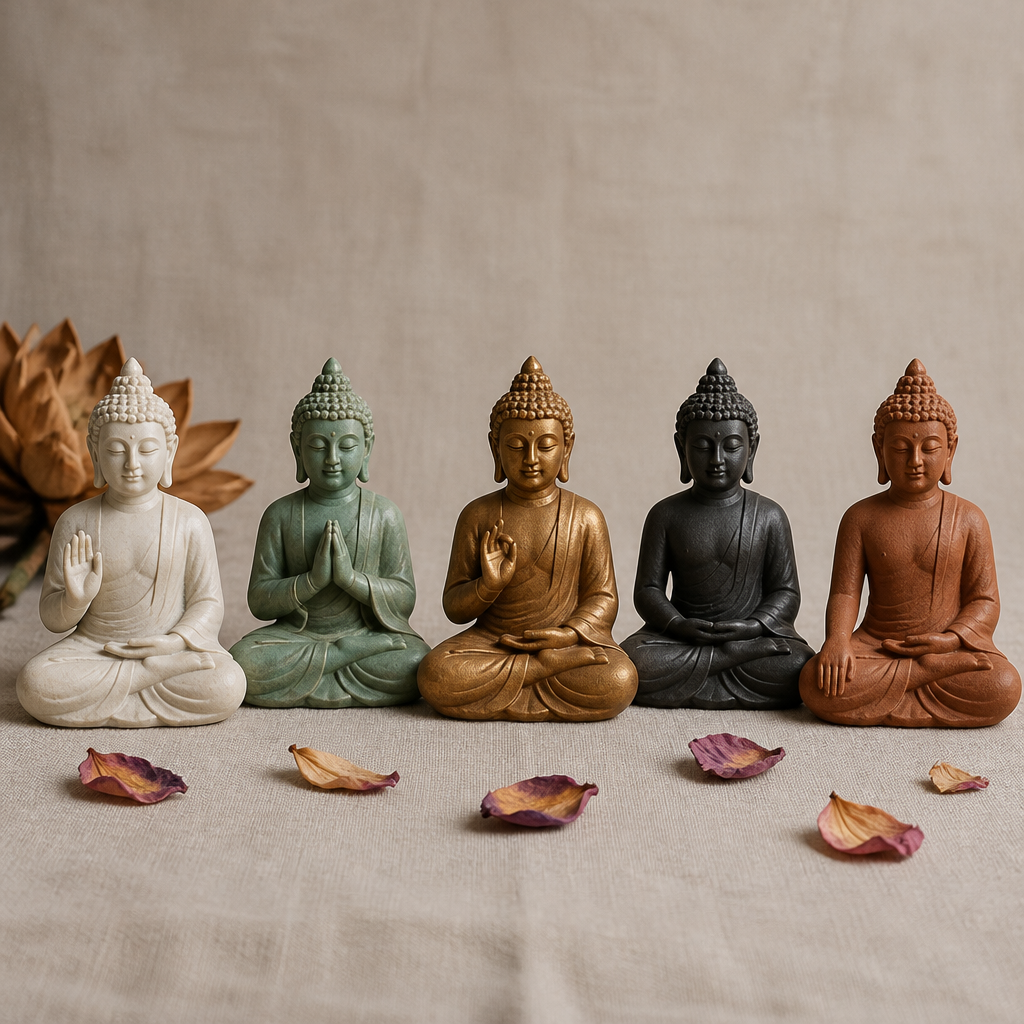
Vairocana is usually shown with the dharmachakra gesture, the hands held at the chest as if turning a wheel. Akshobhya touches the earth with one hand, the bhumisparsha gesture, which recalls the moment of enlightenment. Ratnasambhava extends a hand in giving, the varada gesture. Amitabha rests both hands in the lap in meditation, often holding a bowl, and Amoghasiddhi raises a palm in fearlessness, the abhaya gesture. These are the conventional forms, and regional sculptors sometimes vary them, so treat any single detail as evidence rather than proof.
Colors and mandala directions
In the standard mandala arrangement, Vairocana sits at the center, Akshobhya in the east, Ratnasambhava in the south, Amitabha in the west, and Amoghasiddhi in the north. The colors commonly associated with them are white, blue, yellow, red, and green, in the same order. Color is useful, but gilding and paint wear away and can be renewed, so do not rely on it alone for a bronze or a heavily restored piece.
Pro tip: Photograph the hands and the base straight on before you commit. A clean front view of both lets you compare the gesture and the seat against the family attributes, and it gives you a record if the piece is later re-examined.
Amitabha Buddha: The Figure Most Collectors Start With
Amitabha Buddha is the figure many people buy first, and the reasons are devotional as well as practical. EBSCO describes Amitabha, whose name points to boundless light, as central to Pure Land Buddhism, the devotional tradition built around rebirth in his western paradise. That devotional reach means you will usually find more Amitabha images on the market than any other Dhyani Buddha.
In Yoga tantra, Amitabha heads the lotus family and is linked to speech. In practical terms, look for a seated figure with hands in the lap and a lotus base. The meditation gesture and the seat together are usually enough to separate him from Shakyamuni images, which are more often shown with different gestures and simpler robes.
Amitabha in devotional use
Amitabha is often the figure chosen for recitation and devotional practice in the home, which affects how you should buy him. A devotional piece needs a stable base, a placement at eye level when seated, and a finish you can clean without damaging the surface. Because the figure is so common, many devotional buyers pay for a surface that looks new rather than a casting that is sound. Decide what the statue is for before you look at finish.
Amida, Amituofo, and regional names
In Japan the figure is called Amida, and Chinese Buddhist usage calls him Amituofo. Labels using these names are normal in the trade. A good dealer will still tell you whether the piece is Tibetan, Nepalese, Chinese, or Japanese in origin, because the robe, lotus base, and facial modeling differ across these regions. A name alone does not establish origin.
Authenticity and Sourcing: What to Check Before You Buy
Authenticity in Buddhist sculpture is less about paperwork and more about consistency. A piece should show a coherent style, a plausible material, and iconographic details that agree with each other. When one of those three disagrees with the others, step back before you pay. A certificate cannot fix a figure whose hands and seat tell different stories.
Material, casting, and surface wear
Cast bronzes and carved stone or wood age in different ways, so the wear should match the material. Look for wear where hands and fingers would naturally touch, such as the base rim, the knees, and the edges of the lotus. Uniform aging across every surface, especially on gilding, is a warning sign that the finish was applied for sale rather than acquired over time.
Dhyani Buddhas share similar faces by design, so the hand, the seat, and the attribute together carry the identification. Treat the face as the last thing you check, not the first.
Regional styles to compare
A study of Buddha statues from South, Southeast, and East Asia in Lion's Roar shows that stylistic differences and cross-cultural influence are visible when pieces are compared side by side. The Educational Outreach overview of Silk Road exchange notes that early Chinese Buddha images relied heavily on Indian prototypes. A Chinese-made Dhyani Buddha may therefore carry Indian features in the face or robe. Compare any candidate with several pieces from the same region rather than with a single reference photograph.
A Burmese or Thai Buddha in the earth-touching gesture is almost always a Shakyamuni image, even though Akshobhya uses the same hand position. The seat, the robe, and the rest of the iconography decide the identity. This is a frequent source of listing errors, so ask the seller to name the tradition in writing.
Pro tip: Ask for the region of origin and the tradition, such as Vajrayana, Theravada, or Mahayana, in writing before you buy. A clear written answer is a good sign, and a vague one tells you what to verify before you commit.
Comparing Three Ways to Collect the Five
Most collectors choose among three approaches. Each suits a different space, budget, and purpose, and each carries a trade-off you should accept on purpose rather than discover later.
|
Approach |
Best For |
Main Drawback |
|---|---|---|
|
Complete five-piece set from one region |
Study collections and matched altars |
Costs more and needs a level display with room for all five figures |
|
Amitabha as a single focal figure |
Devotional altars and first purchases |
Leaves the mandala logic incomplete, so the family context is missing |
|
Mixed-origin set built over time |
Collectors who value variety and gradual buying |
Casting, patina, and style often clash unless you match them carefully |
My recommendation is to start with Amitabha if your interest is devotional, and to build toward a full set only if you are willing to study the families. A single figure is a complete object in its own right. A partial set bought in a rush, however, usually ends up with pieces that look nothing alike, which defeats the purpose of owning the group.
For a serious study collection, choose one region and buy all five from the same period and workshop style if you can confirm it. Expect the set to take years rather than weeks. Patience produces a more coherent group than bidding on whatever appears in a single season.
Placing Dhyani Buddhas on a Home Altar
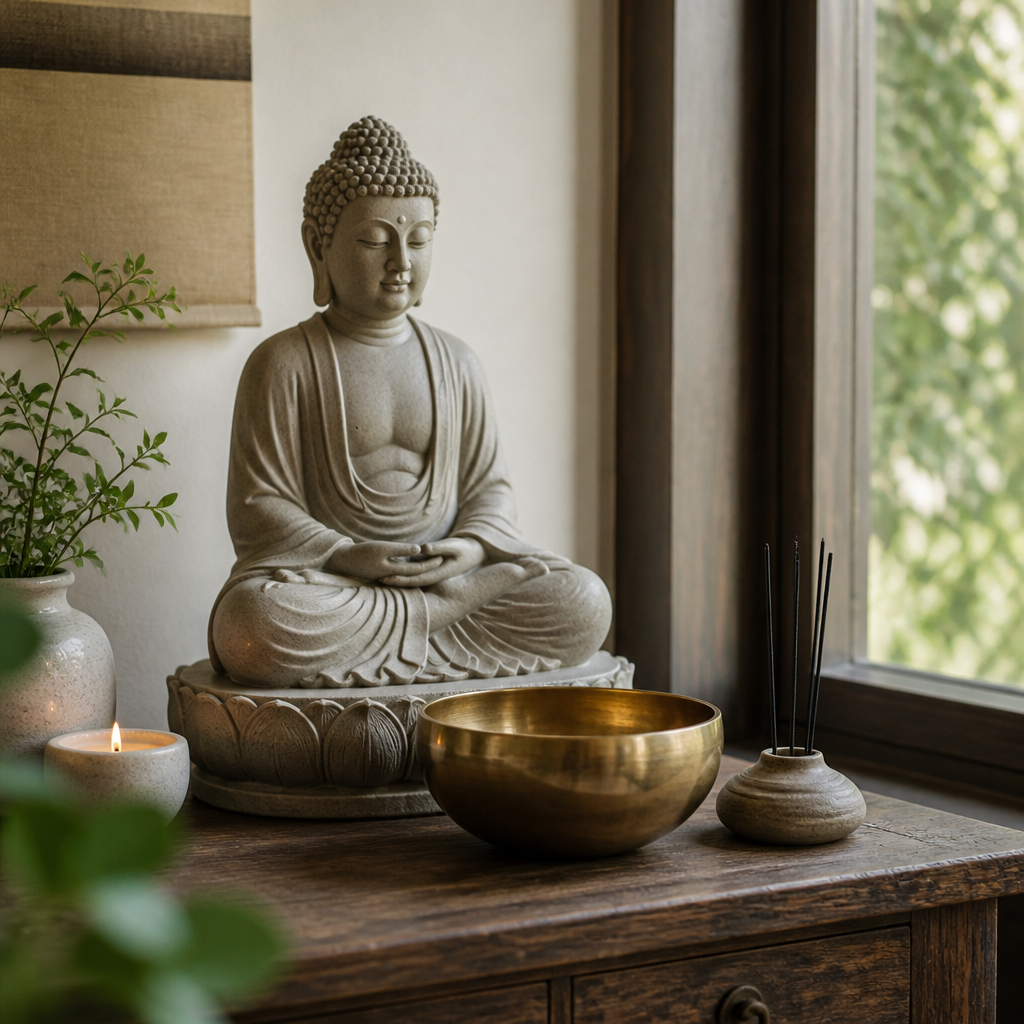
Placement on a home altar should make the hands readable and the central figure clear. A set arranged so that every hand is visible from the place where you sit to practice is more useful than one that looks full from across the room. Think of the altar as a working space first and a display second.
Sightlines and height
Place the central figure, usually Vairocana in a complete set, at the center and at a height that matches your seated eye line. Arrange the others so that their hands remain visible. Do not stack figures or hide hands behind offering bowls, because the gestures are the parts that identify each Buddha. Keep a clear gap between the altar edge and the base so the figures are not crowded.
Offerings, cleaning, and handling
Dust bronzes with a soft brush and avoid acidic cleaners on gilding, which can strip the surface permanently. Lift figures by the base or the torso rather than by raised hands, since outstretched hands can be attached separately and loosen with handling. Water offerings should sit away from the figures, so that a spill does not reach the base or the lotus.
Pro tip: Leave a few centimeters of clear space around each base so that offering bowls and cloths do not rest against the lotus or throne. Repeated contact is one of the most common causes of scratched gilding on altar pieces.
Common Mistakes Collectors Make
The most common mistake is buying by face alone. Dealers photograph faces because they are attractive, but the faces of the five are similar by design, so a beautiful image can hide a figure that is inconsistent with its label. Insist on a clear view of the hands and the base before you decide.
The second mistake is assuming that a set shares one origin. Five pieces listed together may come from several workshops, several centuries, and several regional styles. Compare the casting, the patina, and the robe folds across the group before you accept it as a matched set, and do not let a bundled price substitute for that check.
The third mistake is over-restoration. Repainting gilding or polishing a worn bronze removes evidence that a future buyer or specialist will need. A lightly worn piece with honest surfaces is often worth more than a freshly renewed one, especially in a study collection. Ask what has been restored before you decide what to clean.
Frequently Asked Questions
What are the five Dhyani Buddhas?
The five are Vairocana, Akshobhya, Ratnasambhava, Amitabha, and Amoghasiddhi. Each is associated with a specific family, color, hand gesture, and position in the mandala.
Are Dhyani Buddhas the same as the Buddha statues common in Thailand or Burma?
Not usually. Many Thai and Burmese Buddha images represent Shakyamuni in the Theravada tradition, which does not use the Dhyani Buddha system. Some gestures overlap, such as the earth-touching hand, so check the complete iconography before assigning a family.
Which Dhyani Buddha should a beginner buy first?
Amitabha is the most common starting point, especially for devotional practice. If you are building a study collection, begin with Vairocana, since he anchors the set and makes the others easier to place.
How can I tell Akshobhya from a Shakyamuni Buddha?
Start with the hand and the seat, then check the attributes and the family context. An earth-touching gesture alone is not enough, because Shakyamuni images use it too. Ask the seller to name the tradition and the family in writing.
Do I need all five figures to make a valid altar?
No. A single well-chosen figure, such as Amitabha for devotional use, is a complete and meaningful object. A full set becomes important mainly for study and for displays that aim to show the mandala logic.
What does the term Dhyani mean in practice for buyers?
The term is the one most often used in English for these five figures, and sources also call them wisdom Buddhas. For a buyer, the practical question is not the translation but whether the figure's gesture, seat, and attributes match one of the five families.
Tell us in the comments which Dhyani Buddha you started with and what drew you to that figure over the others.
References
-
Research overview of the Five Dhyani Buddhas and their meanings in Vajrayana
-
Explanation of the Buddha-families across the classes of tantra
-
Article on stylistic differences among Buddha statues from different regions
-
Overview of Buddhist art styles and cultural exchange along the Silk Road
