



Maitreya Buddha Statue: The Future Buddha in Asian Art
Maitreya Buddha Statue: The Future Buddha in Asian Art
Few figures in Asian sculpture carry as much expectation as Maitreya, the Buddha who is said to come after Gautama. If you have ever held a Maitreya statue in a shop and wondered why one figure looks like a seated teacher while another looks like a jeweled prince, you have already met the central puzzle of this iconography.
The same name covers a bodhisattva, a future Buddha, and a meditation deity, and each tradition draws the figure differently. This guide explains what those differences look like in stone, bronze, and wood, and how collectors and home practitioners can read them before they buy.
Table of Contents
- Quick Takeaways
- Who Maitreya Is in Buddhist Thought
- Three Ways Maitreya Appears in Sculpture
- Iconography: Posture and Attributes
- Regional Names Across Asia
- From Gandhara to East Asia
- Comparing Maitreya Figures by Tradition
- Buying a Maitreya Statue
- Displaying Maitreya on a Home Altar
- Frequently Asked Questions
- References
Quick Takeaways
|
Key Insight |
Explanation |
|---|---|
|
Maitreya is a future Buddha, not a historical one |
Buddhist eschatology presents him as the successor to Gautama, so many statues show him poised and ready rather than absorbed in deep meditation. |
|
Identify the form before judging the statue |
Maitreya appears as a bodhisattva in Mahayana sutras, as a Buddha of the future, and as a meditation deity in Vajrayana literature. Each form has different expectations. |
|
Attributes are more useful than size |
Vase, stupa, wheel, mala, and deerskin are the markers to check. A figure with no recognizable attribute deserves a question to the seller. |
|
Posture points to the textual source |
Seated and standing figures are both found, so ask which text or regional tradition a piece follows before you assume it is authentic to a specific period. |
|
The name changes with the country |
Miroku, Mireuk Bosal, Milo Pusa, Phra Si Ariya Mettrai, and Jampa all refer to the same figure in different languages and traditions. |
|
Ask for documentation on age and origin |
Claims of antiquity should be backed by a clear description of material, casting or carving method, and provenance, not by a single adjective on a product page. |
Who Maitreya Is in Buddhist Thought
Maitreya is venerated across the three major branches of Buddhism, Mahayana, Theravada, and Vajrayana, which is unusual for a figure who is not yet in the world. In the standard account of Buddhist eschatology, he is the next Buddha to appear after Gautama, arriving once the teaching of the current age has faded. His name comes from the Sanskrit word for loving kindness, and the Pali form is Metteyya, which is why the figure is so closely tied to compassion and kindness in the way he is discussed in practice.
For a collector, the important point is that Maitreya is not a historical portrait. No sculptor was copying a real teacher who sat in front of them. The image is built from scripture, and that means the iconography follows texts rather than personal likeness. When you look at a statue, you are reading a set of instructions about what the future Buddha is supposed to look like.
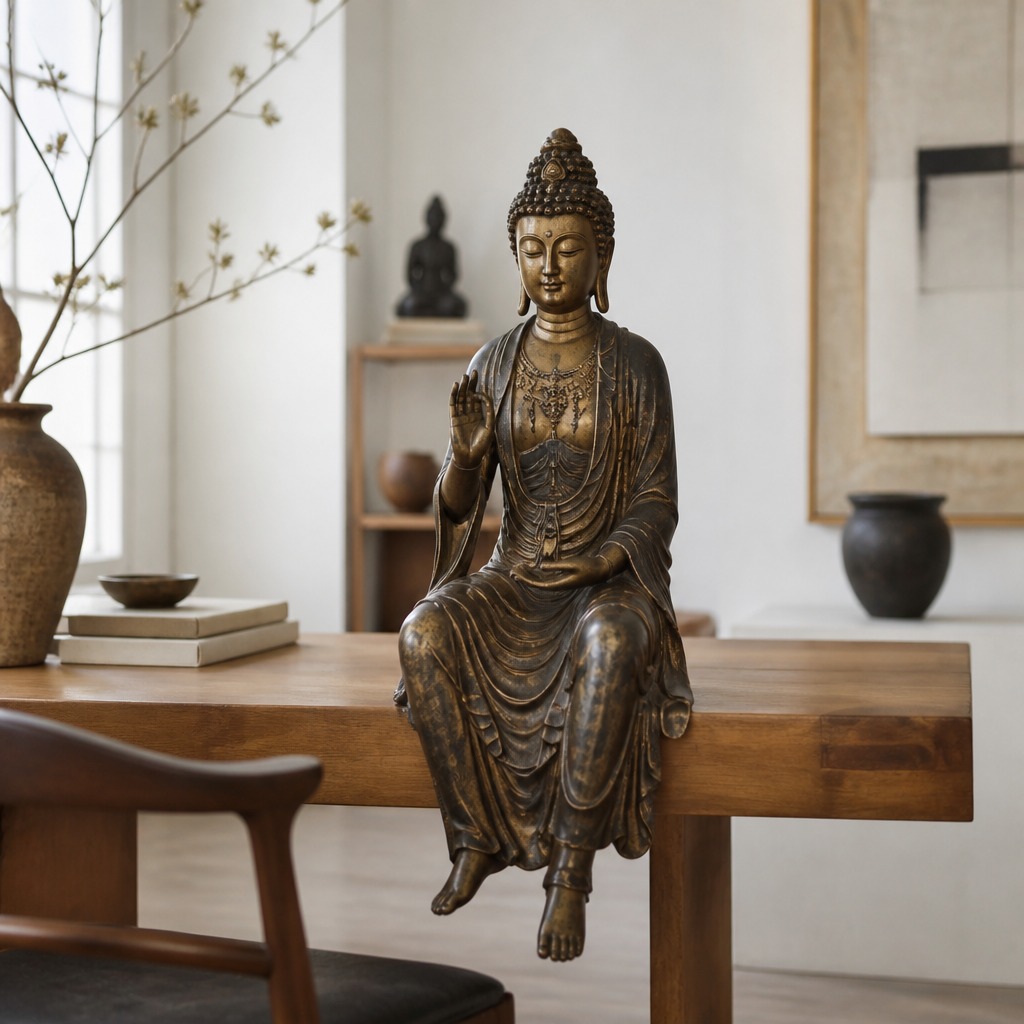
A Maitreya statue is less a portrait of a person than a promise about what comes next, and that promise is what the carver was trying to make visible.
Pro tip: Before you assess any Maitreya figure, write down which branch of Buddhism the seller associates it with. A statue described as Tibetan, Chinese, or Thai will usually follow a different set of conventions, and mixing those expectations is the fastest way to misjudge a piece.
Three Ways Maitreya Appears in Sculpture
Maitreya is not a single fixed image. Iconographic references distinguish three main ways he is presented, and understanding them will save you from comparing unlike objects. The first is a peaceful bodhisattva drawn mainly from Mahayana sutra literature. The second is a Buddha figure, shown as the Buddha of the future. The third is a meditation deity drawn from Tantra, which is the Vajrayana framework.
The bodhisattva in Mahayana sutras
Most Maitreya sculpture in East Asia follows the bodhisattva form. Here he is a student of the Buddha in the sutra narratives, dressed in the robes and ornaments of a bodhisattva rather than the simple monastic robe of a Buddha. Figures of this type tend to show him with a gentle expression and an open, approachable bearing, which fits his role as a figure of kindness and patient waiting.
In practice, this is the form you are most likely to encounter in shops and private collections. A common mistake is to assume that every ornamented Maitreya is a bodhisattva of Chinese origin. Ornament alone does not tell you the region, so the posture and attributes are the more reliable guide.
The Buddha of the future
In the Buddha form, Maitreya appears as a fully awakened teacher who has not yet come into the world. The narrative basis for this image is the prophecy that he will arrive in a later age. Statues in this mode often carry the features of a Buddha, such as the monastic robe and the usharnisha (the cranial protuberance), while being identified as Maitreya by his attributes or by the context of a set.
This distinction matters when you compare a Buddha figure with a bodhisattva of the same material. Both can look similar at a glance, but the Buddha form is building a narrative about the future, while the bodhisattva form is closer to a devotional companion for the practitioner.
The meditational deity of Vajrayana
The third form belongs to Vajrayana practice. Here Maitreya is iconic and tied to tantric literature, rather than narrative. Scholarly references note that Maitreya plays little role in the Tantra texts, but a single meditation practice is recorded in the Rinjung Lhantab of the Jonang tradition, where the form has three faces and four arms. That makes this a rare and specialized image, and it should not be confused with the ordinary bodhisattva.
If a listing describes a multi-armed Maitreya, do not assume it is a mistake. Equally, do not accept the description without checking whether the seller can name the practice or text it follows. Specialist sculptures of this kind are not interchangeable with devotional figures for a general shrine.
Iconography: Posture and Attributes
Iconography gives you a checklist, and the two most useful categories are posture and attributes. Posture tells you how the figure is meant to relate to the viewer, and attributes tell you which vows, teachings, or symbols the carver wanted to emphasize. A good Maitreya statue will show a clear combination of both, while a weak one usually shows neither in a consistent way.
Seated and standing postures
Seated and standing are the two basic postures in Maitreya sculpture, and both are documented in the iconographic record. The seated figure is common in Chinese and Japanese examples, where the body is relaxed and the stance suggests a teacher who is about to speak. The standing figure is frequently associated with the sense of readiness, a figure who is poised to descend and take up his role.
A common error is to treat the posture as decorative. In reality, posture is one of the three key subjects used to classify Maitreya images, alongside appearance and attributes. When a listing names the posture, check that the body language matches. A figure described as standing but drawn with the stillness of a seated meditator is a sign that the description may have been copied carelessly.
The attributes: vase, stupa, wheel, mala, and deerskin
The attributes most often associated with Maitreya are the vase, the stupa, the wheel, the mala (prayer beads), and the deerskin. Each one carries meaning. The vase is linked to the nectar of teaching and to a sense of abundance, while the stupa represents the enlightened mind and the presence of the Buddhist teaching. The wheel refers to the Dharma, and the mala points to recitation and practice. The deerskin is a traditional sign of a practitioner who has committed to a disciplined life.
Not every Maitreya carries all five. Many sculptures show only two or three, and that is normal. The key question is whether the attributes are consistent with the posture and form. Attributes that are added as decoration, placed in a hand that cannot hold them, or scattered without logic usually indicate a piece that was assembled from a generic template.
Pro tip: Ask the seller to describe the attributes in the hand positions, not just the object names. A vase held in the lap reads differently from one held at the shoulder, and that difference often tells you more about the workshop tradition than the material does.
Regional Names Across Asia
Maitreya carries a different name in almost every Buddhist culture, and those names are a practical tool when you are searching for a statue. The Sanskrit form is Maitreya and the Pali form is Metteyya. In Chinese the figure is known as Milo Pusa, and in Japan he is Miroku. In Korea the name is Mireuk Bosal, and in Thailand he is Phra Si Ariya Mettrai. Tibetan sources use Jampa, and in Sri Lanka the figure is known as Maithri Budun. Mongolian tradition uses Maidari.
When you see one of these names in a listing, you have a clue about the regional lineage that the seller is working from. A Japanese Miroku, for example, is usually discussed in terms of temple sculpture and devotional practice, while a Thai Phra Si Ariya Mettrai sits within a Theravada context. Neither is wrong, but they are not the same object type, and treating them as interchangeable can lead to poor comparisons.
A common mistake is to rely on the name alone. Many sellers use a regional name because it sounds appropriate, not because the object was made in that region. Use the name as a starting point for research, then confirm with the material, style, and attributes of the statue itself.
From Gandhara to East Asia
One of the oldest surviving images of Maitreya is a Greco-Buddhist statue from Gandhara, dated to around the third century, which shows how early the figure was taking visual form. Gandhara art blended Hellenistic sculptural habits with Buddhist subjects, and the result is a figure with a more classical body and drapery than most later Asian images. For anyone interested in the spread of Buddhist art, this is a useful starting point because it shows how the image was adapted as it traveled.
As the figure moved north and east along the trade routes, the sculptural language changed. Chinese, Korean, and Japanese Maitreya figures developed their own proportions, drapery patterns, and facial conventions. The image became more closely tied to local temple practice, and the bodhisattva form in particular took on a devotional role that matched local expectations of compassion.
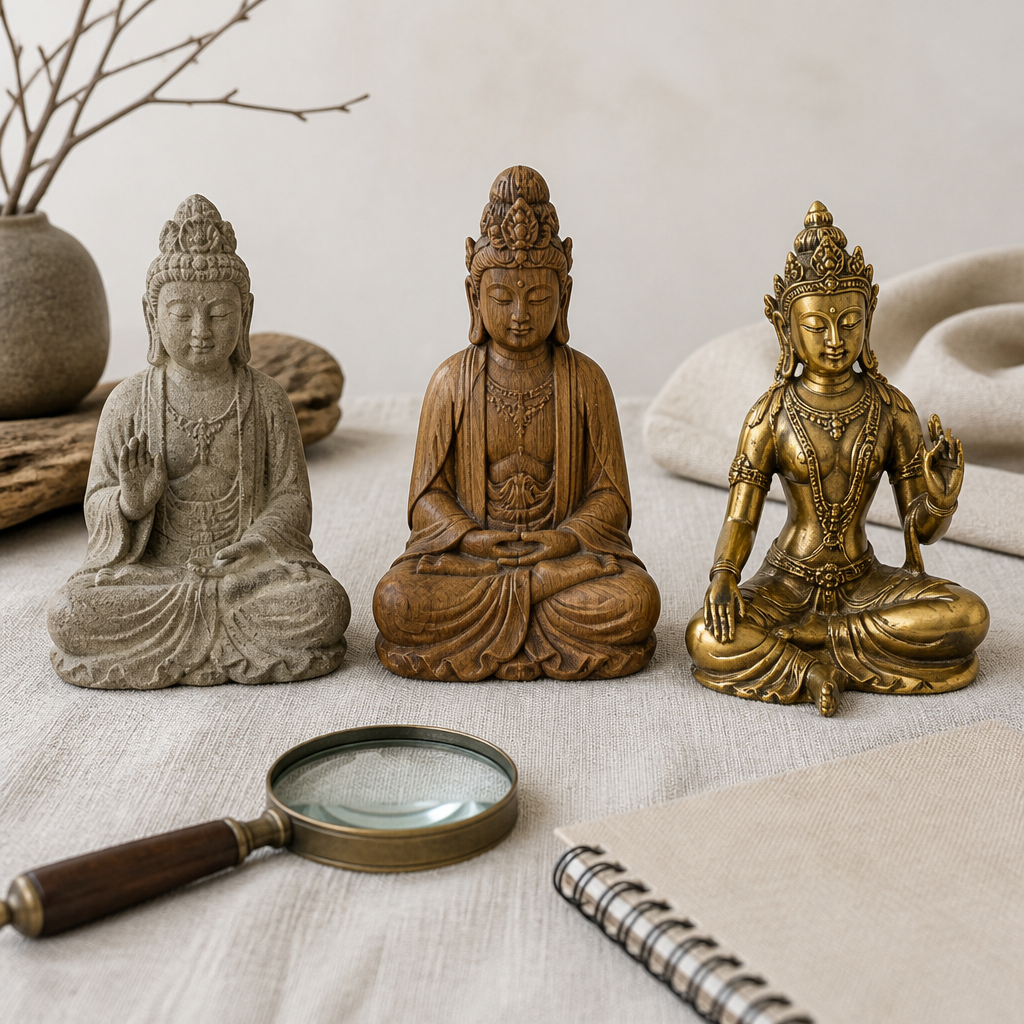
Gandharan beginnings
The Gandharan figure is important for collectors because it shows that the iconography was already stabilizing very early. Even in a carving that looks foreign to later eyes, you can recognize the central idea of a future Buddha who is kind, patient, and waiting for his time. The drapery and body are classical, but the meaning is entirely Buddhist.
In practice, Gandharan examples are rare on the open market and are typically held in museum collections. Anything sold as an early Gandharan Maitreya should come with a strong description of the source and a clear explanation of why the attribution is credible. Be cautious of claims that rely on the Gandharan label without any supporting detail.
China, Japan, and Korea
In China, Maitreya is strongly associated with the bodhisattva form, and the name Milo Pusa is common in devotional settings. Japanese Miroku figures often reflect temple traditions, with careful modeling of the face and robe. Korean Mireuk Bosal figures are often devotional and sometimes large in scale, reflecting a strong local tradition of veneration.
These regional styles are not rigid rules, but they are helpful. A figure that looks Japanese in style but is listed as Chinese is not necessarily a fake, but it deserves a question. Ask the seller how the regional attribution was reached, and whether it rests on material, technique, or documented provenance.
Comparing Maitreya Figures by Tradition
Comparing Maitreya figures is most useful when you hold the tradition constant and vary one feature at a time. The table below sets out three common approaches you will meet in the market, along with the points that matter most when you assess a piece.
|
Tradition and Form |
Typical Characteristics |
What to Check When Buying |
|---|---|---|
|
Mahayana bodhisattva (Chinese Milo Pusa, Japanese Miroku, Korean Mireuk Bosal) |
Ornamented bodhisattva dress, gentle expression, seated or standing posture, common in devotional settings |
Consistency of robes and ornament, regional style in the face and drapery, and whether the attributes match the posture |
|
Buddha of the future (Southeast Asian and Theravada contexts, including Phra Si Ariya Mettrai and Maithri Budun) |
Monastic robe with Buddha features, identified by context, set arrangement, or attributes rather than by ornament |
Whether the figure reads as a Buddha rather than a bodhisattva, and whether the seller can name the regional tradition behind it |
|
Vajrayana meditational deity (Tibetan and Himalayan Jampa forms) |
Iconic, tantric framework, specialized forms such as the three-faced, four-armed figure recorded in the Jonang tradition |
Whether the seller can name the practice or text, and whether the number of faces and arms is consistent with the listing |
The table is a starting point, not a verdict. A single statue can show features from more than one column, especially in regional workshops that borrowed from neighboring traditions. Use the table to narrow your questions, then judge the object in front of you.
Where the comparison becomes useful is in price and purpose. A devotional bodhisattva for a home shrine has different requirements from a specialized Vajrayana piece intended for study or a themed set. Decide which role the statue must play before you narrow your search.
Buying a Maitreya Statue
Buying a Maitreya statue is less about finding the most striking object and more about matching the form to your purpose. Collectors looking for historical interest should focus on documentation and regional style. Practitioners looking for a devotional focus should focus on proportion, finish, and whether the figure feels right to live with. Both groups benefit from asking precise questions before they commit.
Reading the seller's description
A good description names the form, the posture, the attributes, the material, and the regional tradition. It should avoid vague superlatives and should explain any unusual features. If the description says only "ancient" or "rare" without a basis for either word, treat it as marketing rather than information.
In practice, the most useful question is simple: which of the three forms does this figure represent, and how can you tell? A seller who can answer that clearly, with reference to posture and attributes, is worth more than one who offers a long list of adjectives. At HD Asian Art, our product descriptions are written around these same questions, so you can compare pieces on the same terms.
Materials, finish, and condition
Material affects both appearance and care. Stone, bronze, and wood each age differently, and each has its own signs of wear. Bronze can show patina that is genuine age or the result of recent treatment, so ask how the finish was produced. Wood needs a dry, stable environment, and stone can show surface wear that should be described rather than hidden.
Condition deserves a precise description. Look for chips, repairs, and replaced attributes, and ask whether any missing pieces were restored or are original. A replaced hand or vase is not always a deal breaker, but it changes how the figure should be valued and displayed.
Pro tip: Check the listing for a description of the attributes and their placement before you check the price. If a figure's hands cannot logically hold the objects the listing names, the piece may have been assembled from parts, and that is worth knowing before you pay.
Displaying Maitreya on a Home Altar
A Maitreya statue on a home altar works best when it has a clear place in the arrangement and is not crowded out by other objects. Maitreya is often shown in sets, such as the Buddhas of the Three Times or the Eight Great Bodhisattvas, and those groupings can guide how you position him. A single figure can stand on its own, but it should still have a sense of order around it.
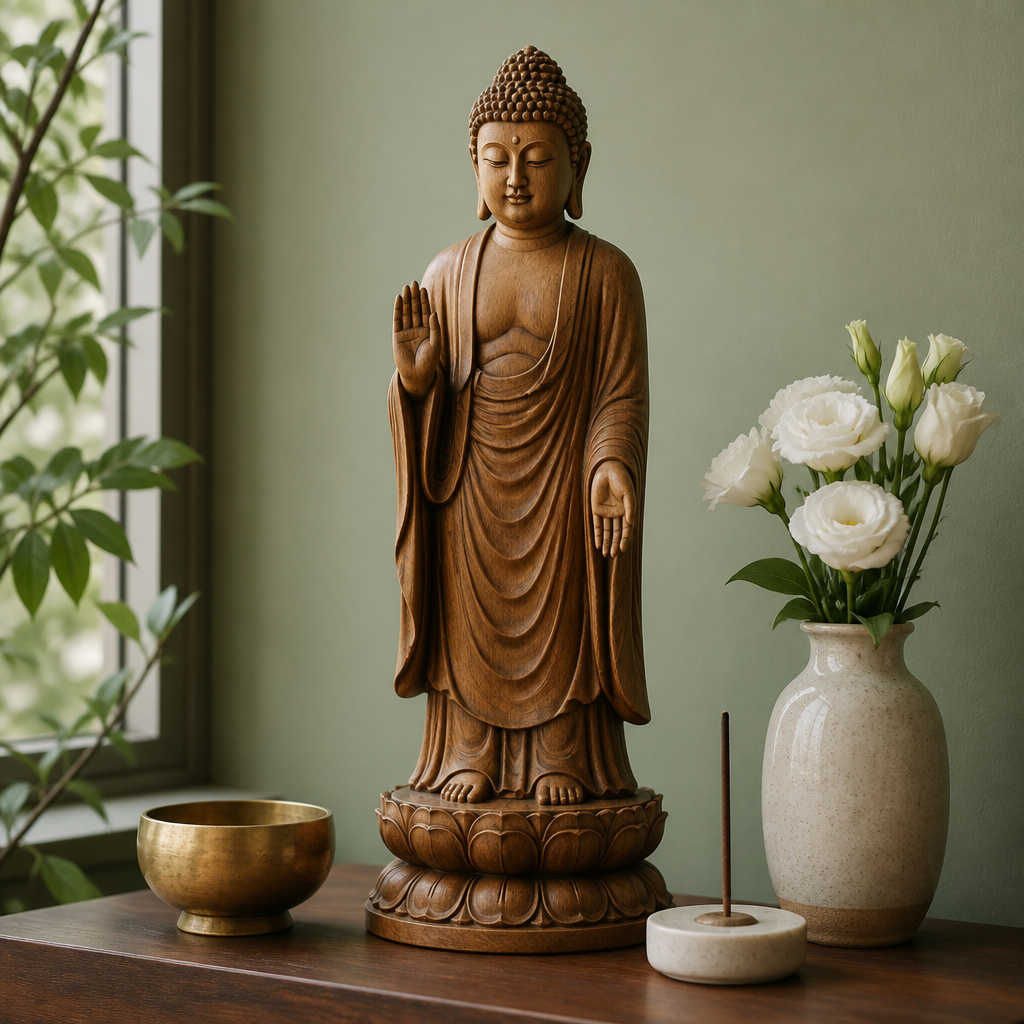
Placement and sightline
Place the statue where it is at eye level when you sit in front of the altar. Maitreya's posture is often calm but forward-looking, and a figure placed too high or too low loses that quality. Keep the sightline clear, and avoid placing the statue directly against a wall where the back and attributes cannot be seen.
Light matters as well. Direct sunlight can fade textiles and dry out wood, while strong overhead light can flatten the detail in stone and bronze. A side-lit position usually brings out the modeling of the face and the attributes without exposing the surface to harsh heat.
Pairing Maitreya with other figures
Maitreya pairs naturally with other Buddhas and bodhisattvas in traditional arrangements, especially where a set is part of the practice. Themed groupings can help a home altar feel coherent, but the pairing should follow the tradition the statue belongs to. Mixing a Vajrayana deity with a Theravada Buddha without a clear reason can make the arrangement feel arbitrary.
If you are building a set, start with the Maitreya statue, then choose companions that share the same regional lineage and material. Consistency in tone and finish makes the group easier to read, and it gives visitors a clearer sense of what the altar is meant to represent.
Frequently Asked Questions
Is Maitreya worshipped in all Buddhist traditions?
Maitreya is venerated in Mahayana, Theravada, and Vajrayana Buddhism, although the way he is approached differs between them. In Mahayana contexts he is often a bodhisattva of compassion, while in Vajrayana he can appear as a meditation deity. The shared element is his role as the future Buddha.
How can I tell if a Maitreya statue is a bodhisattva or a Buddha?
Look first at the robes and ornaments. A bodhisattva typically wears ornamented dress and jewelry, while a Buddha figure is usually shown in a simpler monastic robe. Posture and attributes can confirm the reading, and the seller should be able to explain which form the piece represents.
What do the attributes of a Maitreya statue mean?
The common attributes are the vase, stupa, wheel, mala, and deerskin. The vase relates to teaching and abundance, the stupa to the enlightened mind, the wheel to the Dharma, the mala to recitation, and the deerskin to disciplined practice. Not every statue will show all of them.
Why does the same figure have different names in different countries?
Buddhist names follow the languages and traditions of each region. Milo Pusa in Chinese, Miroku in Japanese, Mireuk Bosal in Korean, and Phra Si Ariya Mettrai in Thai all refer to the same future Buddha, so the name is a clue to the regional context rather than a different figure.
What should I ask before buying an antique-style Maitreya statue?
Ask for the material, the method of making, the regional attribution, and any documented provenance. Ask whether any parts are replaced or restored. A seller who can answer these questions clearly is giving you the information you need to judge the piece.
Which Maitreya form has caught your attention most in your own collecting or practice, and what helped you decide between a bodhisattva, a Buddha figure, or a meditation deity? We would welcome your experience in the comments or by getting in touch.
References
-
Overview of Maitreya as a future Buddha in Buddhist eschatology
-
Maitreya iconography covering bodhisattva, Buddha, and meditational deity forms
-
Teaching resources on religion in Asian art from a major museum collection
