



Indonesian Hindu Art: Majapahit Legacy Beyond Java
Indonesian Hindu Art: Majapahit Legacy Beyond Java
When most people picture Indonesian Hindu art, they think of Bali, with its carved deities, guardian figures and temple gateways. That picture is real, but it leaves out a long earlier chapter. The Majapahit Empire, a Javanese kingdom that flourished from the late thirteenth century, produced a large body of Hindu-Buddhist brick temples and sculpture, and its artistic influence still shapes how collectors read regional styles. If you buy or display Indonesian religious art, knowing where Majapahit fits will help you separate a Javanese tradition from a later Balinese interpretation, and it will help you ask better questions before you buy.
Table of Contents
- Quick Takeaways
- The Majapahit Empire in Brief
- Brick Temples and Red Gates
- Sculpture Before Majapahit
- Balinese Hindu Sculpture in Context
- Islam, Syncretism and Shared Roof Forms
- Comparing Three Regional Traditions
- Buying and Checking Authentic Pieces
- Frequently Asked Questions
- References
Quick Takeaways
|
Key Insight |
Explanation |
|---|---|
|
Majapahit is the reference point for Javanese brick architecture |
Its Hindu-Buddhist brick temples, tall slender-roofed red brick gates and geometric design are the period's most recognizable architectural signature. |
|
Start your dating with 1293 |
Majapahit was established after the Mongol invasion, and King Kertarajasa Jayawardhana was crowned on 10 November 1293. Sources disagree on the end point, so state which dates you are using. |
|
Early sculpture is a separate chapter |
Free-standing and relief sculpture flourished between the 8th and 10th centuries in Java and Bali, known for delicacy and serenity of expression. |
|
Judge Balinese pieces on their own terms |
Balinese Hindu work is a living tradition with its own roof forms and carving conventions, so do not date it using Majapahit benchmarks alone. |
|
Mixed motifs are normal |
Islam became dominant by the 15th century, yet local mosques kept roof shapes related to Balinese temple pagodas. A mixed design is evidence of cultural exchange, not automatically a fake. |
|
Learn four terms before you shop |
Candi, mandala, syncretism and animism appear constantly in listings. Candi also covers gates, ruins and bathing places, not only temples. |
The Majapahit Empire in Brief
Majapahit was a Javanese empire that ruled from 1293 until it was disestablished in 1527, according to the Wikipedia overview of the kingdom. It was founded after a Mongol invasion, and its first king, Kertarajasa Jayawardhana, also known as Raden Wijaya, was crowned on 10 November 1293. Its capital, also called Majapahit, sat at Trowulan, and its religious life combined Hinduism, with Shaivism as the listed branch, and Buddhism.
The empire was run as a mandala state, a loose network of territories under a Maharaja with a Mahapatih acting as prime minister. That structure explains why the empire's reach was a matter of allegiance as much as direct rule. Influence did not always mean control on the ground.
Art historians date Majapahit's golden age differently depending on the source. The Libretexts art history overview describes another golden age of Indonesian art under Majapahit spanning 1293 to 1500, while the Wikipedia entry gives 1527 as the formal end. In practice, I date works by style and context first and treat the empire's dates as a frame, not a precise label for every object.
The empire's reach is usually traced through the Nagarakretagama, a 1365 narrative eulogy poem. Maps of its greatest extent draw on that poem, and they express a claimed sphere of influence rather than a line of firm control. When you see such a map in a book or catalogue, read it as a statement of prestige.
For a buyer, the practical use of this history is simple. When a listing says Majapahit, ask whether the attribution refers to the empire's period, its territory or its style. Those are three different claims, and each needs different evidence.
Brick Temples and Red Gates
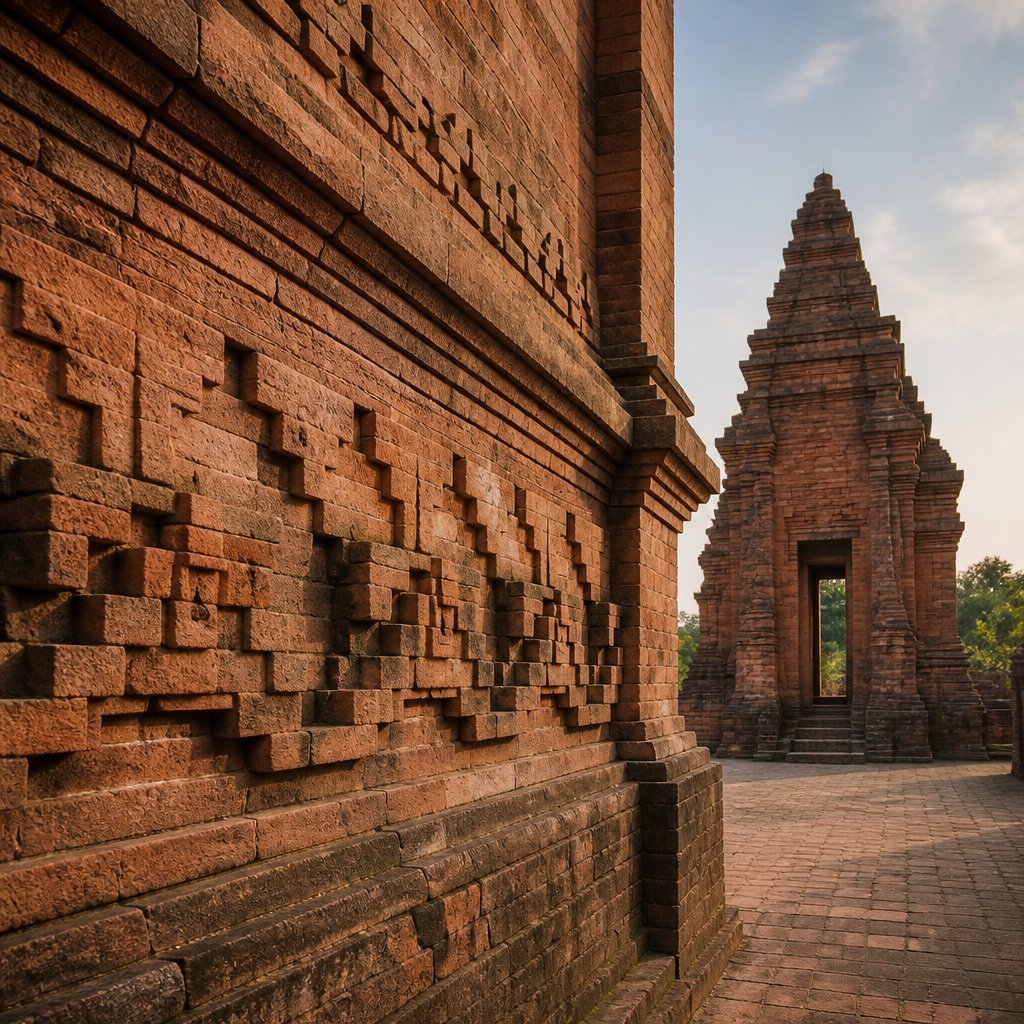
The architectural signature of the Majapahit period is brick. Sources describe a large number of Hindu-Buddhist brick temples built in this era, many characterized by tall, slender-roofed red brick gates and a strong geometric quality. The gates are what most people remember, and they are the first thing I look for in any Majapahit-era reference.
The Slender-Roofed Red Brick Gate
A gate in this tradition is more than an entrance. Its height and narrow roof profile draw the eye upward, and the red brick surface gives the structure a warmth that stone cannot match. When you compare images, the roof silhouette is often a quicker identifier than any single carved detail.
Brick is also fragile in a way stone is not. Exposed brick loses surface and mortar over centuries, so a standing gate or temple rarely looks as it did originally. Expect erosion, reconstruction and modern consolidation in any photograph you study.
Why Geometry Matters to Collectors
The strong geometric quality of Majapahit architecture is a practical tool. Symmetry, stepped forms and repeated proportions are easier to recognize than figurative detail, especially in fragments. A collector who learns the geometry can spot a Majapahit-inspired design even when the figures on it are unfamiliar.
The word candi complicates matters. The term refers to Hindu and Buddhist temples and sanctuaries built mostly between the 8th and 15th centuries, but it is also used for gates, urban ruins and bathing places. A listing that says candi may describe a religious building, a gate or an archaeological fragment, so ask which one.
Pro tip: Ask any seller whether a brick or stone piece is a religious sculpture or an architectural fragment. The answer changes how you should value it and how you should display it.
Sculpture Before Majapahit
Majapahit did not invent Indonesian Hindu-Buddhist art. The region was strongly influenced by India from the 1st century CE onward, and the earliest surviving Buddhist structures in Indonesia are the 4th century Batujaya plastered brick stupas in West Java. Those early works show that the exchange of ideas long predates the empire.
The Batujaya stupas matter because they show Buddhist architecture was already established in the region centuries before the Majapahit court. When a seller places a sculpture in this earlier context, ask what evidence links the object to a site, not just to a style.
The Sailendra Dynasty and Sri Vijaya
Buddhist art in Indonesia reached a golden era under the Sailendra dynasty of the Sri Vijaya Empire between the 8th and 13th centuries. That period matters for Hindu art too, because the two traditions shared a sculptural vocabulary, and it is easy to file one as the other. Keeping the Buddhist and Hindu strands distinct helps you read each object correctly.
Delicacy and Serenity in the Eighth to Tenth Centuries
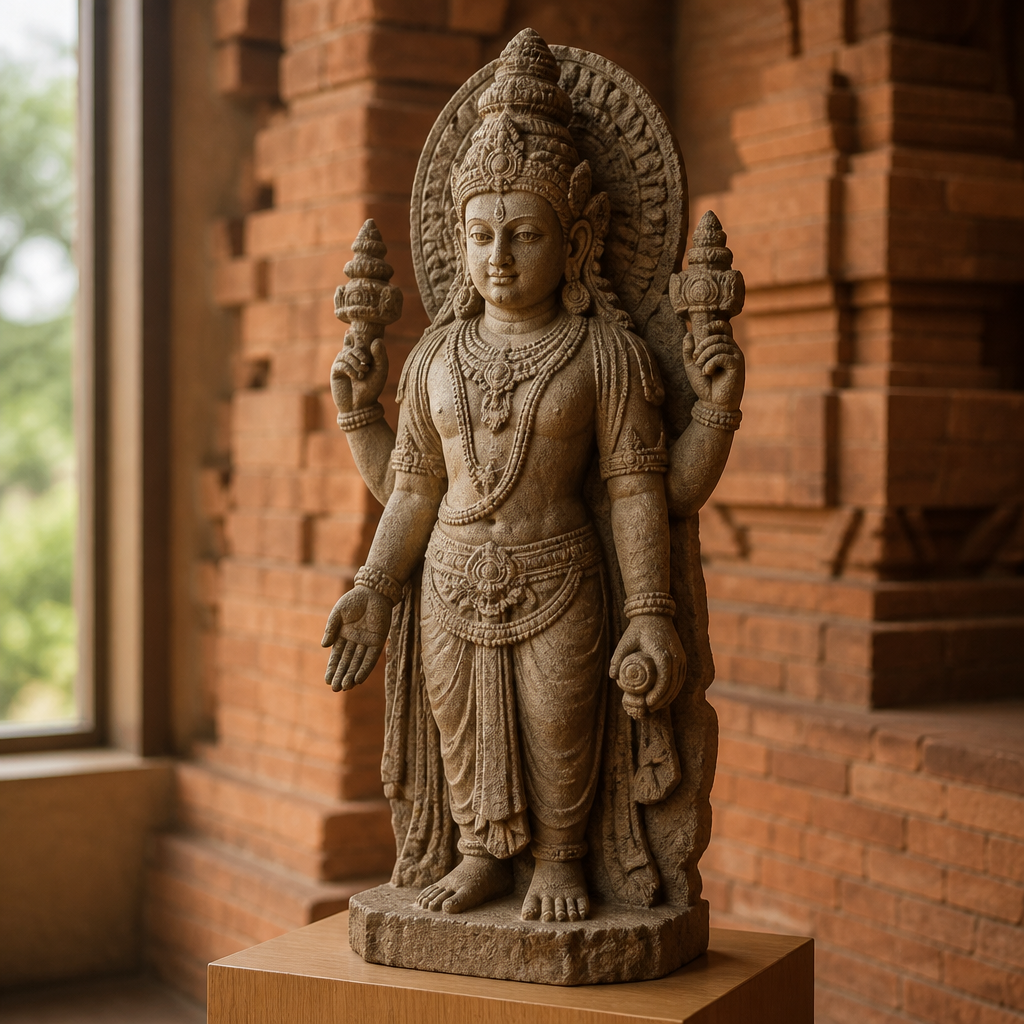
Sculpture flourished between the 8th and 10th centuries in both Java and Bali. It took two forms: free-standing statues and relief carvings built into temples. The style is known for delicacy and a serenity of expression, which is the quality I use as a first check when a piece is presented as early.
In practice, a carved face that looks heavy, flat or overly ornamented is a reason to slow down. Early work tends to balance restraint with precise detail. A piece that feels theatrical may still be valuable, but it should not be dated to this period on appearance alone.
Pro tip: Photograph a sculpture from the front, side and back under even daylight before you compare it with reference images. Surface wear is easier to judge when you can see how it sits across the whole form.
Balinese Hindu Sculpture in Context
Bali is where many buyers first encounter Indonesian Hindu art, and it is also where the most confusion starts. Early sculpture from the 8th to 10th centuries was made in both Java and Bali, but the island's religious life continued long afterward. Hinduism remains central to Balinese culture today, so you are looking at a living tradition as well as a historical one.
That continuity is why a recently made piece can look convincingly old. Carvers working in a traditional idiom reproduce the proportions and surface treatment of older work. Ask the seller to separate three things: the period the style comes from, the place where the piece was carved, and the year it was made.
Reading Balinese Style on Its Own Terms
Balinese sculpture should be judged against its own conventions, not only against the Javanese brick temples of the Majapahit period. The two traditions share roots in Hindu-Buddhist art, but a collector who uses one as the standard for the other will misread proportions, ornament and finish. Compare like with like whenever you can.
When you compare two Balinese pieces, look at how the figure is integrated with its base or backing. Carvers often shaped the stone for a particular setting, and that origin shows in how the piece is finished on the reverse. A sculpture finished on all sides may have been made for a different setting than one intended for a wall or niche.
Temple Roofs and Pagoda Shapes
Balinese Hindu temples are recognized by their tiered roof forms, and the timber tiered roofs of older local mosques are often compared to the pagodas of those temples. Tiered silhouettes are a useful visual reference when you study architectural fragments or photographs of temple structures. Use the silhouette as a starting point, then check the material and setting before you assign a date.
Islam, Syncretism and Shared Roof Forms
By the 15th century, Islam had become the dominant religion in Indonesia. Local mosques reflected both indigenous and Islamic influences. They lacked the Islamic dome and instead had tall timber tiered roofs similar to the pagodas of Balinese Hindu temples, which is one of the clearest examples of shared architectural language across faiths.
When Islam Became the Dominant Faith
The shift to Islam did not erase the older art overnight. Builders kept familiar roof shapes and local materials, and the result was a building that did not follow a single religious model. For a collector, this is a reminder that religious change in the region was gradual and often visible in the architecture.
This matters when you read dates. A timber roof form in a photograph does not, by itself, prove a religious origin. You need the material, the setting and the documented history before you assign a faith or a century.
Syncretism as a Way of Reading Objects
Syncretism refers to the reconciliation or fusion of different belief systems, or the attempt at such fusion. In Indonesian art it is a normal feature rather than an exception, and animism, the belief that spirits inhabit natural objects, sits alongside Hindu and Buddhist forms in many traditions. Treat a mixed motif as a clue to local belief rather than an error to be corrected.
Mixed motifs are usually evidence of a living tradition, not a mistake to correct. The useful question is which belief each element was meant to serve.
A common mistake is to try to sort every object into a single faith category. That approach strips away the context that gives the object its meaning. A better habit is to describe the tradition, the period and the mix of influences in plain language.
Comparing Three Regional Traditions
Three traditions cover most of what buyers encounter under the heading Indonesian Hindu art. They differ in period, material and the questions a buyer should ask. The table below sets them side by side so you can see which checks belong to which object.
|
Tradition |
Period and Setting |
What to Check Before Buying |
|---|---|---|
|
Majapahit brick temple architecture and gates |
Majapahit era, from 1293 onward, with many Hindu-Buddhist brick temples and red brick gates |
Confirm whether the piece is a gate, a temple fragment or a sculpture, and check for reconstruction or consolidation. |
|
Early Java and Bali sculpture |
Free-standing and relief work from the 8th to 10th centuries, known for delicacy and serenity |
Look for restrained carving and balanced detail, and be cautious of heavy or theatrical finishes presented as early. |
|
Balinese Hindu temple sculpture and roof forms |
A living tradition that continues today, with tiered roof and pagoda-like shapes |
Ask for the carving origin, the style reference and the production date, and do not judge it by Majapahit standards alone. |
The practical lesson is that no single checklist works for every object. A gate fragment needs a structural conversation with the seller, while a small early sculpture needs a close look at its surface and proportions. Matching the test to the tradition saves time and avoids costly misreadings.
Some listings combine all three under one broad label. That is a sign to ask follow-up questions, because a Majapahit architectural fragment and a Balinese temple statue require different evidence. A seller who can explain the difference is usually a seller who knows the material.
Buying and Checking Authentic Pieces
Buying Indonesian Hindu art well starts with the questions you ask before you pay. A useful listing names the tradition, the carving origin and the material, not just the country. If those details are missing, you are being asked to trust a label rather than evidence.
Questions to Ask a Seller
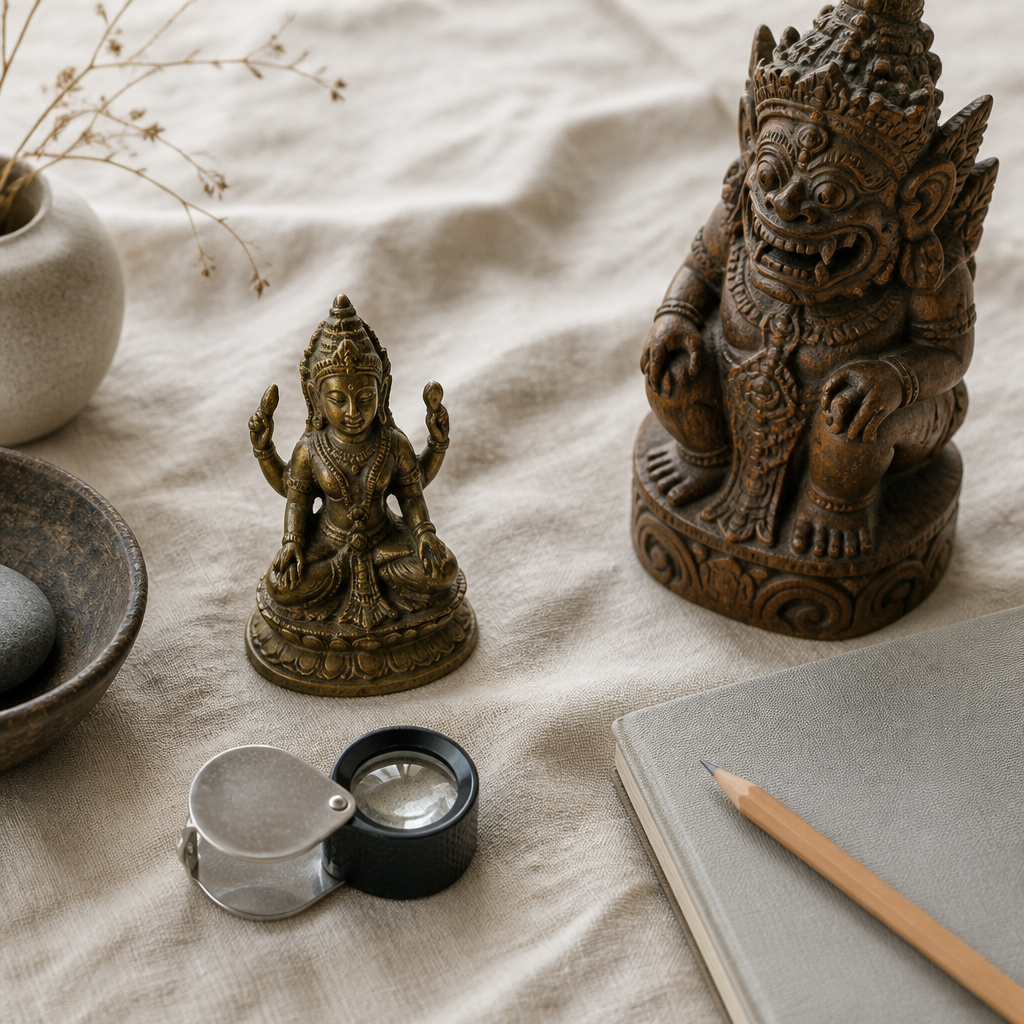
Ask for exact dimensions, the material, and whether the piece is a reproduction or an original carving. Ask who carved it and where. A reputable seller can answer these questions directly and will not object to a second look at the reverse, base or any repairs.
Ask also how the piece was finished. Some carvings are polished for display while others keep their rough working surfaces. A piece that has been heavily restored may still be attractive, but it should be described as restored, not as untouched.
Materials, Wear and Repairs
Weathering on stone is not automatic proof of age. Wear can come from rough handling, from a tumbling process or from deliberate treatment, and a freshly carved piece can be aged to look older. Judge the wear by where it appears, how it sits in the recesses and whether it matches the rest of the surface.
Repairs need the same scrutiny. Mortar lines, fresh adhesive or mismatched tones on a brick or stone surface should be disclosed. An honest repair does not necessarily reduce a piece's value for a home altar or a study collection, but a hidden one does.
Pro tip: Ask for close photographs of the reverse, the base and any joins before you commit. Most problems that matter to a collector show up in those areas, not on the front.
Frequently Asked Questions
What makes Majapahit art different from earlier Javanese sculpture?
Majapahit is best known for its large number of Hindu-Buddhist brick temples, tall slender-roofed red brick gates and strong geometric quality. Earlier sculpture from the 8th to 10th centuries is known for stone carving with delicacy and serenity of expression.
Is Balinese Hindu sculpture the same as Majapahit art?
No. The two are related through the wider Hindu-Buddhist tradition of the region, but Balinese work has its own conventions and remains a living tradition. Judge each piece against its own style and period.
Why do sources give different end dates for Majapahit?
One source gives 1500 as the end of the golden age in Indonesian art, while another gives 1527 as the date the empire was disestablished. They measure different things, so state which frame you are using when you describe an object.
Did the rise of Islam end Hindu art in the region?
No. By the 15th century Islam was dominant, but local mosques reflected both indigenous and Islamic influences, and Hinduism remains central in Bali today. Mixed forms are part of the history, not proof of a fake.
How can I tell whether a candi piece is a temple or a gate?
Ask the seller. The term candi covers Hindu and Buddhist temples and sanctuaries, but it is also used for gates, urban ruins and bathing places. A clear description of the object's function is more useful than the label alone.
Can Indonesian Hindu statues be used on a home altar?
Yes, many people use them in home practice. Decide what the figure represents to you, choose a stable, clean surface at a comfortable height, and handle stone and brick pieces carefully because their surfaces are fragile.
Which Indonesian Hindu piece has changed the way you read regional style, and what did you notice that you had missed before?
References
-
Art history overview of Indonesian architecture and Hindu-Buddhist sculpture
-
Encyclopedia overview of the Majapahit Empire, its dates and territory
