



Indonesian Buddha Statues: A Practical Guide
Indonesian Buddha Statues: A Practical Guide
You're comparing two bronze figures, both labelled Indonesian Buddha, but their faces, ornament and prices look quite different. One seller offers a confident ancient date; another describes a Javanese-style piece without claiming antiquity. Before deciding which you prefer, you need to know what each description establishes.
Table of Contents
- Why Indonesian Buddha Statues Deserve Their Own Guide
- Central Javanese Buddhist Sculpture and the Shailendra Patronage
- East Javanese Styles and How to Tell Them Apart
- Materials, Casting, and the Mystery of the Open Base
- Reading Ritual and Decorative Functions in the Iconography
- Provenance, Documentation, and Due Diligence for UK Collectors
- Conservation, Display, and Shipping Fragile Statues
- Bringing It All Together on Indonesian Buddha Statues
Why Indonesian Buddha Statues Deserve Their Own Guide
Indonesian Buddha statues belong to a regional family, not a single fixed style. A useful assessment separates the figure's identity, its proposed place of manufacture, its material and its documented history. These questions overlap, but answering one doesn't settle the others.
The distinction matters when you're buying. A convincing identification of a Buddhist figure doesn't authenticate its age, and a recognisably Javanese appearance doesn't establish where an object was excavated or previously owned. Treat each part of a catalogue description as a separate claim requiring appropriate evidence.
Start with the description, not the price
Read the wording closely. Indonesian, Javanese, Central Javanese and Indonesian-style aren't interchangeable descriptions. Ask whether the seller intends a geographical attribution, a stylistic comparison or an acknowledgement of the design's inspiration.
The same discipline applies to dates. Ask what supports the proposed period: comparison with a documented museum object, examination of manufacture, ownership records, or some combination of these. A persuasive comparison should identify particular features rather than relying on an overall impression of serenity or age.
Bring these questions to any viewing:
- Identity: Which figure is represented, and which visible attributes support that identification?
- Attribution: What makes the proposed region more convincing than another?
- Construction: What are the material, casting characteristics and condition?
- History: Which parts of the ownership and movement history are documented?
- Purpose: Is the object offered as an antique, a contemporary devotional sculpture or a decorative interpretation?
Buying principle: A precise description of uncertainty is more useful than an unsupported promise of certainty.
Museum catalogues offer comparison objects, not shortcuts to authentication. Use them to sharpen your questions, then assess the actual object and its paperwork together. That approach works whether you're building a collection, choosing an altar image or commissioning a considered interior.
Central Javanese Buddhist Sculpture and the Shailendra Patronage
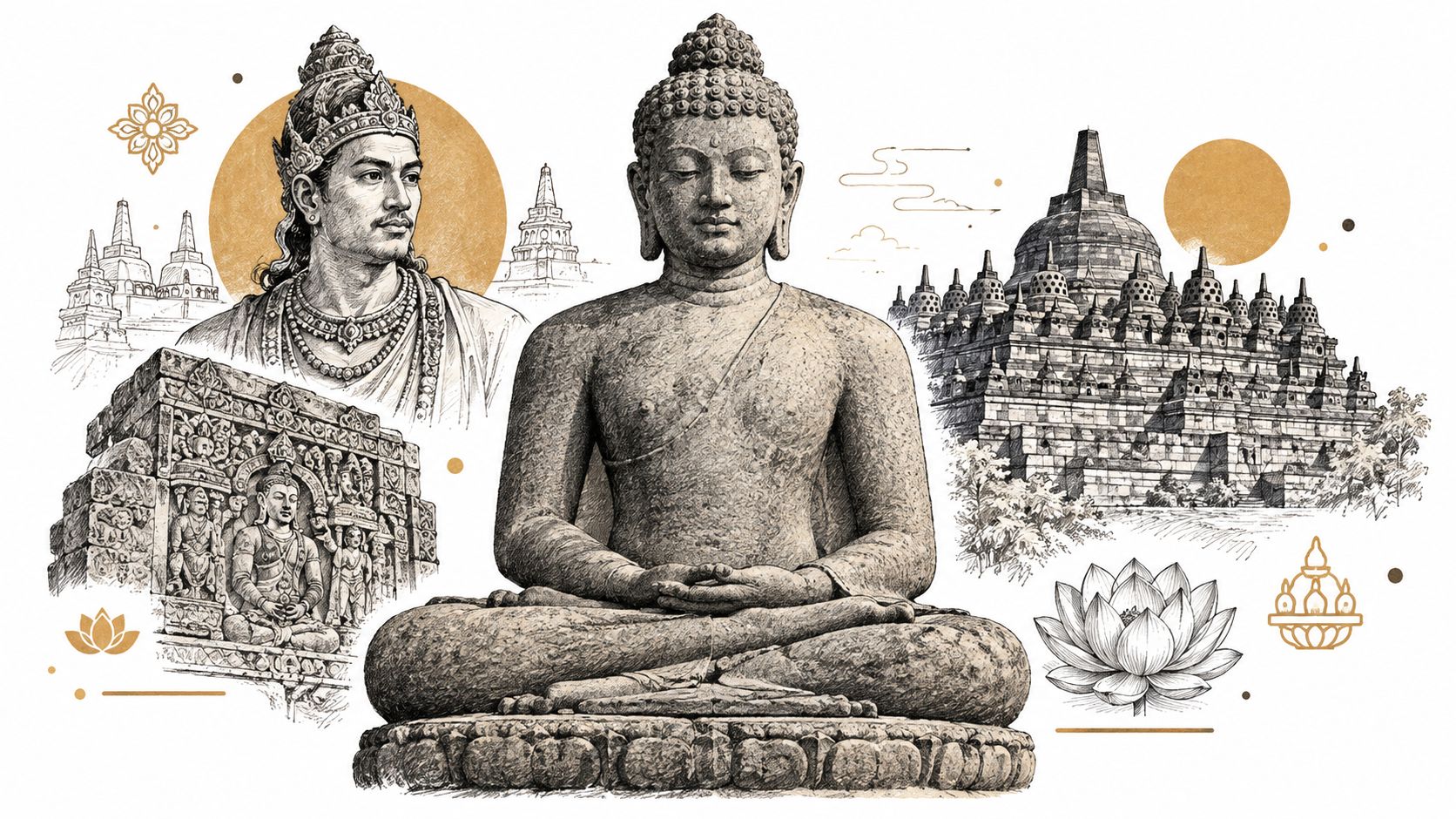
Central Java provides an essential starting point. The Shailendra rulers, who governed approximately 760–830 CE, supported Mahayana Buddhism and sponsored Borobudur, conceived as a three-dimensional mandala; the wider monumental context is discussed alongside the British Museum's Borobudur Buddha head.
Think of a mandala here as an organised sacred arrangement expressed through architecture. That context changes how you approach a detached sculpture: an individual head or seated figure may once have belonged to a much larger visual and religious programme.
Learn the vocabulary without turning it into a checklist
When examining a figure, distinguish the ushnisha, the cranial prominence, from a crown or separate ornament. Look separately at the face, shoulders, robe, hands and seat. A halo behind the head, often described as a nimbus or aureole, belongs to a different part of the composition from the figure's bodily features.
Don't assume that every feature associated with Buddhist sculpture proves Central Javanese manufacture. The more useful question is whether the proportions, posture, modelling and surviving architectural elements form a coherent comparison.
The British Museum record cited above identifies its ninth-century volcanic-stone head as belonging to one of just over 500 Buddha figures placed in niches and trellised stupas at Borobudur. That setting explains why architectural relationships matter: the sculpture wasn't necessarily conceived as an isolated display object.
For broader historical orientation, the history and iconography of Buddhism in Indonesia provides a useful companion to object-by-object study.
- Read the whole silhouette: Compare the head's relationship to the shoulders and torso, not merely the expression.
- Separate survival from design: A missing halo or damaged hand can obscure the original composition.
- Keep scale in view: Don't assess a portable devotional image as though it were a reduced architectural sculpture.
Political change shouldn't be treated as an abrupt stylistic boundary. Buddhist activity continued after the Shailendras' displacement by the Sanjaya dynasty, alongside the Hindu monumental tradition represented by Prambanan. For attribution, a historical period provides context, not a verdict.
East Javanese Styles and How to Tell Them Apart
An elaborately ornamented figure shouldn't be dismissed because it differs from a restrained monument-derived Buddha. The better approach is to ask whether its ornament, facial modelling and construction belong together.
The V&A's Central Javanese seated Buddha comparison dates to the ninth–tenth century and has a double-lotus throne, a robe over the left shoulder, a raised teaching hand and traces of a circular nimbus. The same catalogue discussion distinguishes late-tenth- to early-eleventh-century Nganjuk bronzes through exuberant ornamentation and unusually crisp detail.
Central Javanese vs East Javanese Diagnostic Features
The date bands below are broad comparison categories, not rigid boundaries. The cited Central Javanese example itself extends beyond the earlier band.
| Feature | Central Java (8th-9th c.) | East Java (10th-11th c. and later) |
|---|---|---|
| Overall modelling | Restrained, monument-related forms provide a useful baseline | More elaborate treatment may be relevant, especially in Nganjuk comparisons |
| Ornament | Assess the relationship between body, robe and seat | Examine jewellery, waist girdles and sharply articulated detail |
| Surrounding elements | Nimbus fragments and lotus-throne geometry can assist comparison | Throne-back design may offer additional evidence |
| Attribution limit | Restraint alone doesn't establish origin | Dense decoration alone doesn't establish origin |
These contrasts are most useful when you compare equivalent subjects. Comparing an unadorned Buddha with a jewelled bodhisattva without recognising their different identities can produce a false regional distinction.
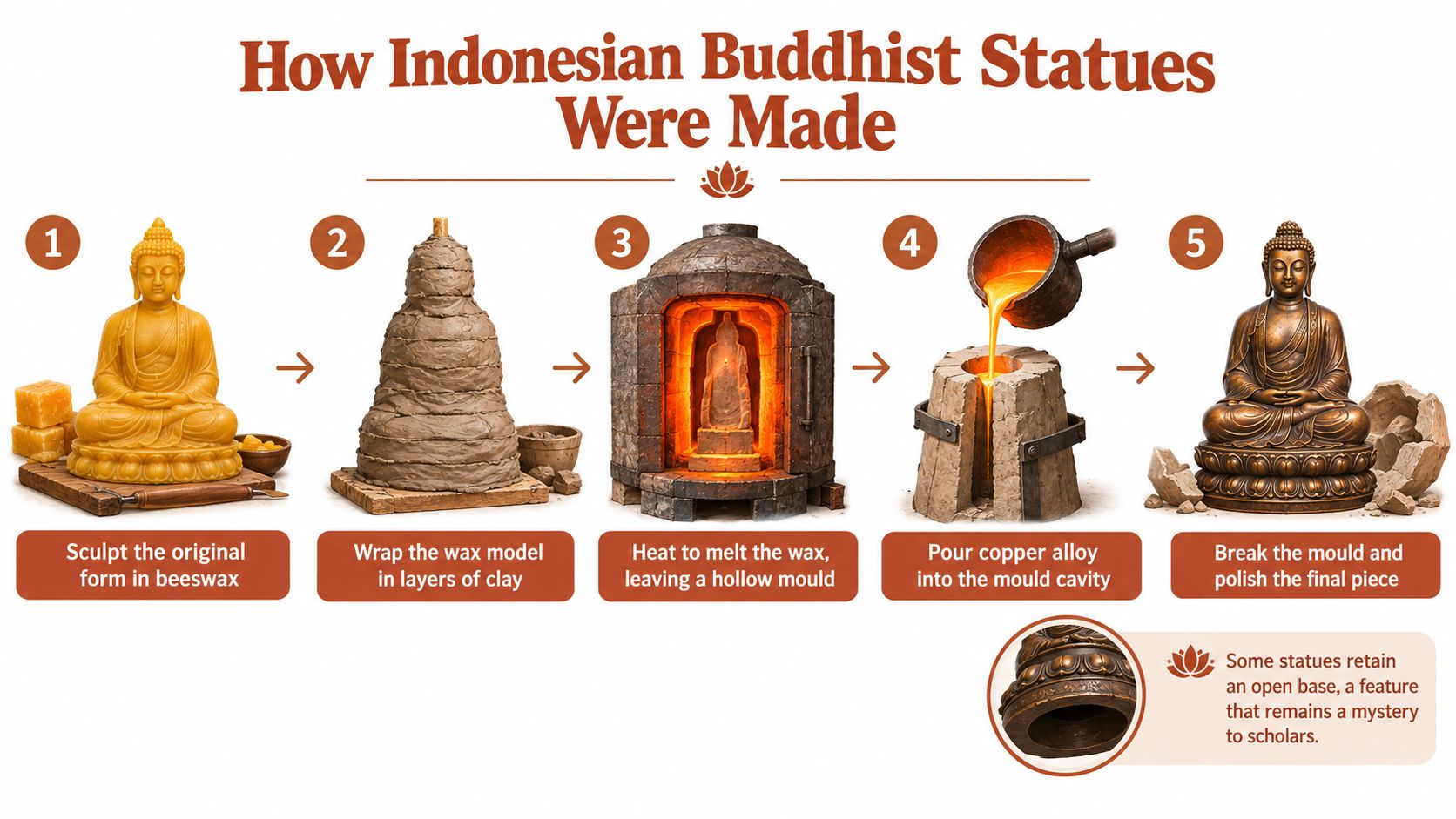
The casting illustration below offers a construction reference, rather than a method of assigning regional origin.
Allow for overlap
Chronology also complicates simple labels. The V&A's Javanese bodhisattva catalogue discussion identifies possible Vajrayana elements in a late-ninth- to early-tenth-century figure and notes the increasing importance of these traditions during the twelfth–fourteenth centuries.
That doesn't make every tantric image late, or every earlier image non-tantric. It means that religious identity and regional style must be considered together.
A regional attribution is strongest when several independent observations agree. One attractive resemblance isn't enough.
For a high-value acquisition, request a written explanation of the comparison and appropriate scientific examination. Genuine variation, damage and restoration can all blur the appearance of an otherwise useful diagnostic feature.
Materials, Casting, and the Mystery of the Open Base
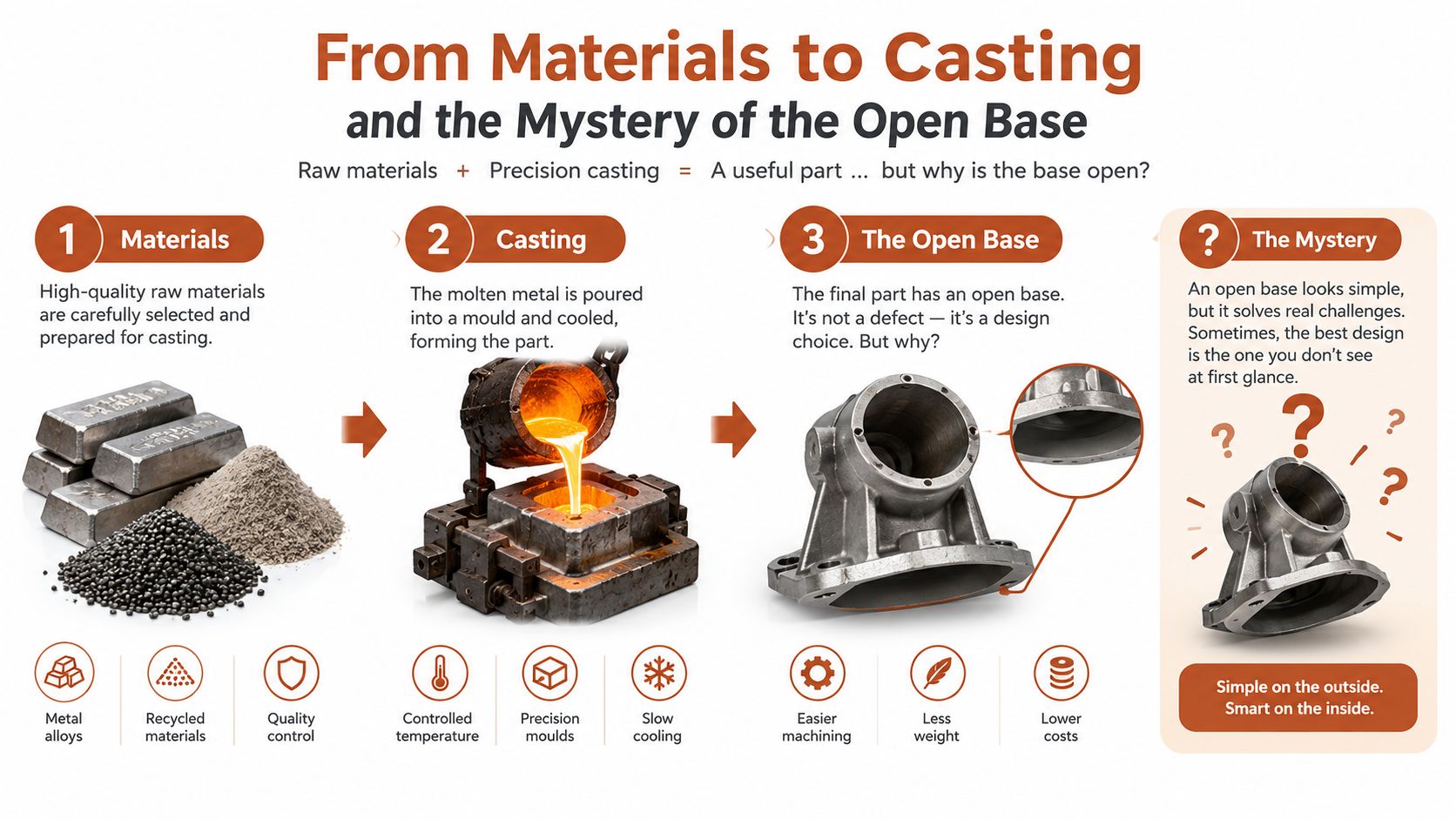
An open underside can make a buyer hesitate. Before calling it damage, ask whether the opening belongs to the sculpture's original construction.
The V&A records a tenth- or eleventh-century East Javanese copper-alloy Buddha Shakyamuni as lost-wax cast, with an open underside and a cavity probably intended for a consecratory deposit, originally closed by a now-missing plate. Its catalogue record documents both the construction and the proposed ritual explanation.
Material and manufacture are separate questions
Use copper alloy when the precise composition hasn't been established. Calling a sculpture bronze may be reasonable catalogue shorthand, but it shouldn't imply that someone has analysed its composition.
Likewise, identifying lost-wax manufacture doesn't establish antiquity. Treat technique as part of the object's description, then ask separately what supports its date. For an accessible introduction to the method, consult how bronze casting works in ancient Asia.
Stone, silver and copper alloy also require different comparisons. Borobudur's architectural sculpture belongs to a different physical setting from the small silver devotional group discussed below. Material alone doesn't establish religious importance, geographical origin or market value.
Examine the opening rather than explaining it away
A condition report should distinguish among possible causes:
- Missing closure: Does the underside retain evidence consistent with a former sealing plate?
- Casting flaw: Is the irregularity part of manufacture rather than later damage?
- Later intervention: Do cut edges, tool marks or disturbed surfaces suggest subsequent opening?
- Unresolved construction: Is the evidence insufficient to choose between these explanations?
X-radiography, endoscopy, alloy analysis and close examination of tool marks can help investigate these questions. Ask the examiner to explain what each method can establish and what remains uncertain.
Condition caution: A ritual explanation for one documented cavity doesn't authenticate every statue with an open base.
The wording probably intended for a consecratory deposit matters. It preserves the difference between observation and interpretation. Don't replace that measured conclusion with a confident story about relics that haven't been documented.
Reading Ritual and Decorative Functions in the Iconography
Begin with the hands, then examine the objects they hold. This keeps identification grounded in visible evidence rather than the general mood of a sculpture.
The East Javanese Buddha already discussed displays bhumisparsha, the earth-touching gesture. The Central Javanese comparison raises a hand in vitarka, a teaching gesture. These examples show why the position of an individual hand can be more informative than a seller's broad description of a peaceful Buddha.

Attributes can narrow an identification
The V&A's Vajrasattva sculpture is a ninth-century copper-alloy figure from western Indonesia, stylistically comparable with Central Javanese works. It holds a vajra-bell in the left hand and a vajra in the right, raised towards the centre of the chest; the museum connects these implements with esoteric Buddhist ritual.
Here, the paired attributes support a specific identification. A damaged hand or missing implement would reduce that confidence, so a catalogue should acknowledge losses rather than reconstructing the intended image.
A meditation label needs similar care. If a seller uses dhyana, ask them to identify the relevant hand arrangement and explain the proposed subject. Don't infer a particular Buddha solely from a seated posture.
Groups need to be read as groups
The V&A documents three silver Buddhist sculptures from eighth- or ninth-century Central Java: a standing Avalokiteshvara with seated female bodhisattvas, possibly Tara and Bhrikuti or two forms of Tara. Its silver triad record also notes Indonesian facial characteristics, simple looped aureoles and the use of precious metals for small devotional images.
The alternative identifications are important. The arrangement is meaningful even where the precise identities of the accompanying figures remain uncertain.
- Describe what survives: Record gestures, attributes, aureoles and attachments before offering an interpretation.
- Keep function qualified: Iconography can indicate a ritual context without proving how this particular object was used.
- Respect the distinction: Contemporary decorative placement doesn't erase a design's religious meaning.
For buyers, lenders and insurers, a careful description should separate identification, proposed original function and current use. They're related questions, but they aren't the same question.
Provenance, Documentation, and Due Diligence for UK Collectors
A place name in a catalogue can describe manufacture, discovery or cultural affiliation. Before accepting an Indonesian attribution, ask which meaning the seller intends.
Museum histories demonstrate the need for this distinction. V&A records include objects acquired through collector and dealer networks, as well as a Sri Lankan Buddha head reportedly found in Java; the V&A's collection documentation provides a starting point for examining such histories. A reported findspot shouldn't be silently converted into a manufacturing origin.
Build an object file before committing
Request documents that identify the actual sculpture, ideally through photographs, dimensions and distinctive marks. A general account of a collection isn't the same as an ownership record for the object you're considering.
- Ownership history: Ask for named previous owners, acquisition circumstances and supporting records.
- Movement documents: Request available export permissions, import records and the date of entry into the UK.
- Transaction records: Retain invoices, acquisition receipts and the seller's written description.
- Condition evidence: Obtain photographs, restoration notes and relevant examination reports.
- Cultural-property status: Ask whether restrictions, ownership disputes or concerns about illicit removal have been investigated.
The guide to provenance research for Asian antique sculpture offers a practical framework for organising these enquiries.
Separate documentation from legal conclusions
UK government guidance published in June 2025 identifies provenance as relevant to establishing when an object entered the UK, assessing the Waverley cultural-heritage criteria and checking compliance with UK laws on illicit cultural objects. A museum object page isn't a substitute for that government guidance or for legal advice about a particular transaction.
Ask a suitably qualified adviser to review unresolved legal questions before purchase or export. Don't assume that an invoice, however professionally presented, resolves every issue.
Disclosure standard: Record gaps in the history explicitly. Don't fill them with plausible-sounding ownership stories.
Responsible uncertainty should affect both the description and the buying decision. If the seller can't substantiate an important claim, ask for revised wording or decline the acquisition.
Conservation, Display, and Shipping Fragile Statues
Once you've chosen a sculpture, plan its care before arranging delivery. My practical recommendation is to treat the figure, its mount and its documentation as a single acquisition project.
Don't assume that a substantial-looking bronze or stone statue is safe to lift by its projecting parts. Inspect the relationship between the body, base, halo and any surviving attributes, then ask a conservator or specialist art handler to identify suitable support points.
Prepare the display position
Choose a secure surface and a location protected from accidental knocks. Aim for stable environmental conditions, avoid unnecessary strong light, and seek object-specific advice where corrosion, old repairs or mixed materials complicate the assessment.
- Support the structure: Have a mount designed around sound areas rather than vulnerable projections.
- Avoid improvised cleaning: Don't polish, oil, scrape or chemically treat an unfamiliar surface.
- Monitor changes: Keep clear photographs so you can compare suspicious areas over time.
- Plan access: Leave enough room to inspect and move the object without gripping fragile details.
Collectors who also display works on paper may find Famous Movie Posters' poster preservation tips for UK collectors useful for thinking about material-specific conservation decisions. Paper treatments shouldn't be transferred to sculpture; the relevant lesson is to choose care methods appropriate to the object.
Document the journey
Before packing, photograph the front, back, sides, underside and vulnerable details. Prepare a written condition report that identifies existing cracks, losses, repairs and loose components, and agree who will check it on arrival.
For transport, request a written packing proposal explaining how the object will be immobilised without pressure on projecting features. Ask whether a specialist crate, separate packing for detachable elements or professional installation is appropriate.
International shipments also need accurate descriptions, a detailed packing list, customs paperwork and an agreed insurance valuation. Confirm who is responsible for permissions, declarations and claims before dispatch, rather than after a delay or accident.
Keep the unpacking instructions accessible outside the inner packaging. A carefully packed sculpture can still be damaged if the recipient doesn't know which components are loose or where to place their hands.
Bringing It All Together on Indonesian Buddha Statues
The most useful mental map is a sequence of regional comparisons, not a single ideal Indonesian Buddha. Begin with Central Java's monument-related traditions, recognise the different possibilities offered by East Javanese modelling and ornament, and assess tantric attributes without assuming they settle the date.
That approach leaves room for variation. A sculpture may have a convincing regional character while retaining uncertainty about its precise workshop or period. Good cataloguing makes those distinctions visible rather than compressing them into an impressive label.
Bring the evidence together
Use style, material and provenance as connected checkpoints. Style helps you formulate an attribution; examination tests what the object's construction and condition can support; provenance records what is known about its history.
None should be used to excuse weaknesses in the others. A close museum parallel doesn't supply missing export records, and a long ownership history doesn't automatically validate an ambitious date.
For a prospective purchase, ask the seller for a short written assessment that separates observations from interpretations. You should be able to see which conclusions rest on visible features, which depend on documents and which remain provisional.
- Identify: Name the figure through surviving gestures and attributes.
- Compare: Use a specific museum object, explaining both similarities and differences.
- Examine: Investigate construction, alterations and condition without treating appearance as proof.
- Document: Preserve ownership, movement and transaction records.
- Protect: Agree display, handling and transport arrangements before the object moves.
The strongest buying decision isn't necessarily the most confident attribution. It's the decision you can explain clearly, with evidence proportionate to the claim and an honest account of what remains unknown.
An attractive Indonesian label should begin the enquiry, not end it. Whether you choose an antique or a contemporary interpretation, insist on language that accurately describes what you're acquiring.
HD Asian Art offers antique and contemporary Buddhist and Hindu sculpture, including Indonesian pieces, alongside educational resources. Visit to compare available forms, then request the object-specific photographs, condition information and attribution evidence relevant to your choice.
