



Votive Stupas and Their Religious Purpose Explained
Votive Stupas and Their Religious Purpose Explained
Table of Contents
- Votive Stupas and Their Religious Purpose: An Introduction
- What Is a Votive Stupa? Understanding the Votive Stupa Meaning
- Buddhist Stupa Symbolism: Dome, Harmika, and Chattra
- Stupa Offerings and Worship: How Devotees Interact with Sacred Monuments
- Stupa Circumambulation Meaning: Walking as Devotion
- Merit, Karma, and the Spiritual Benefit of Votive Stupas
- Conclusion: Bringing Votive Stupa Devotion into Your Space
- Frequently Asked Questions
Votive Stupas and Their Religious Purpose: An Introduction
A votive stupa is a miniature Buddhist monument built to earn merit, commemorate a sacred moment, or house a small offering rather than a Buddha's remains.
The answer sits at the intersection of devotion, architecture, and belief about karma. A study of Buddhist votive tablets from the Nusantara archipelago dated to the 7th-10th centuries AD found that their ritual function reflected a hybridization of Buddhist faith and local beliefs (Indradjaja and Wahyudi study on votive tablets).
Below, we explain the votive stupa meaning, how it differs from a relic stupa, what its parts symbolize, and how devotees still interact with these monuments today.
What Is a Votive Stupa? Understanding the Votive Stupa Meaning
A votive stupa is a small stupa erected as an offering, usually to mark a pilgrimage, honor a revered figure, or accumulate merit, rather than to enshrine a relic. The word "votive" comes from the Latin votum, a vow or dedication, and that is precisely what these structures represent: a promise made visible in stone, clay, or metal.
Votive stupas range from hand-sized clay models pressed from molds to waist-high stone structures arranged around a temple complex. Many were deposited in rows beside a main stupa, so a single sacred site could hold hundreds of individual acts of devotion. Their scale made devotion accessible. A pilgrim who could not fund a grand monument could still commission a small one.
Votive Stupa vs Relic Stupa: The Critical Difference
The distinction matters, and most guides blur it. A relic stupa enshrines physical remains or possessions of the Buddha or a revered teacher, which is why it functions as a primary object of veneration. A votive stupa enshrines no relic. Its purpose is the act of dedication itself.
That difference shapes everything: placement, scale, materials, and how devotees approach each one. Relic stupas anchor a site. Votive stupas cluster around it, each one a private prayer made public.
Buddhist Stupa Symbolism: Dome, Harmika, and Chattra
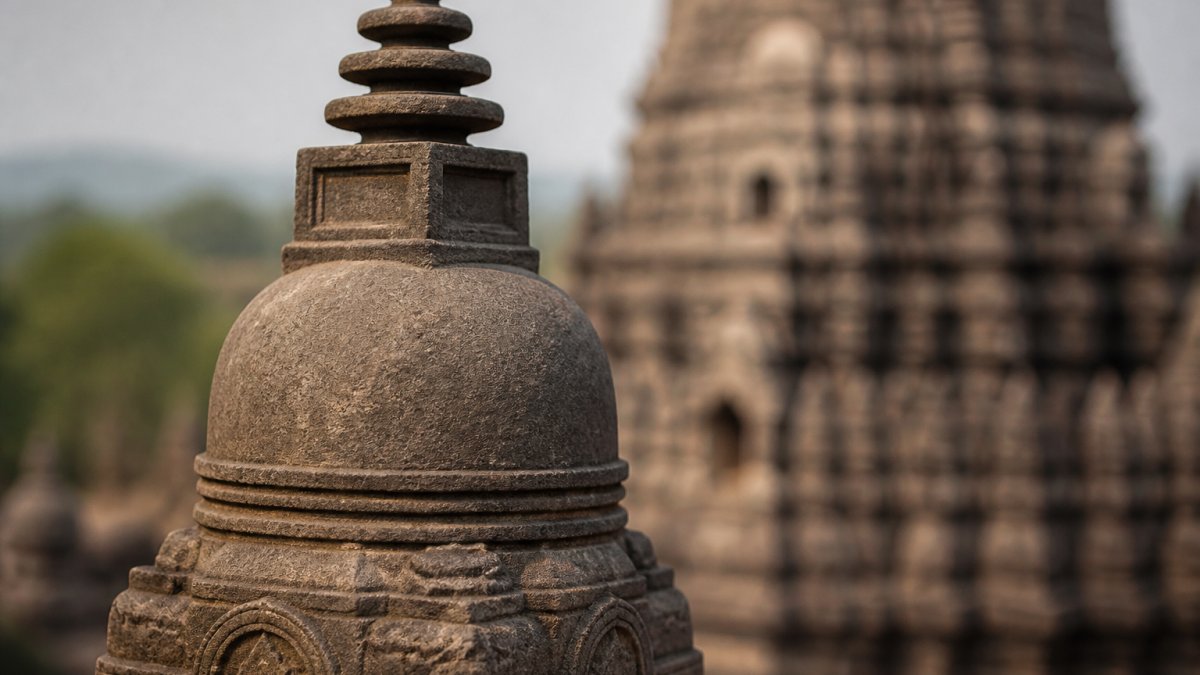
Buddhist stupa symbolism maps the path to enlightenment onto built form. The stupa is not decoration; it is a diagram of Buddhist cosmology, and every component carries meaning that persists whether the structure stands sixty feet tall at a temple complex or fits in the palm of your hand.
The core vocabulary is consistent across traditions:
- Dome (anda): the hemispherical mass representing the cosmos and the Buddha's enlightened mind. In early stone examples the dome was solid and unenterable; the point was the silhouette, not the interior.
- Harmika: the square railing or box above the dome, marking the axis where the earthly meets the transcendent. It echoes the railing that once enclosed a relic chamber.
- Chattra: the stacked umbrella discs at the top, signifying the Buddha's sovereignty and the spread of Buddhist teachings. The number of discs varies, three, seven, and thirteen are all attested, and in many traditions the count corresponds to stages of the path or to specific celestial realms.
- Medhi: the drum or base platform beneath the dome, which raises the whole structure and, at large sites, provides the walking surface for circumambulation.
- Pradakshina patha: the circumambulatory walkway itself, often enclosed by a railing (vedika) with gateways (torana) at the cardinal points.
A 2024 comparative study in Religions examined Buddhist sacred structures across Asia and their historical development (From Stupa to Pagoda study), showing how these core elements persisted even as regional forms diverged, the dome flattening in some traditions, the chattra multiplying in others, the whole profile stretching upward into the pagoda silhouette.
Why the Parts Matter for Votive Stupas Specifically
On a miniature votive stupa, the same grammar appears compressed. Mold-pressed clay examples from monastic sites often reduce the dome to a rounded lump, the harmika to a small square block, and the chattra to a single incised ring or a stack of three. Stone votive stupas at pilgrimage sites tend to preserve more of the full profile because they were carved rather than pressed.
This compression is not sloppiness. It is economy of meaning: the devotee who commissioned a hand-sized stupa still received the full cosmological statement, just at a scale that could be carried, deposited, and repeated.
Stupa Offerings and Worship: How Devotees Interact with Sacred Monuments
Stupa offerings and worship follow a recognizable pattern across traditions. Devotees present flowers, incense, lamps, and food, then bow or prostrate before the monument. The offering is not a transaction. It is an act of attention, and the merit comes from the intent behind it.
In practice, this means a votive stupa can sit on a home altar and receive the same gestures as a temple monument. The scale changes; the practice does not.
Stupa Circumambulation Meaning: Walking as Devotion
Stupa circumambulation meaning is straightforward: walking clockwise around a sacred monument is a physical enactment of devotion, with the monument kept on the walker's right. Known as pradakshina, the practice aligns the body with the mind's focus and turns a monument into a moving meditation.
The circuit is usually performed three times, though the count varies by tradition and occasion. What matters is the direction and the attention. In a home setting, even a small votive stupa can anchor the same gesture, which is why serious practitioners often keep one at floor level rather than on a high shelf.
Merit, Karma, and the Spiritual Benefit of Votive Stupas
Merit and karma sit at the center of why votive stupas exist, and the two concepts are often used loosely in popular writing. It is worth separating them.
Karma in Buddhist thought is intentional action and its consequences: what you deliberately do, say, or think shapes future conditions for yourself and others. Merit (often punya in Sanskrit, puñña in Pali) is the wholesome potential generated by beneficial intentional action, a kind of store that can be dedicated toward a good rebirth, toward the welfare of others, or toward progress on the path.
This is the framework in which a votive stupa makes sense. Commissioning one, funding one, circumambulating one, or simply making an offering before one all count as intentional acts. The structure itself is the occasion for the act, not the source of its power.
How the Mechanism Actually Works in Practice
A common pattern across traditions runs roughly like this:
- Intention (cetana): the devotee forms the wish to make an offering, often dedicating it to a specific purpose, a deceased relative, a safe journey, a vow fulfilled.
- The act: commissioning the stupa, depositing a small offering inside or beside it, or performing circumambulation and prostration.
- Dedication (parinamana): the merit is formally offered, either toward one's own future welfare or toward the benefit of all beings. Many traditions treat dedication as what makes merit inexhaustible rather than self-consuming.
- Rejoicing: in some traditions, the devotee or others later rejoice in the act, which is itself considered a merit-bearing mental action.
This sequence explains why votive stupas cluster at pilgrimage sites. A pilgrim who traveled a long distance could mark the journey with a physical act that remained after departure, a small monument that continued to stand as evidence of the vow.
Votive Stupa vs Relic Stupa: Why the Merit Logic Differs
A relic stupa is venerated because of what it contains. A votive stupa is venerated because of what the devotee does around it. The spiritual benefit attributed to the votive form flows from the act of dedication, not from the presence of a relic.
| Element | Relic Stupa | Votive Stupa |
|---|---|---|
| Contents | Relics or sacred remains | Offering, no relic |
| Scale | Monumental | Small to portable |
| Primary purpose | Veneration of the Buddha | Merit, commemoration |
| Placement | Temple focal point | Clustered, home altar |
| Merit logic | Derived from the relic's presence | Derived from the devotee's intentional act |
A common mistake is treating a votive stupa as interchangeable with a relic stupa when describing it to buyers or fellow practitioners. The two carry different ritual weight, and conflating them misrepresents the object's history.
What the Evidence Supports, and What It Doesn't
It is worth being honest about the limits of the record. Inscriptions on surviving votive stupas frequently name the donor and state a dedication, which gives us direct evidence of intent. Excavated deposits of miniature stupas at pilgrimage sites show that the practice was widespread and repetitive.
Purposes also varied by period and community. A votive stupa deposited at a monastic site in one century might commemorate a teacher; one deposited at a pilgrimage site in another might fulfill a vow made during illness. Most practitioners and scholars treat the votive stupa as a flexible devotional form rather than a single fixed ritual, and that flexibility is part of why it survived across so many Buddhist regions.
Conclusion: Bringing Votive Stupa Devotion into Your Space
Understanding votive stupas changes how you see them. They are not scaled-down copies of grand monuments; they are a distinct devotional form, built for the merit of the person who commissioned them and the practice of the person who keeps them today.
At HD Asian Art, we curate Buddhist and Hindu statues alongside Khmer and Southeast Asian sculptures, with pieces suited to altars, meditation spaces, and refined home interiors. Every order ships free, and each piece is selected for the craftsmanship and history that a serious practitioner or collector expects to feel in person.
Browse the HD Asian Art collection and find a stupa or sculpture that earns its place in your practice.
Frequently Asked Questions
What are the four main types of stupas?
Buddhist tradition classifies stupas into four functional types: relic stupas (containing sacred remains), object stupas (holding relics of enlightened teachers), commemorative stupas (marking events in the Buddha's life), and votive stupas (built as acts of devotion or merit). Votive stupas are the most numerous because anyone can commission one, from a simple clay tablet to an elaborate stone structure. Each type serves a distinct purpose within Buddhist practice, but all share the same basic architectural form.
What was the religious purpose of a votive stupa?
A votive stupa was built primarily to generate merit for the donor and to express devotion to the Buddha and his teachings. Unlike relic stupas, which housed sacred remains, votive stupas functioned as personal offerings. Devotees commissioned them to commemorate a pilgrimage, fulfill a vow, or seek spiritual benefit for themselves or deceased relatives. A 2017 study of Nusantara votive tablets from the 7th to 10th centuries AD found that their ritual function reflected a hybridization of Buddhist faith and local beliefs, showing how votive practice adapted across regions.
How is a votive stupa different from a relic stupa?
The key difference lies in what they contain and their purpose. Relic stupas enshrine bodily relics of the Buddha or revered teachers and serve as major pilgrimage destinations. Votive stupas contain no relics; they are devotional offerings made of clay, stone, or metal, often small and deposited at sacred sites. While relic stupas anchor communal worship, votive stupas allow individual expression of faith. Both forms share architectural features like the dome and chattra, but only relic stupas are consecrated with sacred remains.
What do Buddhists offer at a stupa?
Offerings at stupas typically include flowers, incense, candles, food, and water. Devotees may also leave small votive stupas, prayer flags, or written prayers. The act of offering is not about pleasing a deity but about cultivating generosity and letting go of attachment. Circumambulation often accompanies these offerings, with practitioners walking clockwise around the structure while reciting mantras or prayers. The merit generated from these actions is dedicated to the welfare of all beings.
