



Lakshmi and Vishnu Consort Sculptures: A Collector's Guide
Lakshmi and Vishnu Consort Sculptures: A Collector's Guide
Most collectors who come looking for a Lakshmi statue focus almost entirely on aesthetics, picking a piece because it looks beautiful or fits a shelf. That instinct is understandable, but it skips the most important question: what is this sculpture actually saying? Lakshmi and Vishnu sculptures are not decorative objects that happen to depict deities.
They are a precise visual language, developed over centuries, where every hand gesture, every attribute held, and every positional relationship between the two figures carries a specific theological meaning. Understanding that language is what separates a collection from a cabinet of curiosities.
Table of Contents
- Quick Takeaways
- Who Are Lakshmi and Vishnu, and Why Are They Depicted Together?
- Reading a Lakshmi Statue: Iconography You Need to Know
- Reading a Vishnu Statue: Attributes, Postures, and Their Meanings
- The Main Forms of Hindu Consort Sculpture
- Regional Styles and What They Mean for Your Collection
- Comparing Consort Sculpture Formats: Standalone vs. Joint vs. Lakshminarayana
- How to Buy a Lakshmi or Vishnu Statue with Confidence
- Placement and Display: Altar Logic vs. Interior Design
- Frequently Asked Questions
- References
Quick Takeaways
|
Key Insight |
Explanation |
|---|---|
|
Lakshmi's lotus is not just decorative |
The lotus she holds or stands upon is a deliberate symbol of spiritual purity and non-attachment to material wealth, even as she embodies prosperity. |
|
Gold coins flowing from her hand signal the right type of statue |
Lakshmi with an open downward-facing palm releasing coins (Varada mudra combined with coins) is the prosperity-granting form, the most common choice for home altars. |
|
Vishnu's four attributes identify his form immediately |
The conch (shankha), discus (chakra), mace (gada), and lotus held across his four arms indicate the complete, fully manifested form of the preserver deity. |
|
Joint sculptures carry a specific theological statement |
A Lakshmi-Vishnu or Lakshminarayana sculpture expresses the union of divine protection and prosperity, not simply two deities placed side by side. |
|
Regional style affects iconographic detail, not meaning |
South Indian temple-style sculptures tend toward elongated, ornate forms; North Indian pieces favor softer, rounder proportions. The symbolic content remains consistent. |
|
Lakshmi's association with Vishnu intensified around 400 CE |
According to Wikipedia's entry on Lakshmi, her role as Vishnu's consort became particularly prominent during the late epic period, giving collectors a historical anchor for dating stylistic traditions. |
|
Placement direction matters if the statue is for worship |
Vastu tradition holds that deity idols placed facing east or northeast align with positive directional energies, a practical consideration when positioning a statue in a home altar. |
Who Are Lakshmi and Vishnu, and Why Are They Depicted Together?
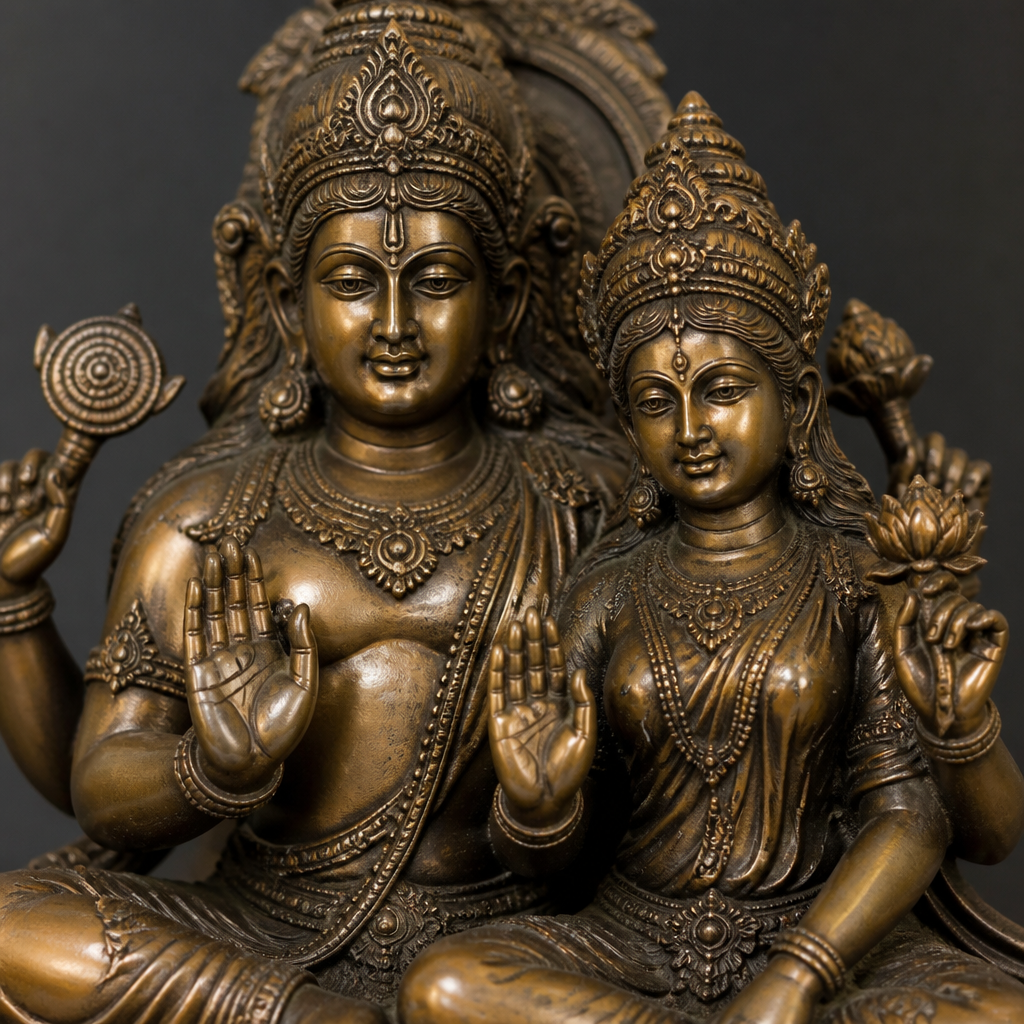
Vishnu is the preserver of cosmic order, the deity responsible for maintaining balance in the universe. Lakshmi is the goddess of wealth, fortune, and prosperity, both material and spiritual. Together they form one of Hinduism's most theologically complete divine partnerships: protection without abundance is incomplete, and abundance without order becomes chaos. The sculpture tradition captures this balance literally, placing the two figures in precise spatial and gestural relationship to each other.
According to the Wikipedia entry on Lakshmi, her association with Vishnu as his consort grew significantly during the late epic period, around 400 CE. This is not a minor historical footnote. It means the sculptural tradition of depicting them together has more than fifteen centuries of continuous development behind it, producing a remarkably refined visual vocabulary that serious collectors should be able to read.
"Among the many divine treasures that emerged from the ocean, the most radiant was Lakshmi. She chose to reside forever at the heart of Vishnu, the protector of the universe."
This origin narrative, drawn from the churning of the cosmic ocean (Samudra Manthan), is precisely why the two deities are considered inseparable rather than merely associated. A sculpture depicting them together is not illustrating a relationship of convenience. It is expressing a cosmological truth about how the universe is sustained.
Reading a Lakshmi Statue: Iconography You Need to Know
A serious collector should be able to identify Lakshmi's form within seconds. Her core iconographic elements are consistent across centuries and regions, even as surface style varies enormously.
The Lotus: Her Most Defining Symbol
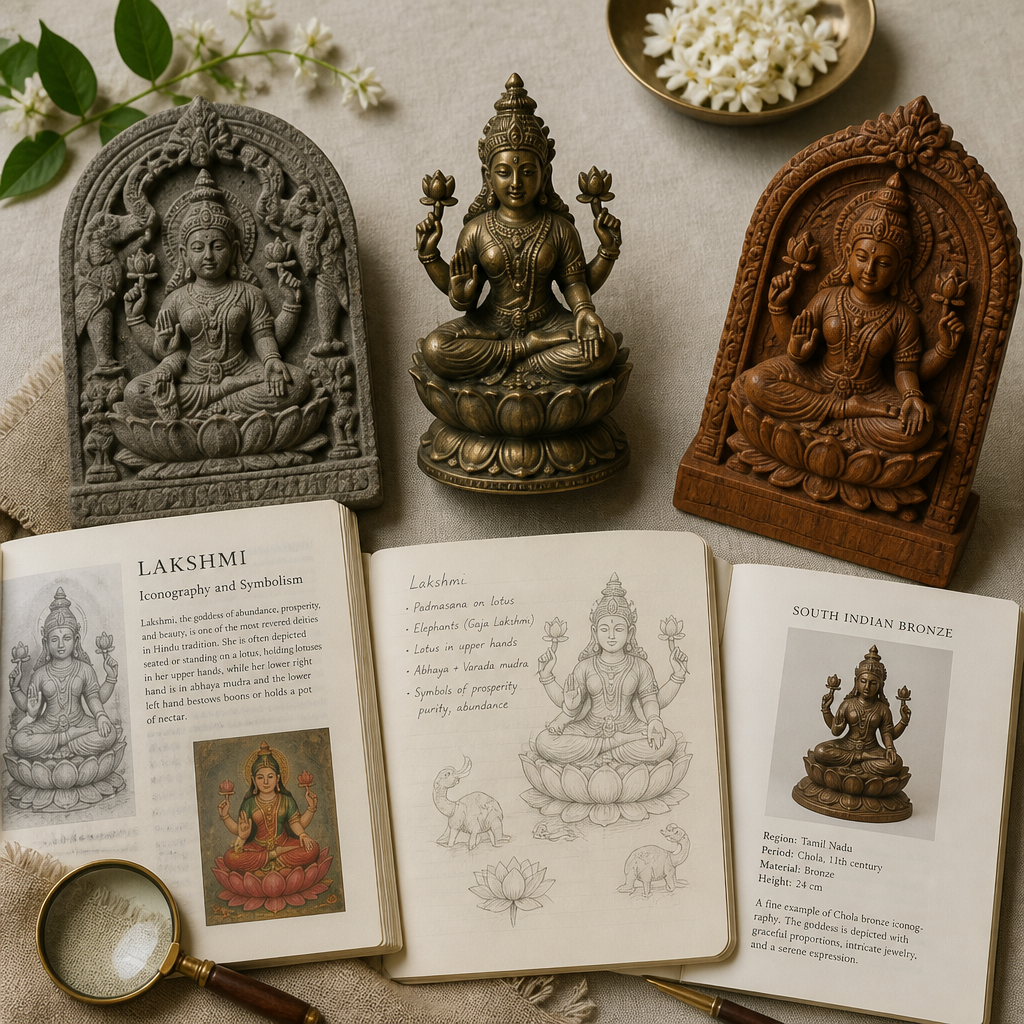
Lakshmi is depicted either seated or standing on a lotus, and frequently holds one in her hand. The lotus symbolizes purity and spiritual enlightenment, growing from muddy water but remaining unstained. This is theologically precise: the goddess of material wealth is simultaneously a symbol of non-attachment to that wealth. A Lakshmi statue without a lotus is either a very unusual regional variant or a piece that warrants closer authentication scrutiny.
The Flowing Gold Coins
One of Lakshmi's most recognizable gestures shows her open palm facing downward with gold coins cascading from her fingers. This is the varada mudra, the gesture of giving. When combined with coins, it specifically represents the bestowal of material prosperity. This is the form most commonly chosen by collectors and practitioners for home altars and businesses, for obvious reasons. A less common variant shows Lakshmi with both hands in different mudras, addressing both material and spiritual dimensions simultaneously.
The Elephants Flanking Her
In the Gajalakshmi form, two elephants stand on either side of Lakshmi, raising their trunks and pouring water over her. The elephants signify royal power and strength. This form is particularly prominent in temple architecture and in sculptural traditions from South India. When you encounter a Gajalakshmi piece, you are looking at one of the oldest formulations of the goddess, one that predates her firm association with Vishnu and connects back to her earlier role tied to agricultural fertility and royal consecration.
Pro tip: When examining a Lakshmi statue for your collection, count the number of arms. Two-armed Lakshmi is the domestic, accessible form suited to home altars. Four-armed Lakshmi, holding lotus blooms in her rear hands and displaying mudras with her front hands, is the more formal, temple-derived representation and tends to command higher attention from serious collectors.
Reading a Vishnu Statue: Attributes, Postures, and Their Meanings
A Vishnu statue in his complete, standard form carries four attributes across four arms: the conch (shankha), the discus (chakra), the mace (gada), and the lotus. Each attribute has a specific function in the theology of the preserver. The conch announces divine presence and dispels negative energies. The chakra, the spinning discus weapon, represents the mind and the cosmic cycle of time. The mace is the power of knowledge and sovereignty. The lotus, again, represents purity and creative potential.
Vishnu's Standing and Reclining Forms
The standing form of Vishnu, known as Sthanakamurti, shows him in a formal frontal posture, often with both feet planted evenly, conveying stability and cosmic authority. This is the form most commonly found in bronze sculptures from South India, and the form most frequently paired with a standing Lakshmi in Hindu consort sculpture.
The reclining form, Anantashayana or Vishnu Anantashayi, shows him lying on the cosmic serpent Ananta (also called Shesha), often with Lakshmi seated at his feet. This is a more complex compositional form, philosophically rich but more spatially demanding in a collection or altar setting. It is one of the most powerful subjects in Hindu sculpture and requires appropriate context and space to display correctly.
Vishnu Iconography and the Placement of Lakshmi
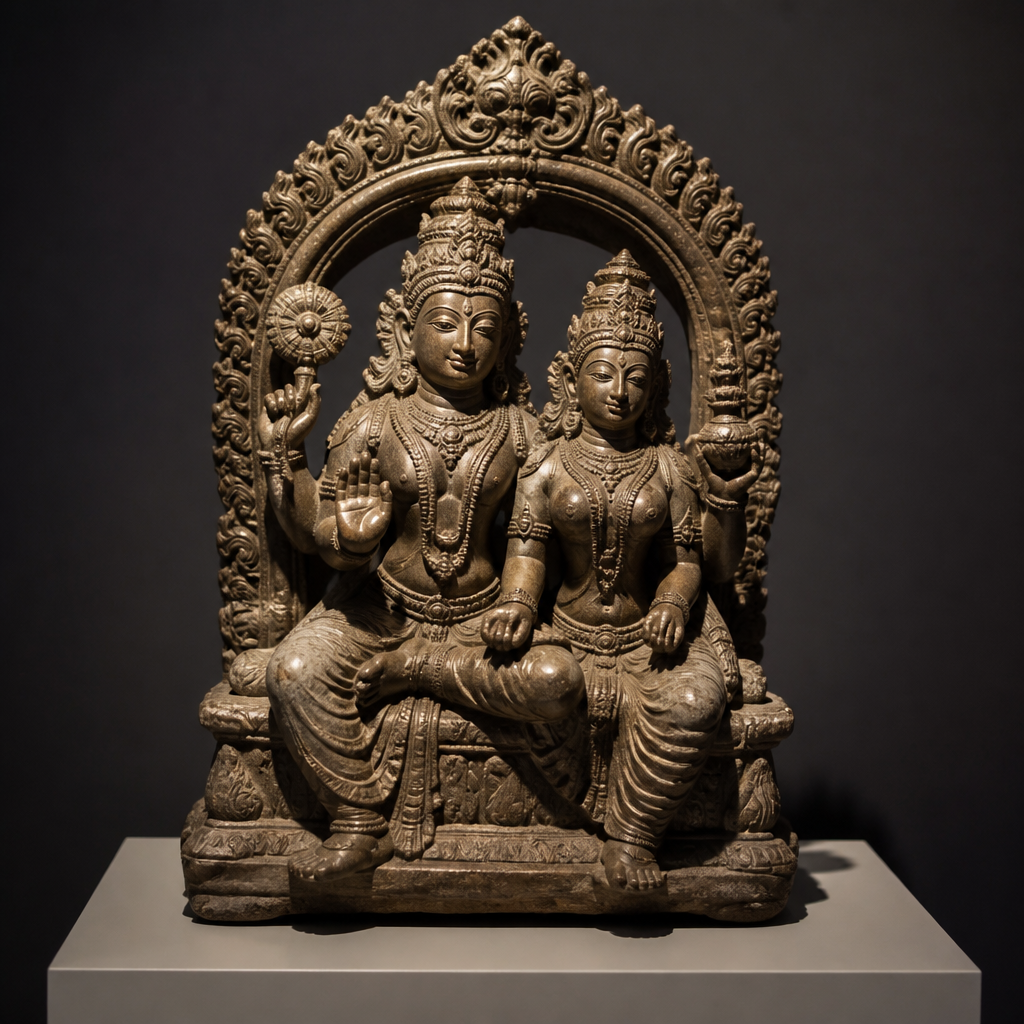
In joint Vishnu-Lakshmi sculptures, Lakshmi is almost invariably positioned on Vishnu's left side. This is not arbitrary. In Hindu iconographic convention, the left side of a deity is associated with Shakti, the divine feminine creative energy. Placing Lakshmi on Vishnu's left is a spatial encoding of the theological relationship between the preserver and his energizing consort.
Pro tip: A common mistake when buying a joint sculpture is treating the two figures as interchangeable in composition. If the female figure is on the right of the male figure, that may indicate a different pairing entirely, such as Shiva and Parvati, rather than Vishnu and Lakshmi. Always cross-check the attributes held by both figures before purchasing.
The Main Forms of Hindu Consort Sculpture
Not all Lakshmi and Vishnu sculptures present the pair in the same format. There are three main approaches you will encounter, and each carries a different emphasis and serves a different function in practice and in collecting.
Lakshmi Flanking Vishnu (the Temple Format)
This is the format derived directly from temple iconography, where Vishnu stands at the center and Lakshmi (often alongside Bhudevi, the earth goddess) flanks him on his left. This triadic arrangement is common in South Indian bronze traditions and is among the most historically grounded formats a collector can acquire. It is also the most spatially complex and tends to require a dedicated altar or display space rather than a shelf.
The Lakshminarayana Form
In the Lakshminarayana form, Lakshmi sits on Vishnu's left thigh while he stands or is seated. This is an intimate composition that emphasizes the union of the divine couple rather than their individual divine functions. The Lakshminarayana form is particularly popular for home worship and as a gift for householders, because it expresses domestic and spiritual harmony simultaneously.
Separate Paired Statues
Many collectors, particularly those building a home altar incrementally, purchase separate Lakshmi and Vishnu statues sized to be displayed together. This approach gives more flexibility, but it requires attention to scale and stylistic consistency. A bronze Chola-style Vishnu paired with a white marble Lakshmi from a different tradition creates visual incoherence. The pair should share material, finish, and ideally regional stylistic origin.
Regional Styles and What They Mean for Your Collection
The iconographic content of Lakshmi and Vishnu sculptures is largely consistent across India and the broader South and Southeast Asian sculptural tradition. What changes dramatically by region is the surface treatment, proportional system, and material.
South Indian Temple Bronze Tradition
South Indian sculptures, particularly those drawing from the Chola bronze tradition, are characterized by precise proportions governed by the Shilpashastra, the classical treatises on sculpture. Figures tend to be elongated, with highly detailed jewelry, garments, and facial features. These pieces are among the most refined in the entire Hindu sculptural tradition and represent the gold standard for collectors focused on iconographic accuracy.
North Indian Carved Stone Traditions
Northern Indian sculptural traditions, as reflected in temple carvings from the Gupta period onward, tend toward softer, more rounded forms with a sensuous fullness to the figures. Lakshmi in Northern Indian art is frequently characterized by intricate carved ornamentation. Stone pieces in this tradition, even modern examples carved in classical styles, tend to have a monumental quality that bronze cannot replicate at the same scale.
Southeast Asian Derivations
HD Asian Art sources sculptures from across Southeast Asia, including Cambodia, Indonesia, Thailand, and Burma. These regions absorbed Hindu sculptural traditions and developed distinctive local variations. Khmer-style Vishnu sculptures from Cambodia, for example, display a characteristic serenity of facial expression and a simplified treatment of ornament that distinguishes them immediately from Indian originals. Collectors who focus on Southeast Asian Hindu sculpture are working in a field where regional stylistic knowledge is as important as iconographic knowledge.
Comparing Consort Sculpture Formats: Standalone vs. Joint vs. Lakshminarayana
|
Format |
Best Suited For |
Key Considerations for Collectors |
|---|---|---|
|
Standalone Lakshmi Statue |
Home altars focused on prosperity; Diwali worship; spiritual practitioners seeking a direct connection with the goddess |
Check for varada mudra (gift-giving gesture) and lotus. Two-armed forms are more intimate; four-armed forms are more formal and iconographically complete. |
|
Joint Lakshmi-Vishnu / Lakshminarayana |
Householders seeking harmony; collectors wanting a single unified composition; gifting for weddings or new homes |
Confirm Lakshmi is on Vishnu's left side. Ensure both figures share material and stylistic tradition. Lakshminarayana (Lakshmi seated on Vishnu's thigh) is the most intimate form of this pairing. |
|
Triadic Temple Format (Vishnu flanked by Lakshmi and Bhudevi) |
Serious collectors building a museum-quality display; dedicated home temple spaces; buyers with prior knowledge of South Indian iconography |
Requires significant display space. Proportion and stylistic unity across all three figures is critical. Most historically grounded of the three formats. |
How to Buy a Lakshmi or Vishnu Statue with Confidence
The market for Hindu deity sculptures spans a wide range, from mass-produced resin figures to museum-quality hand-cast bronzes. Navigating it well requires knowing exactly what questions to ask before committing to a purchase.
Material and Craft Quality
Bronze remains the traditional material for South Indian deity sculptures, with a history stretching back to the Chola period. Stone, brass, and wood each have their own regional and historical associations. Avoid resin pieces described with vague terms like "cold cast bronze" if your aim is a museum-quality collection. The weight of a properly cast metal sculpture should feel substantial relative to its size. A piece that feels hollow or unusually light relative to its apparent material warrants scrutiny.
Iconographic Accuracy
A supplier who cannot explain the iconographic attributes of a piece is not a reliable source for serious collectors. When you buy a Lakshmi statue from a specialist retailer like HD Asian Art, the expectation should be that the piece is described with attention to its iconographic content, not just its visual appearance. Questions like "which form of Lakshmi is this?" and "what does she hold in each hand?" should have clear, informed answers.
Provenance and Sourcing
Museum-quality pieces sourced directly from across Asia, as HD Asian Art does, carry a different level of authenticity than catalogue products manufactured to a generic template. Ask specifically where a piece was made, in what tradition, and whether the sculptor or workshop is known. This information does not just add value to the piece. It makes the collection coherent and traceable.
Pro tip: If you are building a paired display of separate Lakshmi and Vishnu statues, buy them from the same source at the same time whenever possible. Even if the sculptures are not manufactured as a matched set, a knowledgeable specialist can confirm that the scale, finish, and stylistic tradition are compatible before you commit to both pieces.
Placement and Display: Altar Logic vs. Interior Design
How you place a Lakshmi or Vishnu sculpture depends on whether it functions primarily as a devotional object, a collectible, or both. These are not mutually exclusive, but they do create different priorities.
For Spiritual Practitioners and Home Altar Decorators
Vastu tradition, the classical Hindu system of spatial arrangement, holds that deity idols should be placed facing east or northeast. The east direction is associated with the sun and with universal positive energy. Northeast is considered the directional abode of divine energies. In practice, this means positioning the sculpture so that the deity faces into the room from an east or northeast wall, allowing a worshipper facing the sculpture to face in the corresponding auspicious direction.
Lakshmi and Vishnu should ideally be placed at eye level when seated for worship, not above the head of the worshipper and not on the floor. A dedicated wooden altar stand or a clean shelf cleared of unrelated objects is the minimum appropriate setting.
For Collectors and Home Decorators
Sculptural display logic is somewhat different from altar logic, but the core principle holds: the piece deserves a setting that allows its iconographic detail to be seen. A bronze Lakshmi on a crowded shelf between unrelated objects loses the visual authority the sculptor built into it. Adequate lighting, particularly warm directional light that picks up the surface detail of a cast metal piece, transforms the presence of the sculpture in a room.
Joint Lakshminarayana or triadic compositions need space around them to read as unified compositions. Pushing a multi-figure piece into a corner where one figure is in shadow defeats the purpose of the composition entirely.
Frequently Asked Questions
What is the difference between a Lakshmi statue and a Lakshminarayana statue?
A standalone Lakshmi statue depicts the goddess independently, emphasizing her own divine attributes and powers. A Lakshminarayana statue shows Lakshmi seated on Vishnu's left thigh, with the two figures forming a single unified composition. The Lakshminarayana form expresses the divine union and complementary nature of the pair, rather than Lakshmi's individual sovereignty. Both are valid choices; the right one depends on whether the focus of the devotion or collection is the goddess alone or the divine partnership.
How can I tell if a Vishnu statue is iconographically complete?
A fully iconographically complete Vishnu statue in his standard form should display four arms holding four specific attributes: the conch (shankha), the spinning discus (chakra), the mace (gada), and the lotus. If a four-armed Vishnu statue is missing one of these attributes or holds something different, it may represent a specific avatar or regional variant rather than the standard Vaikuntha form. A knowledgeable seller should be able to tell you which form the piece represents.
Is it appropriate to display a Lakshmi statue purely as a decorative object without religious intent?
This is a question collectors frequently face and avoid asking directly. The honest answer is that there is no single authoritative ruling on this. Many collectors worldwide display Hindu deity sculptures as art objects and cultural artifacts without regular devotional practice. The important thing is to treat the object with appropriate respect, which means not placing it in degrading positions, not using it as a prop, and understanding what it represents. A piece displayed thoughtfully, with knowledge of its iconographic content, honors the tradition that produced it regardless of the collector's personal religious practice.
What regional style of Lakshmi sculpture should a first-time buyer consider?
For a first-time buyer, South Indian bronze-style Lakshmi statues represent the best entry point because the iconographic tradition is the most precisely codified and the most thoroughly documented. This makes it easier to learn to read what the sculpture is saying. Southeast Asian derivations, such as those from Thailand or Cambodia, offer a fascinating parallel tradition but require more specialist knowledge to appreciate the regional variations. Start where the iconographic logic is clearest, then branch out.
Can Lakshmi and Vishnu statues be displayed outdoors or in a garden?
This depends entirely on the material. Stone sculptures, particularly those carved from durable granite or sandstone, are appropriate for outdoor garden settings in many climates, though prolonged exposure to frost, extreme moisture, or direct sun will affect any sculpture over time. Bronze pieces, even well-patinated ones, are generally better suited to indoor or sheltered settings where the surface finish can be maintained. Resin or painted composite sculptures are not suitable for permanent outdoor placement regardless of how they are marketed.
Why does Lakshmi always appear on Vishnu's left side in joint sculptures?
In Hindu iconographic convention, the left side of a male deity is the position of Shakti, the divine feminine energy that activates and empowers the deity's cosmic function. Placing Lakshmi on Vishnu's left is not a matter of aesthetic balance. It is a precise theological statement about the relationship between the preserver's authority and the prosperity and creative energy that makes his preservation meaningful. If you encounter a joint sculpture where the female figure is on the right of the male figure, that is a strong indicator the pairing may represent a different divine couple entirely.
Have you collected Lakshmi or Vishnu sculptures, or are you just beginning to explore Hindu consort sculpture? Share what drew you to this tradition and what questions you are still working through in the comments below.
References
-
History and iconographic evolution of Lakshmi in classical Indian art and temple sculpture
-
Detailed guide to the iconography of Vishnu-Lakshmi murtis including postures and attributes
-
Wikipedia overview of Lakshmi covering her historical development and association with Vishnu
