



Arte escultórico de estilo jemer: historia, iconografía y estilos
Arte escultórico de estilo jemer: historia, iconografía y estilos
El arte escultórico de estilo jemer representa una de las tradiciones artísticas más sofisticadas del mundo, que surgió del Imperio jemer entre los siglos VI y XV.
Esta guía explora la escultura jemer desde sus raíces preangkorianas hasta el período clásico refinado, examinando los materiales utilizados por los artesanos y el lenguaje simbólico incrustado en cada superficie tallada.
Tabla de contenidos
La civilización jemer produjo algunos de Los logros artísticos más perdurables del sudeste asiático. A diferencia de muchas tradiciones escultóricas que enfatizan el genio individual, el arte jemer se desarrolló como una expresión colectiva de la realeza divina, la devoción budista y la cosmología hindú.
Las obras que sobreviven hoy, relieves de arenisca, estatuas de bronce y figuras monolíticas, cuentan historias de una cultura que no veía separación entre lo sagrado y lo escultórico.
¿Qué es el arte escultórico de estilo jemer? Definición y contexto histórico
El arte escultórico de estilo jemer abarca las obras talladas y fundidas creadas en los territorios del Imperio jemer, caracterizadas por proporciones refinadas, intrincados trabajos en relieve y sofisticados sistemas iconográficos. La tradición abarca aproximadamente nueve siglos y evolucionó a través de distintas fases estilísticas que reflejan cambios en el poder político, el énfasis religioso y el refinamiento técnico.
El período angkoriano representa la cúspide de esta tradición. A partir del siglo IX, el reino jemer invirtió enormes recursos en la construcción de templos y en la decoración escultórica. No se trataba de obras de arte aisladas, sino de componentes integrales de complejos arquitectónicos diseñados para manifestar el orden divino en la tierra. Lo que hizo distintiva la escultura jemer fue su equilibrio entre naturalismo y abstracción. Una bailarina Apsara tallada muestra un movimiento anatómicamente plausible y al mismo tiempo encarna una gracia de otro mundo.
El período angkoriano y su legado artístico
El período angkoriano, que abarca aproximadamente los siglos IX al XV, transformó la escultura jemer en una fuerza artística importante. Angkor se convirtió en la capital en el año 889 d.C., y los sucesivos reyes encargaron vastos complejos de templos que requirieron ejércitos de escultores. Sólo Angkor Wat contiene miles de paneles en relieve y cientos de esculturas tridimensionales.
El patrocinio real determinó el carácter de la escultura jemer durante esta época. Reyes como Jayavarman VII (r. 1181-1220) entendieron la escultura como una herramienta para consolidar el poder y expresar su papel como Devaraja, el dios-rey que mediaba entre los reinos divino y humano. Los enormes rostros de piedra tallados en las torres del templo de Bayón representan al propio Jayavarman VII, repetidos en toda la estructura para reforzar su autoridad omnipresente. Este legado artístico influyó en las tradiciones de todo el sudeste asiático, desde Tailandia hasta Laos y Vietnam.
Fundamentos preangkorianos
Antes de que el período angkoriano alcanzara su refinamiento clásico, los escultores jemeres desarrollaron técnicas y convenciones estilísticas que definirían la tradición. El período preangkoriano, aproximadamente entre los siglos VI y VIII, revela una cultura que sintetizaba activamente los modelos artísticos indios con las sensibilidades locales del sudeste asiático.
Las primeras esculturas jemeres muestran una clara influencia india, particularmente del período Gupta, pero los artistas jemeres las adaptaron en lugar de copiarlas. Las proporciones se alargaron y los rasgos faciales desarrollaron características distintivas: rostros más anchos, labios más carnosos y una forma particular de representar los ojos que sugería una contemplación interior. Las técnicas de tallado en piedra alcanzaron una notable sofisticación, lo que permitió a los artesanos trabajar la arenisca con una precisión cada vez mayor. Fundición de bronce También surgió como un medio importante, que permitió la creación de objetos sagrados portátiles distribuidos a través de redes comerciales.
Evolución de los estilos de escultura jemer: de las formas tempranas a las clásicas
La evolución estilística de la escultura jemer sigue una clara progresión desde la formalidad geométrica del siglo VI hasta la sofisticación naturalista de los siglos XII y XIII. La escultura jemer temprana (siglos VI-VII) muestra frontalidad formal y abstracción geométrica, pero revela un pensamiento de diseño sofisticado con proporciones que siguen proporciones matemáticas. Los siglos VIII y IX fueron testigos de cambios dramáticos cuando los escultores comenzaron a experimentar con contrapposto y rostros más individualizados. La frontalidad rígida dio paso a poses complejas y los relieves narrativos emergieron como forma escultórica dominante.
Transiciones estilísticas a lo largo de los siglos
Los siglos X y XI consolidaron estas innovaciones. Los escultores lograron una mayor precisión anatómica, representando la musculatura con precisión y creando cortinas naturalistas. Los rostros muestran una notable sensibilidad, con expresiones individuales que transmiten emoción y personalidad. Los reyes y las deidades ya no aparecen como símbolos abstractos sino como presencias humanas convincentes.
El estilo Bayón y el refinamiento de los siglos XII y XIII
El estilo Bayon representa la culminación del logro escultórico jemer. Este estilo, que lleva el nombre del complejo de templos construido por Jayavarman VII, surgió a finales del siglo XII y representa la síntesis más sofisticada de dominio técnico, visión artística y simbolismo religioso.
La escultura de estilo Bayón muestra varias características distintivas. Los rostros se vuelven más redondeados con labios más carnosos y la "sonrisa de Bayon", que sugiere una satisfacción serena o una sabiduría iluminada. Los cuerpos alcanzan proporciones perfectas con un alargamiento elegante y un movimiento grácil. Escultura en relieve alcanza un refinamiento extraordinario, con miles de figuras involucradas en elaboradas secuencias narrativas. La Batalla de Kurukshetra se desarrolla en múltiples paneles con jinetes, infantería y fuerzas navales representados con notable detalle. Escenas de la vida cotidiana aparecen junto a narrativas religiosas, funcionando como enciclopedias visuales que comunican la doctrina religiosa y la organización social.
Técnicas de fundición de bronce jemer: materiales y artesanía
La fundición de bronce representó un logro tecnológico crucial para los artesanos jemeres. El proceso comenzaba con el modelado de arcilla, que luego se recubría con sucesivas capas de arcilla cada vez más gruesa, creando un molde. Los fundidores de bronce jemer emplearon la técnica de la cera perdida, un método sofisticado que permite detalles precisos y fundición hueca. Una vez enfriado, el molde exterior se rompería, dejando al descubierto la escultura de bronce.
El conocimiento metalúrgico requerido era sustancial. Los herreros jemeres entendían la composición de las aleaciones, las proporciones precisas de cobre, estaño y otros metales que creaban bronce con las propiedades de trabajo deseadas. Se utilizaron diferentes aleaciones para diferentes propósitos: algunos bronces eran más duros y quebradizos para elementos decorativos; otros eran más dúctiles, lo que permitía la fundición de paredes delgadas y trabajos de detalle fino.
Tallado en arenisca y técnicas de piedra
La piedra arenisca se convirtió en el material principal de la escultura monumental jemer. La piedra disponible en la región de Angkor poseía propiedades de trabajo ideales, lo suficientemente blandas para tallarlas con herramientas de hierro, pero lo suficientemente duraderas para resistir siglos de exposición. La fina veta permitió un detalle notable.
La extracción de arenisca requirió una gran cantidad de mano de obra. Los trabajadores identificarían caras de piedra adecuadas y luego usarían herramientas metálicas y agua para separar los bloques de la cantera. Una vez en el sitio del templo, los escultores esbozaban la forma básica utilizando martillos de piedra y cinceles, y luego pasaban por fases cada vez más refinadas. La técnica del socavado permitió a los escultores jemeres crear sombras dramáticas y dinamismo visual. Las joyas de una Apsara podían tallarse con tanta delicadeza que la luz pasaba entre la piedra y el cuerpo de la figura.
Métodos de fundición de bronce y desarrollo de pátina.
El proceso de fundición real requería un cuidadoso control de la temperatura. En la cavidad del molde se vertería bronce fundido, calentado a aproximadamente 1100 grados Celsius. Una vez enfriado, el molde se rompería con cuidado para revelar la pieza fundida. La pátina que se desarrolla en el bronce a lo largo de los siglos cuenta una historia de la edad y el entorno del objeto. Una rica pátina verde suele indicar siglos de condiciones de entierro estables o un cuidadoso almacenamiento en interiores. Muchas esculturas de bronce jemer fueron originalmente doradas o incrustadas con materiales preciosos, aunque la mayor parte de este dorado se ha perdido en el tiempo.
Iconografía y simbolismo religioso en el arte escultórico jemer
El lenguaje simbólico de la escultura jemer funciona como una teología visual. Cada pose, gesto y atributo tiene un significado. Gestos con las manos, conocidos como mudras., representan quizás el sistema iconográfico más importante. El Abhaya mudra, la mano derecha levantada con la palma hacia adelante, significa protección y valentía. El Varada mudra, la mano bajada con la palma hacia arriba, representa generosidad. El Dhyana mudra, con ambas manos en el regazo, indica meditación y concentración espiritual.
Deidades hindúes: Vishnu, Shiva y la realeza divina
Vishnu, la deidad conservadora en la cosmología hindú, aparece con frecuencia en la escultura jemer. Por lo general, se le representa con cuatro brazos, cada uno con un atributo: la caracola que representa el sonido cósmico, el disco que simboliza el poder celestial, la maza que representa la autoridad y el loto que simboliza la pureza.
Shiva, el transformador y destructor, recibe un tratamiento escultórico igualmente sofisticado. A menudo se le muestra con un tercer ojo en la frente, que simboliza la percepción espiritual. Su cabello enmarañado contiene la luna creciente y el río Ganges. La serpiente que envuelve su cuerpo representa la energía kundalini y el poder cósmico.
El concepto de Devaraja, el dios-rey, representa una innovación teológica claramente jemer. En lugar de ver al rey simplemente gobernando en nombre de los dioses, la teología jemer posicionó al rey como una manifestación real de la divinidad. Este concepto influyó profundamente en la práctica escultórica. Los retratos reales fueron tallados con la misma reverencia que las imágenes de deidades, con reyes representados en la pose y los atributos de Shiva o Vishnu.
La influencia budista y el Buda sagrado
La influencia del budismo en la escultura jemer se hizo cada vez más fuerte a lo largo del período angkoriano. Las primeras imágenes budistas seguían las convenciones indias, con el Buda sentado en postura de meditación. Los escultores jemeres desarrollaron gradualmente una estética distintiva de Buda. El rostro se volvió más redondeado con rasgos más llenos y la característica sonrisa de Bayón. La proliferación de imágenes de Buda durante el reinado de Jayavarman VII refleja la promoción del budismo mahayana por parte del rey, comunicando un cambio teológico hacia un budismo más inclusivo y universalista.
Mudras, Apsaras y decodificación iconográfica
Más allá de las deidades principales, la escultura jemer incluye numerosas figuras simbólicas. La Apsara, la bailarina celestial, aparece con frecuencia en esculturas en relieve. Estas gráciles figuras, adornadas con elaboradas joyas y distintivos tocados, representan la belleza divina. En la cosmología budista, las Apsaras encarnan la impermanencia de los placeres terrenales y recuerdan a los espectadores la fugacidad de todas las cosas condicionadas.
Decodificar la iconografía jemer requiere atención a múltiples sistemas simbólicos. La pose de una figura indica un estado o función espiritual. Los atributos que se tienen en las manos comunican poderes o roles específicos. El traje, las joyas, el tocado y las prendas identifican el estatus y la naturaleza de la figura. El contexto arquitectónico determina el significado: una figura tallada sobre una puerta funciona de manera diferente a una dentro de un relieve narrativo.
Ejemplos famosos de escultura jemer: obras maestras y variaciones regionales
Las obras maestras de la escultura jemer revelan toda la gama de la tradición, desde íntimos bronces portátiles hasta monumentales relieves de piedra. Estas obras demuestran el virtuosismo técnico y la visión artística que los escultores jemeres lograron a través de múltiples siglos y materiales.
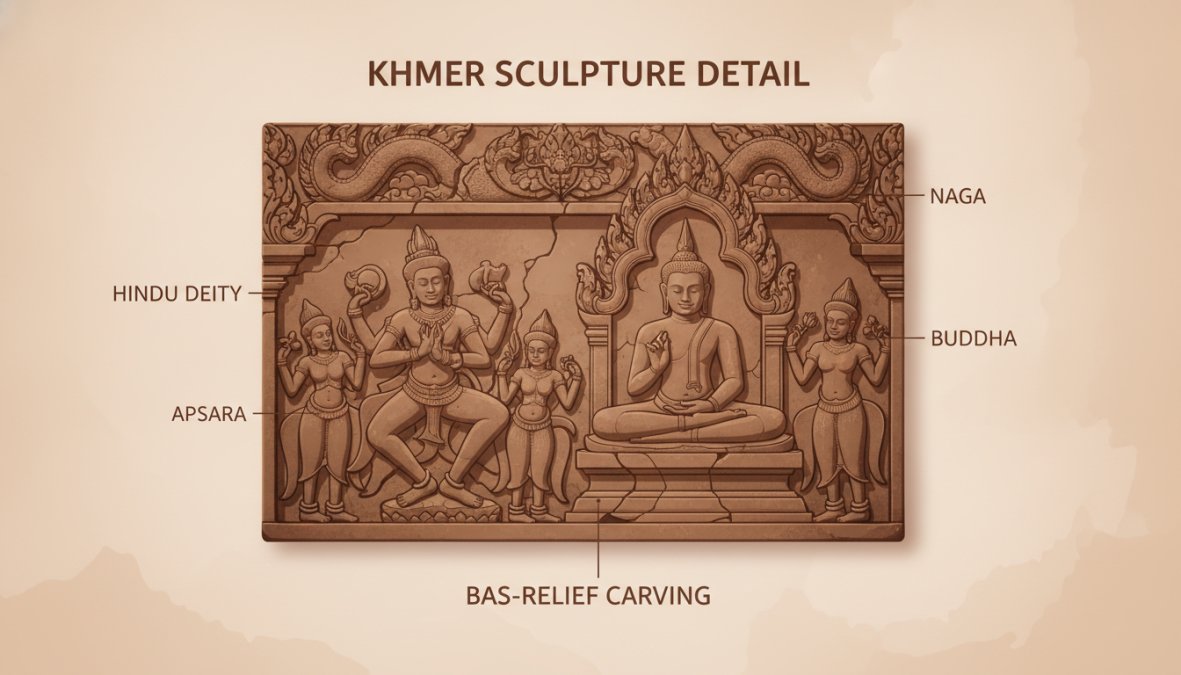
Esculturas en relieve y bajorrelieves icónicos
Los relieves de Angkor Wat representan quizás el programa escultórico más ambicioso de la historia de la humanidad. Las galerías del templo contienen más de 1.200 metros de relieves continuos que representan escenas de epopeyas hindúes y la vida real jemer. Los paneles de la Batalla de Kurukshetra muestran miles de figuras enzarzadas en la guerra con un detalle asombroso: los soldados individuales muestran armaduras, armas y expresiones faciales distintas. Los paneles en relieve de Bayón, tallados durante el reinado de Jayavarman VII, representan la vida cotidiana: mercados con comerciantes, escenas de pesca con redes y barcos, expediciones de caza con perros y elefantes. Estas escenas tenían fines educativos, comunicaban el orden social adecuado y el papel del rey en el mantenimiento de la armonía cósmica.
Estatuas monolíticas y dinteles de templos
Las estatuas independientes de Buda representan una de las categorías más conmovedoras de la escultura jemer. Estas figuras, que variaban desde tamaños modestos hasta varios metros de altura, generalmente estaban talladas en bloques de piedra individuales. Los mejores ejemplos muestran una notable sensibilidad en la expresión facial y las proporciones corporales.
Los dinteles del templo, los elementos horizontales de piedra sobre las puertas, recibieron un tratamiento escultórico particularmente refinado. Estos elementos arquitectónicos relativamente pequeños fueron tallados con elaborados programas decorativos: hileras de apsaras, seres celestiales, motivos florales y animales simbólicos. Las figuras de pie de Vishnu talladas durante el período angkoriano demuestran la capacidad de los escultores para representar una iconografía compleja a escala monumental. Estas figuras, que a menudo superan los tres metros de altura, muestran cuatro brazos que sostienen sus respectivos atributos manteniendo proporciones elegantes y una expresión tranquila.
Identificación de auténticas antigüedades jemeres: procedencia y autenticación
El mercado de la escultura jemer ha creado importantes desafíos de autenticación. La demanda de los coleccionistas ha incentivado tanto el saqueo de yacimientos arqueológicos como la creación de falsificaciones convincentes. Comprender cómo evaluar la autenticidad y la procedencia se ha vuelto esencial para las instituciones y coleccionistas serios.
Auténticas esculturas jemeres muestran características que son difíciles de replicar. La pátina de la piedra, los patrones de erosión, el crecimiento de líquenes y la erosión tras siglos de exposición se desarrollan de maneras que las herramientas modernas no pueden simular fácilmente. Las esculturas de arenisca muestran patrones de erosión específicos: erosión diferencial donde las capas de piedra más blandas se desgastan más rápido, patrones de manchas de agua y daños a las raíces de los sitios de los templos. Las esculturas de bronce desarrollan pátinas que reflejan su historia funeraria, con diferentes características según la composición del suelo.
Métodos modernos de autenticación y evidencia arqueológica
La autenticación contemporánea se basa en múltiples enfoques científicos. La radiografía puede revelar la estructura interna de las piezas fundidas de bronce, mostrando si la pieza se fundió utilizando técnicas antiguas o métodos modernos. La presencia de ciertas composiciones de aleaciones, en particular la proporción de cobre y estaño, puede indicar si un bronce coincide con las prácticas metalúrgicas jemeres conocidas.
El análisis estilístico sigue siendo crucial. Los expertos familiarizados con las convenciones escultóricas jemeres a menudo pueden identificar anacronismos o inconsistencias estilísticas que sugieren una creación moderna. Una figura de Buda con proporciones que no coinciden con las convenciones jemeres conocidas, o con elementos iconográficos que aparecen en diferentes períodos de tiempo, puede ser una creación moderna.
Documentación de procedencia y directrices para coleccionistas
La procedencia, la historia documentada de la propiedad y ubicación de un objeto, proporciona evidencia esencial de autenticidad. Los objetos con procedencia clara, particularmente aquellos documentados en colecciones de museos o publicaciones académicas antes de la década de 1970, tienen mayor credibilidad. El mercado internacional del arte ha desarrollado directrices éticas que abordan los artefactos saqueados. La Convención de la UNESCO sobre el Robo de Bienes Culturales de 1970 estableció que los artefactos retirados de los países sin permiso constituyen propiedad robada. Muchos países, incluida Camboya, tienen leyes que prohíben la exportación de materiales arqueológicos. Los coleccionistas deben verificar que cualquier escultura jemer que adquieran haya sido exportada legalmente y que la documentación de procedencia respalde su autenticidad.
El legado cultural de la escultura jemer en la Camboya moderna
Los logros artísticos del período angkoriano siguen siendo fundamentales para la identidad cultural camboyana. Las esculturas, relieves y complejos arquitectónicos creados hace siglos siguen inspirando a artistas y artesanos camboyanos contemporáneos. La tradición escultórica jemer representa una conexión con un pasado glorioso y una fuente de orgullo nacional.
La Camboya moderna enfrenta importantes desafíos a la hora de preservar su patrimonio escultórico. El período de los Jemeres Rojos fue testigo de la destrucción deliberada de artefactos culturales. En las décadas siguientes, el saqueo y el tráfico ilegal de antigüedades han sustraído innumerables piezas de Camboya. Los esfuerzos contemporáneos para preservar la escultura jemer implican cooperación internacional e iniciativas nacionales. La UNESCO ha designado a Angkor como Patrimonio de la Humanidad, atrayendo atención y recursos internacionales a los esfuerzos de preservación. Los arqueólogos y conservadores camboyanos trabajan para documentar, estabilizar y restaurar esculturas dañadas. Los artesanos camboyanos modernos continúan las tradiciones escultóricas de sus antepasados, creando nuevas esculturas inspiradas en los estilos clásicos jemeres.
El arte escultórico de estilo jemer representa uno de los grandes logros artísticos de la humanidad, una tradición que sintetizó la devoción religiosa, el dominio técnico y la visión estética en obras de belleza duradera. Ya sea atraído por los rostros serenos de las figuras de Buda, la energía dinámica de las esculturas en relieve o los sofisticados sistemas iconográficos que comunican conceptos espirituales, la escultura jemer ofrece profundas recompensas para quienes la estudian detenidamente.
En HD Asian Art, seleccionamos una colección cuidadosamente seleccionada de auténticas esculturas jemeres y del sudeste asiático. Nuestra colección presenta obras cuidadosamente autentificadas que abarcan múltiples períodos y estilos, cada una elegida por su mérito artístico y significado histórico. Ya sea que busque una figura contemplativa de Buda para un espacio de meditación o una impactante escultura en relieve para un interior refinado, nuestro equipo lo ayudará a descubrir piezas que traen la belleza espiritual de la civilización jemer a su hogar.
Preguntas frecuentes
¿Qué define el arte escultórico jemer y qué lo hace único?
El arte escultórico jemer abarca las obras monumentales y decorativas de piedra y bronce creadas durante el Imperio jemer, en particular el período angkoriano (siglos IX-XV). Se caracteriza por su síntesis de iconografía hindú y budista, el uso magistral de la piedra arenisca y la fundición de bronce, una intrincada narración en bajorrelieve y la distintiva "sonrisa jemer", una expresión serena y enigmática que refleja la satisfacción divina. El arte refleja el patrocinio real y el concepto de realeza divina (Devaraja), lo que lo hace claramente espiritual y políticamente significativo.
¿Qué materiales y técnicas se utilizaron en la fundición de bronce tradicional jemer?
Los artesanos jemeres emplearon dos materiales principales: piedra arenisca para esculturas, dinteles y frontones monumentales, y bronce para estatuas y objetos votivos más pequeños. La fundición de bronce utilizó la técnica de la cera perdida, lo que permitió detalles finos y posiciones intrincadas de las manos mudra. El tallado en piedra arenisca requería conocimientos especializados en el trabajo de la piedra para lograr los delicados relieves que se ven en las decoraciones de los templos. Ambos materiales desarrollaron pátinas distintivas a lo largo de los siglos, que los expertos utilizan ahora en la autenticación y evaluación de procedencia.
¿Cómo puedo identificar una auténtica escultura antigua jemer?
La autenticación implica examinar varios factores: procedencia arqueológica (historia de excavación documentada), análisis de materiales (composición de arenisca, consistencia de la pátina de bronce), marcadores estilísticos (características del estilo Bayon, detalles iconográficos) y técnicas de construcción (marcas de cincel, costuras de fundición). Las piezas auténticas suelen mostrar envejecimiento natural, patrones de desgaste consistentes con los entornos del templo y precisión iconográfica que refleja convenciones religiosas hindúes o budistas. Consultar bases de datos de museos y documentación de procedencia; Distribuidores acreditados proporcionan un contexto arqueológico detallado y un historial de adquisición de piezas verificadas.
¿Cuál es el significado de la iconografía religiosa en la escultura jemer?
La iconografía religiosa en la escultura jemer tenía propósitos tanto espirituales como políticos. Las deidades hindúes como Vishnu y Shiva representaban el orden cósmico y el poder real a través del concepto de realeza divina. Las influencias budistas introdujeron al Buda y los bodhisattvas, enfatizando la iluminación y la compasión. Mudras (gestos con las manos), apsaras (bailarines celestiales) y atributos simbólicos específicos transmitían narrativas religiosas y enseñanzas morales. Este lenguaje iconográfico transformó los templos en escrituras visuales, educando a los devotos y legitimando la autoridad real a través de imágenes sagradas.
