



Laotian Buddha Statue: A Collector's Complete Guide
Laotian Buddha Statue: A Collector's Complete Guide
Most collectors who turn their attention to Southeast Asian religious art spend years focused on Thai and Cambodian work before discovering that the most iconographically distinct sculptural tradition in the region has been sitting quietly in the background.
The Laotian Buddha statue occupies a category of its own: it produced two hand gestures found nowhere else in Buddhist art, developed a flame finial so architecturally refined it became a regional signature, and reached its creative peak during a golden age that lasted roughly two centuries. Despite all of this, Laos Buddhist sculpture remains dramatically underrepresented in Western collections. For serious collectors, that gap is not a problem. It is an opportunity.
Table of Contents
- Quick Takeaways
- Why Laotian Sculpture Is Undervalued
- The Golden Age of Lao Buddhist Art
- Iconographic Signatures: What Makes a Lao Sculpture Lao
- Materials and Craftsmanship
- Regional Styles Within Laos
- Comparing Lao, Thai, and Khmer Sculptural Traditions
- What to Look for When Collecting
- Frequently Asked Questions
- References
Quick Takeaways
|
Key Insight |
Explanation |
|---|---|
|
Unique mudras exist only in Lao art |
The "Calling for Rain" and "Contemplating the Bodhi Tree" poses are found almost exclusively in Lao Buddhist sculpture and are not replicated in any other regional tradition. |
|
The golden age ran from roughly 1500 to 1695 |
Under three exceptional kings of the Lan Xang kingdom, Lao Buddhist art reached its highest creative and technical expression, producing the works most prized by collectors today. |
|
Bronze alloy quality is a collector's signal |
Authentic Lao bronze, known as samrit, includes precious metals and carries a distinctive lustrous dark grey or muted gold colour that distinguishes it from later imitations. |
|
The flame finial is a regional identifier |
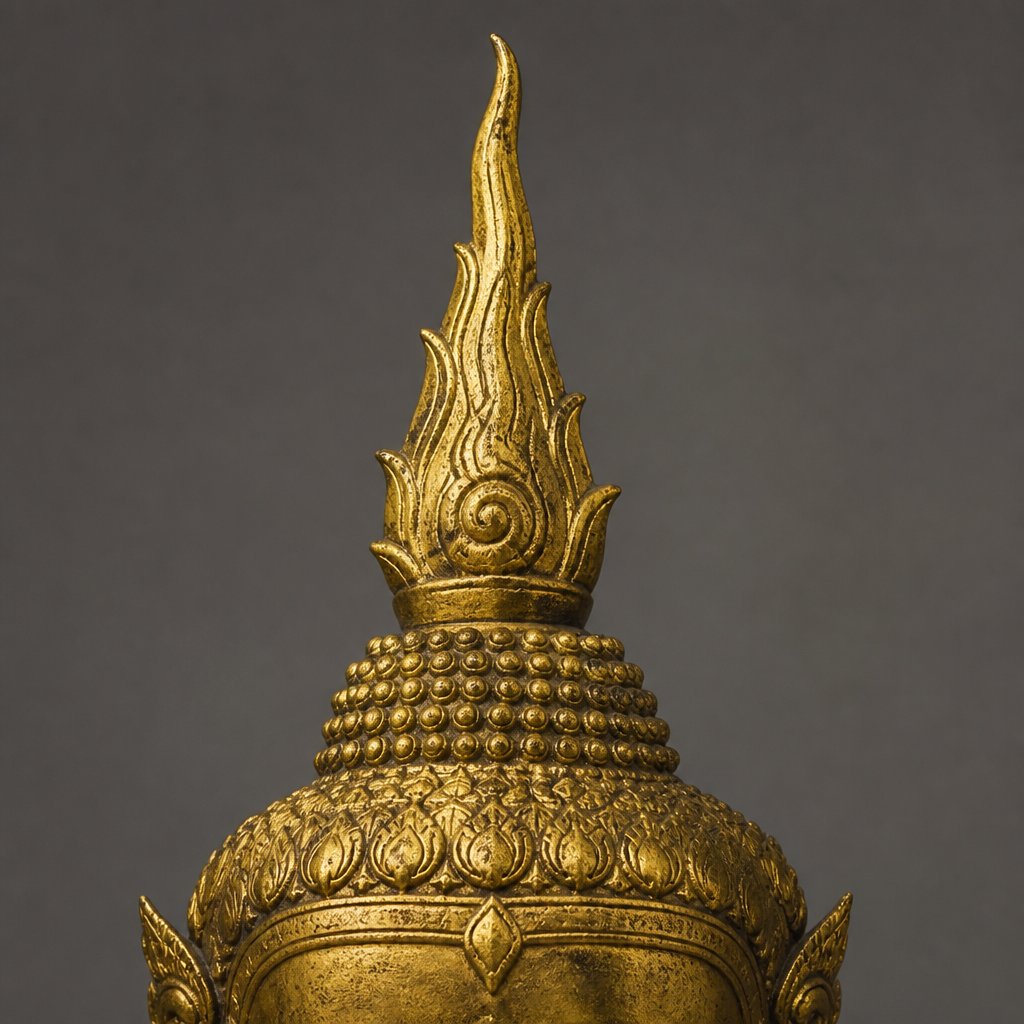
A tall, tapering flame above the ushnisha (cranial protuberance) is a consistent and refined feature of Lao sculpture, varying in height and form across periods and sub-regions. |
|
Phra Bang style requires geographic scrutiny |
Phra Bang-influenced work was produced across a wide territory including parts of modern Thailand; distinguishing Lao-origin pieces requires attention to base design and iconographic detail. |
|
Seated images are more iconographically Lao than standing ones |
Standing Lao Buddhas show more Khmer and Thai influence, while seated images are the tradition's most internally distinctive contribution, with characteristic facial and robe features unique to the Lao style. |
|
Wood and bronze represent distinct collecting categories |
Both materials were used throughout Lao sculptural history. Wood pieces are rarer and more fragile, making surviving examples particularly significant for collectors focused on Southeast Asian art. |
Why Laotian Sculpture Is Undervalued
The short answer is geography. Laos is landlocked, politically isolated for much of the modern era, and its artistic output never benefited from the kind of sustained Western institutional attention that Cambodian Khmer work received from the late nineteenth century onward. When European collectors and museum curators were actively documenting Southeast Asian art traditions, the monuments and sculpture of the Khmer empire were already drawing focus. Lao material sat further from the colonial centres and was far less systematically catalogued.
The result is a market imbalance that has persisted into the present. Thai Buddha statues and Cambodian Khmer bronzes are better documented, more frequently illustrated in auction catalogues, and therefore more familiar to collectors by default. Familiarity drives demand, and demand drives recognition. Lao sculpture, by contrast, rewards the collector who takes the time to learn the tradition on its own terms rather than as an appendix to neighbouring styles.
This is also, frankly, why the prices remain more accessible relative to quality. A piece of genuine Lao bronze sculpture from the golden age period carries iconographic complexity, artistic refinement, and historical depth that would command a significant premium if it wore a more recognisable label. The collector who understands what they are looking at is in a far stronger position than one relying on name recognition alone.
The Golden Age of Lao Buddhist Art
The period that collectors refer to as the golden age of Lao Buddhist sculpture runs from approximately 1500 to 1695. This era was shaped decisively by the Lan Xang kingdom, which translates as "Land of a Million Elephants," and by three kings in particular: Wisunarath (1501 to 1520), Photisarath (1520 to 1550), and Sai Setthathirat I (1550 to 1571). Under their patronage, an extraordinary flowering of Buddhist art and architecture took place, producing sculpture that was technically accomplished, iconographically original, and spiritually charged in ways that remain visible to a careful eye today.
The kingdom's capital at Vientiane emerged as a major centre for Buddhist learning, and significant works from this period can still be seen in the Haw Phra Kaew museum and Wat Sisakhet in Vientiane, and at the Luang Prabang National Museum. These institutions serve as benchmarks. A collector studying the golden age tradition should spend time with documented examples in these collections before attempting to assess pieces in the open market.
What Happened After the Golden Age
By the seventeenth century, the Lan Xang kingdom began to fragment into the smaller kingdoms of Luang Prabang, Vientiane, and Champassak. This political fracture had direct artistic consequences. As Siamese influence expanded during the eighteenth century, Lao sculpture was progressively shaped by the contemporaneous Ayutthaya and later Bangkok (Rattanakosin) styles. The tradition did not disappear, but it lost the distinctive internal momentum that had produced its most original work.
By the French colonial period, image casting had declined sharply. Understanding this trajectory matters for collecting: the most iconographically pure Lao work predates significant Siamese stylistic absorption, while later pieces show varying degrees of cross-influence that a trained eye can identify and assess.
Pro tip: When examining a piece described as Lao, ask where in the stylistic timeline it sits. A figure showing strong Rattanakosin-period influence is not necessarily less beautiful, but it is a different kind of object from golden-age Lan Xang work, and the attribution should reflect that difference honestly.
Iconographic Signatures: What Makes a Lao Sculpture Lao
Lao Buddhist sculpture has several iconographic features that either appear exclusively in this tradition or appear here in a form sufficiently distinctive to function as identifiers. Learning these features is not an academic exercise. It is the practical foundation of informed collecting.
The Calling for Rain Pose
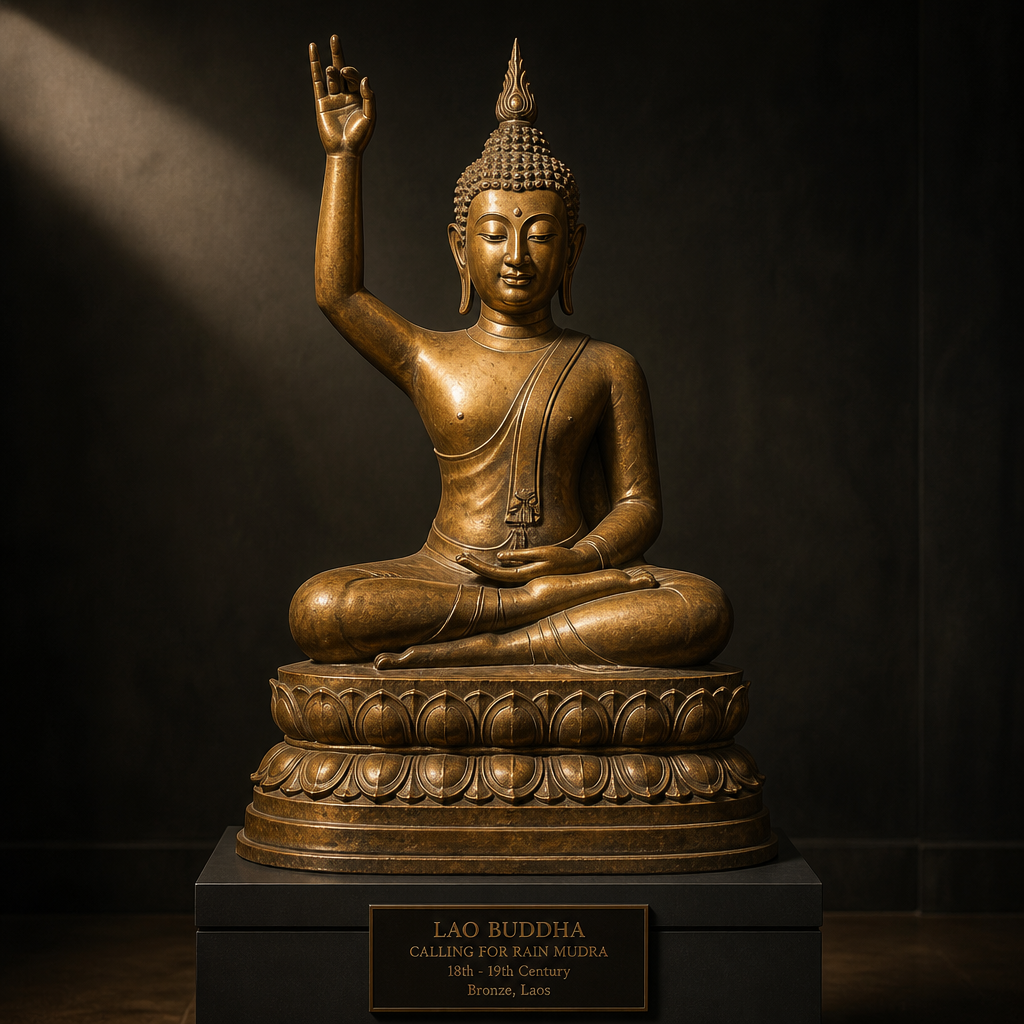
The most recognisable uniquely Lao contribution to Buddhist iconography is the "Calling for Rain" pose. In this posture, the Buddha stands with both arms held rigidly at the sides of the body, fingers pointing toward the ground. What makes the Lao version especially distinctive is the treatment of the robe: at the base of the figure, the robe flares outward and upward on both sides in a perfectly symmetrical fashion. This flaring hem is not incidental. It is a deliberate compositional choice that gives the standing figure a sense of contained energy and formal elegance that photographs rarely capture as well as physical examination does.
This pose is documented almost exclusively within the Lao sculptural tradition and in Lao-influenced areas of northeastern Thailand. It does not appear in the major sculptural traditions of Cambodia, Burma, or Sri Lanka. For a collector focused on Southeast Asian art collecting, a genuine Lao "Calling for Rain" figure represents one of the rarest iconographic types in the entire region.
The Contemplating the Bodhi Tree Pose
The second pose specific to Lao sculpture has the Buddha standing with hands crossed at the wrists in front of the body. This is known as the "Contemplating the Bodhi Tree" pose, referencing the large banyan tree under which the historical Buddha attained enlightenment. Like the Calling for Rain, this posture appears with meaningful frequency only in the Lao tradition. The two poses together represent a contribution to Buddhist sculptural iconography that is genuinely original, not a regional variant of something found elsewhere across Asia.
Facial Features and the Flame Finial
Seated Lao Buddha images show a distinctive facial character: a beak-like nose, defined arching brows, and a contained facial expression that is meditative without being blank. The ushnisha, the cranial protuberance indicating the Buddha's wisdom, is topped with a flame finial. In Lao work, this flame is tall, tapering, and architecturally specific in its proportions. The height and exact form of the flame varies across periods and sub-regions, which makes it a useful dating and attribution tool for experienced collectors.
Materials and Craftsmanship
Lao artisans worked across a range of materials including bronze, wood, gold, silver, and precious stones. Of these, bronze is by far the most common and has been used to create the tradition's most important surviving works.
The Lao bronze, referred to as samrit (a term shared with Cambodian and Thai practice), includes precious metals in its alloy composition. The balance of ingredients determines the visual character of the resulting cast. Lao samrit often has a relatively high percentage of tin, which gives newly cast images a lustrous dark grey colour. Other works, such as figures with higher copper content and traces of gold, develop a muted gold appearance that is immediately recognisable and visually distinct from Thai gilded surfaces. This material specificity is not decorative accident. It reflects the practical knowledge of Lao foundry traditions developed over centuries.
Wood sculpture, while less common in surviving collections, represents a distinct and often underappreciated category. Wood figures are inherently more fragile and more susceptible to damage from humidity, insects, and handling. Surviving examples in good condition are genuinely rare and carry particular significance for collectors focused on the breadth of the Asian religious art tradition. When a wood piece can be authenticated to the golden age period, it deserves serious attention.
Pro tip: If you are comparing a Lao-attributed bronze to northern Thai work in the same stylistic family, examine the base. Lao figures often have a simpler, more architecturally abstract lotus base, while northern Thai pieces in a related style tend toward more elaborate petal modelling with visible layering.
Regional Styles Within Laos
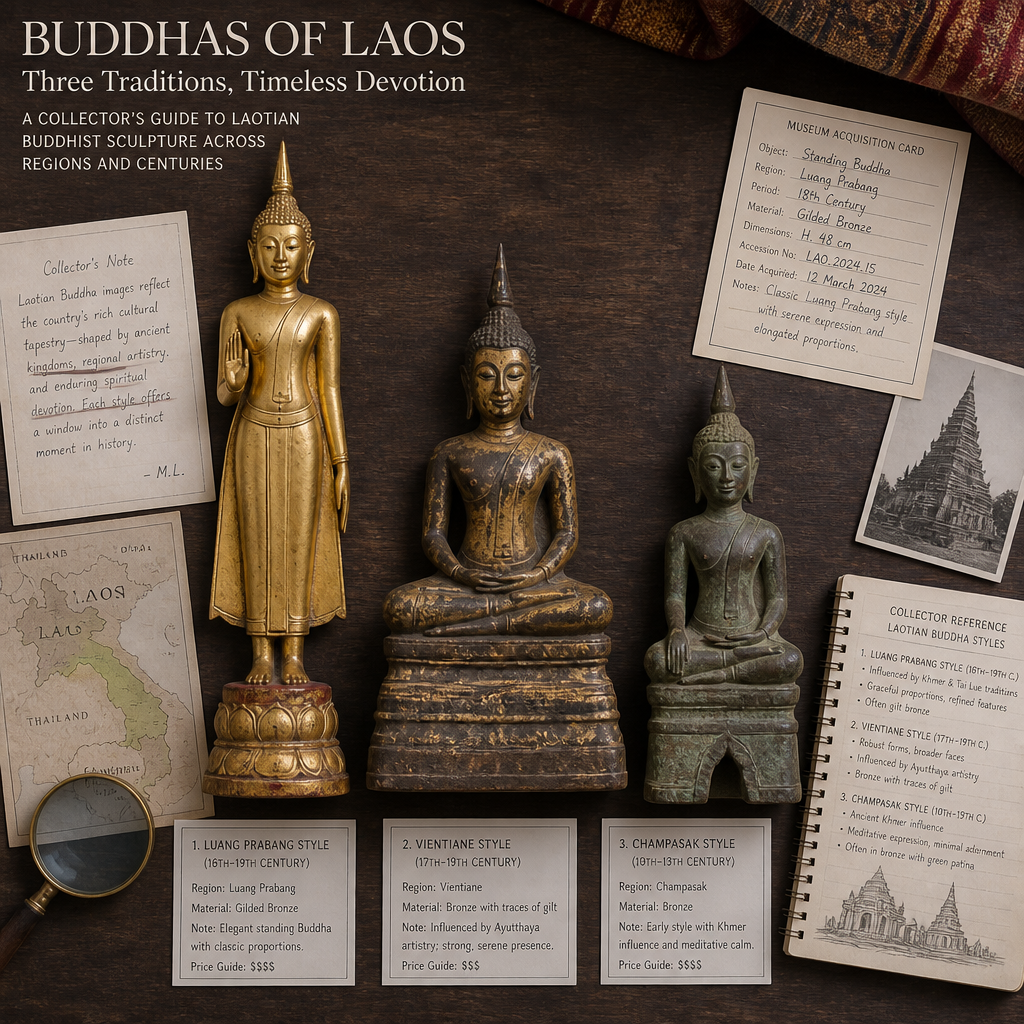
Laos is not a single stylistic entity. The major regional centres of Luang Prabang, Vientiane, and Champassak each developed distinctive artistic characters, shaped by their political histories, their proximity to neighbouring cultures, and the specific Buddhist traditions they hosted. Understanding regional variation is essential for any collector moving beyond surface-level acquisition.
Luang Prabang and the Phra Bang Style
Luang Prabang is the artistic heart of the tradition for most collectors. The city takes its name from the Phra Bang, the sacred gold image that is considered the palladium of Laos, a figure of Sinhalese origin held to contain relics of the Buddha. The sculptural style associated with Luang Prabang developed its own distinctive visual language, characterised by refined proportions, careful attention to robe detail, and a particular quality of facial expression.
One practical challenge for collectors is that Phra Bang-style images were produced across a wide geographic area, including areas that now fall within Thai territory. Distinguishing a piece made in Luang Prabang from one made under its influence in adjacent regions requires attention to material, finish, and specific iconographic details. The base design is one of the most reliable distinguishing features: Lao-origin pieces in the Phra Bang tradition typically show a simpler, more abstract lotus base compared to northern Thai work in the same stylistic family.
Vientiane and Later Stylistic Developments
Vientiane developed as an important centre for Buddhist learning and produced sculpture that reflects both the refinements of the golden age and, in later periods, the growing influence of Siamese court styles. Pieces from Vientiane in the eighteenth century onward can show clear markers of Ayutthaya or Rattanakosin influence while retaining distinctively Lao elements in facial treatment and robe structure. These hybrid pieces are not lesser works. They are historical documents of a tradition negotiating external pressure while maintaining internal coherence.
Comparing Lao, Thai, and Khmer Sculptural Traditions
For collectors approaching museum quality sculpture from Southeast Asia, understanding where the Lao tradition sits relative to its neighbours is practically useful. The following comparison addresses the features most relevant to identification and collecting decisions.
|
Feature |
Lao Buddhist Sculpture |
Thai Buddhist Sculpture |
Khmer Buddhist Sculpture |
|---|---|---|---|
|
Exclusive mudras |
Calling for Rain and Contemplating the Bodhi Tree, unique to the Lao tradition |
Standard Buddhist mudras shared across the broader tradition; no exclusively Thai poses |
Standard mudras with specific Khmer compositional conventions; no exclusively Khmer poses |
|
Flame finial (ushnisha) |
Tall, tapering, architecturally specific; height varies by period and sub-region |
Present across periods; proportions and style vary by dynasty (Sukhothai, Ayutthaya, Rattanakosin) |
Generally absent or replaced by ornate headdress in royal Buddha forms |
|
Primary bronze character |
Samrit with higher tin content; lustrous dark grey to muted gold depending on alloy mix |
Wide variation; gilded surfaces common in later periods; Sukhothai bronzes have distinctive tonal character |
Dense, often darker bronze; surface frequently left ungilded with a deep patina |
|
Robe treatment |
Characteristic flaring hem in standing figures; restrained and precise in seated forms |
Varies by period; Sukhothai robes often highly stylised with elongated loops |
Robe generally minimal and closely fitted to the body; little decorative robe elaboration |
|
Facial expression |
Meditative, with beak-like nose and defined arching brows; internalized quality |
Sukhothai faces highly idealised with oval form; later periods show more naturalistic treatment |
Characteristic Khmer smile; broader face with strong jaw and contained expression |
|
Collector availability |
Underrepresented in Western collections; less documented in mainstream auction catalogues |
Well-documented; strong auction presence; wide price range from accessible to museum-grade |
Well-documented; Angkor-period pieces carry significant premium; many regional variants available |
The most iconographically specific sculptural tradition in mainland Southeast Asia is not the one that has received the most collector attention. That gap between creative originality and market recognition is precisely where informed collecting happens.
What to Look for When Collecting
Collecting Lao Buddhist sculpture well requires a different approach than collecting more documented traditions. The field is less crowded with published catalogues, there are fewer public collections in Western institutions to use as reference benchmarks, and the range of quality available in the market spans from genuinely significant works to pieces that borrow Lao iconographic elements without the underlying craftsmanship that distinguishes the real tradition.
Iconographic Authenticity Over Surface Appeal
The first question when approaching any piece described as Lao is whether the iconography is internally consistent. A "Calling for Rain" figure should show the correct robe flare at the base. A seated figure attributed to the golden age period should have facial features consistent with the Lao tradition, not a Thai facial type wearing Lao iconographic dress. Surface appeal, patina, and size are secondary. Iconographic consistency is primary.
A common mistake is to accept a Lao attribution on the basis of one or two visual features in isolation. In practice, the full iconographic package matters: pose, base design, flame finial proportions, facial character, and robe treatment should all point in the same direction. If they do not, the attribution deserves closer scrutiny.
The Importance of Provenance and Scholarly Context
For serious collectors of Laos Buddhist sculpture, documentation matters increasingly over time. A piece with clear provenance, or one that appears in a published collection catalogue or exhibition record, carries a different status from an undocumented example regardless of quality. This does not mean undocumented pieces lack value. It means their value rests more heavily on the buyer's own knowledge and the rigour of the attribution they can construct.
Visiting reference collections in person, studying comparative material, and building relationships with specialists who have handled significant volumes of Southeast Asian material are all practices that compound over time. There is no shortcut to this kind of knowledge, but it is also not inaccessible. The tradition is well documented in the specialist literature even if it is underrepresented in the general market.
At HD Asian Art, the collection of Laotian statues spans both bronze and wood examples across multiple poses and periods, allowing collectors to compare the material traditions directly rather than working from photographs alone. The range includes both the signature standing poses unique to Laos and the seated forms that represent the tradition's most internally developed iconographic contribution. Exploring the Laos statues collection provides a direct reference point for understanding what quality and stylistic consistency look like across different expressions of this tradition.
Frequently Asked Questions
What makes a Laotian Buddha statue different from a Thai Buddha statue?
The most significant differences are iconographic. Lao sculpture produced two hand gestures, the Calling for Rain and the Contemplating the Bodhi Tree poses, that do not appear in Thai Buddhist sculpture. The flame finial on Lao figures tends to be taller and more architecturally specific than on comparable Thai works. Lao bronze alloy often has a distinctive dark grey or muted gold tone from the samrit formula used. Facial expression in Lao pieces also tends toward a more internally contained quality compared to the more idealised oval faces of Sukhothai Thai work.
When was the golden age of Lao Buddhist sculpture?
The golden age is generally placed between approximately 1500 and 1695, corresponding to the height of the Lan Xang kingdom. Three kings drove this period of artistic flowering: Wisunarath, Photisarath, and Sai Setthathirat I. The period ended as Lan Xang fragmented into smaller kingdoms and Siamese stylistic influence began to reshape the tradition. The most iconographically pure and creatively distinct Lao work dates from this era.
What is the Phra Bang and why does it matter to collectors?
The Phra Bang is the most famous sacred image in Laos, a gold figure of Sinhalese origin held to contain relics of the Buddha, and the spiritual palladium of the Lao kingdom. It gives Luang Prabang its name and its most important sculptural association. The Phra Bang style refers to the broader Luang Prabang sculptural tradition that developed around this image. For collectors, it matters because Phra Bang-style figures were produced across a wide area including parts of modern Thailand, requiring careful iconographic and material analysis to distinguish Lao-origin pieces from related work made under Lao influence elsewhere.
Is wood or bronze Lao sculpture more valuable to collect?
Neither material is categorically superior, but they represent different collecting propositions. Bronze is far more common in surviving collections and provides a wider range of examples for comparison. Wood is rarer precisely because it is more vulnerable to damage, meaning that surviving examples in good condition are genuinely uncommon. A well-preserved wood figure from the golden age period can be more significant than a comparable bronze simply on the basis of survival rarity. For collectors building a focused collection, holding both materials allows for direct comparison of how the tradition expressed itself across different technical demands.
How do I know if a Lao Buddha statue is authentically attributed?
The most reliable approach is to check the full iconographic package rather than any single feature. Pose, base design, flame finial proportions, facial character, and robe treatment should all be internally consistent with the Lao tradition. A piece with one or two Lao features grafted onto a non-Lao underlying form is not a Lao sculpture. Beyond visual analysis, documented provenance, appearance in published collection catalogues, and the track record of the source all contribute to a credible attribution. Working with specialists who have handled significant volumes of Southeast Asian material reduces the risk of misattribution substantially.
What is samrit and why does it matter for identifying Lao bronzes?
Samrit is the term used in Laos, Cambodia, and Thailand for the bronze alloy used to cast Buddha images. It is distinguished from standard bronze by the inclusion of precious metals in the mix. In Lao practice, the alloy frequently has a relatively high tin content, which gives newly cast pieces a lustrous dark grey colour. Other Lao bronzes with higher copper content and traces of gold develop a muted gold appearance. Understanding the expected visual character of authentic samrit helps collectors recognise pieces consistent with genuine Lao foundry tradition and identify those that are not.
If you collect or study Lao Buddhist art, we would genuinely like to hear what you find most challenging about attributing or sourcing pieces, whether it is distinguishing regional styles, interpreting iconographic details, or finding quality examples in the first place.
We would love your feedback and any insights you would share with others. What perspective would you add?
References
-
Buddhist art and sculpture of Laos including mudra types and Lan Xang period context at Asia in Ch
-
Specialist guide to the Phra Bang sculptural style and regional attribution for collectors
-
In-depth guide to the Calling for Rain pose and its iconographic significance in Lao sculpture
