



Vishnu Statue: The Preserver God's Four Attributes
Vishnu Statue: The Preserver God's Four Attributes
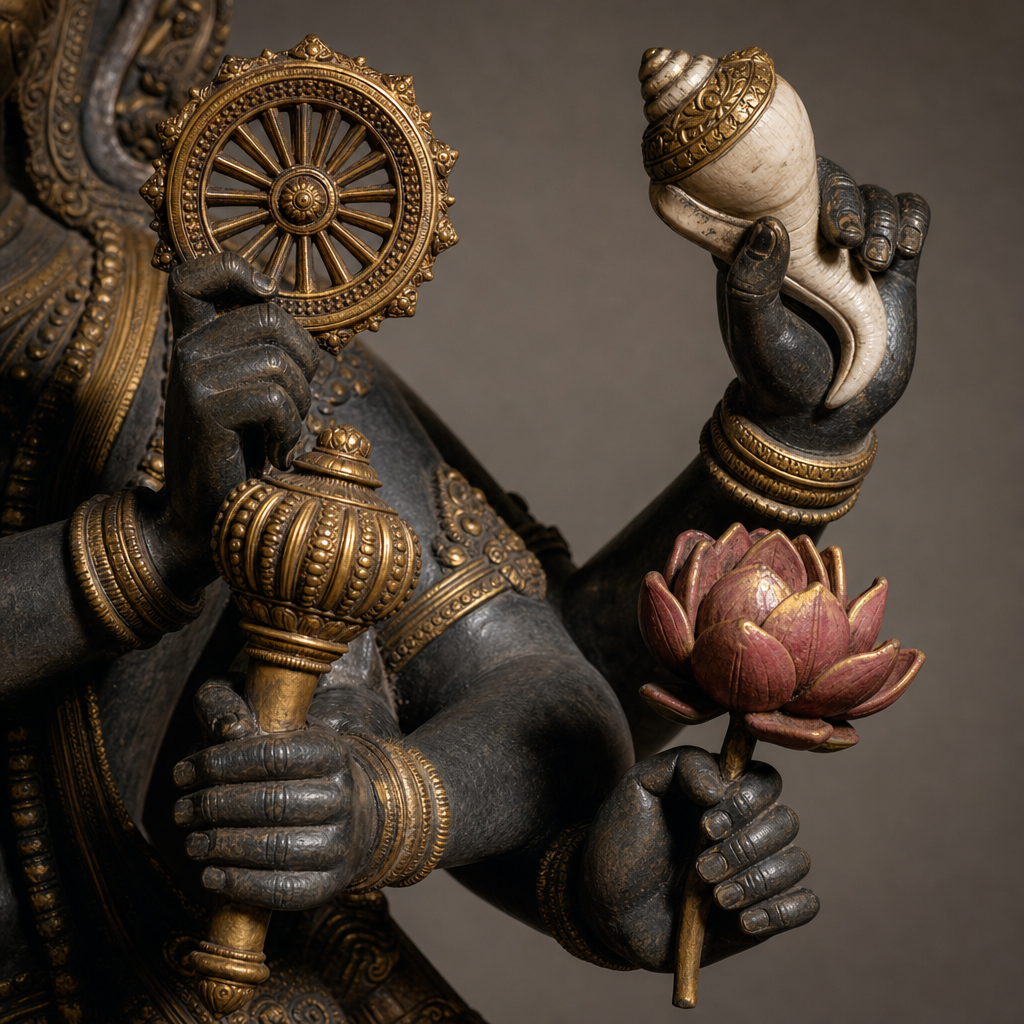
Most buyers of a Vishnu statue know they are purchasing something significant, but surprisingly few understand why he holds four specific objects in four specific hands. That gap matters. A collector who understands Vishnu's iconography does not just own a beautiful sculpture. They own a layered theological statement about cosmic order, divine protection, and the cyclical nature of existence.
This guide cuts through the vague spiritual generalities and explains, in concrete terms, what every attribute means, how regional sculptural traditions differ, and what to look for when selecting a Lord Vishnu sculpture for your collection or altar.
Table of Contents
Quick Takeaways
|
Key Insight |
Explanation |
|---|---|
|
Vishnu's four arms are not decorative |
Each arm holds a specific attribute with a precise theological meaning tied to cosmic preservation and divine authority. |
|
The Shankha (conch) signals the primordial sound of creation |
When Vishnu blows the Panchajanya conch, it represents the sound from which the universe originated, echoing the concept of Om. |
|
The Sudarshana Chakra is the most feared attribute |
This spinning discus-weapon destroys evil and ignorance. Its spinning motion symbolises the cyclical nature of time itself. |
|
The Kaumodaki Mace represents authority over physical and mental forces |
The mace signifies the power of knowledge and the strength to uphold dharma against those who would disrupt cosmic order. |
|
The Padma (lotus) is a symbol of purity and liberation |
Held in one hand, the lotus signals that liberation (moksha) can be attained while still existing within the material world. |
|
Regional sculptural traditions change how attributes are arranged |
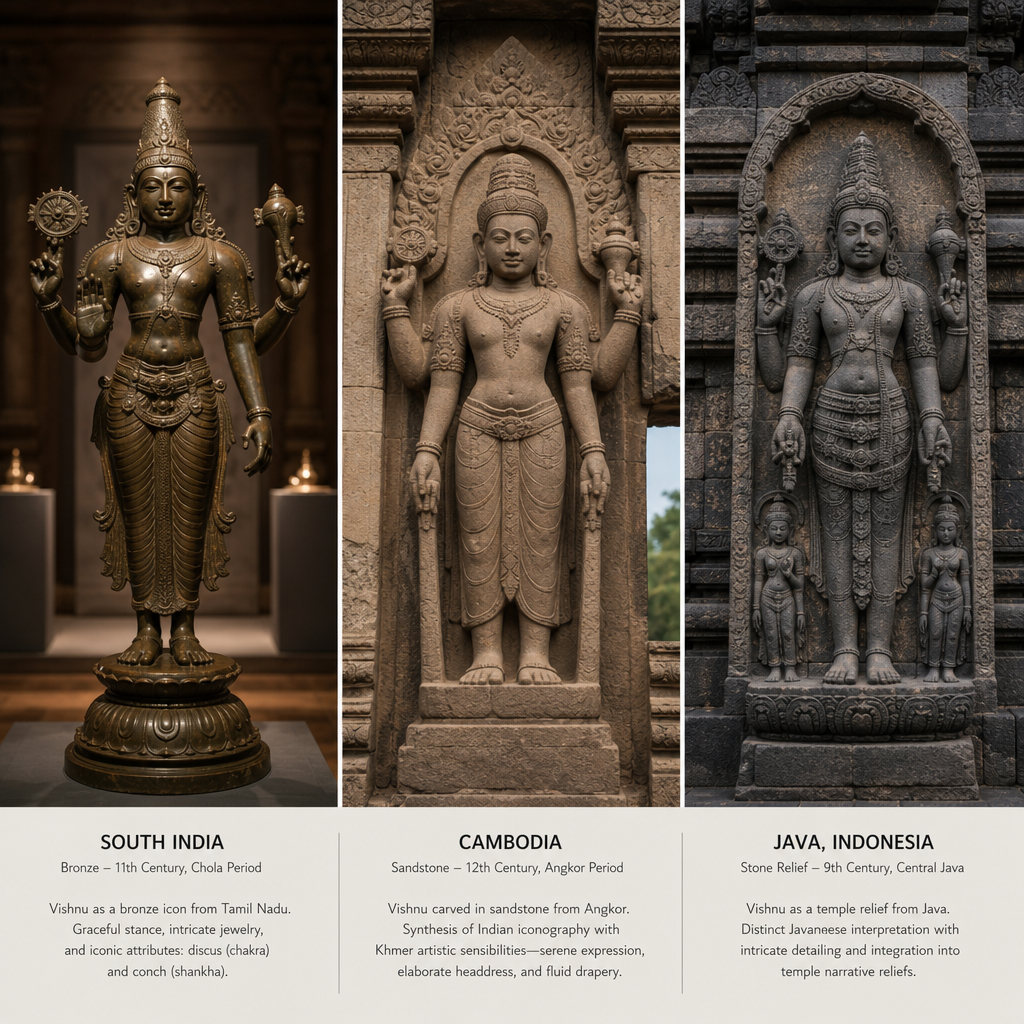
South Indian, Cambodian, and Javanese sculptors each followed distinct canonical rules about which hand holds which object. |
|
Posture communicates theological meaning as clearly as attributes do |
A standing Vishnu (Samabhanga) conveys readiness to act. A reclining Anantashayana form conveys cosmic rest between creation cycles. |
Who Is Vishnu: Role and Cosmic Function
In the Hindu trimurti, Brahma creates, Shiva destroys, and Vishnu preserves. That preservation function is not passive. Vishnu actively intervenes in the world through his ten principal avatars, descending whenever cosmic order (dharma) collapses beyond the capacity of ordinary forces to restore it. Ram, Krishna, and Narasimha are all Vishnu in embodied form, arriving precisely when the situation demands it.
This makes a Lord Vishnu sculpture fundamentally different from a statue of a deity who remains transcendent and unreachable. Vishnu is present, engaged, and responsive. Collectors who place a Vishnu statue on a home altar are not venerating an abstraction. They are honouring a deity whose defining characteristic is willingness to enter history.
Understanding this active, protective function is the essential starting point for reading his iconography correctly.
Vishnu's Relationship to His Consort and Vehicle
Vishnu is inseparable from Lakshmi, the goddess of prosperity, who is often depicted seated beside him or on his knee in sculpted forms. His vehicle is the Garuda, a mighty eagle-being, which in sculptural programs is sometimes depicted at the base of the pedestal or as a separate accompanying figure. Both Lakshmi and Garuda reinforce Vishnu's dual identity as a sovereign (supported by prosperity) and a warrior (carried by a swift, predatory being).
In Cambodian Khmer sculpture from the Angkor period, Vishnu is frequently depicted riding Garuda in dynamic, monumental stone carvings, which differs considerably from the more contemplative standing forms common in South Indian bronze work from the Chola period.
The Four Attributes and Their Meanings
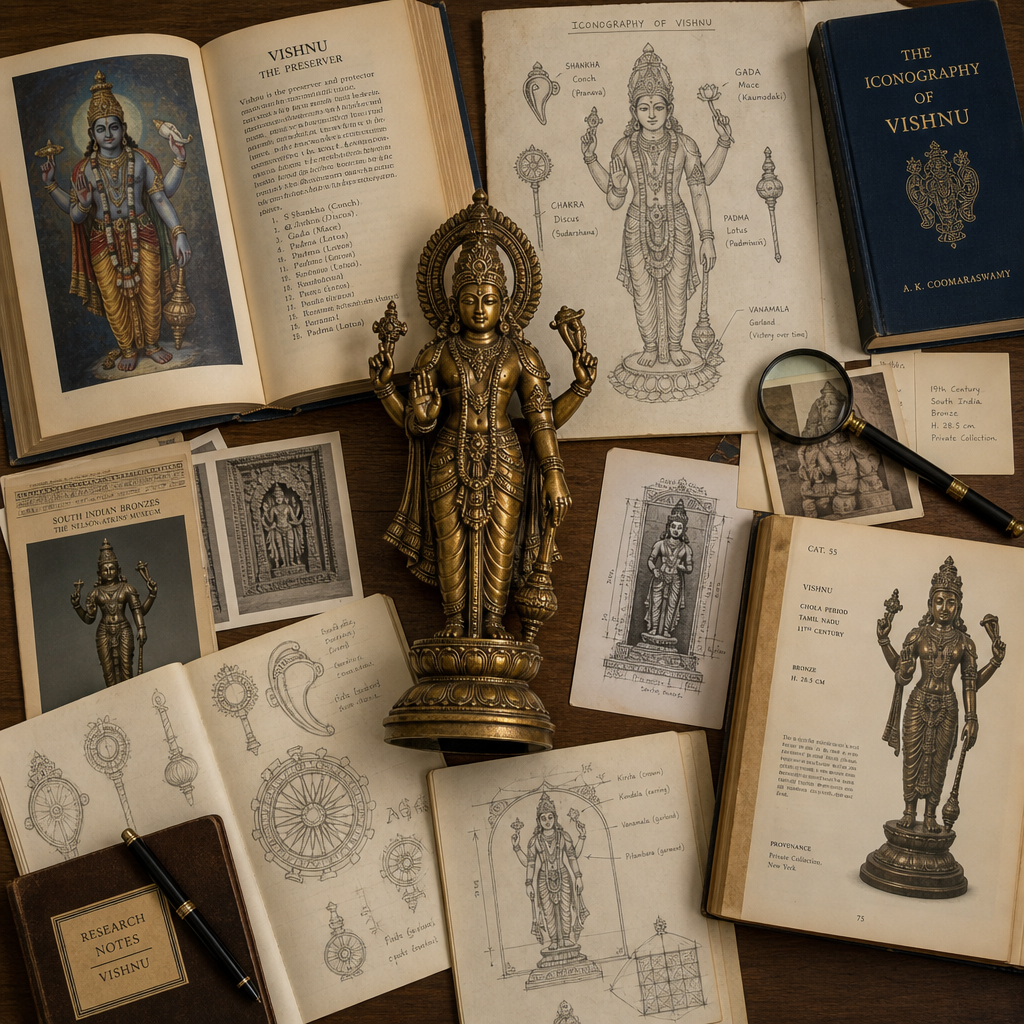
The four objects Vishnu carries are not interchangeable, and their positions in his four hands follow rules that vary by regional canon. Each object carries a name, a mythological origin, and a specific symbolic weight. Knowing all four transforms how you read any Lord Vishnu sculpture.
The Shankha: Primordial Sound and Divine Command
The Shankha is the sacred conch shell named Panchajanya, which Vishnu retrieved from the demon Shankhasura at the bottom of the ocean. When blown, it produces the primordial sound linked to Om, the syllable from which creation itself is said to emerge. In battle contexts within Hindu epic literature, the sound of Vishnu's conch signalled to all parties that divine authority had entered the field.
In sculpture, the conch is almost always held in the upper left hand in South Indian canonical forms, though this varies in Cambodian and Javanese traditions.
The Sudarshana Chakra: The Wheel That Destroys Ignorance
The Sudarshana Chakra is a spinning discus with 108 serrated edges. The number 108 is itself sacred in Hindu cosmology, appearing in the number of Upanishads, the distance between the Earth and the Sun measured in solar diameters, and the beads of a standard mala. The Chakra represents the mind at its most focused and disciplined, cutting through illusion and destroying adharma (that which opposes cosmic order).
In some sculptural traditions, particularly in South India, the Chakra is personified as Sudarshana Purusha, a humanoid form with the discus framing his body. This represents a distinct sculptural sub-tradition worth knowing about when purchasing a specialised piece.
The Kaumodaki Mace: Sovereignty and the Power of Knowledge
The Kaumodaki is Vishnu's personal mace, a weapon associated with elemental power and the authority to enforce cosmic law. Textually, the mace is associated with the planet Venus and represents the power of jnana (knowledge) used not for contemplation alone but for active governance. A deity who carries a mace is explicitly a ruler, not merely a teacher.
In practice, sculptors depict the mace as a thick club with a rounded head, often plain or lightly ornamented. A common mistake among buyers is confusing the mace with a lotus stem when both are held at similar angles in a sculpture. The mace will always appear more solid and weapon-like.
The Padma: Purity That Emerges From the World
The lotus held by Vishnu is the Padma, identical in symbolic weight to the lotus seen across Buddhist iconography. It grows from muddy water yet remains unstained, making it the definitive symbol of spiritual liberation within worldly existence. For Vaishnava theology, the Padma in Vishnu's hand signals that moksha (liberation) is not achieved by escaping the world but by remaining pure within it, which mirrors Vishnu's own characteristic of descending into the world repeatedly.
"The lotus is born in the water, grows in the water, yet it is not polluted by the water. So too, the sage who lives in the world is not polluted by it." - Attributed to the Bhagavata Purana tradition, widely cited in comparative religion scholarship.
Vishnu Iconography Across Asian Sculptural Traditions
One of the most rewarding aspects of collecting Vishnu iconography is tracing how the same deity was interpreted by sculptors across thousands of miles and several centuries. The theological core remains consistent, but the aesthetic grammar shifts dramatically between South India, Cambodia, Java, and Nepal.
South Indian Bronze Vishnu Statues
The Chola period (9th to 13th centuries) produced some of the finest bronze Vishnu sculptures ever made. Chola bronzes typically depict Vishnu in a formal standing posture (samapada or tribhanga) with all four attributes clearly delineated. The crown (kirita mukuta) is tall, cylindrical, and elaborately ornamented. The garments include a distinctive waistband (udarabandha) and lower cloth draped in a specific fan-fold pattern that became a regional signature.
South Indian sculptors followed the Agamic texts strictly, which means the canonical hand-attribute assignments are most reliably observed in pieces from this tradition.
Cambodian Khmer Vishnu Sculptures
Khmer sculptors from the 9th to 14th centuries produced Vishnu images in both sandstone and bronze that differ markedly from their South Indian counterparts. The Khmer Vishnu often wears a cylindrical mitre-style crown rather than the elaborate South Indian kirita mukuta. Facial features are broader, with a characteristic slight smile, and the overall posture tends toward a more contained, frontal gravity.
The Angkor Wat temple complex, dedicated primarily to Vishnu during its founding, contains some of the most important surviving Vishnu sculptures in the world, and the Khmer stylistic vocabulary they established influenced Lao and Thai sculptural production for centuries afterward.
Javanese and Balinese Vishnu Sculpture
In Java (Indonesia), the Central Javanese period (8th to 10th centuries) produced Vishnu sculptures heavily influenced by both Indian Gupta aesthetics and local artistic conventions. Javanese Vishnu figures tend to be more slender and elongated, with finely carved foliate halos (prabhavali) framing the body. In Bali, where Hinduism has maintained a continuous living practice, Vishnu remains actively venerated and sculptural production continues to draw on ancient iconographic rules while incorporating regional stylistic elements.
Pro tip: If you are comparing a Javanese Vishnu sculpture to a South Indian piece, look first at the crown form and the halo structure. These two elements are the fastest way to identify regional origin before examining the attribute arrangement in the hands.
Comparison: Three Major Vishnu Forms in Sculpture
|
Vishnu Form |
Posture and Context |
What It Communicates to the Viewer |
|---|---|---|
|
Chaturbhuja Vishnu (Standing, Four-Armed) |
Upright stance, all four attributes clearly held, standard devotional image found across South Asia and Southeast Asia |
Divine authority in its most approachable form. The deity is present, balanced, and ready to protect. Most common type for home altars and collectors. |
|
Anantashayana Vishnu (Reclining on Shesha) |
Vishnu reclines on the cosmic serpent Ananta/Shesha between cycles of creation, often with Brahma emerging from a lotus from his navel |
Cosmic rest and the interval between destruction and recreation. A deeply philosophical image representing the pause inherent in all cyclical processes. |
|
Vaikunthanatha (Multi-Headed or Expanded Form) |
Central human face flanked by lion (Narasimha) and boar (Varaha) heads, representing Vishnu's omnipresence across his avatars |
The totality of Vishnu's divine nature expressed simultaneously. More theologically complex and rarer in the collector market. Found primarily in Kashmiri and some South Indian traditions. |
Choosing a Vishnu Statue: What Collectors Get Wrong
The most common mistake collectors make is prioritising decorative finish over iconographic integrity. A gilded surface is visually attractive, but if the sculptor has omitted one of the four attributes or placed them in non-canonical hands without following a recognised regional convention, the piece loses its theological coherence. For a spiritual practitioner, that matters directly. For a collector of Asian religious art, it reduces the piece's historical authenticity.
Pro tip: When examining a Vishnu statue, use the Shankha as your first check. The conch should be identifiable as a spiral shell form, not a generic cylindrical object. If the sculptor has not differentiated the conch clearly from the mace, the piece likely comes from a workshop with limited iconographic knowledge.
Material and Its Relationship to Intended Use
Bronze and brass Vishnu statues are appropriate for home altars and personal devotional practice. Stone sculptures, particularly sandstone and granite, are better suited to garden shrines or large interior display spaces where their weight and weathered presence work in their favour. Collectors of museum-quality pieces will generally focus on bronze due to its historical association with the finest workshop traditions, particularly Chola South India and Khmer Cambodia.
At HD Asian Art, the collection of Hindu deity statues includes pieces that span these regional traditions, allowing collectors to compare iconographic approaches directly rather than relying on catalogue descriptions alone.
Size, Proportion, and the Viewer Relationship
In classical Indian sculptural theory (Shilpa Shastra), the proportions of a deity image are not arbitrary. The ideal Vishnu image follows a specific canon of measurement derived from the tala system, where the total height is divided into ten face-lengths. A statue that deviates significantly from these proportions will feel aesthetically wrong even to a viewer with no formal training in Shilpa Shastra, because the human eye responds to proportion intuitively.
For home altar use, a Vishnu statue between 20 and 45 centimetres in height tends to work best. At this scale, the four attributes remain visible and legible without the piece dominating the space. Larger sculptures, above 60 centimetres, shift from altar pieces to statement sculptures and require architectural consideration in placement.
Frequently Asked Questions
What are the four attributes of Vishnu and why do they matter?
The four attributes are the Shankha (conch), the Sudarshana Chakra (spinning discus), the Kaumodaki Mace, and the Padma (lotus). Together they represent the four dimensions of Vishnu's divine function: the creative sound of the universe, the destroying force that eliminates evil, the sovereign authority to maintain cosmic law, and the promise of liberation available even within worldly existence. A Vishnu sculpture without all four attributes is iconographically incomplete.
How do I identify which hand holds which attribute in a Vishnu statue?
In the standard South Indian canonical arrangement, the upper right hand holds the Chakra, the upper left hand holds the Shankha, the lower right hand is in the Abhaya (protection) mudra or holds the Mace, and the lower left hand holds the Lotus or the Mace depending on the specific school. Cambodian Khmer pieces sometimes reverse the Shankha and Chakra positions. Always research the regional tradition of a specific piece before assuming the South Indian arrangement applies.
What is the difference between a Vishnu statue and a Krishna statue?
Krishna is one of Vishnu's avatars and is often depicted with a flute rather than the four canonical attributes of Vishnu. A full Chaturbhuja (four-armed) Vishnu is almost always depicted with the Shankha, Chakra, Mace, and Lotus. Krishna in his iconic form is typically two-armed, holding a flute or sometimes depicted in the Vishvarupa (cosmic) form. If a four-armed figure holds all four Vaishnava attributes, it is Vishnu rather than Krishna in his common devotional representation.
Is a Vishnu statue appropriate for a home altar even for non-Hindu practitioners?
Many collectors and spiritual practitioners from outside the Hindu tradition place Vishnu sculptures on altars or in dedicated meditation spaces as objects of contemplation. The theology of preservation, protection, and cyclical restoration resonates across many spiritual orientations. Approaching the statue with respect, learning its iconographic meaning, and handling it with care are the most important considerations regardless of one's own tradition.
What regional traditions produce the highest quality Vishnu sculptures for collectors?
South Indian bronze work from the Chola period (9th to 13th centuries) is widely regarded as the apex of Vishnu sculptural production. Cambodian Khmer sandstone and bronze pieces from the 9th to 14th centuries are equally prized. For collectors with more accessible budgets, contemporary artisans working in the traditional workshop systems of Tamil Nadu, Bali, and Nepal produce technically accomplished pieces that follow classical iconographic rules. HD Asian Art sources from across this range, providing options at multiple collecting levels.
What does the reclining Vishnu (Anantashayana) form represent?
The Anantashayana form shows Vishnu reclining on the infinite cosmic serpent Ananta (also called Shesha) during the interval between destruction of one universe and creation of the next. From his navel, a lotus grows and Brahma sits upon it, ready to begin the new creation cycle. This image encapsulates Vaishnava cosmology: Vishnu is the substrate of all existence, and creation itself emerges from him. It is among the most philosophically rich and visually striking forms in Hindu sculpture.
If you own a Vishnu statue, are considering adding one to your collection, or have a question about a specific regional form you have encountered, share your experience or question in the comments below.
We would love your feedback and any insights you would share with others. What perspective would you add?
References
