



Thai vs Khmer Buddha Statues: Key Design Differences
Thai vs Khmer Buddha Statues: Key Design Differences
Table of Contents
Thai vs Khmer Buddha Statues: A Visual and Cultural Comparison
Thai and Khmer Buddha statues represent two fundamentally different artistic traditions shaped by centuries of cultural evolution, religious interpretation, and sculptural innovation. The differences reveal themselves in every detail, from facial structure to hand gestures to materials. Understanding these distinctions matters whether you're building a meditation space, collecting art, or appreciating the craftsmanship behind these sacred objects. Thai and Khmer traditions express distinct philosophies about representing the divine, one emphasizes grace and spiritual refinement; the other grounds idealism in architectural monumentality.
Khmer Buddha Statue Characteristics and Regional Aesthetics
Khmer Buddha statuary emerged from a civilization that understood scale, permanence, and the marriage of architecture with sculpture. The Khmer Empire, centered in what is now Cambodia, built temples designed to last millennia. Their Buddha statues reflect that ambition, monumental, structurally confident, and deeply rooted in the Gupta prototype tradition that originated in India.
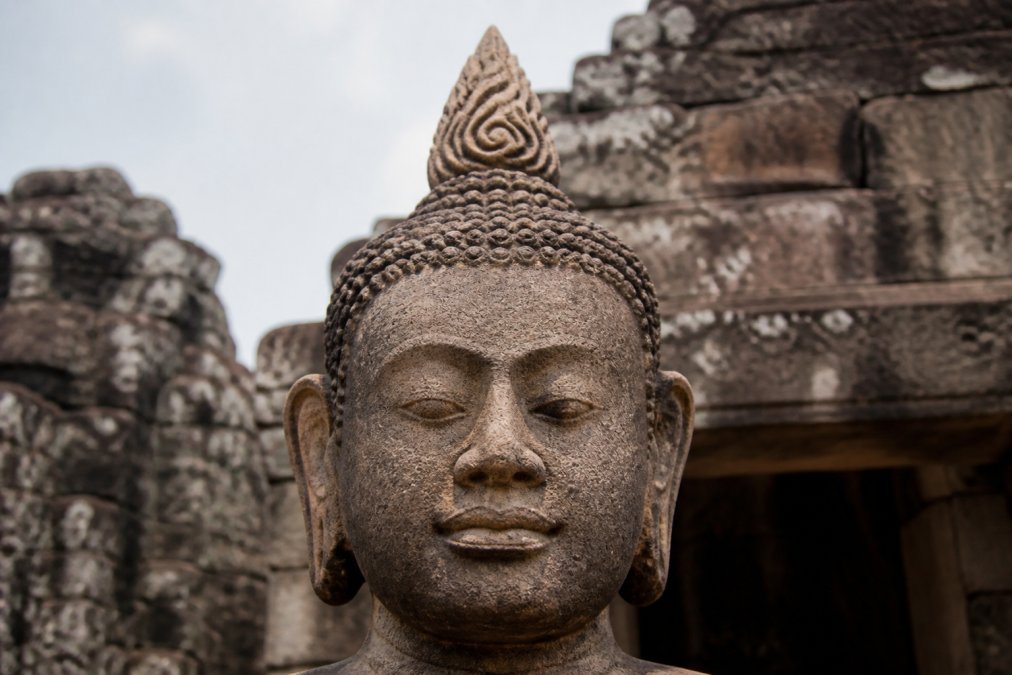
The most distinctive feature of Khmer Buddha statues is their facial structure. Khmer artisans favored broad faces with full cheeks, a characteristic that distinguishes them immediately from Thai work. The face is wider at the temples and tapers only slightly toward the chin, creating an impression of stability and earthiness while maintaining spiritual symbolism. The expression is serene but substantial, grounded rather than ethereal.
Facial Features and Expressions
Khmer Buddha faces typically feature a straighter nose bridge and fuller lips compared to Thai interpretations. The eyes are often slightly downcast in meditation posture, but the overall gaze feels more direct and less withdrawn. Khmer artisans rendered the face with anatomical realism, proportions reflecting actual human features rather than idealized abstraction. The cheekbones sit high and prominent, the chin is rounded but defined. This approach connects directly to Gupta prototypes, which emphasized anthropomorphic accuracy within a spiritual framework. A Khmer Buddha statue doesn't float above the world; it inhabits it.
Mudras and Hand Gestures
Khmer Buddha statues employ mudras, hand gestures with specific symbolic meaning. The most common is the Bhumi Sparsha Mudra, where the right hand touches the earth and the left rests on the lap, representing the Buddha subduing Mara, the demon of temptation. The hands are typically rendered with anatomical precision, fingers clearly defined and positioned with intentional spacing. Khmer artisans paid careful attention to hand proportions, scaling them naturally to the body rather than oversizing or abstracting them.
Ushnisha and Cranial Protuberance
The ushnisha, the cranial bump representing spiritual enlightenment, appears in Khmer Buddha statuary as a prominent, often elongated protuberance that rises sharply from the crown and tapers to a point, sometimes crowned with a flame-like finial. This vertical emphasis adds height to the composition and draws the eye upward, reinforcing spiritual ascent. The finial atop the ushnisha often resembles a stylized flame or lotus bud, creating visual drama and spiritual emphasis.
Thai Buddha Art Styles: Sukhothai and Ayutthaya Traditions
Thai Buddha statuary evolved through distinct historical periods. The Sukhothai period (13th-15th centuries) is often called the "golden age" of Thai art, while the Ayutthaya period (14th-18th centuries) brought a different aesthetic sensibility.
Sukhothai Style: Grace and Idealism
Sukhothai Buddha statues prioritize elegance and spiritual refinement. The proportions are elongated, the face is narrower than Khmer work, the body is slender, and the overall composition emphasizes verticality and grace. Sukhothai artisans favored idealism over realism, creating a visual expression of spiritual perfection.
The face is oval or slightly heart-shaped, with a narrower chin than Khmer statuary. The nose is fine and delicate, the eyes are almond-shaped and positioned to suggest gentle downward gaze. The overall expression is more withdrawn and ethereal than Khmer work. Sukhothai Buddha statues often feature a flame-like ushnisha that rises to a sharp point, typically more refined and less architecturally prominent than in Khmer pieces. The body is often rendered with minimal clothing, the monastic robes drape lightly and reveal the underlying form.
Ayutthaya Style: Refinement and Realism
Ayutthaya Buddha statues represent a shift toward greater realism and architectural presence. While maintaining the elegance characteristic of Thai work, Ayutthaya pieces are more substantial than Sukhothai examples. The face is broader, the features are more defined, and the overall composition feels more grounded.
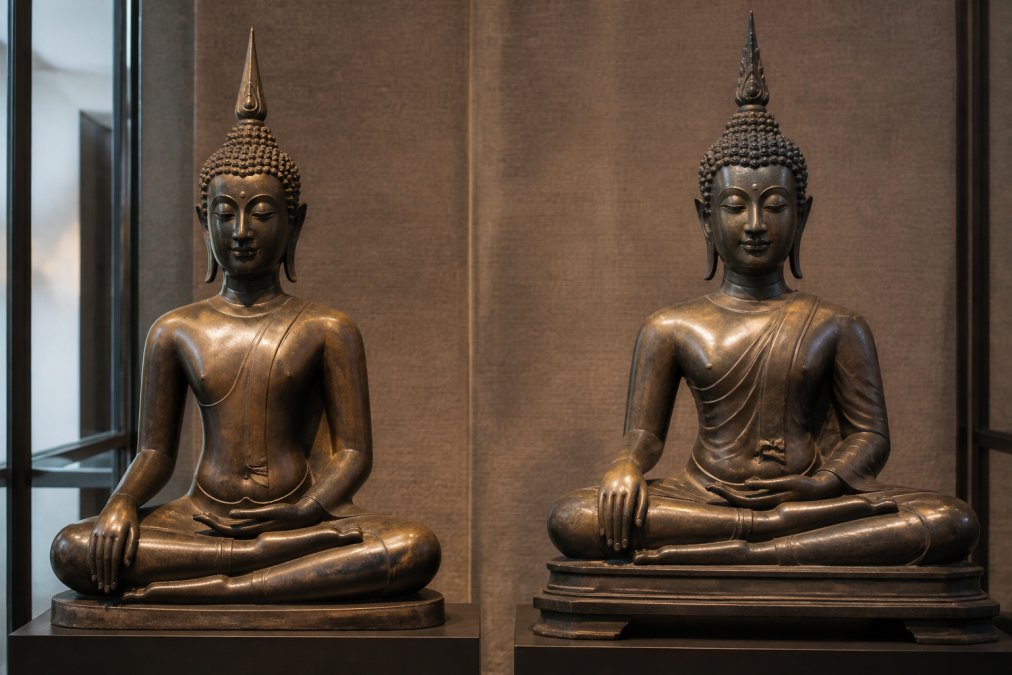
Ayutthaya artisans often worked in bronze, and the material influenced their approach. The facial features are crisper than in Sukhothai stone work. The expression is still serene, but it reads as more knowing and aware. The ushnisha in Ayutthaya work is often less pointed than in Sukhothai pieces, sometimes flatter or adorned with additional ornamentation. The robes are often rendered with greater sculptural detail, folds and pleats are more pronounced, creating visual interest and movement.
Material Usage and Sculptural Techniques
The materials chosen for Buddha statuary shaped both the final appearance and the sculptural techniques available to artisans. Thai and Khmer traditions favored different materials, reflecting both practical considerations and aesthetic preferences.
Bronze Casting and Stone Carving
Khmer artisans predominantly worked in sandstone, quarried locally and carved by hand. Sandstone is relatively soft, allowing for fine detail work, but it's porous and vulnerable to weathering. This material choice reflects the Khmer commitment to monumental, permanent sculpture meant to endure in temple complexes for centuries.
Thai artisans worked in both bronze and stone, but bronze casting became increasingly dominant during the Ayutthaya period. Bronze casting allows for greater precision in fine details and more complex compositions. Bronze Buddha statues often feature sharper edges, finer facial features, and more intricate hand gestures than stone pieces. The material develops a rich patina over time, the greenish or brownish oxidation prized by collectors as evidence of age and authenticity.
Sandstone and Regional Preferences
Sandstone dominates Khmer Buddha statuary. Khmer sculptors developed sophisticated techniques for rendering texture, drape, and facial features in sandstone. Thai artisans also used sandstone but were more likely to experiment with other materials like stucco and wood for portable pieces. These material choices reflect different contexts, Khmer pieces were often monumental temple sculptures; Thai pieces ranged from massive temple statuary to intimate portable objects for personal devotion.
Robes, Drapery, and Ornamentation
In Khmer statuary, the robes are often rendered with minimal detail. The fabric drapes simply, following the body's form without elaborate folds or pleats, creating a sense of dignity and simplicity. Thai Buddha statues, particularly those from the Ayutthaya period, feature more elaborate drapery with pronounced folds and pleats, appearing to have weight and texture.
Ornamentation also differs between traditions. Khmer Buddha statues are typically unadorned, with focus on the figure itself. Thai pieces, particularly royal or temple commissions, sometimes feature additional ornamentation like crowns, jewelry, or elaborate headdresses. The base or pedestal also varies, Khmer Buddha statues often rest on a simple lotus pedestal rendered with geometric precision, while Thai pieces may feature more elaborate pedestals with multiple tiers decorated with lotus motifs or architectural details.
Iconographic Evolution: Gupta Prototypes and Artistic Lineage
The Gupta Empire in India (4th-6th centuries) established the basic iconography of the Buddha in stone and bronze, a serene expression, subtle ushnisha, idealized proportions, and flowing robes. This model spread throughout Asia, influencing artistic traditions from Central Asia to Southeast Asia.
Khmer artisans adopted and adapted the Gupta prototype, maintaining the basic compositional structure while emphasizing monumentality and architectural presence. Thai artisans also drew from the Gupta tradition but developed their own distinctive approach. Sukhothai style emphasized the spiritual refinement suggested by the Gupta model, pushing it further toward idealism and grace. Ayutthaya style reintroduced greater realism and material specificity while maintaining the elegance characteristic of Thai work.
This artistic lineage is visible in specific iconographic features, the meditation mudra, the downward gaze, the serene expression, elements appearing across all three traditions because they derive from a shared understanding of how the Buddha should be represented. But the interpretation of these elements varies. Regional aesthetics also reflect different historical circumstances. The Khmer Empire's stability during the Angkor period (9th-15th centuries) allowed for monumental, permanent sculpture. Thai kingdoms experienced more political fragmentation, influencing the scale and portability of their artistic output.
Identifying Antique Buddha Statues: Provenance and Authentication
For collectors and serious practitioners, authenticity is paramount. An antique Buddha statue carries spiritual weight and historical significance. Identifying genuine pieces requires understanding style, material, craftsmanship, and provenance.
The first step is visual analysis. Study the style carefully. Does the face match Khmer or Thai characteristics? Is the ushnisha Sukhothai-style or Ayutthaya-style? What material is it? These observations narrow down the origin and period.
Khmer Buddha statues in sandstone often show signs of age through weathering. The surface may be soft or slightly crumbly. Ancient sandstone develops a patina, a layer of mineral deposits and oxidation, that gives the surface a distinctive appearance difficult to fake convincingly. Thai bronze Buddha statues develop a characteristic patina over centuries as the bronze oxidizes, creating a greenish or brownish surface. This patina is one of the most reliable indicators of age.
Archaeological Context and Visual Markers
The archaeological context of a Buddha statue provides crucial information about authenticity and age. Where was it found? In what temple or location? Does it match known examples from that region and period? These questions help establish provenance, the documented history of ownership and origin.
Specific visual markers help identify period and origin. The flame-like finial on the ushnisha is more common in Thai work than Khmer. The broad face with full cheeks is distinctly Khmer. The elongated proportions and narrow face are characteristic of Sukhothai style. Wear patterns on the surface tell a story. An ancient Buddha statue that has been handled and worshipped for centuries will show signs of wear in specific places, the face, the hands, the knees. These wear patterns are difficult to fake convincingly.
Patina, Wear Patterns, and Material Science
The patina on an ancient Buddha statue is evidence of time and exposure. Bronze patina develops through oxidation, a chemical process occurring slowly over decades and centuries. A genuine ancient bronze Buddha statue will have patina extending deep into the surface, not merely a thin coating on top.
Sandstone patina develops differently. The stone absorbs minerals and develops a slightly darker, more weathered appearance. The surface becomes softer as the stone weathers. This process takes decades to centuries to develop authentically. Artificial aging techniques can approximate this appearance but rarely achieve the depth and complexity of genuine weathering.
When evaluating an antique Buddha statue, consider the complete picture. Does the style match the claimed period? Is the material consistent with that origin? Does the patina look authentic? Are the wear patterns natural? Do the proportions and iconographic details match known examples? Does the provenance documentation support the attribution?
At HD Asian Art, every piece in our collection has been carefully evaluated for authenticity. We provide detailed documentation about each statue's origin, period, and provenance. We understand that collectors and practitioners want to know that a piece is genuine, that it carries the spiritual and historical weight of authentic craftsmanship and age.
The differences between Thai and Khmer Buddha statues reflect centuries of distinct artistic evolution, each tradition expressing its own understanding of how the divine should be represented. Whether you're drawn to the monumental presence of Khmer sandstone work or the refined grace of Sukhothai bronze, these pieces embody spiritual intention and cultural heritage. When you're ready to bring an authentic Thai or Khmer Buddha statue into your meditation space or collection, HD Asian Art's carefully curated selection connects you directly to this artistic lineage. Browse our collection to discover pieces authenticated for provenance, crafted with the temple-inspired artistry that transforms a space into a sanctuary.
| Tradition | Facial Structure | Material | Ushnisha Style | Artistic Emphasis |
|---|---|---|---|---|
| Khmer | Broad, full cheeks | Sandstone | Prominent, flame-like finial | Monumental, architectural |
| Sukhothai | Narrow, oval | Bronze, stone | Refined, pointed | Grace, idealism |
| Ayutthaya | Broader than Sukhothai | Bronze | Flatter, geometric | Refinement, realism |
Frequently Asked Questions
How can you tell the difference between Thai and Khmer Buddha statues?
Thai and Khmer Buddha statues differ in facial proportions, mudra positioning, and ushnisha style. Khmer Buddhas typically feature broader faces with more idealized features, while Thai statues, especially Sukhothai examples, show elongated proportions and graceful curves. The ushnisha (cranial protuberance) appears as a flame-like finial in Khmer work but as a more rounded or pointed topknot in Thai traditions. Material also signals origin: Khmer artisans favored sandstone, while Thai sculptors worked extensively in bronze and stone.
What are the primary facial feature differences in Khmer vs. Thai Buddha art?
Khmer Buddha faces display broader, more anthropomorphic proportions with fuller cheeks and a serene, idealized expression emphasizing spiritual perfection. The eyes are typically almond-shaped with a gentle gaze. Thai Buddhas, particularly Sukhothai pieces, feature more refined, elongated faces with sharper features and a contemplative expression. Ayutthaya Thai statues show increased realism and individualized characteristics compared to the universal idealism of Khmer work. These differences reflect the Khmer Empire's influence on Thai sculptural lineage and the evolution of regional aesthetics over centuries.
What materials were traditionally used for Khmer versus Thai Buddha statues?
Khmer artisans predominantly used sandstone from local quarries, carved with intricate detail and often weathered by centuries of temple exposure. Bronze casting also appears in Khmer work, though less frequently. Thai sculptors employed bronze casting extensively during the Sukhothai and Ayutthaya periods, creating pieces with superior durability and refined detail. Stone, including sandstone and limestone, remained important in Thai traditions as well. Bronze casting allowed Thai artisans to achieve the delicate, flowing drapery and elongated proportions characteristic of Sukhothai idealism, while sandstone's brittleness limited Khmer sculptors to bolder, more robust forms.
How did the Khmer Empire influence Thai Buddhist sculpture styles?
The Khmer Empire's artistic innovations profoundly shaped Thai sculptural traditions. Thai artisans adopted Khmer iconographic conventions, including mudra positioning, ushnisha symbolism, and the subduing Mara gesture. The Gupta prototype, transmitted through Khmer intermediaries, established the foundational visual language for Buddhist statuary across mainland Southeast Asia. Thai sculptors then developed their own regional aesthetics by refining Khmer forms: Sukhothai artists created more idealized, graceful interpretations, while Ayutthaya sculptors introduced greater realism and individualized expression. This artistic lineage demonstrates how cultural heritage flowed from the Khmer Empire into Thai artistic identity, creating distinct yet interconnected traditions.
