



Temple Art Pieces in Resort Lobby Design: A Curator's Guide
Temple Art Pieces in Resort Lobby Design: A Curator's Guide
Anchor your lobby with one or two museum-quality temple art pieces, then layer contemporary commissions and architectural framing around them. That single decision, made early, determines whether a resort lobby feels like a curated sense of place or a themed hallway. Skip the scattered approach: a dozen small statues placed for decoration rarely add up to a coherent guest experience.
A single bronze Buddha or carved Ganesha at the arrival terminus, properly lit and given room to breathe, does.
That approach pays off in three concrete ways:
- Sense of place, instantly. A well-placed antique temple piece tells guests where they are within seconds of walking through the door.
- Built-in pause points. Guests slow down near a strong anchor piece, which gives front desk staff breathing room and creates a natural rhythm to the arrival sequence.
- A photo moment that travels. Signature pieces, lit and framed correctly, become the shot guests post, and that’s free marketing no brochure can buy.
Choose an authentic antique when provenance and long-term collectability matter to your brand story. Choose a contemporary temple-inspired commission when you need exact dimensions, a site-specific narrative, or a piece faster than the antique market can supply. Most successful lobbies use both.
Key Takeaways
Anchoring a resort lobby with one or two authenticated temple art pieces, framed by architecture and layered with contemporary commissions, is the most reliable way to build a genuine sense of place.
| Point | Details |
|---|---|
| Curate, don’t clutter | Choose one or two anchor pieces rather than scattering many smaller statues across the lobby. |
| Place at the arrival terminus | Position the primary piece where a guest’s eye naturally lands after entering the space. |
| Verify provenance first | Require ownership history, export paperwork, and restoration records before purchasing any antique. |
| Plan logistics early | Confirm structural support, insured shipping, and conservation needs at the concept stage, not after purchase. |
| Source with a specialist | HD Asian Art offers individually authenticated antique Buddhist and Hindu statues with documented provenance and insured worldwide DHL shipping for hospitality projects. |
Table of Contents
Why Temple Art Pieces Work in Resort Lobby Design
Temple-inspired art creates an immediate cultural anchor, and that anchor sets the emotional tone before a guest says a word to staff. This isn’t decoration in the usual sense. It’s a signal, and guests read it the way they’d read the entrance of a cathedral or a courthouse: this place has weight, history, intention.
Resorts have long used antique Buddhist and Hindu statues at entrances and reception halls to mark a transition into a calmer, more intentional environment. The piece doesn’t need to explain itself. A carved stone Buddha or a bronze standing Vishnu does the work simply by existing at the threshold, framed by architecture that gives it room.
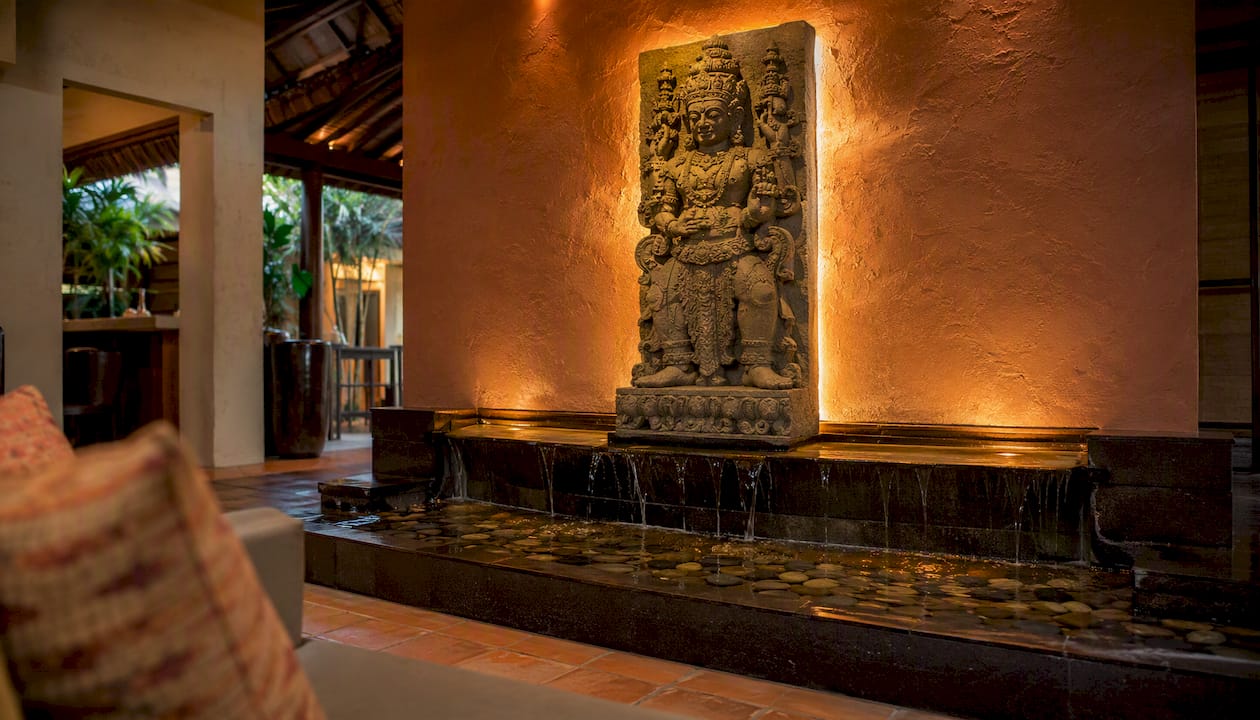
Consider what happens at the arrival sequence of a well-designed lobby. Guests move from a car or shuttle, through a threshold, into a space designed to slow their pace. A temple art anchor gives that sequence its climax point, the place eyes land and stay. Architectural framing, whether it’s a niche, an arch, or a pool of still water beneath a relief carving, tells guests where to look without a sign or a staff member pointing the way.
Scale and materiality do heavy lifting here. A small bronze figure lost against a two-story lobby ceiling reads as an afterthought. The 175-foot handwoven textile installation at Kimpton Miralina Resort & Villas proves the opposite case. It took months to develop and functions as both an architectural gesture and a storytelling device, anchoring the entire lobby volume rather than competing with it.
- Pieces placed at eye level or slightly above draw sustained attention; pieces placed too low get treated as furniture.
- Negative space around an anchor piece communicates value more effectively than crowding it with supporting objects.
- A single strong piece, correctly scaled, outperforms several smaller ones competing for the same sightline.
Design Strategies for Placing Temple Art in a Lobby
The most reliable strategy is anchoring plus a framed approach: place your primary temple piece at the arrival terminus, the point where a guest’s eye naturally lands after entering. Everything else in the composition should support that one point, not compete with it.
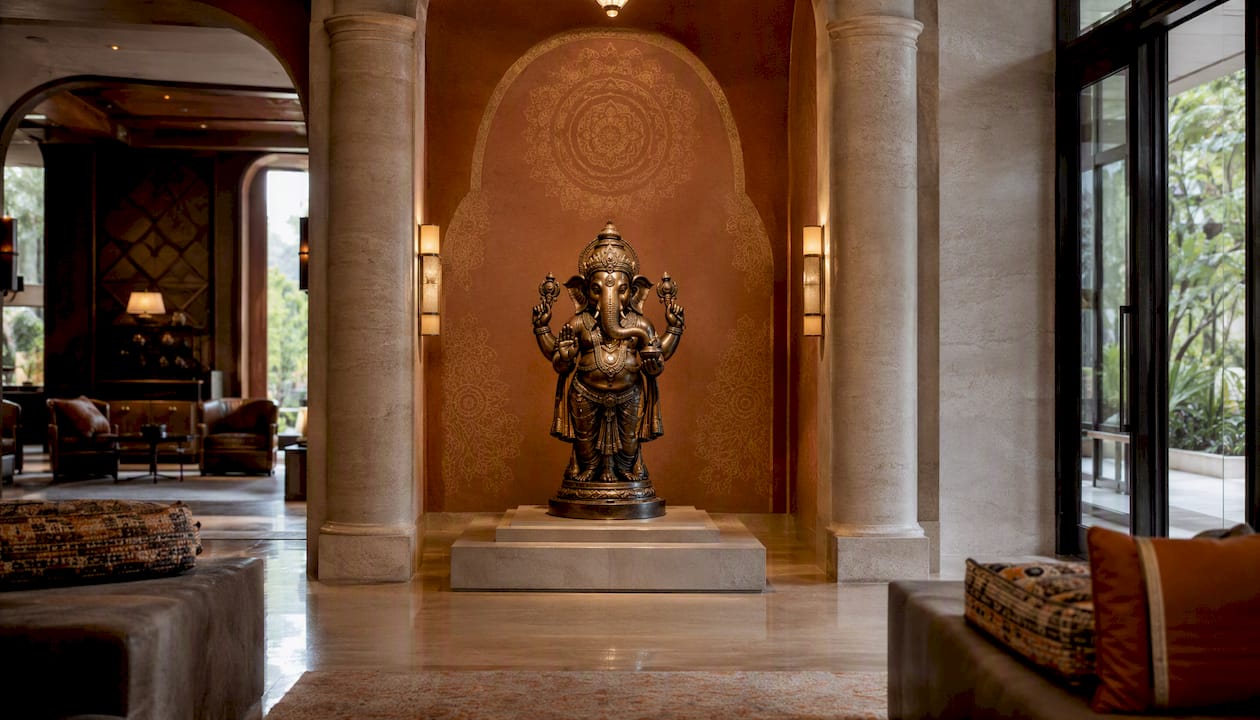
Scale relative to the room. A general rule of thumb: your anchor piece’s height should read as roughly a third to half of the available wall or niche height, leaving generous negative space above and around it. In a lobby with a 20-foot ceiling, a 6 to 8-foot carved relief or standing statue tends to hold the space without disappearing into it. Reception desks and circulation furniture should stay visually subordinate to the anchor, not compete with it for attention.
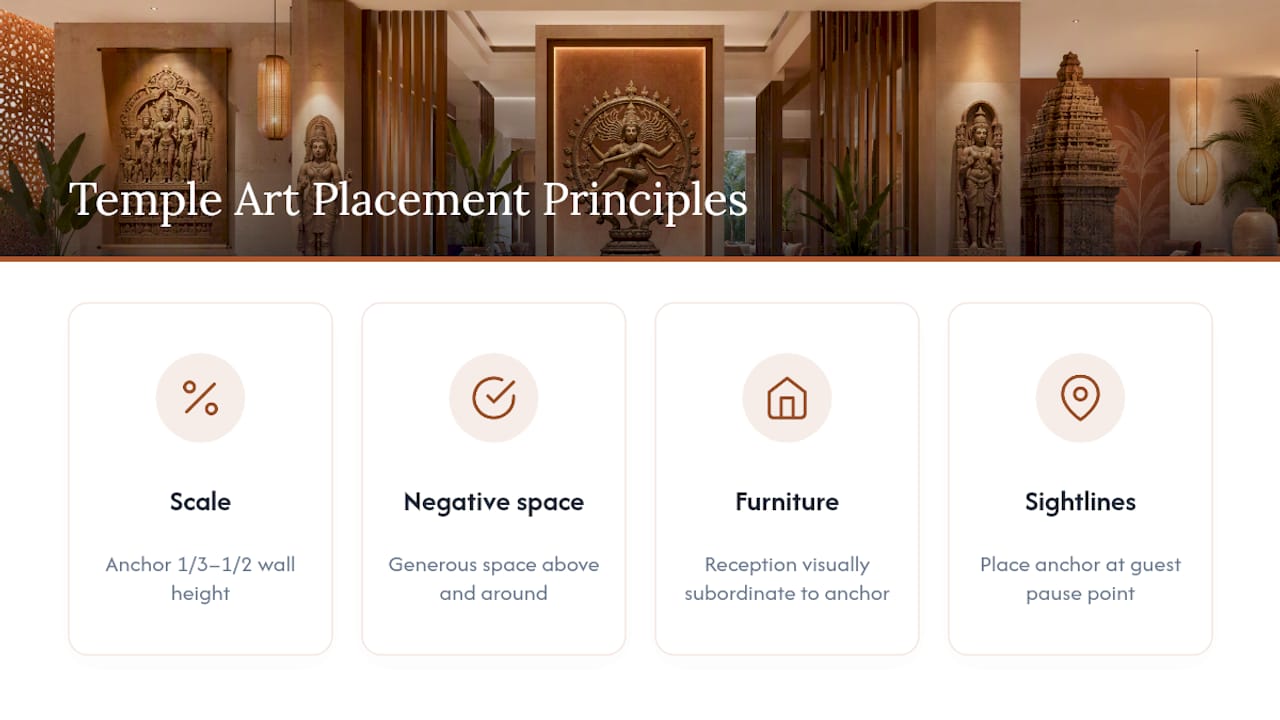
Sightlines and approach. Map the guest’s path from the entrance to the desk and identify where they naturally pause: usually at a turn, a change in flooring, or a threshold. That pause point is where your anchor piece belongs. Umana Bali built its lobby around exactly this logic, using a banyan tree-inspired roof structure paired with antique Balinese dancer statues and a custom chandelier interpreted from a traditional dance, so architecture and antiques reinforce the same story from multiple approach angles.
Layering. Combine one antique or commissioned sculptural anchor with a contemporary supporting layer: a woven textile, a subtle relief wall, or a lighting installation. The St. Regis Longboat Key art program took this further across an entire property, combining oversized paintings, immersive murals, and layered installations to build a location-driven identity rather than relying on any single piece.
Lighting. Mix three layers: focused spot lighting on the piece itself, an ambient wash across the surrounding wall, and, where appropriate, subtle backlighting to separate the piece from its background. Avoid flooding stone or bronze with harsh, high-UV light, which flattens carved detail and accelerates fading on painted or lacquered surfaces.
Pro Tip: Use low-UV LED spotlights angled at 30 to 45 degrees to reveal carved detail and patina without glare. Direct overhead light tends to wash out the subtle shading that gives antique bronze and stone their depth.
Material pairings matter as much as placement. Stone and bronze anchors pair naturally with water features and warm-toned flooring; pairing an authentic antique piece with obviously synthetic materials nearby is the fastest route to a “theme park” feel instead of an authentic one.
Choosing Authentic Temple Art: Provenance and Cultural Respect
Prioritize provenance documentation and museum-quality craftsmanship over price or speed of acquisition. A piece without a documented ownership history is a liability, not a bargain, regardless of how convincing it looks in photos.
Run every candidate piece through this checklist:
- Provenance documentation. Ask for previous ownership records, export paperwork from the country of origin, and any restoration history.
- Material identification. Bronze, stone, hardwood, and lacquer age differently and carry different conservation needs; know exactly what you’re buying.
- Condition assessment. Cracks, prior repairs, and structural stability all affect both display options and long-term cost.
- Cultural sensitivity. Confirm the piece’s original religious or ceremonial function and whether display in a commercial lobby is appropriate for that specific iconography.
- Scale and transportability. Confirm dimensions and weight against your lobby’s structural capacity before committing.
Avoid looted or undocumented pieces entirely; the ethical and legal risk far outweighs any aesthetic gain. When a seller can’t produce clear provenance, the safer route is a commissioned contemporary interpretation with a documented artisan and a clear attribution trail. For respectful display of religious Buddhist art, placement and framing decisions carry as much weight as the sourcing decision itself, since even an authentic piece can be displayed in a way that reads as disrespectful.
A basic provenance statement should tell you who owned the piece before, how it left its country of origin, and whether it has been restored. If a seller can’t answer those three questions clearly, treat that as a warning sign rather than a minor gap.
Logistics: Sizing, Shipping, and Long-Term Maintenance
Plan structural support, insurance, and climate control at the concept stage, not after a piece has already been purchased. Retrofitting a lobby floor to bear the weight of a half-ton stone sculpture after installation day is far more expensive than engineering for it up front.
Mounting and structural support. Stone and bronze pieces need engineered pedestal bases rated for their exact weight, and high-traffic lobbies benefit from recessed niches or tempered-glass enclosures that protect the piece without visually isolating it from guests.
Shipping and customs. Antique pieces typically involve longer lead times than new commissions because of export documentation and customs clearance in the country of origin; commissioned contemporary work often ships faster since there’s no antiquities paperwork involved. Either way, insist on insured, tracked worldwide shipping, since a piece worth tens of thousands of dollars deserves nothing less.
Maintenance by material:
- Bronze needs periodic wax treatment and dust removal; avoid harsh chemical cleaners that strip patina.
- Stone requires humidity monitoring, especially in tropical resort climates, to prevent surface staining.
- Wood and lacquer pieces need the most careful humidity and light control, since both materials are sensitive to swings in moisture.
- All materials benefit from a documented cleaning schedule, ideally quarterly for public-space pieces exposed to guest traffic and touch.
Budget concentrates in three places: procurement (the piece itself), structural engineering (mounting and floor reinforcement), and installation labor. Antique acquisitions can take several months from sourcing to delivery once shipping and customs are factored in; commissioned works often move faster but still require realistic lead time for fabrication.
Sourcing and Commissioning Temple-Inspired Art
Use specialist galleries for authenticated antiques and local artisan commissions for site-specific contemporary work. These two paths solve different problems, and most successful lobbies use both rather than picking one exclusively.
Before committing to any supplier, confirm:
- Authentication and documented provenance for every antique piece under consideration.
- Shipping capability, specifically insured, tracked, international logistics rather than domestic-only service.
- Condition reports detailing existing damage, repairs, or conservation needs.
- Export paperwork already cleared or clearly explained.
- Installation support, or at minimum clear guidance for your own installation team.
HD Asian Art works specifically in this space, offering individually researched and authenticated antique Buddhist and Hindu statues and temple art from Cambodia, Thailand, Indonesia, Sri Lanka, Vietnam, and beyond, each piece documented with detailed provenance and shipped worldwide with insured DHL delivery. For a hospitality project where authenticity and long-term collectability matter, that curator-led sourcing model removes much of the guesswork that comes with buying antiquities directly from unverified sellers.
Commission a contemporary piece when you need exact dimensions for a specific niche, a narrative tied directly to the resort’s location, or when a comparable antique simply isn’t available at the scale you need. When briefing an artisan or studio, specify material, finish, the cultural or narrative story you want the piece to tell, and every installation constraint (weight limits, mounting points, lighting infrastructure) up front. Ayodya Resort Bali built its entire compound around this kind of integrated approach, using tri mandala zoning with a courtyard shrine and carved reliefs to weave temple motifs through the guest journey rather than isolating them to the lobby alone.
Case Studies: Resort Lobbies That Got It Right
The pattern across successful projects is consistent: one large signature piece, layered with a supporting artisan program, builds a cohesive narrative that a scattering of smaller objects never achieves.
Kimpton Miralina Resort & Villas. A 175-foot handwoven textile installation became the lobby’s signature feature, developed over months in partnership with local artisans and calibrated to the surrounding landscape’s colors. The takeaway for other projects: a single oversized, custom-made piece can carry an entire lobby’s identity if it’s given the physical space and the time investment to be done right, as seen in many Luxury Resorts In St George Utah that emphasize curated artistic features.
Umana Bali. Antique Balinese dancer statues sit alongside a custom chandelier reinterpreting a traditional dance, all under a roofline inspired by the banyan tree. The lesson: architecture and antiques should tell the same story from different materials, not compete for attention.
Caribe Royale Orlando. Sculpted preserved moss walls solved a real climate problem, delivering a durable, biophilic feature that holds up in Florida’s humidity without the maintenance burden of live plants. Any resort in a high-humidity market should study this as a model for material selection that survives the environment rather than fighting it.
Le Temple, Borobudur. The property borrows Borobudur’s stupa geometry directly into its architecture, using Buddhist reliefs and a central Buddha relief framed by shallow pools to anchor interior public space. It’s a reminder that temple references can operate at building scale, not just as standalone objects within a room.
When briefing photographers or reviewing a designer’s concept package, ask for approach shots taken from the actual entrance sequence, not just straight-on product photography. A piece that photographs beautifully in isolation can still fail if it doesn’t read correctly from the angle a guest actually walks in from.
A Designer’s Perspective on Temple Art in Hospitality
From experience across hospitality projects, the single biggest mistake is over-decoration. Teams get excited about a cultural theme and start layering in statue after statue, textile after textile, until the lobby reads as a gift shop rather than a curated space. Restraint is the harder skill, and it’s the one that separates a lobby guests remember from one they walk past.
The tactical detail most people skip: get a written condition report and conservation plan before a single antique piece ships, not after it arrives cracked or with undocumented prior repairs. That document should specify humidity tolerances, cleaning frequency, and any restoration already performed, because that paperwork becomes your reference point for the next decade of maintenance decisions.
If a project involves antique Buddhist or Hindu statuary, bring in a specialist source early, before floor plans are finalized. Structural, provenance, and cultural placement decisions all get harder and more expensive to fix once construction is underway.
Work With HD Asian Art on Your Lobby’s Signature Piece
For hospitality projects that need documented provenance rather than a guess, HD Asian Art functions as a curator-led sourcing partner instead of an open marketplace where authenticity checks fall entirely on you.
Every piece in the collection, from bronze standing Buddhas to carved Hindu deities and Burmese lacquerware, is individually researched, photographed, and described before it’s listed, with detailed provenance included rather than left for you to chase down after purchase. Shipping arrives insured worldwide via DHL, which matters considerably when a single piece represents both a design investment and a genuine collectible.
For designers assembling a broader program, the gallery’s range across Cambodia, Thailand, Indonesia, Sri Lanka, and Vietnam gives enough material variety to layer an anchor antique with complementary pieces from the same cultural lineage rather than mixing unrelated regional styles. Browse the current collection of authenticated Buddhist and Hindu statues to shortlist candidates for your lobby’s arrival terminus, or reach out directly to discuss provenance documentation and shipping timelines for a specific project.
Sources
Designers researching real installations should look directly at the original project write-ups rather than secondhand summaries, since the imagery and installation notes often reveal details a description alone can’t capture.
- Obakki’s Custom Loom Installation at Kimpton Miralina Resort & Villas
- Umana Bali, LXR Hotels & Resorts | WATG
- St. Regis Longboat Key Resort project — Kevin Barry Art Advisory
- Award-Winning Moss Art for Caribe Royale Orlando - McCaren Designs
- Le Temple Borobudur Hotel and Restaurant — Archello
