



Seated vs. Standing Buddha Statues: Meaning & Which to Choose
Seated vs. Standing Buddha Statues: Meaning & Which to Choose
Most people choose a Buddha statue based on appearance alone, and then spend months wondering why it feels slightly wrong in the space. The truth is that seated Buddha statue meaning and standing Buddha statue symbolism are not interchangeable.
These postures carry centuries of iconographic tradition rooted in specific moments from the Buddha's life and specific intentions for the viewer. Get the posture wrong and you have a beautiful object. Get it right and you have something that genuinely serves its purpose, whether that is meditation, protection, abundance, or devotion.
Table of Contents
Quick Takeaways
|
Key Insight |
Explanation |
|---|---|
|
Seated posture signals enlightenment and meditative depth |
The seated Buddha most often depicts the moment of the Buddha's awakening under the Bodhi tree, making it the primary choice for meditation spaces and home altars. |
|
Standing Buddha represents active compassion and protection |
A standing figure is typically in motion, either walking toward devotees to offer blessing or standing firm to offer protection. It is not a passive posture. |
|
The mudra (hand gesture) changes the meaning more than the posture alone |
A seated Buddha with the Abhaya mudra (raised palm) signals protection. The same seated figure with Dhyana mudra (hands in lap) signals pure meditation. Posture and gesture must be read together. |
|
Thai and Burmese standing Buddhas have distinct iconographic rules |
Thai standing Buddhas frequently depict the Giving Blessing posture. Burmese versions often show the Buddha with both arms at the sides, a rare and powerful protective form. |
|
Seated statues suit confined or low spaces better |
A seated figure creates visual stillness and works at altar height. A standing figure commands vertical space and suits entryways, larger rooms, or garden settings. |
|
The Bhumisparsha mudra is exclusively seated |
The Earth-touching gesture, where the right hand reaches toward the ground to call the earth as witness to enlightenment, is iconographically impossible in a standing figure. This is one of the most doctrinally significant gestures in Buddhist art. |
|
Material and origin affect which posture is traditional |
Cambodian Khmer bronze sculpture favors seated meditation forms. Japanese wood sculpture produces extraordinary standing Kannon (Bodhisattva) forms. Knowing the regional tradition helps you evaluate authenticity and quality. |
What Seated Buddha Statue Meaning Really Tells You
The seated Buddha is the most doctrinally significant posture in Buddhist iconography, and that is not an opinion. It is a direct consequence of the fact that the Buddha achieved enlightenment while seated in deep meditation under the Bodhi tree in Bodh Gaya. When you see a seated figure, you are looking at a representation of that exact moment, or at least an image designed to invoke its qualities.
The seated Buddha statue meaning shifts depending on the specific posture of the legs. The full lotus position (Padmasana), with both feet resting on opposite thighs, is the most complete form. It signifies total stability and the highest meditative absorption. The half-lotus (Ardha-Padmasana) is slightly less formal but equally valid for home altars and personal practice spaces. A seated figure with legs pendant, hanging down from a throne, represents the Maitreya Buddha, the future Buddha, and signals anticipation and benevolence toward the world.
The Bhumisparsha Mudra: Why It Matters
Among all seated postures, the Bhumisparsha mudra is the one most collectors encounter first. The right hand extends downward to touch the earth while the left rests in the lap. This gesture calls the earth goddess Sthavara as witness to the Buddha's right to claim enlightenment, a direct response to the demon Mara's challenge. It is a posture of unshakeable conviction, not serenity in the passive sense.
In practice, a seated Bhumisparsha figure works powerfully in any space where you want to project rootedness and authenticity. Many practitioners who work in environments of uncertainty or conflict place this form specifically because of what it iconographically represents: a claim that cannot be disputed.
Pro tip: If you are choosing a seated Buddha for a meditation room, prioritize the Dhyana mudra (both hands resting in the lap, right over left) rather than the Bhumisparsha. Dhyana is purely contemplative with no narrative content to distract the viewer's attention.
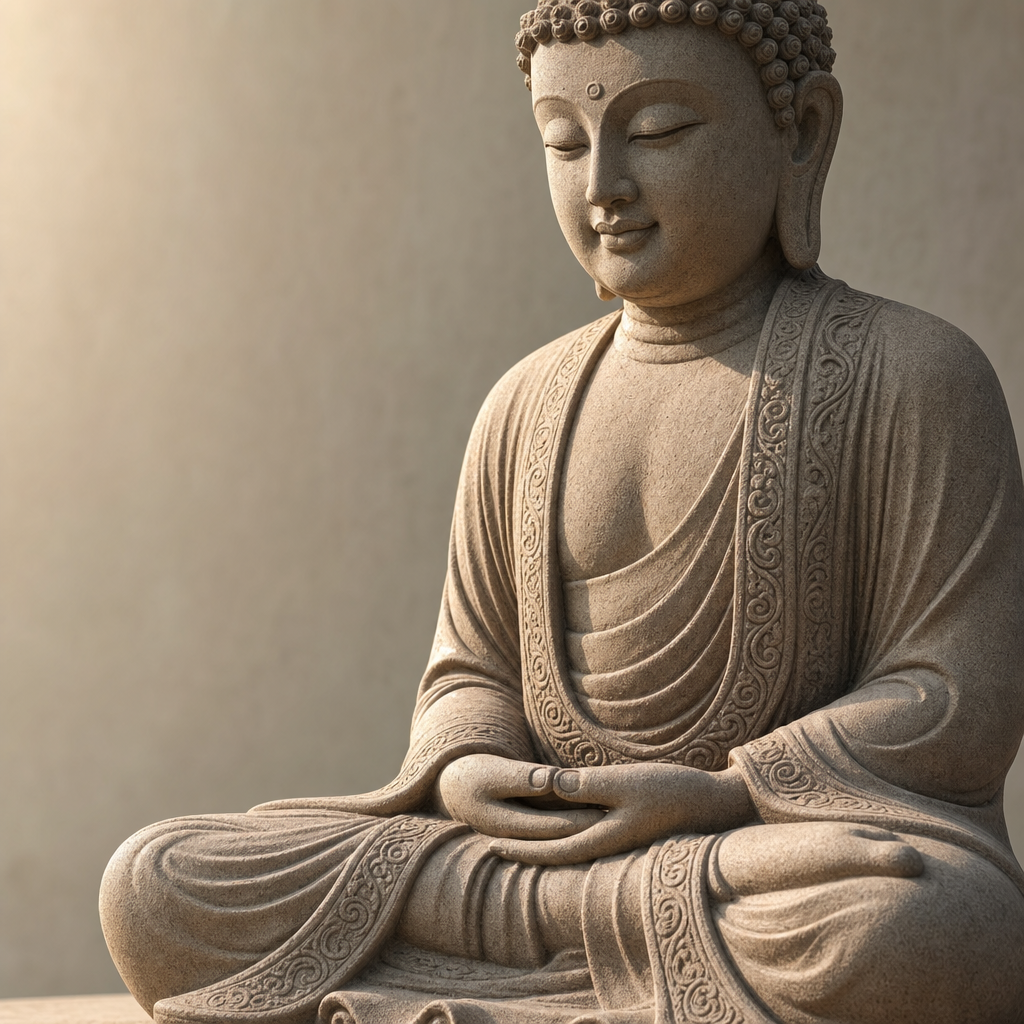
Seated Buddhas in the HD Asian Art Collection
Across the collection at HD Asian Art, seated figures span traditions from the refined gilded Burmese Mandalay style to the sandstone gravitas of Cambodian Khmer work. Each tradition interprets the seated posture differently while preserving its doctrinal core. A Burmese seated Buddha tends toward a more elongated face and flame-shaped ushnisha (cranial protuberance). A Thai seated form often features a more stylized, jeweled crown reflecting the Rattanakosin royal aesthetic.
Standing Buddha Statue: Posture, Purpose, and Regional Variations
The standing Buddha is not a substitute for a seated form. It is a completely different doctrinal statement. Where the seated Buddha looks inward, the standing Buddha looks outward. It represents the Buddha after enlightenment, moving through the world to teach, to bless, and to protect.
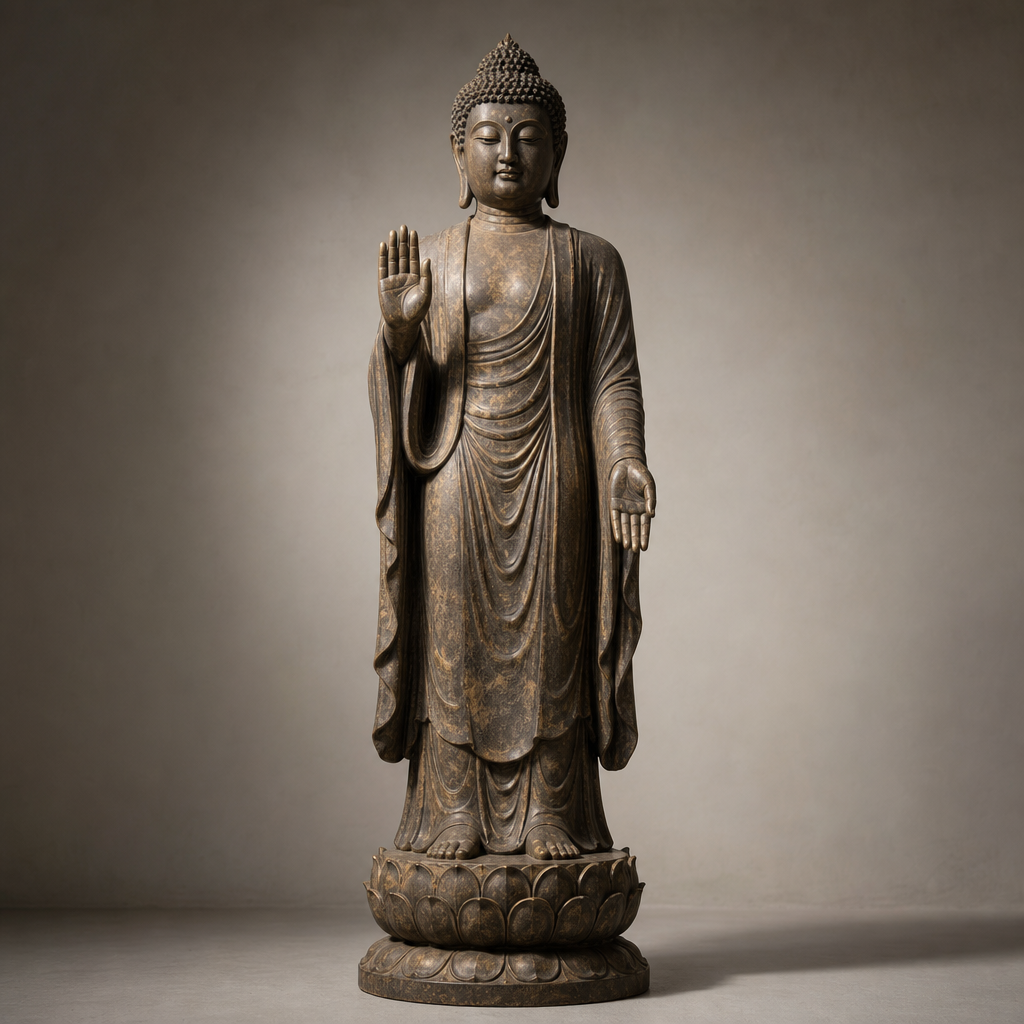
The most common standing posture in Southeast Asian Buddhist art is the Giving Blessing posture, where one or both arms are raised with the palm facing outward. This is the Abhaya mudra in standing form, and it translates literally as the gesture of fearlessness. It is an active gift to the viewer. A standing Buddha with this gesture placed near an entrance to a home or business is one of the most traditional and iconographically appropriate placements in Buddhist decorative tradition.
The Walking Buddha of Thailand
Thailand's Sukhothai period produced one of the most innovative forms in all of Buddhist art: the walking Buddha (Phra Phut Lerla Buat). This figure moves with one foot raised and one hand raised in the Abhaya gesture. It is technically a standing posture in motion. The Sukhothai walking Buddha has an almost otherworldly quality with its flame-shaped ushnisha, sinuous arms, and the sense that the figure is descending from heaven to bring the Dharma to earth.
A common mistake is placing a walking Buddha in a meditation room. Its energy is directional and forward-moving. It belongs in transitional spaces: hallways, entranceways, garden paths, or any area that represents movement and progress.
Burmese Standing Buddha Forms
Burmese standing Buddhas differ significantly from their Thai counterparts. The classic Burmese form shows the Buddha with both arms hanging at the sides, a posture called Attha, associated with protection and a specific moment in the Buddhist canon when the Buddha subdued a rogue elephant. This is a comparatively rare form globally but appears with some frequency in quality Burmese lacquer and bronze work. At HD Asian Art's Burmese collection, you will find examples of both this protective standing form and the more familiar blessing posture.
Pro tip: When evaluating a standing Buddha's quality, look at the treatment of the robe. In Khmer and Pala tradition, the robe is thin to the point of near-transparency, clinging to the body. In Thai work, the robe edge is more clearly defined. Both are correct within their traditions. Robe treatment is one of the clearest indicators of regional authenticity.
Buddha Posture Symbolism Decoded: The Role of Hand Gestures
Posture and mudra are inseparable. Reading the posture without reading the mudra is like reading a sentence and skipping half the words. The body position establishes the context. The hand gesture delivers the specific meaning.
"Buddhist iconography is not decorative. Every line, gesture, and attribute is a sentence in a visual language that took centuries to develop." - Robert Beer, The Handbook of Tibetan Buddhist Symbols, Serindia Publications.
The following mudras appear across both seated and standing forms, though some are exclusive to one or the other.
Mudras That Appear in Both Seated and Standing Forms
Abhaya mudra (right hand raised, palm outward) means protection and fearlessness. It appears in both postures across virtually every Buddhist tradition from India to Japan. Varada mudra (hand extended downward, palm outward) means gift-giving and generosity. It is equally common in both seated and standing figures, particularly in Southeast Asian art.
The combination of Abhaya and Varada together, one hand raised and one lowered, is known as the Double Blessing posture and is specific to standing Buddhas in Thai and Sri Lankan tradition. You will not find it in a seated figure. This specificity matters when you are making a purchase decision.
Mudras Exclusive to Seated Figures
Bhumisparsha (earth-touching), Dhyana (meditation), and Vitarka (teaching, with thumb and forefinger touching) in its most elaborate form are almost entirely the domain of seated Buddhas. This is a doctrinal point, not a stylistic preference. The moments these gestures depict either happened while the Buddha was seated or are associated with formal teaching settings where the seated position is implied.
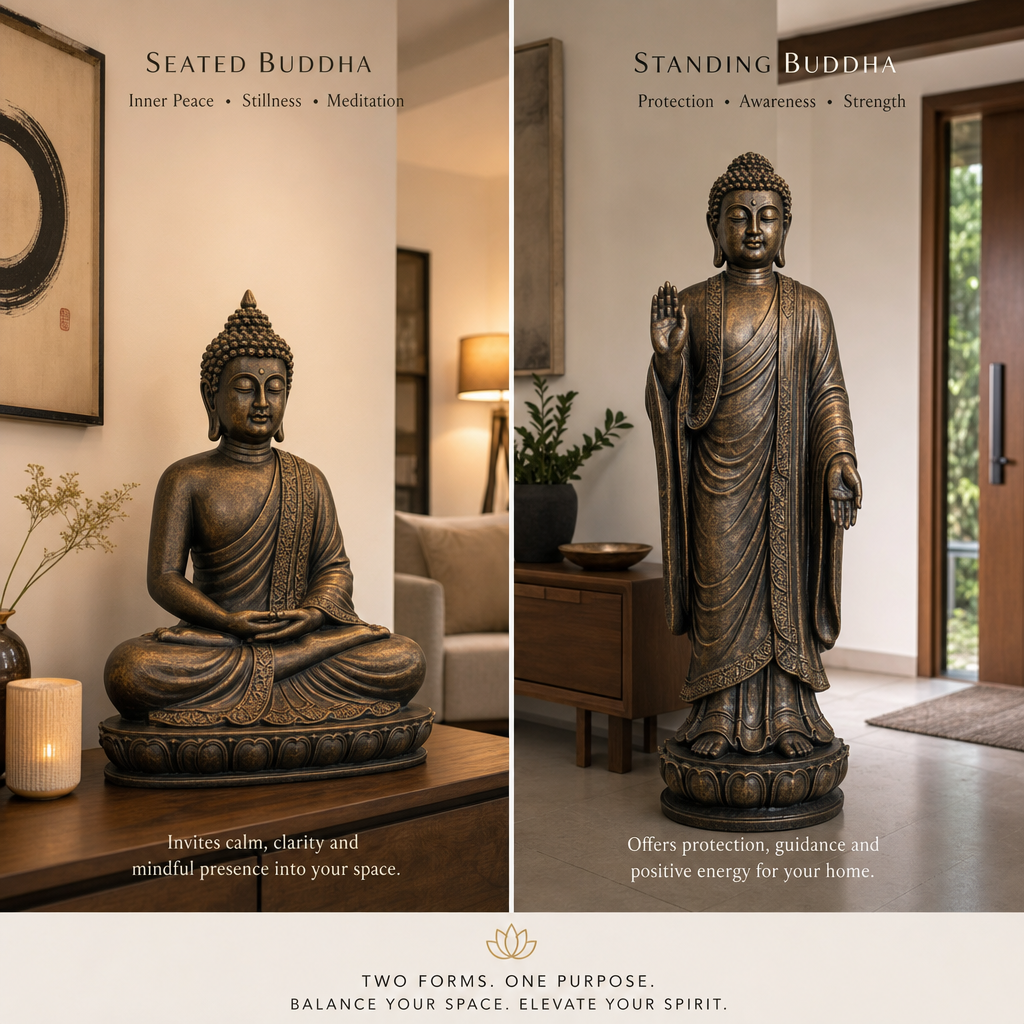
Comparing Seated and Standing Buddha Statues Side by Side
|
Feature |
Seated Buddha |
Standing Buddha |
|---|---|---|
|
Primary doctrinal association |
Enlightenment, meditation, inner stillness |
Active compassion, protection, teaching, blessing |
|
Best placement in the home |
Meditation room, altar, bedroom, study |
Entrance hall, garden, transitional spaces, living room |
|
Most common mudras |
Dhyana, Bhumisparsha, Vitarka, Abhaya |
Abhaya, Varada, Double Blessing (both hands) |
|
Regional traditions where most developed |
India (Gupta, Pala), Cambodia, Burma, Japan (Zen) |
Thailand (Sukhothai, Ayutthaya), Sri Lanka, Burma (Attha form), Gandhara |
|
Space requirement |
Works well at eye level when seated; suits compact altars |
Requires vertical space; commands a room or entryway |
|
Suitable for art collectors |
Yes, extremely high variation in style and period |
Yes, particularly Sukhothai and Gandhara forms command strong collector interest |
|
Suitability for spiritual practitioners |
Highest, particularly Dhyana and Bhumisparsha forms |
Strong, particularly for practitioners seeking protection or active blessing energy |
Which to Choose: Practical Guidance for Collectors and Practitioners
The answer is specific, not vague. Choose a seated Buddha if your primary purpose is meditation, devotion at a home altar, or the creation of a space that invites stillness. The seated form is the correct iconographic choice for these purposes, not merely a preference.
Choose a standing Buddha if you want to express active energy in a space, mark an entryway as protected or blessed, or if the vertical scale of your space demands a figure that rises rather than anchors. Standing Buddhas are also the more unexpected choice for serious collectors who have already developed a seated collection and want to explore less common forms.
For Meditation Rooms and Private Altars
A seated Buddha in Dhyana mudra is the most doctrinally appropriate choice for a dedicated meditation space. Place it at eye level when you are seated in your own meditation posture. The point of the figure is to provide a focus for attention, not to be admired from across the room. Size matters here more than many buyers expect. A figure between 20 and 40 centimetres works well for personal altar use. Larger pieces belong in shared spaces.
HD Asian Art's Buddha statue collection covers exactly this range, with pieces from multiple traditions so you can match the figure to the specific style of practice or aesthetic context you have in mind.
For Home Decor and Collector Displays
If your primary goal is art collection or interior design with cultural depth, both postures offer exceptional options. The seated forms from Cambodia and Burma represent some of the highest achievements in Asian sculptural tradition. The standing Sukhothai walking Buddha is one of the most visually distinctive forms in world art.
Do not choose purely on visual impact. A common mistake among new collectors is buying the most dramatic piece available without considering what the piece communicates to anyone who knows the tradition. A Bhumisparsha figure placed at an entrance, for example, is iconographically odd. That gesture belongs in a contemplative context, not a greeting one.
How Regional Traditions Shape the Form
Buddha posture symbolism does not exist in a single uniform system. The Indian Gupta period established the canonical grammar of Buddhist sculpture between the 4th and 6th centuries CE, but every region that adopted Buddhism adapted that grammar to its own aesthetic and doctrinal emphases.
Thai Buddhas, particularly from the Sukhothai period, have an almost impossibly graceful quality. The fingers are equal in length, the ushnisha is flame-shaped, and the seated form has a distinctive elongation that no other tradition reproduces. Burmese Buddhas, especially those from the Mandalay period, tend toward a more frontal, hieratic presentation with lavish gilding and inlaid glass ornamentation. Cambodian Khmer Buddhas, particularly from the Angkor period, have a powerful, quietly monumental quality entirely different from the delicate refinement of Thai work.
Japanese Buddhist sculpture, meanwhile, developed a seated Amida (Amitabha) Buddha tradition of extraordinary subtlety, particularly in lacquered wood. The Japanese Buddha statues in the HD Asian Art collection reflect this contemplative refinement.
Understanding these regional distinctions is not academic. It directly affects how you evaluate a piece's quality and appropriateness for your specific purpose. A Thai Dhyana mudra figure has a completely different visual and spiritual register than a Burmese one, even though both are technically the same posture.
Frequently Asked Questions
What does a seated Buddha statue symbolize compared to a standing one?
A seated Buddha primarily symbolizes the moment and state of enlightenment, meditation, and inner stillness. A standing Buddha symbolizes the Buddha's active presence in the world: walking to teach, standing to protect, and reaching out to bless. The two postures are doctrinally distinct, not interchangeable variations of the same idea.
Which Buddha posture is best for a home altar?
A seated Buddha in Dhyana mudra (hands resting in the lap) is the most appropriate for a home altar or meditation space. This posture directly invites contemplation and is what most Buddhist traditions worldwide place at the center of a devotional setting. A standing or walking Buddha works better in transitional spaces like entryways or garden settings.
Does the direction a Buddha statue faces matter?
Yes, in most traditions it does. A Buddha statue facing the entrance of a room or home is considered most auspicious in Thai, Burmese, and Chinese Buddhist practice, as it allows the figure to greet and bless those who enter. Facing the figure east, toward the direction of the rising sun and of Bodh Gaya, is also a traditional choice for altar placement.
Can I have both a seated and a standing Buddha in the same space?
Yes, and in temple settings this is common. In home settings, place the seated figure as the focal point of the altar or meditation area and the standing figure in a secondary position or a different area entirely. Mixing them in the same altar grouping without a clear focal hierarchy can dilute the visual and devotional intention of both.
What is the difference between Buddha posture symbolism across Thai, Burmese, and Cambodian traditions?
Thai tradition is particularly rich in standing and walking forms, especially from the Sukhothai period, and tends toward graceful elongation. Burmese tradition favors frontally composed seated figures with elaborate gilding, and its standing Attha form is distinctive. Cambodian Khmer sculpture, whether seated or standing, has a monumental stillness and tends toward smooth, unornamented surfaces that emphasize pure form. All three are high-quality collecting traditions but with very different aesthetic registers.
Is it appropriate to buy a Buddha statue purely for decoration without being Buddhist?
Many serious collectors and interior decorators acquire Buddhist sculpture without practicing Buddhism, and this is entirely legitimate within the art collecting tradition. The more important consideration is treating the piece with the respect its craftsmanship and cultural significance deserve. Placing a Buddha statue in a bathroom or on the floor, for example, is widely considered disrespectful across Asian cultures regardless of the buyer's faith.
How do I know if a seated Buddha statue is authentic and museum quality?
Look for consistency between the regional style claimed and the actual sculptural details: proportions, mudra accuracy, robe treatment, and ushnisha form. A genuine Burmese Mandalay piece will have specific gilding and glass inlay characteristics. A Thai Ayutthaya piece will have a distinctive crown form. Buying from a specialist retailer with documented sourcing, such as HD Asian Art, is considerably more reliable than buying from general auction platforms where misattribution is common.
What posture or mudra drew you to your first Buddha statue, and did it fit the purpose you had in mind? Share your experience in the comments.
References
