



Restoring Damaged Antique Buddhist Bronze Sculptures
Restoring Damaged Antique Buddhist Bronze Sculptures
Table of Contents
- Assessing Structural Integrity Before You Touch the Bronze
- Tools for Antique Metal Restoration: What Belongs in Your Kit
- Common Causes of Damage to Buddhist Bronze Sculptures
- Risks of Improper Cleaning and DIY Repair on Sacred Objects
- Preventative Care for Buddhist Statues: Protecting Patina and Provenance
- Preparing for Professional Restoration and Documentation
- Conclusion: Preserving History with Care
- Frequently Asked Questions
Last Updated: October 6, 2026
Assessing Structural Integrity Before You Touch the Bronze
Restoring damaged antique buddhist bronze sculptures starts with slow assessment, not a cloth and polish. At HD Asian Art, we know most damage comes from good intentions.
Checking for Cracks, Gouges, and Base Stability
With a bright light, tilt the statue and look for hairline cracks near the ankles, wrists, and neck, the thin points where metal fatigue shows first.
Then rock the base softly on a felt pad; any wobble means base stability is compromised.
- Hairline cracks near joints and thin castings
- Gouges that expose raw metal under the patina
- A base that rocks, tilts, or feels loose
Mark every fault with a paper tag. Never with tape.
Identifying Surface Materials: Gilding, Lacquer, and Pigment
Gilding is a thin layer of gold applied over bronze, and it wears away with every wrong touch. Lacquer and pigment react differently to water and solvents.
Look for these surface layers:
- Gold gilding, often worn at the hands and face
- Dark lacquer that may hide old repairs
- Painted pigment, sometimes flaking at the edges
Material identification decides everything that follows. Get it wrong and you strip a century of history in one swipe.
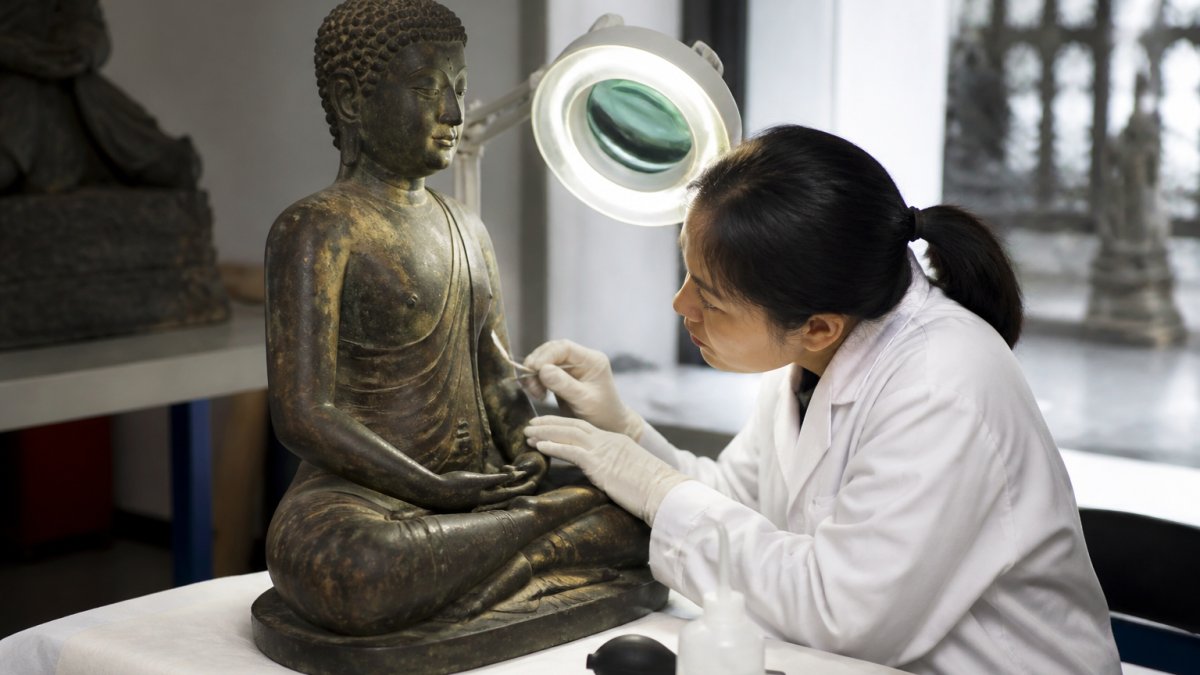
Tools for Antique Metal Restoration: What Belongs in Your Kit
A good kit is small, soft, and boring. Bronze is an alloy of copper with tin, lead, or zinc, and antique castings are often thinner at the extremities than they look. Every tool removes material, redistributes it, or leaves residue, choose tools that do none of the three.
What we keep on hand, and why:
| Tool | Purpose | Why It Is Safe on Antique Bronze | Frequency of Use |
|---|---|---|---|
| Soft sable or squirrel-hair brush | Lifts loose dust from crevices | Bristles are softer than the metal and cannot scratch gilding | Weekly |
| Distilled water | Dampens cloths, never tap water | No dissolved minerals to deposit or etch | As needed |
| Microfiber cloths | Buffs without scratching | Fiber diameter is finer than the surface profile of aged patina | As needed |
| Cotton swabs | Cleans tight details | Controlled contact, disposable, no cross-contamination | As needed |
| Magnifying lamp | Spots cracks and lifting gilding | Reveals faults before a tool touches them | Every session |
| Nitrile gloves | Keeps skin oils off the metal | Blocks chloride and fatty acids from bare hands | Every session |
| Soft cosmetic sponge | Blots, never wipes, moisture | No abrasion, no lint | As needed |
| Wooden skewer | Supports a lifting flake while you photograph it | Softer than bronze, harder than pigment | Rare |
What Never Goes in the Kit
Some tools are commonly recommended for metal, but they are not safe on antique bronze:
- Metal polish. Most formulas contain abrasives plus ammonia or acid. They cut through patina and gilding in a single pass and leave a residue in every pit.
- Wire brushes and steel wool. They scratch the surface and shed ferrous fragments that rust in place.
- Household cleaners. Even mild dish soap carries surfactants and perfumes that can be absorbed into porous corrosion layers.
The DIY vs. Professional Threshold
Most collectors need a decision matrix, not a rulebook. Use this one before you open the kit:
| Situation | Safe to Handle Yourself | Stop and Call a Conservator |
|---|---|---|
| Loose surface dust | Yes, dry soft brush | , |
| Stable, uniform patina | Yes, leave it alone | , |
| Fingerprints or handling smudges | Yes, dry microfiber, no water | , |
| White or green powder on the surface | No | Yes, active corrosion |
| Cracks that flex when pressed nearby | No | Yes, structural |
| Lifting gilding or flaking pigment | No | Yes, any contact risks loss |
| Base that will not sit flat | No | Yes, casting or repair failure |
| Visible old repair of unknown material | No | Yes, compatibility unknown |
| Piece with documented provenance or museum history | No | Yes, documentation required first |
If any row in the right-hand column applies, the next step is a photograph, not a tool. A conservator can usually tell from images whether the piece needs hands-on treatment or just better storage.
How Cleaning Agents Actually Behave on Old Bronze
This is where most damage starts. The reaction depends on the alloy and what sits on top of it.
- Distilled water is the only liquid most collectors should ever apply. It is inert to bronze and to gold gilding, and it will not dissolve cured lacquer. It can, however, lift flaking pigment by capillary action, so never apply it to a painted surface.
- Ethanol and isopropyl alcohol dissolve some lacquers and shellacs but not others, and they can carry pigment into porous corrosion. On a modern replica with a factory lacquer, alcohol may be fine. On an antique with a hand-applied urushi-style lacquer, it can cloud the surface permanently.
- Acetone and other ketones attack most organic coatings and will strip gilding that has been laid over an organic binder. They are conservator tools, not collector tools.
A modern replica and an antique casting can look identical yet behave differently under the same cloth. When you do not know the alloy or coating, assume the piece is antique and the answer is distilled water or nothing.
Common Causes of Damage to Buddhist Bronze Sculptures
Damage rarely comes from one event. It builds.
The usual culprits:
- Corrosion and oxidation from humid air and skin contact
- Mechanical cleaning with harsh cloths or brushes
- Chemical cleaning that strips patina and gilding
Old repairs are their own category. According to EXARC's study of historical bronze repairs, ancient repairs are a real part of an object's history, not just damage to undo.
That changes how you treat them.
Risks of Improper Cleaning and DIY Repair on Sacred Objects
Sacred objects carry meaning beyond their metal. A wrong repair can erase provenance and historical value. The biggest risks:
- Stripping original patina that took decades to form
- Lifting gilding with a single wet cloth
- Introducing new chemicals that keep reacting for years
Conservators have shifted toward reversible methods for exactly this reason. The growing preference for lacquer fills and wooden inserts that can be undone later, rather than permanent alterations.
When to Stop and Call a Professional Conservator
Stop when any of these appear:
- Active corrosion or green powder on the surface
- Cracks that move when you press nearby
- Lifting gilding or flaking pigment
Preventative Care for Buddhist Statues: Protecting Patina and Provenance
Preventative care for buddhist statues comes down to stable conditions and clean hands. Small habits protect more than any repair.
- Keep humidity steady, ideally between 40% and 50%
- Display away from direct sun and heat vents
- Dust with a dry soft brush, never a damp cloth
Patina preservation matters here. Some collectors and conservators argue that aged patina, and even old historical repairs, should stay as they are. A Mystik River discussion of patina and provenance makes the case that age is part of the object's story.
We agree with that view for most pieces. Clean less. Document more.
Preparing for Professional Restoration and Documentation
Documentation and provenance separate a careful restoration from a gamble. Before any conservator touches the piece, build a file as if someone else will inherit it, because eventually someone will.
What Goes in the File
A working restoration file has five parts. Keep them in one place and date every entry.
- Condition record. High-resolution photographs from every angle, plus raking-light shots that reveal surface texture and old repairs. Include a scale reference in at least one frame.
- Damage map. A simple sketch of the statue with every crack, gouge, loss, and old repair marked and numbered. Cross-reference the numbers to close-up photos.
- Material notes. Your best description of the surface layers, gilding, lacquer, pigment, later paint, and how you determined each one. Note anything you are unsure about.
- History. Any receipts, auction records, prior owner notes, exhibition labels, or family history. Even a handwritten note from a previous owner is provenance.
- Treatment goals. State plainly whether you want stabilization only, surface cleaning, or full restoration. Conservators work to the brief you give them.
Why Documentation Protects Value
A restoration that is not documented is indistinguishable from damage. Museums, insurers, and future buyers read the file before the object. A dated, photographed, signed record does three things:
- It proves the work was deliberate and reversible rather than an amateur intervention.
- It preserves the object's history, including any old repairs that are themselves part of that history.
- It gives the next conservator a baseline, so future treatment does not have to guess at what is underneath.
Experienced collectors keep the file with the object at all times, attached to the piece, not in a drawer or email folder.
Sourcing a Qualified Conservator
"Restorer" and "conservator" are not interchangeable. A conservator stabilizes an object with minimum intervention and documents every step; a restorer may be trained to make the object look new. For an antique bronze, you want the first.
Look for these credentials and signals:
- Formal training in art conservation from a recognized graduate program, or a documented apprenticeship under a conservator.
- Specialization in metals or in Asian art. A paintings conservator is not the right person for a bronze.
- A portfolio of comparable work. Ask to see before-and-after documentation for bronze pieces of similar age and alloy.
Questions to Ask Before You Hire Anyone
- Will your methods be reversible?
- What materials will you use, and how do they behave over time?
- Can you show me similar bronze pieces you have treated, with documentation?
- Will you provide a written treatment proposal and a final report?
- What will you do if you find an old repair underneath?
- Will you photograph each stage of the work?
If a conservator cannot answer these in plain language, keep looking. The right one will welcome the questions.
A Model of Patient Work
The University of Chicago's Oriental Institute has shown what careful work can achieve. Its conservators completed the reassembly of shattered ancient Buddhist statues dating from the first to 6th centuries, a project University of Chicago News documented as a model of patient, ethics-first conservation.
A professional conservator will also flag when a piece should not be restored at all. Sometimes stabilization is the whole job, and the file you built is the only intervention the object needs.
Reversible methods, full documentation, and a light touch protect both the bronze and its history. Anything permanent deserves a second opinion, and every treatment deserves a dated entry in the file.
Conclusion: Preserving History with Care
Restoring damaged antique buddhist bronze sculptures is slow work, and that is the point. Assess first, clean gently, document everything, and hand off anything that scares you.
When you are ready to add a piece with real provenance to your space, HD Asian Art curates Buddhist and Hindu statues, including Khmer and Southeast Asian sculptures, for altars and meditation rooms.
Frequently Asked Questions
How can I fix a broken statue?
Fixing a broken bronze statue depends on the damage. For minor cracks or loose parts, a professional conservator can use reversible adhesives like synthetic resins. Avoid DIY glues, which can cause further damage. If the break is structural, such as a detached base, consult a specialist. The University of Chicago Oriental Institute successfully reassembled shattered statues from the 1st to 6th centuries using conservation-grade methods, so even severe damage can be addressed by experts.
Is it okay to touch a Buddha statue?
In many traditions, touching a Buddha statue is acceptable with respect, but frequent handling can transfer oils and acids from your skin, leading to corrosion and patina loss. For antique bronze sculptures, minimize direct contact. If you must move it, wear cotton gloves. This aligns with preventative care for Buddhist statues, which emphasizes stable indoor climate and gentle handling to preserve sacred objects.
What are the risks of DIY bronze repair?
DIY repairs risk irreversible damage: harsh chemicals can strip patina, abrasive tools can scratch gilding, and improper adhesives may fail or cause corrosion. Additionally, non-reversible restorations can reduce historical value. Conservation standards favor reversible methods like lacquer fills or wooden inserts, as noted by Butuzou in 2026. Without training, you may also miss underlying metal fatigue or base instability, leading to further cracks.
How do I choose a qualified conservator for my Buddhist bronze sculpture?
Look for conservators with experience in Asian art and metals. Check affiliations with professional organizations like the American Institute for Conservation (AIC). Ask for documentation of previous projects, especially those involving bronze and gilding. A qualified conservator will provide a treatment proposal outlining reversible techniques and materials. For high-value pieces, request references and ensure they carry insurance. This step is crucial for preserving provenance and historical value.
