



Murugan Statue: Tamil War God & the Vel Spear Explained
Murugan Statue: Tamil War God & the Vel Spear Explained
Most people who encounter a Murugan statue for the first time mistake it for a generic warrior deity. That misreading costs them the entire depth of what they are looking at. Murugan, known across South Asia as the Tamil god of war, youth, and spiritual victory, is one of the most iconographically rich figures in the Hindu tradition.
His primary symbol, the Vel spear, carries theological weight that took Tamil scholars centuries to articulate. Whether you are a collector sourcing a museum-quality piece, a spiritual practitioner building a home altar, or simply someone drawn to the power of Lord Kartikeya sculpture, understanding the symbolism unlocks the object entirely.
Table of Contents
Quick Takeaways
|
Key Insight |
Explanation |
|---|---|
|
The Vel spear is not a weapon of war |
In Tamil Shaivism, the Vel represents the piercing of ignorance and ego, not physical destruction. It is a symbol of divine wisdom. |
|
Murugan has at least six canonical names |
Skanda, Kartikeya, Subramanya, Saravana, Shanmukha, and Kumara all refer to the same deity with regional doctrinal nuances attached to each. |
|
The peacock mount carries specific meaning |
The peacock (Paravani) subdued under Murugan's feet represents the conquest of ego and pride, not merely a decorative motif. |
|
Six faces are a canonical iconographic feature |
Shanmukha, meaning six-faced, reflects Murugan's capacity to perceive all six directions simultaneously, symbolizing omniscience. |
|
South Indian Chola bronzes set the benchmark |
Chola-period bronzes from Tamil Nadu (9th to 13th centuries) remain the most studied and referenced standard for authentic Murugan iconography. |
|
The rooster flag (Kodi) signals doctrinal affiliation |
A banner showing a rooster identifies the sculpture as aligned with Tamil Shaiva Siddhanta tradition, not the northern Skanda Purana lineage. |
|
Material and finish affect ritual suitability |
Bronze and panchaloha (five-metal alloy) statues are traditionally considered ritually active in South Indian temple practice, not stone or resin. |
Who Is Murugan? Origins and Regional Names
Murugan is among the oldest continuously worshipped deities in the Tamil-speaking world. Tamil literary evidence for his cult dates to the Sangam period, roughly 300 BCE to 300 CE, making the tradition older than most surviving Sanskrit texts on Skanda. The Tolkappiyam, one of the oldest Tamil grammatical texts, assigns Murugan to the mountainous landscape (Kurinji) of ancient Tamil Nadu, connecting him to youth, beauty, and the emotional register of erotic longing as much as warfare.
The name Murugan itself derives from the Tamil root meaning beauty or youth. When the same deity was absorbed into the Sanskrit Puranic tradition, he became Kartikeya, son of Shiva and Parvati, raised by the six Krittika star-nymphs. In Karnataka and Andhra Pradesh he is Subramanya. In Maharashtra he is Skanda. Each regional name carries doctrinal emphases that show up directly in sculpture.
In practice, a collector who conflates the South Indian Murugan tradition with the northern Kartikeya tradition will misread statues consistently. The iconographic programs differ in the number of arms, the presence or absence of the Vel, the mount used, and the accompanying consorts.
The Vel Spear: What It Actually Means
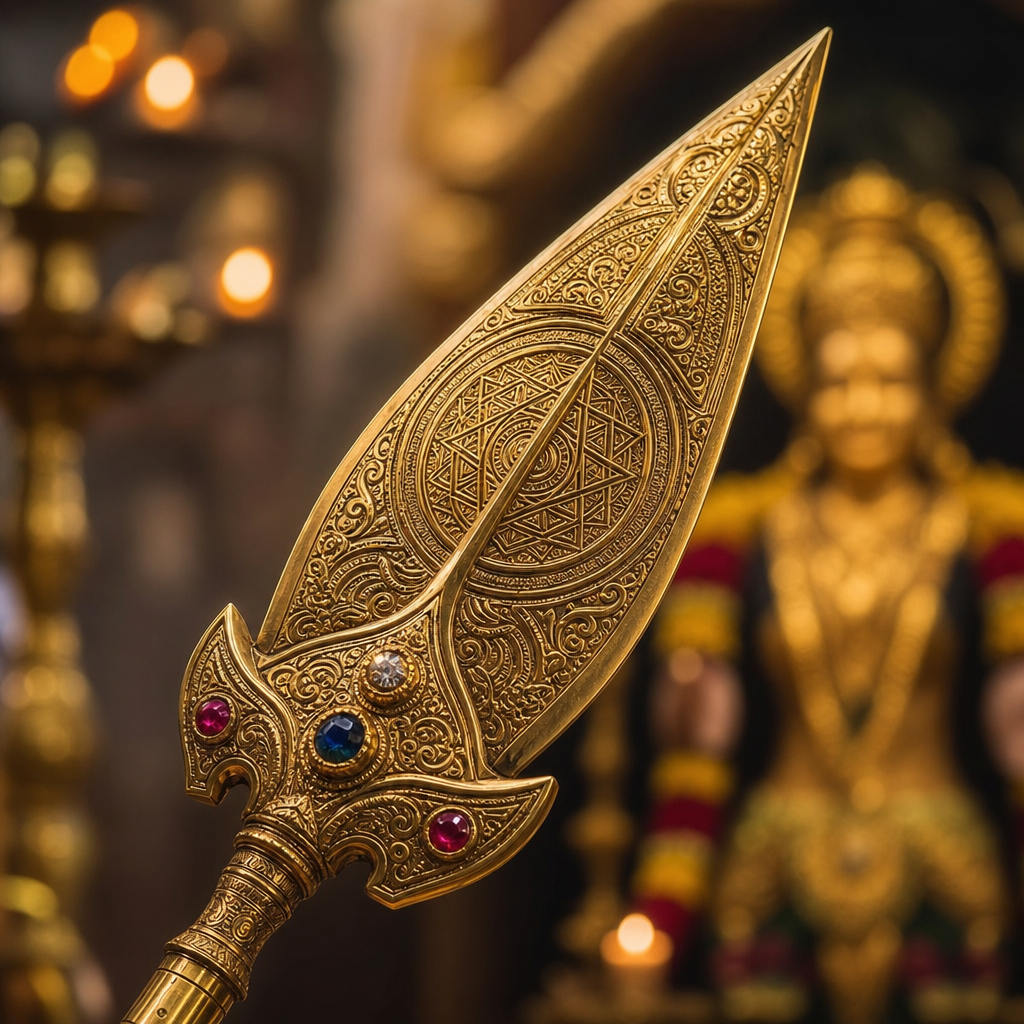
The Vel is the single most important attribute of a Murugan statue, and it is almost universally misunderstood by Western collectors encountering it for the first time. The Vel is not primarily a military weapon. In Tamil Shaiva Siddhanta theology, the Vel is jnana shakti, the power of divine knowledge made manifest as a piercing force.
The Myth Behind the Vel
The gift of the Vel to Murugan by his mother Parvati is the theological centerpiece of the Tamil devotional text Tirumurugatruppadai, composed by the poet Nakkirar. In that text, Parvati gives the Vel to Murugan specifically to defeat the demon Soorapadman. Soorapadman is not simply a monster; in Shaiva Siddhanta interpretation, he represents the primordial ego and the force of pasha, the bondage that keeps souls from recognizing divine reality.
When Murugan splits Soorapadman with the Vel, he transforms the demon rather than annihilates him. The two halves of Soorapadman become the peacock (Murugan's mount) and the rooster (Murugan's banner). This transformation is theologically significant: the Vel does not destroy ignorance through brute force. It transforms it into vehicles of grace.
Visual Representation of the Vel in Sculpture
In a well-executed Murugan statue, the Vel is shown with a leaf-shaped blade, often very elongated, representing both the spear point and the sacred Ashoka or Vel leaf. The handle is usually plain or minimally decorated. Statues where the Vel is ornate or oversized are departing from classical Chola iconographic norms and are usually later, more decorative productions.
Pro tip: When evaluating a Murugan sculpture for authenticity to classical Tamil iconography, check whether the Vel is held in the right hand pointing downward or resting against the shoulder. A Vel thrust forward in a combat posture reflects later, more martial interpretations common in North Indian Kartikeya sculpture rather than South Indian devotional tradition.
Reading a Murugan Statue: Iconographic Details That Matter
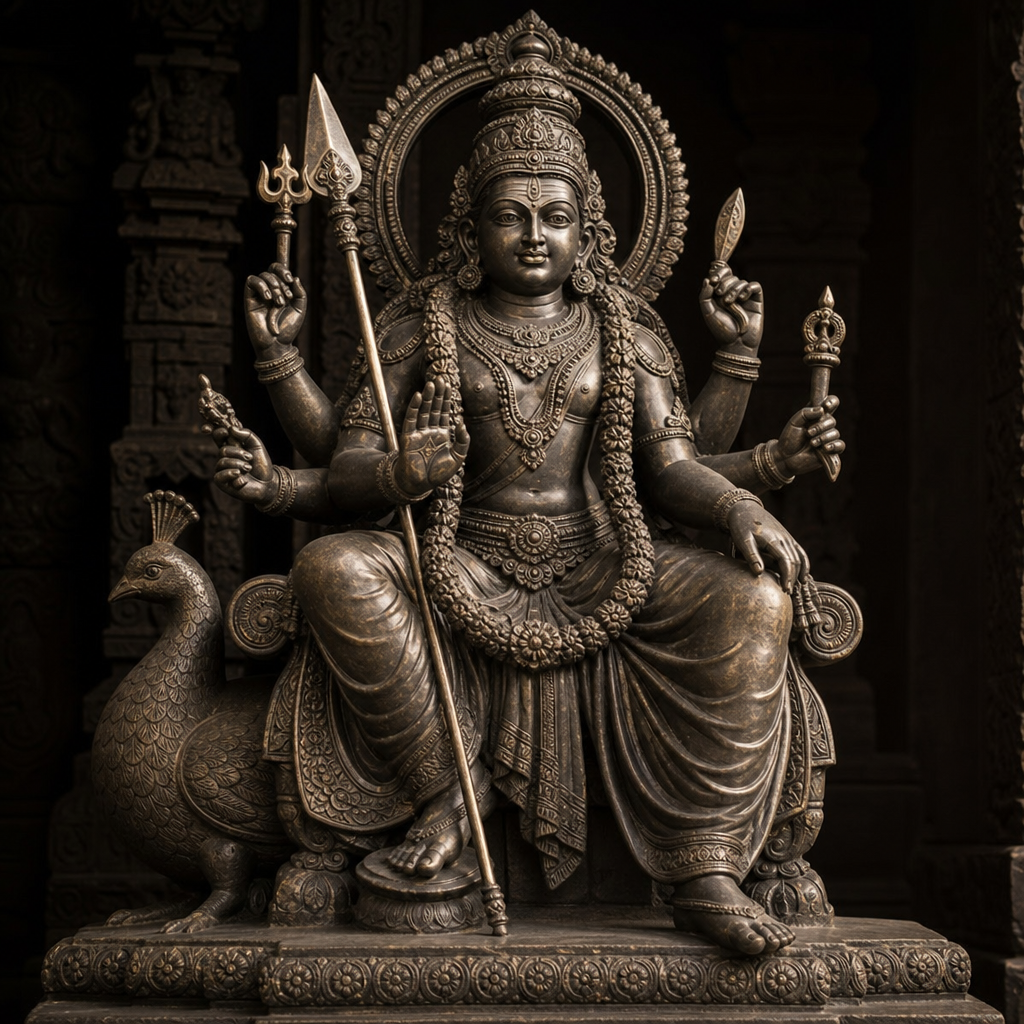
A genuine understanding of Tamil Hindu god art requires reading every element of a Murugan statue as intentional content. Nothing is purely decorative. The position of hands (mudras), the number of arms, the mount, the consorts, and even the posture (standing, seated, or dancing) communicate specific theological propositions.
Number of Arms and Their Attributes
The simplest and most common South Indian Murugan form shows two arms, one holding the Vel and one raised in the Abhaya mudra (gesture of protection and reassurance). More elaborate forms show four or six arms, carrying combinations of the Vel, a bow, arrows, a sword, a rooster banner, and a noose. The six-armed form directly references his name Shanmukha and is associated with temple processional sculpture in Tamil Nadu.
Consorts: Valli and Devasena
In Tamil tradition, Murugan has two consorts: Valli, a hunter girl representing the individual human soul seeking union with the divine, and Devasena (also called Devayanai), the daughter of Indra representing the cosmic order. Their presence flanking Murugan in a three-figure composition (tirumurthi arrangement) is a specifically South Indian iconographic formula not found in northern Kartikeya sculpture.
Collectors building a home altar should know that a Murugan statue flanked by both consorts represents completeness: the union of human aspiration (Valli) and divine law (Devasena) with spiritual grace (Murugan). A lone standing figure with the Vel is more appropriate for a meditation or contemplative setting.
"The Vel is not a weapon that destroys. It is a force that reveals. What it pierces is not flesh but the veil of illusion that separates the soul from the divine." - T.N. Ramachandran, Tamil Shaiva Siddhanta scholar, in his analysis of Tirumurugatruppadai
Murugan vs. Kartikeya: Same God, Different Traditions
The distinction between Murugan and Kartikeya matters practically when you are acquiring a Lord Kartikeya sculpture and want it to be doctrinally coherent with the tradition you are honoring. These are not interchangeable aesthetic variants. They are two distinct iconographic programs rooted in different textual traditions.
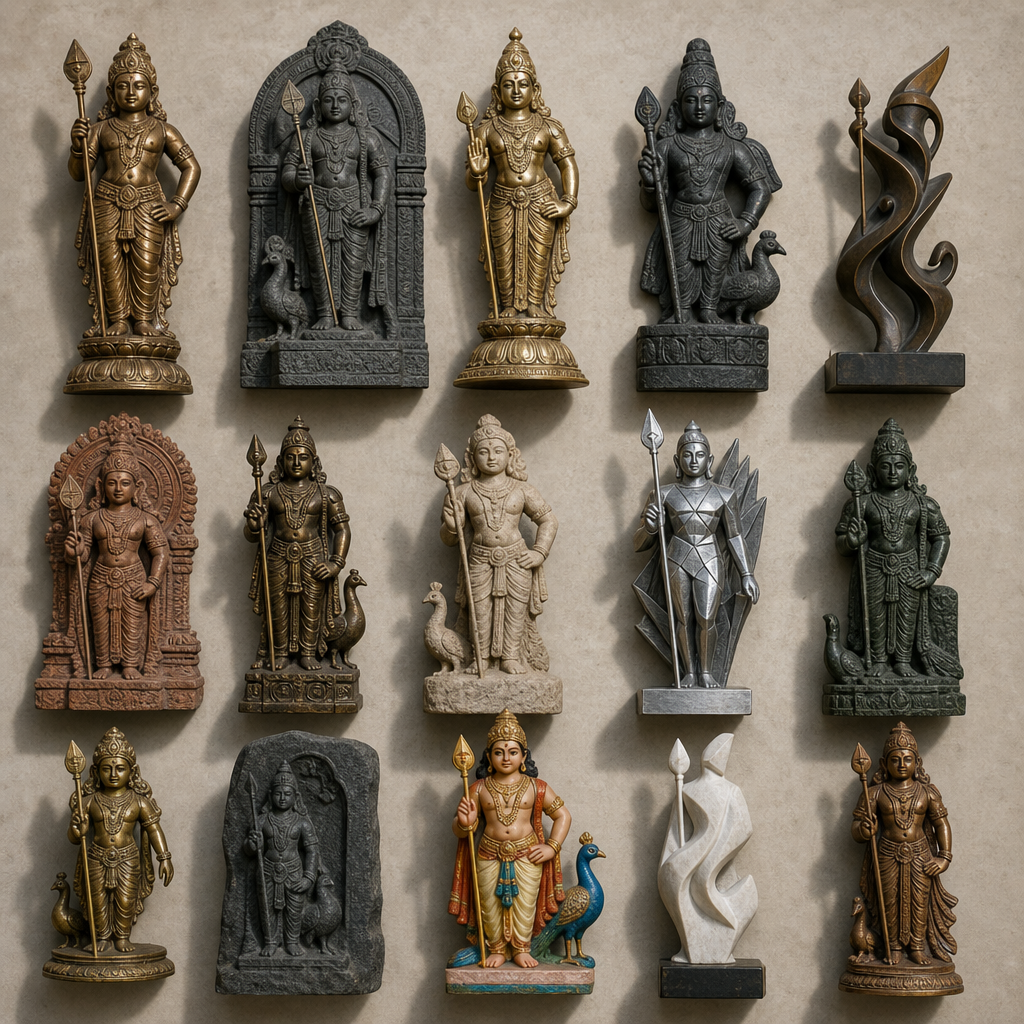
Murugan iconography draws primarily from Tamil Sangam literature, the Paripadal, the Tirumurugatruppadai, and the Shaiva Siddhanta philosophical tradition. Kartikeya iconography draws from the Skanda Purana, the Mahabharata, and northern Shaiva traditions. The northern Kartikeya is primarily a war god, a general of the divine army. The Tamil Murugan is primarily a god of spiritual youth, love, and the piercing of ignorance.
A common mistake among collectors is purchasing a North Indian Kartikeya sculpture in a martial posture and placing it on a Tamil-tradition altar, or vice versa. The theological dissonance is real even if the aesthetic result is pleasing.
Choosing a Murugan Statue for Your Collection or Altar
The choice of material is not merely aesthetic. In South Indian temple practice, bronze and panchaloha (an alloy of gold, silver, copper, iron, and lead or zinc) are the traditional materials for ritually active images. Stone sculpture was used for fixed temple installation, not for home altars. Resin and polyresin pieces are modern reproductions suitable for display but carry no traditional ritual status.
What Museum-Quality Actually Means for Murugan Statues
The term museum-quality is overused in the art market. For a Murugan statue, it should specifically mean: iconographic accuracy to a recognized classical tradition, casting quality that resolves fine detail (facial features, finger positions, fabric folds), and surface treatment that reflects appropriate patination or lacquering for the period style being referenced.
HD Asian Art sources sculptures across South and Southeast Asia, and the regional variation in Murugan representations is significant. A Southeast Asian Murugan from a Sri Lankan tradition will differ from a Tamil Nadu-influenced piece, and both differ from the northern Kartikeya bronzes of Rajasthan or Himachal Pradesh. Knowing which tradition you are buying into protects your collection's coherence.
Scale and Placement Considerations
For a home altar, figures between 15 cm and 45 cm height are standard in traditional South Indian practice. Larger processional-scale figures (above 60 cm) are associated with temple use and can overwhelm a domestic space. The Vel on any properly proportioned statue should be no less than two-thirds the height of the figure itself; shorter versions are modern compromises driven by production cost, not iconographic intent.
Pro tip: If you are building a multi-figure altar incorporating Murugan alongside Shiva or Ganesha, place Murugan to the left of Shiva (viewer's right) in accordance with the Agamic canon. Reversing this arrangement is a common error even among experienced practitioners.
Regional Tamil Hindu God Art Traditions and What They Tell You
Tamil Hindu god art is not a monolithic tradition. The major regional schools produce statues that are visually and theologically distinct, and a collector who can read those distinctions is positioned to build a far more coherent and valuable collection.
The Chola school of Tamil Nadu (9th to 13th centuries CE) is the gold standard for Murugan bronze casting. Chola bronzes are characterized by fluid contrapposto postures, extremely fine surface modeling of textiles and jewelry, and a physiognomic ideal of serene, youthful beauty. The Vel in Chola Murugan bronzes is always proportioned with precision.
The Vijayanagara school (14th to 16th centuries CE) moved toward more frontal, hieratic postures with heavier jewelry and more complex multi-arm configurations. This school produced many of the large temple bronzes still in active worship across Karnataka and Andhra Pradesh today.
Sri Lankan Murugan sculpture reflects both South Indian Chola influence and local aesthetic preferences, particularly a tendency toward simpler jewelry and a slightly more elongated figure canon. Collectors interested in cross-cultural comparison find Sri Lankan pieces particularly interesting because the iconographic core is Tamil while the execution reflects island workshop traditions.
Comparing Murugan Statue Types by Origin and Style
|
Tradition |
Key Visual Characteristics |
Best Suited For |
|---|---|---|
|
South Indian Chola Bronze (Tamil Nadu) |
Fluid contrapposto stance, finely modeled jewelry and textiles, proportionate Vel, serene facial expression, panchaloha or bronze casting |
Serious collectors, Tamil Shaiva Siddhanta practitioners, museum-quality altar centerpieces |
|
North Indian Kartikeya (Rajasthan, Himachal Pradesh) |
More martial posture, peacock or ram mount (regional variation), northern ornamental style, fewer devotional consorts, Skanda Purana iconographic program |
Collectors focused on northern Hindu art traditions, comparative iconography study, devotees of the Skanda Purana tradition |
|
Sri Lankan Murugan Sculpture |
Chola-influenced figure canon, simpler jewelry treatment, elongated proportions, island workshop patination style, often paired with both consorts |
Home altar use in diaspora Tamil communities, collectors seeking Southeast Asian regional variation, practitioners combining Tamil and Sri Lankan devotional traditions |
Frequently Asked Questions
What does the Vel spear represent in a Murugan statue?
The Vel represents jnana shakti, the power of divine knowledge that pierces ignorance and ego. In Tamil Shaiva Siddhanta theology, it is the weapon given by Parvati to Murugan specifically to transform the demon Soorapadman, who symbolizes the ego-bound soul. The Vel does not destroy; it transforms.
What is the difference between a Murugan statue and a Lord Kartikeya sculpture?
They depict the same deity but from different regional and textual traditions. Tamil Murugan iconography is rooted in Sangam literature and Shaiva Siddhanta philosophy, emphasizing spiritual youth and the conquest of ignorance. North Indian Kartikeya iconography comes from the Skanda Purana and emphasizes the deity's role as a military commander of the divine army. Iconographic details including posture, mount, consorts, and the presence of the Vel differ significantly between the two traditions.
Why does Murugan stand on a peacock in most statues?
The peacock in Tamil Murugan iconography is the transformed body of the demon Soorapadman, whom Murugan defeated with the Vel. The peacock does not represent mere beauty or vanity. It represents the ego and pride that Murugan has subdued and transformed into a vehicle of grace. Murugan standing on or riding the peacock communicates his mastery over these forces.
How do I know if a Murugan statue is iconographically accurate to the classical Tamil tradition?
Check four things: whether the Vel is proportionately sized (at least two-thirds the height of the figure), whether the posture is a natural contrapposto or standing tribhanga rather than a rigid frontal pose, whether the peacock is present at the base or as a mount, and whether the facial expression reflects the canonical ideal of serene youth rather than fierce warrior affect. Chola bronze standards from Tamil Nadu are the reference point for the classical tradition.
Is bronze the only appropriate material for a Murugan statue on a home altar?
Bronze and panchaloha (five-metal alloy) are the traditional materials in South Indian Agamic practice for ritually active images, meaning images that can be consecrated and used in active worship. Stone was used for fixed temple installation. Resin and polyresin are modern materials appropriate for display and contemplative use but are not traditionally considered eligible for consecration in South Indian ritual practice. If your use is devotional rather than purely aesthetic, material selection carries doctrinal weight.
What is the significance of Murugan's six faces in some statues?
The six-faced form, known as Shanmukha, represents Murugan's omniscience and his capacity to perceive all six directions simultaneously, including the four cardinal points plus zenith and nadir. Each face is also associated with one of his six divine mothers (the Krittika nymphs who raised him) and with one of the six Shaiva Siddhanta principles of creation. Shanmukha sculptures are most common in temple contexts and in devotional images intended for worship by the Saiva community.
If you have spent time with a Murugan statue on your altar or in your collection and noticed details in the iconography that surprised you, share what you found in the comments below.
We would love your feedback and any insights you would share with others. What perspective would you add?
