



How to Identify a Sukhothai Buddha: Flame Ushnisha, Graceful Form and Walking Buddha
How to Identify a Sukhothai Buddha: Flame Ushnisha, Graceful Form and Walking Buddha
You're standing at a viewing table or scrolling through auction photos, and one bronze catches your eye because it feels unusually light, elegant, and alive. The question is simple, but the answer isn't, because a Sukhothai Buddha is rarely identified by one trait alone. You have to read the body, the head, and the pose together, the way a curator does when a piece sits under neutral light and every small line matters.
A good attribution starts with the three textbook markers, flame ushnisha, graceful form, and walking Buddha. Each one can mislead on its own, but together they create a profile that is much harder to fake. That is why careful collectors compare a candidate figure against museum holdings and documented sales, rather than trusting a dealer's shorthand.
Table of Contents
- Why These Three Features Define a Sukhothai Buddha
- Recognising the Walking Pose and Reassurance Gesture
- Reading the Flame Ushnisha and Cranial Finial
- The Graceful Form Behind the Style
- Where Sukhothai Features Can Fool You
- A Practical Identification Workflow You Can Use Today
- Benchmarking Against UK Museum and Auction Records
Why These Three Features Define a Sukhothai Buddha
A collector often notices one feature first. Maybe it is the flame rising from the crown, maybe the body's soft sway, or maybe the fact that the Buddha is walking rather than seated. The mistake is to stop there, because Sukhothai sculpture works as a complete visual language, not as a checklist of isolated clues.
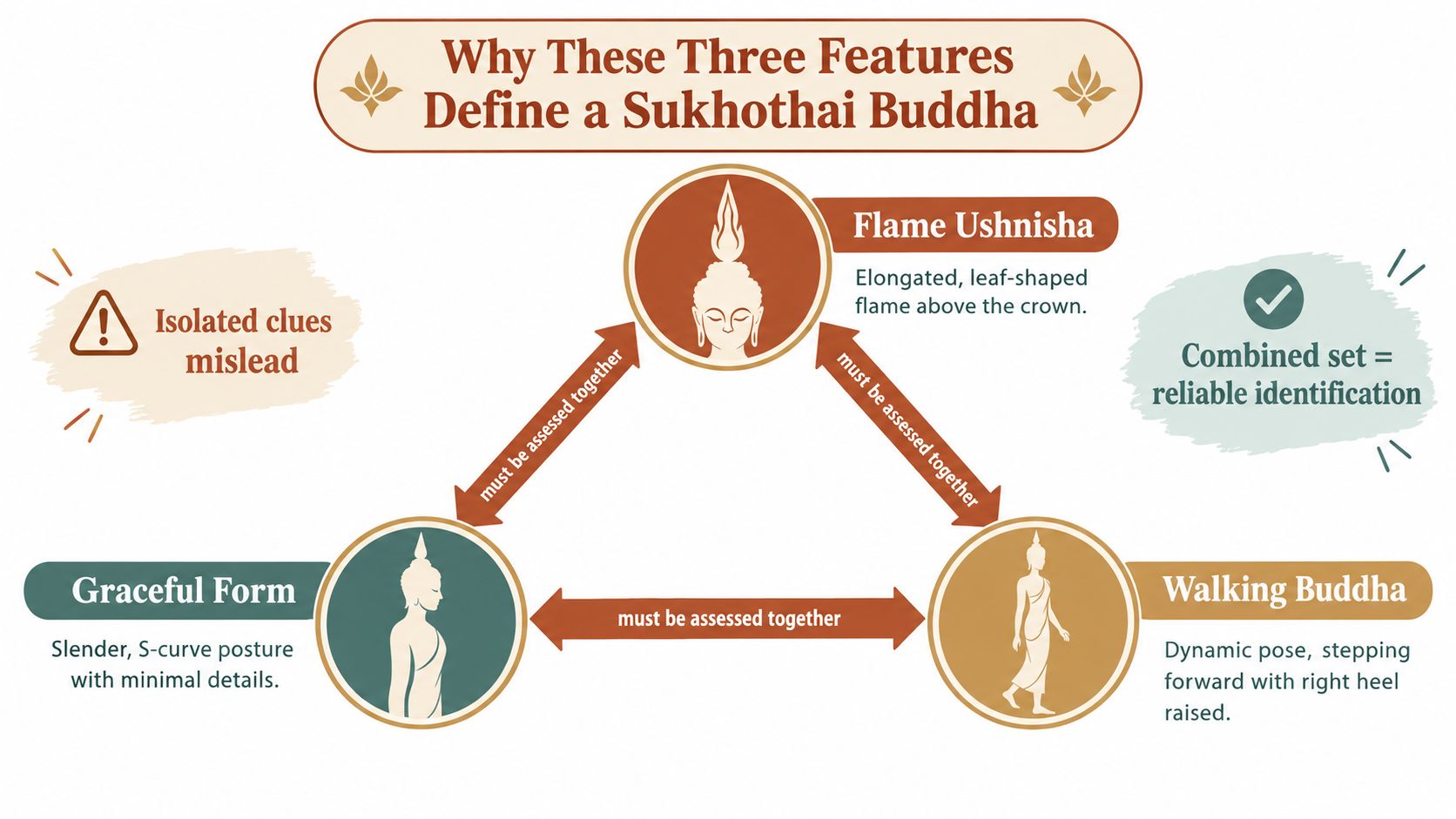
The style became one of the canonical Thai Buddha traditions in the 14th century, and it is defined by sinuous curves, cylindrical forms, and an unusually weightless body language. That combination is why Sukhothai images read differently from heavier regional traditions. The figure feels idealised rather than anatomically forceful, and that idealisation is a major part of its identity. A concise overview of Thai Buddha styles helps place those visual cues in a broader Thai context.
Practical rule: if the flame crown, the body's elegance, and the walking stance do not reinforce one another, you should hesitate before calling the piece Sukhothai.
The three markers as a single system
The flame ushnisha points to spiritual radiance, but it doesn't fix the style by itself. Graceful form narrows the field further, yet later Thai schools can also borrow elegance. The walking pose is the strongest behavioural clue, because it is a distinctly developed Sukhothai image type, but even that can be copied in later workshops.
What matters is the convergence. A true Sukhothai body is usually refined in every part of the composition, with soft modelling, balanced movement, and an overall calm that feels internally consistent. When those qualities appear together, the identification becomes much more credible than any single ornament or gesture.
Recognising the Walking Pose and Reassurance Gesture
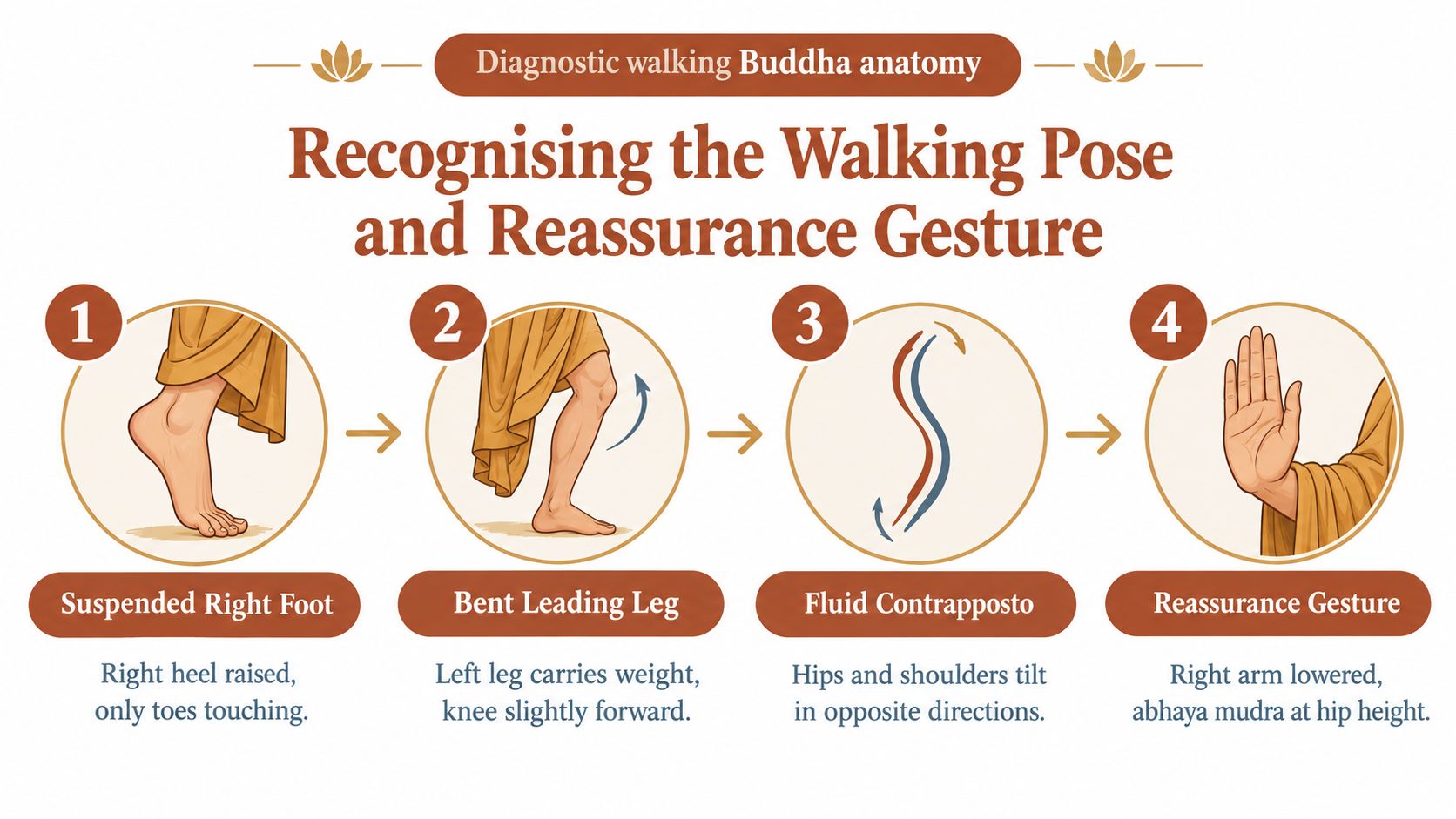
The walking Buddha is the easiest place to start because the pose is so distinctive. Look for a lifted foot, a steady forward step, and a body that doesn't strain to move. The movement should look poised, not marching, and the hips and shoulders should tilt in a controlled, fluid way.
Reading the stance in order
Start at the feet. The lifted foot should feel suspended, with the raised heel giving the body a sense of motion that hasn't broken its calm. Then check which leg bears the weight, because the leading leg should support the figure without stiffness. Finally, look at the torso and hips together, since the Sukhothai walking form depends on a gentle counterbalance rather than a rigid straight line.
The right arm is the next key point. In the classic walking type, it is lowered in abhaya mudra, the reassurance gesture, usually carried at hip height. That arm position is not decorative. It helps define the mood of the figure, which is one of composed confidence rather than heroic stride. The linked internal guide on the Sukhothai walking Buddha is useful here, because it places the pose within its Thai art-historical setting.
The pose should feel like the Buddha is moving with purpose, not striding in the manner of a human figure.
What not to misread
A standing Buddha with one elegant trait is not automatically a walking Buddha. A seated image with a soft face and flame crown is still seated, and classification should not be forced. Collectors often over-read gesture because it is visually dramatic, but pose only counts when the body expresses forward motion.
Elongated earlobes, slim limbs, and draped folds often support the reading, yet they're secondary to the stepping body and lowered reassuring hand. If those elements appear without the walking posture, treat them as style markers, not as proof of the type. The walking Buddha is a complete iconographic decision, not just a lively pose.
Reading the Flame Ushnisha and Cranial Finial
A collector may first notice the flame above the head, especially in a dealer photograph, and assume the attribution is settled. Treat that feature as an opening clue instead. A flame-shaped ushnisha is strongly associated with Sukhothai sculpture, but related Thai traditions, as well as later Burmese and Lao workshops, adopted similar forms. Examine its construction, scale, and relationship to the head before reaching a conclusion.
What the flame should look like
Sukhothai examples commonly present a flame-shaped projection rising cleanly from the cranial protuberance. The finial should appear tall, tapering, and visually light, with a controlled profile rather than a swollen or heavily ornamented crown. The Metropolitan Museum's Heilbrunn Timeline describes the Sukhothai finial as a flame-shaped projection rising from the cranial protuberance, a useful institutional benchmark when a catalogue description offers only the word “flame.”
Proportion matters. The finial should rise with clarity and restraint, like a narrow flame held steady above a lamp. A crowded, thick, or highly baroque crown may indicate another Thai tradition or a later reinterpretation. For how the ushnisha functions across Buddha traditions, see the role of the ushnisha in Buddha statues. This explanation of the flame ushnisha also helps clarify why the feature carries symbolic meaning rather than serving as surface decoration alone.
The surrounding cranial markers
Read the flame together with the rest of the head. Hair whorls should appear tight and orderly, while the face remains serene and the earlobes elongated. The forehead, brow line, cranial rise, and finial should form one coherent design. A convincing flame attached to an incompatible facial type is only a partial match.
| Tradition | Finial Shape | Hair Whorl | Proportion |
|---|---|---|---|
| Sukhothai | Tall, tapering flame | Tight, orderly, refined | Slender and balanced |
| Related Thai traditions | Flame may be thicker or more ornate | Can be less restrained | Often heavier overall |
Use the table as a comparison aid, not a checklist that overrides the sculpture. A flame alone cannot establish authenticity or period. Compare the head with the body and robe, then check the result against documented museum holdings and UK auction records rather than relying on a seller's label.
The Graceful Form Behind the Style
Sukhothai grace is easiest to recognise when you compare it with heavier Thai and Khmer-derived figures. The body should feel slender, poised, and softly idealised, not muscular or block-like. The point is harmony, not realism.
Proportion over decoration
The torso often sways in a subtle S-curve, while the shoulders stay narrow enough to keep the silhouette elegant. In heavier traditions, the upper body can feel more columnar, with a denser visual weight across the chest and shoulders. Sukhothai sculpture does the opposite. It lightens the form, then lets the robe and limbs carry the rhythm.
The face usually supports that reading. Look for a lean, elongated face, downcast eyes, arched brows, and a quiet mouth that seems to hold a soft smile. Those elements create the serene Sukhothai expression described in scholarly discussions of the style, and they are not the same as a generic “peaceful” Buddha face. A study of Sukhothai image character is useful because it treats the facial shape as a stylistic marker, not a decorative preference.
Candid note: if the face looks calm but the body feels heavy, don't force the attribution.
Robe and silhouette
The robe matters because Sukhothai artists often used it almost like a second skin. In many cases, the drapery is thin and controlled, with a hem that can flare into a fish-tail-like fold. That asymmetry helps the body feel alive without becoming theatrical. Heavy or opaque folds usually point you away from the classical Sukhothai reading.
| Proportional Cue | Sukhothai Convention | Heavier Thai Tradition |
|---|---|---|
| Torso | Slender and swayed | Broader and more columnar |
| Face | Lean, elongated, serene | Fuller or more forceful |
| Drapery | Thin, fluid, clinging | Denser, heavier folds |
Read the form as a whole. If the silhouette, robe, and face all agree, the piece is moving in the right direction. If one area feels out of step, pause before settling on a label.
Where Sukhothai Features Can Fool You
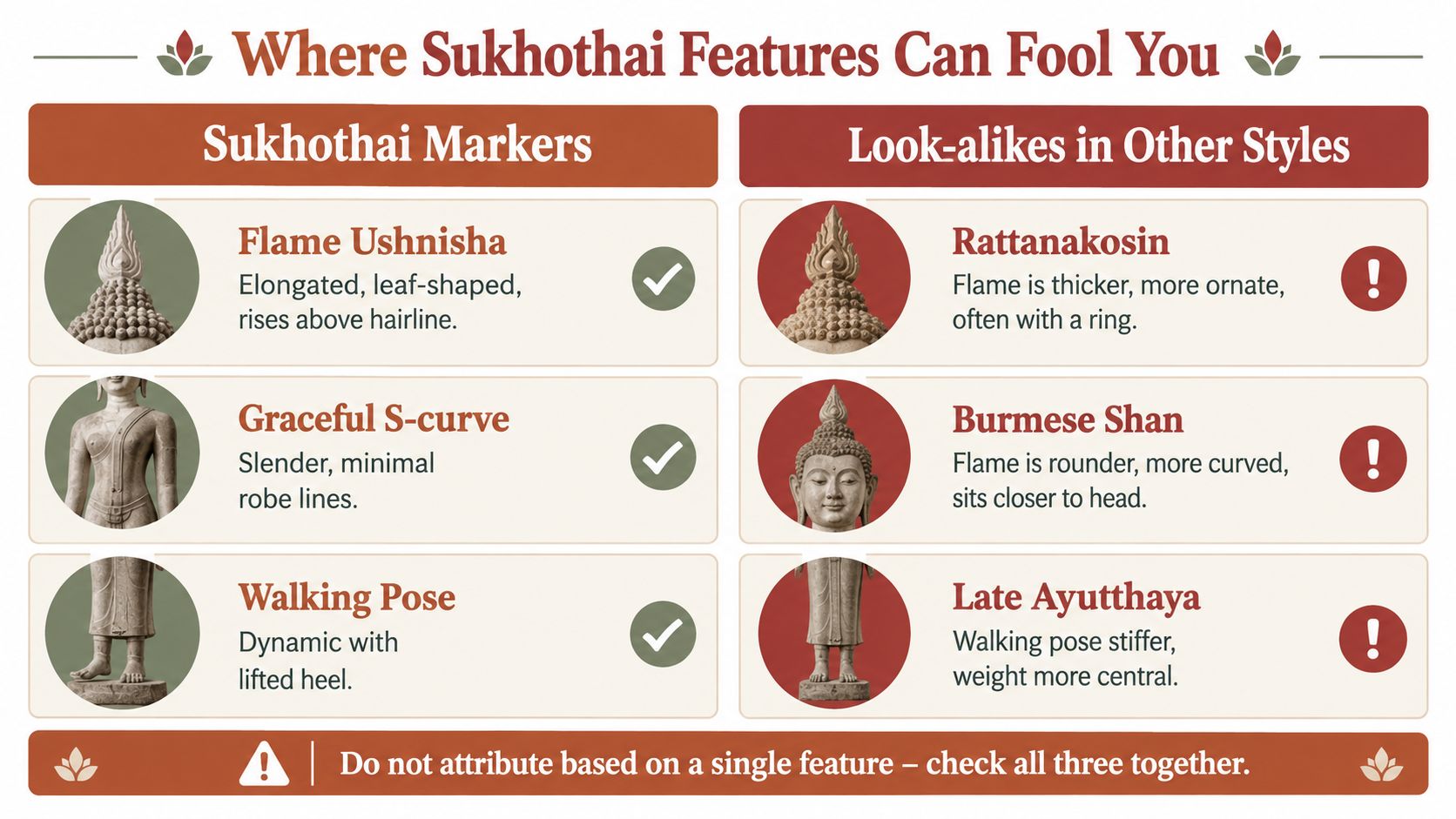
The hardest part of attribution is accepting that Sukhothai traits travel. Later makers across Southeast Asia admired the style and reused parts of its visual vocabulary. That means a correct-looking flame crown or a graceful face can still belong to a different tradition.
Common look-alikes
A flame ushnisha appears in later Rattanakosin and Burmese Shan bronzes, and even in some Sinhalese-derived works. The walking pose is also copied elsewhere, especially in Burmese Mandalay production, where raised-foot walking Buddhas remain a familiar type. Graceful oval faces are not unique either, because later Ayutthaya sculpture can share that serene expression, and later Lanna works may also take on a fish-tail robe hem.
That is why single-trait attribution fails. A flame crown does not equal Sukhothai. A soft face does not equal Sukhothai. A lifted foot does not equal Sukhothai. The style only becomes convincing when all three markers, flame ushnisha, walking pose, and graceful proportional harmony, sit together on one body and the casting, wear, and patina make sense for the period.
Why surface history matters
A later bronze may mimic the pose but not the ageing. A modern reproduction may echo the silhouette but miss the casting character. Even when the iconography is close, the surface often tells a different story. Look for consistency in wear, metal tone, and the way details settle into the base and folds.
Do not attribute based on a single feature. Check all three together, then compare the surface history with known examples.
The safest interpretation is often the least dramatic one. If a figure borrows Sukhothai language but doesn't carry the full structure, call it related, inspired, or later, rather than forcing a period attribution.
A Practical Identification Workflow You Can Use Today
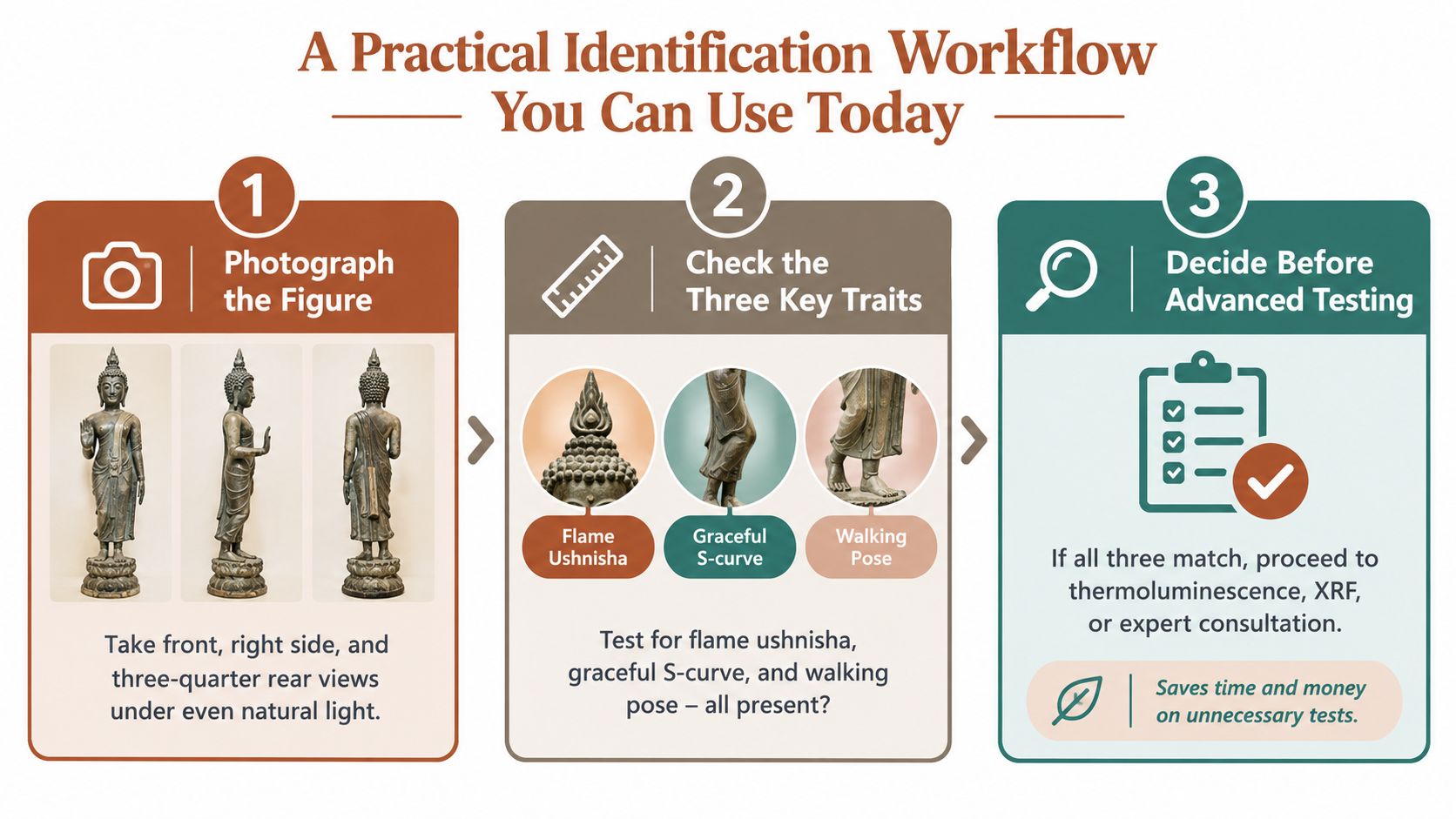
Start with documentation, not intuition. Good photos solve more problems than memory does, especially when you're comparing a candidate bronze against museum records or old sale images. Neutral daylight, a plain background, and multiple angles will show whether the figure really holds together as a Sukhothai piece.
Three checks before you spend money
First, photograph the figure from the front, right side, and three-quarter rear. That gives you a readable outline of the finial, shoulders, and stepping leg. Then zoom in on the crown and ask whether the flame is smooth and balanced, or whether it looks tacked on as an ornament.
Second, compare the body against a simple visual grid. You're looking at head-to-body proportion, torso sway, shoulder width, and the position of the right arm in abhaya mudra. A Sukhothai candidate should look internally coherent, with the robe, step, and face all answering the same stylistic logic.
Third, only after those checks should you think about advanced testing. If the piece still looks persuasive, then thermoluminescence, XRF, or a specialist opinion can be worth the cost. If the visual evidence is weak, testing won't rescue the attribution.
| Step | What to Check | What It Tells You |
|---|---|---|
| Photograph | Front, side, rear angles | Overall structure and balance |
| Compare | Flame, form, walking pose | Whether the three markers agree |
| Decide | Material analysis or expert review | Whether the object justifies deeper scrutiny |
A practical workflow like this saves time and money because it stops you from paying for science before the eye test is even complete. It also helps you keep your notes tidy, which matters when you later ask questions about provenance or casting history.
Benchmarking Against UK Museum and Auction Records
A collector examining a possible Sukhothai Buddha can test a dealer's attribution against British museum catalogues and UK sale records. These references are useful because they show how comparable objects were described, photographed, measured, and assessed over time. Treat the three visual markers as a set: the flame ushnisha, the elongated graceful body, and, where present, the walking pose with the abhaya mudra.
| Source | Type | Notable Sukhothai Holdings | How to Access |
|---|---|---|---|
| British Museum | Museum collection | Thai and related Buddha figures for stylistic comparison | Search the online collection catalogue |
| Victoria and Albert Museum | Museum collection | Southeast Asian holdings, including a Buddha head purchased in 1927 from E.G. Sebastian | Review the V&A collection record and object notes |
| Royal Asiatic Society | Institutional holdings | Comparative Southeast Asian material | Check catalogue references and study access where available |
The Victoria and Albert Museum's documented purchase provides a useful example of the paper trail collectors should seek. A dated acquisition and named previous owner do not establish a sculpture's authenticity by themselves, but they make the object's history testable. Compare that record with the object in front of you. Does its head shape, finial, drapery, or casting method support the same broad attribution?
Auction catalogues supply a different kind of benchmark. Firms such as Bonhams, Christie's, Roseberys, Sworders, Dreweatts, and Lyon & Turnbull have published descriptions, condition notes, and images for Southeast Asian bronzes. Read those entries as market records rather than final authorities. A catalogue may call a figure “Sukhothai style” without claiming that it is an early Thai-period work. That distinction matters, especially when a graceful silhouette and flame finial have been copied in later sculpture.
How to use the benchmarks properly
Request a condition report where one is available. Compare base treatment, casting seams, surface wear, and patination with published examples. Place your photographs beside catalogue images and check the silhouette first. The shoulders, torso, stepping leg, robe edge, and hand position should form one coherent design. Then inspect the flame ushnisha. A finial that appears separately attached, unusually heavy, or stylistically unrelated to the head deserves closer scrutiny.
Record inscriptions under raking light so that lettering, abrasions, and changes in the surface remain visible for later review. Keep the catalogue reference, photographs, and your observations together. This creates a working file that can be shown to a conservator or specialist.
Best practice: give more weight to objects with documented handling histories than to descriptions that merely sound convincing.
Sworders and comparable UK auction houses have catalogued Thai bronzes described as Sukhothai style in recent years. Such records demonstrate that Sukhothai-related forms continue to appear in the British market, while also showing how carefully wording must be read. Cross-comparison can test your attribution and limit wishful identification, but it cannot prove authenticity alone.
HD Asian Art offers collector-oriented material on Thai iconography and identification. Use it alongside museum catalogues and auction records, rather than treating any single guide or dealer description as conclusive.
| Benchmark | Source Type | What to Compare | Practical Use |
|---|---|---|---|
| Museum catalogue records | Institutional reference | Pose, finial, drapery, proportions | Style matching |
| Auction catalogues | Market reference | Descriptions, condition, sale images | Market triangulation |
| Published object plates | Visual reference | Silhouette and surface detail | Side-by-side comparison |
