



Ganesh and Lakshmi: Symbols, Rituals and Gift Guidance
Ganesh and Lakshmi: Symbols, Rituals and Gift Guidance
If a paired statue of Ganesh and Lakshmi is only a charm for money and luck, why do families treat the two figures so differently from one night to the next? Shop copy often sells them as one prosperity object. Household practice does not work that way. A statue is devotional when it is worshipped, cultural when it marks a festival or a family story, and decorative when it is kept as art. The same casting can move between those uses. What changes is the occasion, the care, and whether anyone offers prayer.
Ganesh, also called Ganesha, is the deity people call on to clear a path and bless a beginning. Lakshmi is worshipped for wealth, prosperity and good fortune. They are most often honoured together at Diwali. They are not one figure with two names.
Table of Contents
- Ganesh and Lakshmi at a Glance
- Reading Ganesh and Lakshmi Iconography
- Why Ganesh and Lakshmi Share the Diwali Night
- How to Place Your Pair in a Small Home
- Choosing a Ganesh and Lakshmi Statue as a Gift
- Caring for, Repairing and Retiring Your Statue
Ganesh and Lakshmi at a Glance
Ganesh is invoked to remove obstacles and to bless new beginnings. Lakshmi is worshipped for wealth, prosperity and good fortune. UK educational guidance on the RE:ONLINE Hindu traditions page treats the two as distinct but complementary. Ganesh is described there as the remover of obstacles and a bringer of good fortune, commonly shown with an elephant head and a human body. Lakshmi is identified as the goddess of wealth and prosperity. The same guidance notes that puja, Hindu worship, may take place daily at home, and that UK mandirs commonly hold several shrines for different deities. A paired arrangement is therefore a choice of household or festival, not a universal requirement and not a single deity.
Families call on Ganesh before a wedding, a move, a business launch or a long journey because his role is dual. He can place obstacles as well as remove them. You ask him to clear what blocks a good start, and you also ask him not to let a reckless one through. Lakshmi's invitation is different. People turn to her when the question is abundance: a ledger, a harvest of effort, the means to look after a household. Our own reading of the figures follows that split. We suggest a meditation Buddha for a calm room or altar, Ganesha for new beginnings and wisdom, Shiva for transformation, Vishnu for protection, and Lakshmi for abundance.
| Aspect | Ganesh (Ganesha) | Lakshmi |
|---|---|---|
| Core association | Remover of obstacles, auspicious beginnings, wisdom | Wealth, prosperity, good fortune |
| Typical invocation | Before new ventures, weddings, journeys and new homes | Diwali worship and requests for abundance |
| Main festival link | Ganesh Chaturthi, a festival dedicated to him | Diwali, especially the Lakshmi Puja |
| Common offerings | Modak sweets and durva grass | Lotus flowers, lamps and sweets |
| Place in worship | Often invoked first in a puja sequence | Usually worshipped beside Ganesh at Diwali, with arrangements set by the family |
Practical rule: Choose the figure, or the pair, by the event you are marking, not by a slogan on the box.
The table cannot settle priority on its own. A new shop points toward Ganesh. A prosperity blessing points toward Lakshmi, and toward the pair when the household keeps Diwali that way. Later sections cover how to identify each image, which night they share, how a small home can hold them, and how to buy without confusing a gift with a consecrated temple image. For Lakshmi's wider imagery of plenty, see Lakshmi, goddess of prosperity and abundance.
Reading Ganesh and Lakshmi Iconography
A dealer's listing that reads only "seated deity, bronze" tells you almost nothing. Before you place or give a figure, you need to tell Ganesh from Lakshmi and to read what each feature means. Museum reading treats Ganesha's image as a layered set of human, animal and ritual signs, not a portrait that stops at the elephant head.
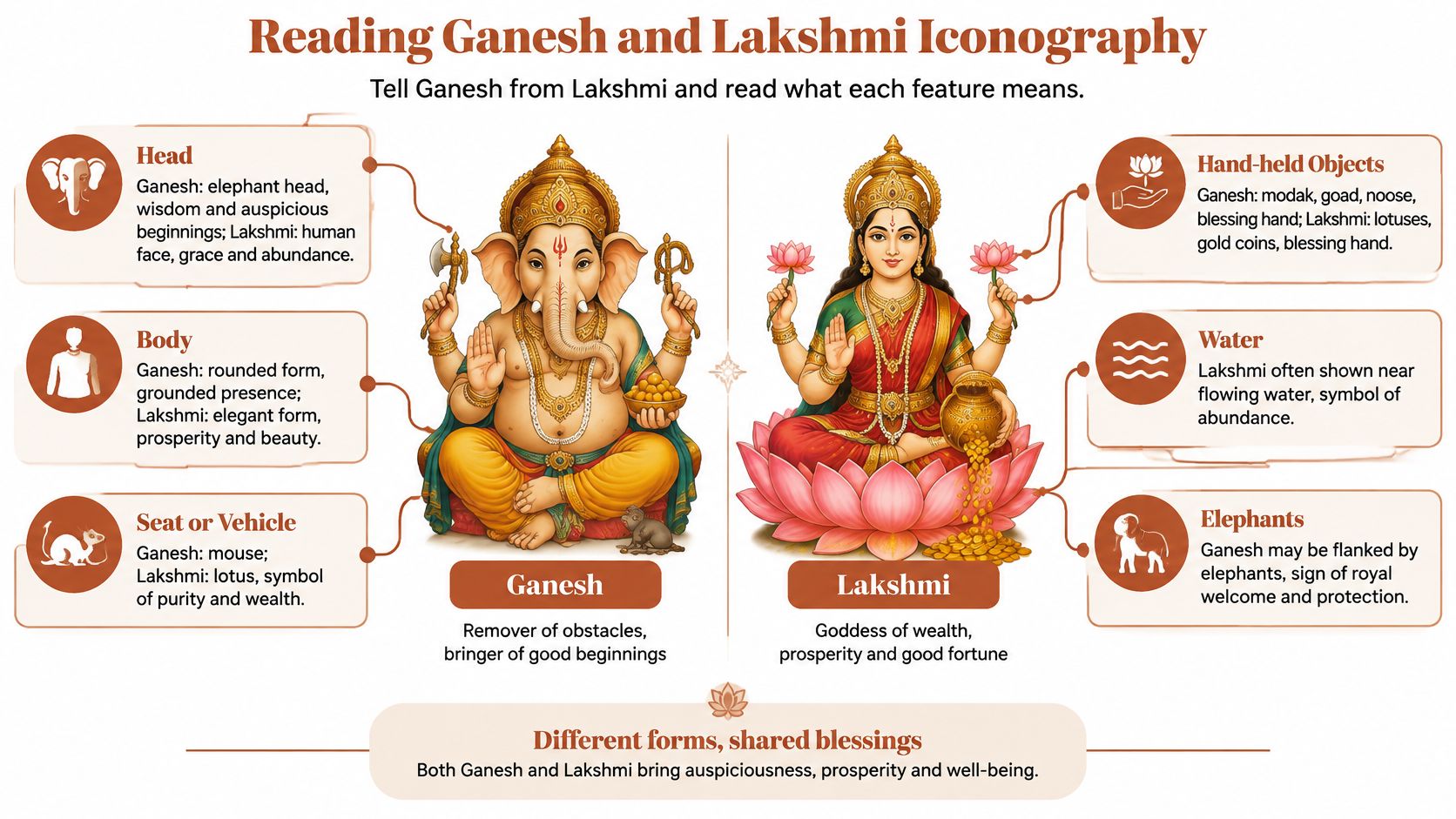
The British Museum large-print guide identifies the elephant head and rounded belly as attributes of the Hindu god of new beginnings. The snake around his body links the image to earlier Indian nature-spirit traditions. A catalogue that only says "Ganesha" is thin. Record the head, pot belly, serpent, posture, hand-held objects, gesture, and any vehicle or attendants. Those details separate regional and chronological forms, and they mark the difference between a careful description and a guess.
| Feature | Ganesh | Lakshmi | What it signals |
|---|---|---|---|
| Head | Elephant head | Human face, serene and composed | Wisdom and discernment for Ganesh; grace for Lakshmi |
| Body | Human body with rounded belly | Slender seated or standing female form | Contentment and capacity to take in good and bad |
| Vehicle or seat | Mouse (mushika) | Lotus seat; owl in some traditions | Mouse signals desire brought under control; lotus signals purity and growth |
| Hand-held objects | Broken tusk, modak sweet, noose, goad | Lotus, purnaghata, coins or cornucopia-like vessel | Each object carries a specific meaning; record all of them |
| Water and elephants | Not typical | Gaja-Lakshmi, elephants pouring water over her | Monsoon rain and life-giving abundance |
| Serpent | Snake coiled around the body | Not typical | Link to earlier Indian nature-spirit traditions |
Water, elephants and a Kashmir sculpture
Lakshmi's programme is fertility, water and abundance. The diagnostic form is Gaja-Lakshmi, Elephant Lakshmi. The British Museum plain-English guide describes her seated on a lotus while elephants pour water over her. The elephants stand for monsoon clouds and for rain that keeps life going. A farm year makes the point plain: if the rain fails, the fields stay empty, however carefully they were sown. The poured water turns that dependence into an image you can read at a glance.
A separate Kashmir sculpture in the same museum adds a tighter checklist. Lakshmi holds a lotus and a purnaghata, a full-bellied abundance vessel. Her lion throne, diadem and cornucopia-like form show Indian, Gandharan, Roman and Sassanian visual habits meeting in one object. The museum also notes her association with prosperity and her later identification as Vishnu's consort, which pulls the image toward order and grace as well as plenty. For a closer reading of Ganesh's attributes, see the symbolic meanings of Ganesha's iconography.
A seated woman with a calm face is not automatically Lakshmi. You still need the lotus, the vessel, the coins or the elephants.
A three-step check in the shop
- Confirm Ganesh by the elephant head and the human body with the rounded belly.
- Confirm Lakshmi by the lotus, a water vessel, coins or elephants pouring water.
- Note chips, later replacements and missing attributes before you buy or display.
Posture shifts between Indian and Southeast Asian workshops, so treat the markers as a guide rather than a stencil, and write down what is original and what has been replaced.
The reading you have just done also settles what the object is to you. The same bronze can be devotional on a home altar where it receives offerings, cultural in a collection kept for its workmanship, or decorative in a hallway chosen for its form. The iconography is identical in all three. What changes is your use, so let that decide how you handle, house and give the figure.
Why Ganesh and Lakshmi Share the Diwali Night
They share a night because the ritual asks for two gifts at once: prosperity, and a start that is not blocked. That is Diwali, not every Tuesday of the year.
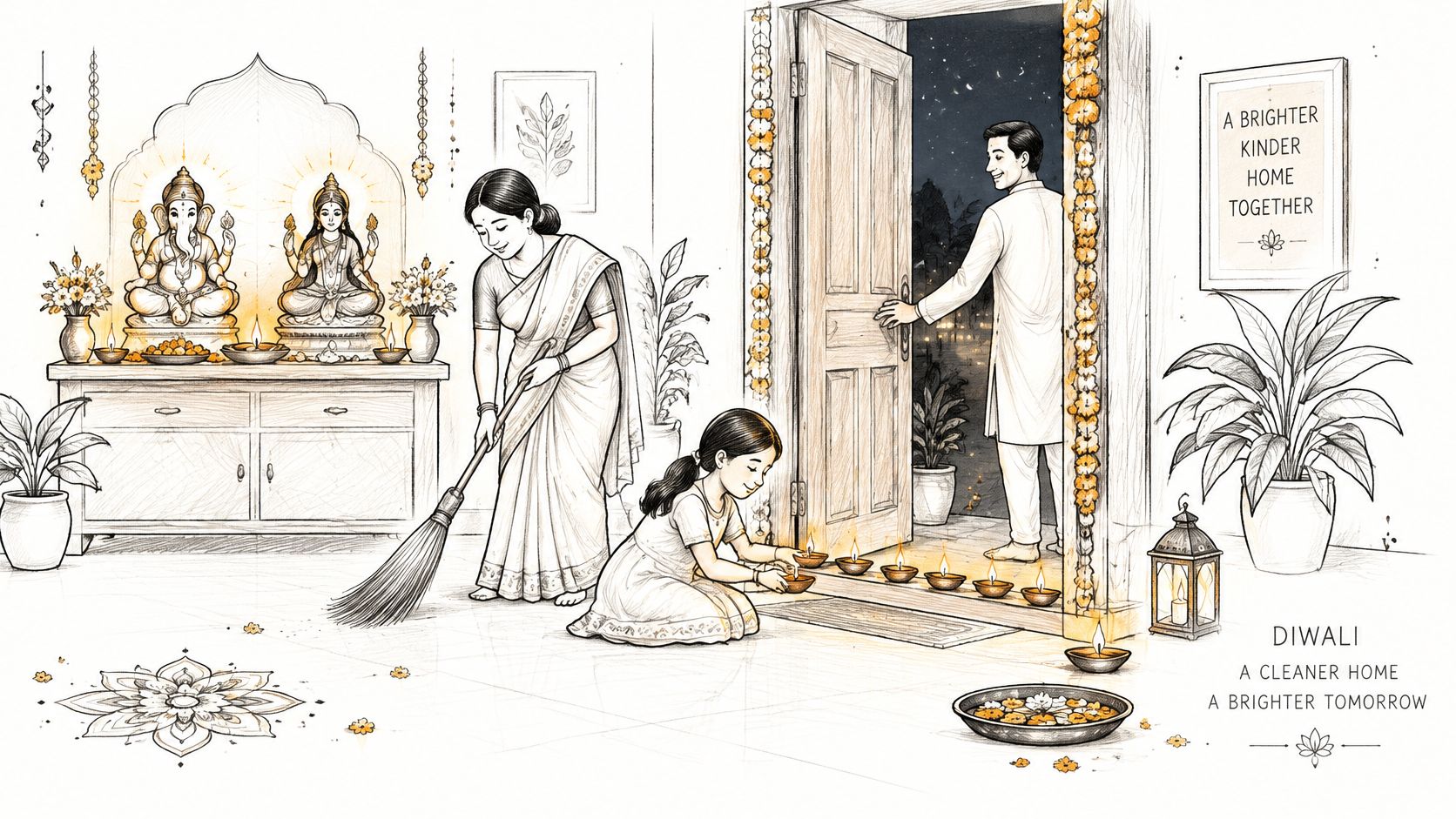
Say a family in Leicester has spent the afternoon sweeping, wiping the shelf and setting a clean cloth. At dusk someone lines small lamps along the threshold so the light faces outward, then inward. The evening opens with prayer. Wealth and a fresh beginning are invited in the same hour, which is why the figures stand together.
A University of Plymouth account of Diwali states that on the third day, the principal day in that account, the Lakshmi-Ganesha pair is worshipped. They are linked there with wealth and auspicious beginnings. The evening includes prayer to Lakshmi, Sarasvati and Ganesh, with lamps and fireworks. Lakshmi is invoked for prosperity. Ganesh is connected with auspicious beginnings and the removal of obstacles. Sarasvati brings learning into the same circle. The trio is common in some regions and not used in others.
| Occasion | Deity focus | Typical practice | Why it matters for the pair |
|---|---|---|---|
| Dhanteras, two days before Diwali | Lakshmi | Buying metal items, lighting lamps, prayers for prosperity | Shows Lakshmi's link to purchasing and new wealth |
| Diwali night, Lakshmi Puja | Lakshmi with Ganesh | Lamps, sweets, prayers to Lakshmi, Ganesh and Sarasvati | The main shared worship of the pair |
| Ganesh Chaturthi, usually August or September | Ganesh alone | Installing a clay image, modak offerings, immersion after a set number of days | Shows Ganesh has a festival of his own |
| Ordinary household puja | Household deities already honoured | Daily or occasional home worship, not a uniform rite | The pair is not a fixed requirement |
How the occasion changes the choice
A Diwali altar, or a gift meant for that night, points to the pair. A new business, a house move or another fresh start points to Ganesh on his own, especially around Ganesh Chaturthi, which is his festival rather than hers. A request for abundance points to Lakshmi, with Ganesh beside her only where that household already does so at Lakshmi Puja. Dhanteras, two days before the main night, is a useful contrast. People buy metalware and pray for prosperity. The emphasis is Lakshmi and the act of acquiring, not a joint festival image.
Practice differs by family tradition, region and community. Ask a parent or an elder which night they keep, and whether Sarasvati joins the shelf. The pairing follows the occasion. It is not a fixed rule you can photocopy onto every home. For the wider rhythm of lamps and renewal, see Diwali, the festival of lights.
How to Place Your Pair in a Small Home
Most British homes do not have a puja room. You may have a shelf in a one-bedroom flat, a shared hallway, or a tenancy that forbids new wall fixings. A calm, clean and stable surface matters more than a formal room.
England and Wales recorded 1,032,775 Hindus in the 2021 Census, with Hindu identification reaching 5.1% in London, as set out in discussion of Ganesh, Saraswati and Lakshmi. Leicester also has a large Hindu community. That is a sizeable urban audience living in ordinary housing, not in temple compounds. Practice varies by family tradition, sampradaya, region and occasion, and many Hindus honour more than one deity. Ganesh Chaturthi belongs to Ganesh alone. Lakshmi becomes especially prominent during Diwali worship. A paired statue can be devotional, cultural or decorative, and none of those uses implies one altar protocol for every household.
Online advice often freezes one order, Ganesh first and Lakshmi second, and calls it universal. It is not. With the figures facing you, many Diwali households place Lakshmi on Ganesh's right, which is your left. That is household and Vastu custom, not a line from a Purana. If your family uses another order, follow the family.
Placement works like seating guests at a table. Who sits where depends on the occasion and the host's custom, not on a single seating plan for every dinner.
Seven steps for a rented flat
- Choose a raised, stable surface, a shelf, sideboard or cabinet top at or slightly below eye level, so the figures are not on the floor, beside bins or in a bathroom.
- Some families favour the north-east corner under Vastu guidance. If the plan of the flat will not allow it, use a quiet room without through traffic.
- Keep both figures at the same height. That is a sensible default when no family order has been handed down.
- For an entrance, set Ganesh just inside the threshold on a secure shelf, out of the path of feet, facing into the home.
- Keep wood, brass and bronze away from radiators, direct sun and damp, because heat can split wood and damp can tarnish brass.
- Wipe with a soft dry cloth, and skip harsh chemicals on wood, brass or bronze.
- In a rental, use felt pads and avoid wall fixings so the piece can move when you do.
Respectful display and ordinary care matter more than forcing a temple plan onto a box room.
The same shelf can serve different owners. A devotee may light a lamp there each evening. Someone else may keep the pair purely as art. Both are legitimate, provided the surface stays clean and the figures are not treated as novelty. Match the arrangement to the room you have, and to how you use it.
Choosing a Ganesh and Lakshmi Statue as a Gift
Start with the question that decides everything else: will the recipient worship the statue, or live with it as art? A statue works like a book in that sense. The same object can sit on a working altar, on a shelf as a cultural marker, or on a mantel as pure decoration, and each role asks something different of you as the giver.
Commercial interest alone does not tell you which role applies. The Royal Mint has released gold bars bearing both deities, and its press centre describes the launch of a Ganesh bar presented to a newly built temple. Buyers may want a shrine, a collectible, a festival centrepiece or a present. Those are different jobs.
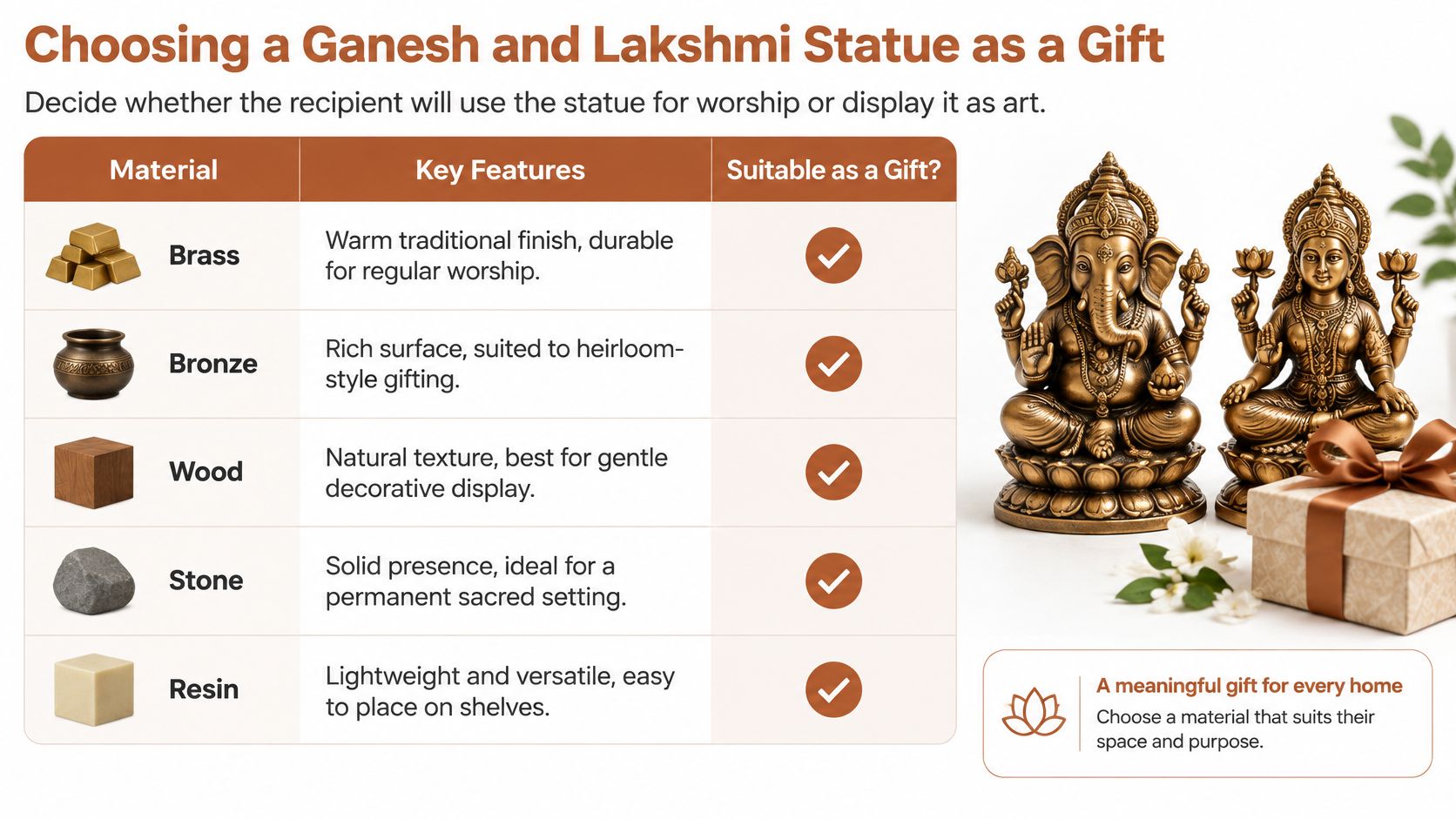
| Material | Strengths | Limits | Suits |
|---|---|---|---|
| Brass | Durable, polishes well, classic puja appearance | Tarnishes and needs regular cleaning | Working altars and everyday use |
| Bronze | Fine, crisp detail with a warm metallic presence | Heavier and costlier; patina varies with age | Collectors and display pieces |
| Wood | Warm tone, light weight, sculptural detail | Sensitive to humidity and heat, can split | Dry interiors and decorative settings |
| Stone | Architectural, grounded and durable | Heavy and cold; needs a strong shelf | Permanent display and larger pieces |
| Resin or composite | Light, affordable, consistent finish | Less surface character and lower perceived value | Budget gifts and temporary display |
Fit, consecration and a straight answer
Match the size to the shelf it will live on. A desk takes a small seated figure. A dedicated altar can hold a larger sculpture. Identify each deity by its markers before you buy: a clear elephant head and rounded belly on Ganesh, a readable lotus and vessel on Lakshmi. When the piece arrives, check it for chips, recarved hands and flaking colour.
A consecrated temple murti is installed for worship under a ritual the temple directs. An unconsecrated decorative or collectible sculpture is what most gift purchases are, and giving one does not oblige the recipient to treat it as a working shrine. Practice varies widely: some Hindus pray daily or attend temples, while others pray at home or not at all. One buyer described giving a Ganesh statue to a friend starting his own laboratory, since Ganesh as the remover of obstacles suited a new venture. That gift worked because it matched the occasion, a beginning, rather than assuming a shrine.
Can a non-Hindu own or display Ganesh and Lakshmi respectfully? Yes. Handle the piece with clean hands, give it a raised place, and do not treat it as a joke or a novelty prop. Include a short card naming both deities and what each is associated with. If you can, ask a relative whether the household already has a shrine, so you do not duplicate one or place a second figure where it is unwelcome.
If the gift sits in a wider rustic scheme rather than a shrine, rustic wall art gift inspiration from Farmhouse World is a useful companion for scale and finish beside a small sculpture.
- Decide the purpose: altar, cultural display, gift or decoration.
- Match the occasion: Diwali night calls for the pair together, a new venture suits Ganesh alone, and a general gift can be either.
- Choose material and size from the table above.
- Confirm the figure by its markers, then check condition when it arrives.
- Read the returns policy and the packaging notes, and confirm that the listing states material and dimensions.
Caring for, Repairing and Retiring Your Statue
Once the figure is home, a short routine does more than an occasional deep clean.
- Dust weekly with a soft dry cloth, including the back and the base.
- Clean brass or bronze with a mild, non-abrasive method. Keep harsh chemicals off wood and stone.
- Each month, look for chips, cracks, loose limbs or flaking gilding, and photograph any damage for a seller or an insurer.
British houses add three ordinary hazards. Radiators and direct sun can split wood along the grain. Damp air tarnishes brass and bronze, especially in a bathroom-adjacent wall or an unheated porch. A heavy stone piece needs a shelf that will not sag. Felt pads stop a metal base scratching a sideboard, but they do not make a weak shelf strong.
For a valuable or antique piece, use a professional conservator. Household glue and metal polish can stain porous stone and lift old gilding. A hairline in wood is often better left stable than filled at the kitchen table.
Do not put a damaged or unwanted statue in the bin. Families commonly store it in a clean cloth, pass it to a temple or a trusted person, or, for clay Ganesh images made for a festival, follow that community's immersion practice. Clay festival images are meant to return to water. A brass or stone figure kept for years is not. Ask family or a local temple which custom they use, because households do not share one retirement rite.
If you are choosing Ganesh for a beginning, Lakshmi for abundance, or a pair for Diwali, HD Asian Art curates antique and contemporary Hindu sculptures for homes, gifts and collections, with guides on form and placement alongside the works. Browse Ganesha and Lakshmi figures, and related deity sculptures, at HD Asian Art.
