



Art Insurance Appraisal for Asian Sculpture: USPAP That Holds Up
Art Insurance Appraisal for Asian Sculpture: USPAP That Holds Up
An art insurance appraisal establishes the replacement value your insurer uses to set coverage limits and settle claims. That number typically runs higher than what your piece would fetch at auction, so the process demands a credentialed, Uniform Standards of Professional Appraisal Practice (USPAP) -compliant appraiser and periodic updates. Look for ASA, ISA, or Appraisers Association of America designations before you hire anyone.
Key Features
- Using an outdated appraisal can lead to significantly lower payout for total loss if market values have shifted since the last report.
- Credentials alone are insufficient; appraisers must be USPAP-compliant and have demonstrated experience in specific Asian art categories to produce defensible valuations.
- Insurers primarily rely on replacement value appraisals, which include retail sourcing and dealer margin, unlike fair market or liquidation estimates.
- Proper documentation, including detailed descriptions, high-quality photos, provenance, and comparison sales, is essential to support a smooth claim process.
- Homeowner policies often fall short by sub-limiting coverage per item, so scheduling items and using dedicated floaters at the correct replacement value prevents underinsurance.
Table of Contents
Art Insurance Appraisal vs Fair Market Value: Why the Numbers Differ
Insurance appraisals and resale appraisals answer different questions, and mixing them up leaves collectors underinsured. Replacement value is the cost to buy a comparable piece at retail, in similar condition, right now. It is generally the highest of the common valuation types, because retail prices include dealer margins, sourcing time, and the reality that a matching piece may take months to locate.
Fair market value estimates what a willing buyer would pay a willing seller, neither under pressure, in the item’s most common market. Liquidation value assumes a forced or rushed sale, often at auction with a tight deadline, and lands lowest of the three.
Here is why the gap matters in practice:
- A 19th century bronze Ganesha might carry a replacement value higher than what it would fetch at fair market value.
- In a forced liquidation, that same piece might bring significantly less than at fair market value.
- If your policy is scheduled at fair market value instead of replacement value, a total loss claim pays out less than what it would cost to replace the piece.
Insurers schedule collections at replacement value specifically because they are obligated to make you whole, not just cover a floor price.
Choosing an Appraiser Your Insurer Will Actually Accept
No federal license governs personal property appraisers in the United States, so credentials do the work a license would otherwise do. Insurers and the IRS both treat ASA, ISA, and Appraisers Association of America designations as the working signal of competence, paired with compliance with the Uniform Standards of Professional Appraisal Practice. An appraiser without USPAP training can produce a document that looks professional and still gets rejected during a claim.
Statistic Callout: No governing license exists for personal property appraisers nationwide. Credentials and USPAP compliance are the substitute standards insurers rely on.
Fee structure matters just as much as credentials. Legitimate appraisers charge hourly or flat fees; a percentage-based fee tied to the assigned value is a conflict of interest and an ethics violation under USPAP. Before hiring, ask directly:
- Are you USPAP-compliant, and can you show current continuing education records?
- What is your fee structure, and will you put it in writing before work begins?
- Have you appraised comparable pieces (Southeast Asian bronzes, Himalayan sculpture, temple carvings) before?
- Will the report state its intended use as insurance coverage?
Any hesitation on that last question is a red flag worth walking away from.
What Belongs in a Defensible Insurance Appraisal Report
Insurers and claims adjusters look for a specific structure, and a report missing pieces of it can stall a claim for weeks. A defensible insurance appraisal includes:
- Itemized description of each piece: medium, dimensions, maker or attribution, and age.
- High-resolution photographs from multiple angles, including any damage or repair.
- Condition notes documenting existing wear, losses, or prior restoration.
- Provenance history, tracing ownership as far back as records allow.
- Market comparables showing recent sales of similar pieces at retail.
- A stated methodology explaining how the appraiser reached the value.
- Intended use statement confirming the report is for insurance coverage, not resale.
- Signature, license or designation number, and effective date.
For damaged pieces, appraisers also document residual diminution, meaning how repair and restoration affect the piece’s market value even after conservation work is complete. A statue that has been professionally repaired rarely returns to its pre-damage value, and a good report says so explicitly.
Pro Tip: Ask for the report in both PDF and printed form, and keep a copy off-site or in cloud storage. If your home suffers a fire or flood, the appraisal is often the only proof of what you owned.
Scheduling, Floaters, and Why Homeowners Policies Fall Short
A standard homeowners policy is not built for fine art, and most collectors do not discover that until they file a claim. Ordinary policies often carry sub-limits between $1,000 and $2,500 per item, regardless of what the piece is actually worth. A $15,000 Khmer stone head sitting under a $2,000 sub-limit means you absorb the rest of the loss yourself.
Scheduling an item, or adding a dedicated fine art floater, fixes that gap by attaching the appraised replacement value directly to the policy. That is the mechanism insurers use to:
- Set individual coverage limits per piece instead of one blanket cap for “personal property.”
- Extend coverage to risks homeowners policies often exclude, like accidental breakage during handling or in-transit damage.
- Reduce disputes at claim time, since the payout figure was agreed upon in advance rather than negotiated after a loss.
A strong appraisal supports a smoother claim, but it is not immune to challenge. Insurers can dispute a valuation if the comparables look thin, the appraiser lacks relevant credentials, or the report is outdated relative to current market conditions. The more specific and well-documented the report, the less room there is for that kind of pushback.
What an Insurance Appraisal Actually Costs
Fees vary by complexity, but most independent appraisers charge hourly rates, with flat fees common for single-item assessments. Specialist categories, like Khmer bronze or Burmese lacquerware, tend to cost more because fewer appraisers have the research background to value them accurately. Travel to inspect a piece in person, multi-item collections, and rush turnaround all push costs upward.
Statistic Callout: Online appraisal services can offer signed reports starting around $59 with a 24 hour turnaround target for straightforward items, but that speed comes with real limits for specialist or high-value pieces that need hands-on inspection.
Turnaround for a full in-person appraisal usually runs one to three weeks depending on research depth. Reappraisal should happen every three to five years for most collections, faster if the category is volatile or if a piece has just been restored, damaged, or newly acquired.
- Get a fresh appraisal immediately after any restoration, damage event, or major market shift in the category.
- Budget for specialist research time on rare or regionally specific pieces.
- Treat the appraisal as a recurring cost of ownership, not a one-time expense.
Preparing Your Collection Before the Appraiser Arrives
Good preparation shortens the appointment and strengthens the final report. Gather these before your appraiser walks in:
- Original receipts or purchase invoices, if you still have them.
- Any prior appraisals, even outdated ones, to show valuation history.
- Provenance documentation, including gallery certificates, export permits, or prior ownership records.
- Conservation or restoration records, with dates and the conservator’s name if known.
- High-resolution photographs taken in even lighting, front and back, including close-ups of any damage.
- Exact dimensions in height, width, and depth, plus weight if practical.
- Written condition notes describing anything you know about wear, repairs, or missing elements.
Virtual and photo-only appraisals work reasonably well for straightforward, lower-value pieces, but they have real limits. An appraiser cannot verify material composition, detect old repairs hidden under patina, or confirm weight and density from a photograph alone. For higher-value Asian statuary, an in-person inspection is usually worth the extra cost.
Pro Tip: Never suggest a target value to your appraiser, and never downplay a known flaw. Both compromise the report’s credibility, and USPAP-compliant appraisers are trained to disregard influence from either the owner or the insurer.
Why Asian Religious Sculpture Needs a Specialist’s Eye
Iconography and dynastic attribution change appraised values more for Asian statuary than for most Western art categories. A standing Avalokiteshvara misidentified by two centuries, or a bronze attributed to the wrong regional workshop, can shift the comparable market by a meaningful margin. Specialist scholarship in dynastic attribution, iconographic analysis, and material identification materially changes which comparables an appraiser can defensibly use.
Insurers increasingly scrutinize appraiser competency, and niche specialists produce more defensible valuations for categories like Khmer bronze, Burmese lacquerware, and Himalayan stone carving than general practice appraisers do. Documentation that strengthens these appraisals includes:
- A clear dynastic identification supported by stylistic and material analysis.
- A provenance chain tracing the piece through prior ownership or export records.
- Museum or academic citations referencing comparable pieces, where available.
- Conservation reports noting any restoration and how it affects residual value.
HD Asian Art documents each piece with detailed photography and researched provenance at the point of sale, which gives collectors a documentation foundation that aligns closely with what insurers expect to see in a claim file.
Filing a Claim: How Your Appraisal Gets Used After Damage or Loss
Your appraisal becomes the backbone of the claims process the moment something goes wrong. An insurance appraisal functions as a legal document central to claim resolution, and the adjuster will compare the report’s itemized detail against what actually happened to the piece.
Start by notifying your insurer promptly and documenting the damage or loss with photographs before moving or attempting any cleanup. If the piece was scheduled individually or covered under a fine art floater, the claims process typically moves faster because the replacement value was already agreed upon. If it was relying on a homeowners policy sub-limit, expect a lower ceiling and more negotiation.
For partial damage, the appraiser (either your original one or one hired for the claim) will assess residual diminution, meaning how much value the piece retains after repair. A cracked stone torso that has been professionally restored rarely returns to its full pre-damage value, and that gap gets documented explicitly rather than assumed. Insurers use this figure to calculate a partial loss payout rather than a total replacement.
For total loss, the insurer pays out at the scheduled replacement value, assuming the original appraisal was current and well-documented. This is where outdated appraisals cause real financial pain: if your last report is eight years old and market values for Southeast Asian bronzes have climbed since, you collect a payout based on stale numbers.
Keep copies of the appraisal, receipts, and any conservation records somewhere outside your home, since a fire or flood claim is exactly the scenario where you cannot retrieve documents from a damaged property. A well-prepared claims file with detailed photographs and a current appraisal moves faster and disputes less than a thin one.
Insurance Appraisal or Auction Estimate: Know the Difference
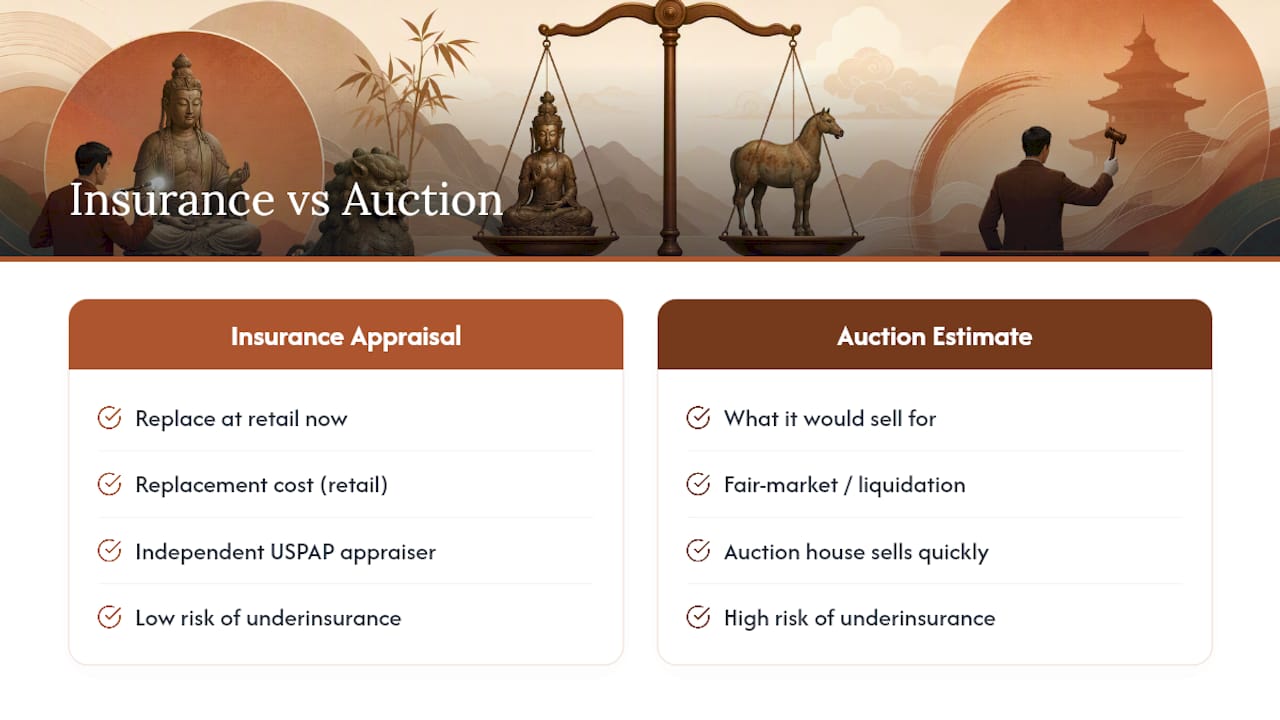
Collectors often assume an auction house estimate can double as an insurance document, and that assumption creates coverage gaps. The two serve entirely different purposes, and confusing them is one of the more expensive mistakes a collector can make.
An auction or sales appraisal estimates fair market value or, in a forced sale scenario, liquidation value. It answers “what would this sell for,” and auction houses have an incentive to estimate conservatively so pieces sell quickly and generate commission. That estimate is not designed to reflect what it would cost you to replace the piece at retail.
An insurance appraisal answers a different question entirely: what would it cost to replace this piece with a comparable one, at retail, right now. It is prepared by an independent, USPAP-compliant appraiser with no financial stake in whether the piece sells, which matters because it removes the conflict of interest built into an auction house’s incentive structure.
The practical consequence: if you insure a piece based on an auction estimate instead of a proper insurance appraisal, you are almost certainly underinsured. A stone Ganesha that an auction house estimates at $6,000 to $8,000 for a quick sale might carry a $12,000 replacement value once you account for retail sourcing time and dealer margin. Submit the auction estimate to your insurer and a total loss claim leaves you thousands short of what it costs to replace the piece.
If you already have an auction estimate on file, treat it as market research, not as your insurance documentation. Commission a separate report with insurance as its explicitly stated intended use.
Red Flags That Sink an Insurance Claim Before It Starts
Most appraisal problems surface only after a loss, when it is far too late to fix them. A handful of recurring mistakes account for most denied or underpaid claims.
The most common pitfall is an outdated appraisal. Values for Southeast Asian bronzes, Himalayan sculpture, and temple carvings shift as scholarship and demand evolve, and a report from a decade ago rarely reflects current replacement cost. Reappraise on the three to five year cycle discussed earlier, and immediately after any market shift specific to your category.
A second red flag: an appraiser without verifiable credentials or USPAP compliance. Some appraisers operate without formal training and produce reports that look thorough but fall apart under an adjuster’s scrutiny. Verify designations directly with ASA, ISA, or the Appraisers Association of America before you pay for a report.
Watch for percentage-based fees. Any appraiser who prices their service as a cut of the assigned value has a direct financial incentive to inflate that value, and insurers know this. A report built on a percentage fee is often the first thing an adjuster challenges during a dispute.

Thin documentation is another common problem. A report with no comparables, no methodology statement, and low-resolution photographs gives an insurer easy grounds to dispute the number. Photo-only or online appraisals can work for low-value, straightforward pieces, but pushing them onto specialist or high-value statuary risks a report that cannot withstand claim scrutiny.
Finally, watch for mismatched intended use. A report written for estate planning or charitable donation purposes is not automatically valid for insurance. Confirm the stated intended use on the document itself before you rely on it for coverage.
The Real Gap in Most Appraisal Advice
Most guides on this topic treat appraisal as a paperwork exercise: hire someone credentialed, get a document, file it away. That advice is not wrong, but it undersells where the actual risk sits for collectors of Asian religious sculpture specifically. A generalist appraiser can produce a technically compliant, USPAP-adherent report that still undervalues a piece badly, simply because they lack the scholarship to identify the right comparables.
The conventional wisdom stops at “hire someone credentialed.” What it misses is that credentials verify process, not category expertise. An ASA-designated appraiser with no background in Khmer bronze or Himalayan stonework can still misattribute a dynasty, miss an iconographic detail that changes market tier, or use comparables from the wrong regional market entirely. That gap does not show up until a claim gets disputed, and by then it is expensive to fix.
If you own pieces in this category, prioritize appraisers with demonstrated experience in Southeast Asian or South Asian religious art specifically, even if that means a longer search than hiring the first USPAP-compliant name you find. Credentials get you in the door. Category expertise is what actually holds up when an insurer pushes back.
— James, HDAsianArt.com
Sources
For the standards themselves, the Uniform Standards of Professional Appraisal Practice governs how a defensible report gets built, and it is worth confirming any appraiser you hire trains against it. The American Society of Appraisers, the International Society of Appraisers, and the Appraisers Association of America each maintain credential directories collectors can search directly. For practical cost and process guidance, the appraisal breakdowns from Masterworks Academy and Poras Fine Arts Appraiser informed much of the guidance above.
- How to Get Art Appraised: Types of Value, Credentialed Appraisers, and What It Costs | Masterworks Academy
- Insurance appraisals | Poras Fine Arts Appraiser
- Insurers — Czudej McDonough Valuations
- Art appraisal insurance coverage guidance | AppraiseItNow
- Insurance appraisals (ARTXPRT)
- Online art appraisal | Appraisily
