



Why Buddha Statues Have Long Earlobes: History and Meaning
Why Buddha Statues Have Long Earlobes: History and Meaning
Table of Contents
The elongated earlobes visible in Buddha statues are one of the most striking features in Buddhist art, appearing across centuries and continents. This distinctive characteristic is rooted in both historical fact and profound spiritual symbolism. Prince Siddhartha, the future Buddha, was born into the Shakya royal family in ancient India and lived a sheltered existence surrounded by luxury. As a prince, he wore heavy gold earrings, a common marker of nobility and wealth in ancient Indian societies. These substantial pieces of jewelry stretched his earlobes over years of wear, creating a visible symbol of his royal status and material abundance.
When Siddhartha eventually renounced his princely life to seek spiritual truth, he left behind his jewels, palace, and royal identity. Yet the stretched earlobes remained, a physical reminder of what he had abandoned. Rather than erase this mark, Buddhist artists chose to preserve it in their depictions of the Buddha. The elongated earlobes became a permanent record of his journey from indulgence to enlightenment.
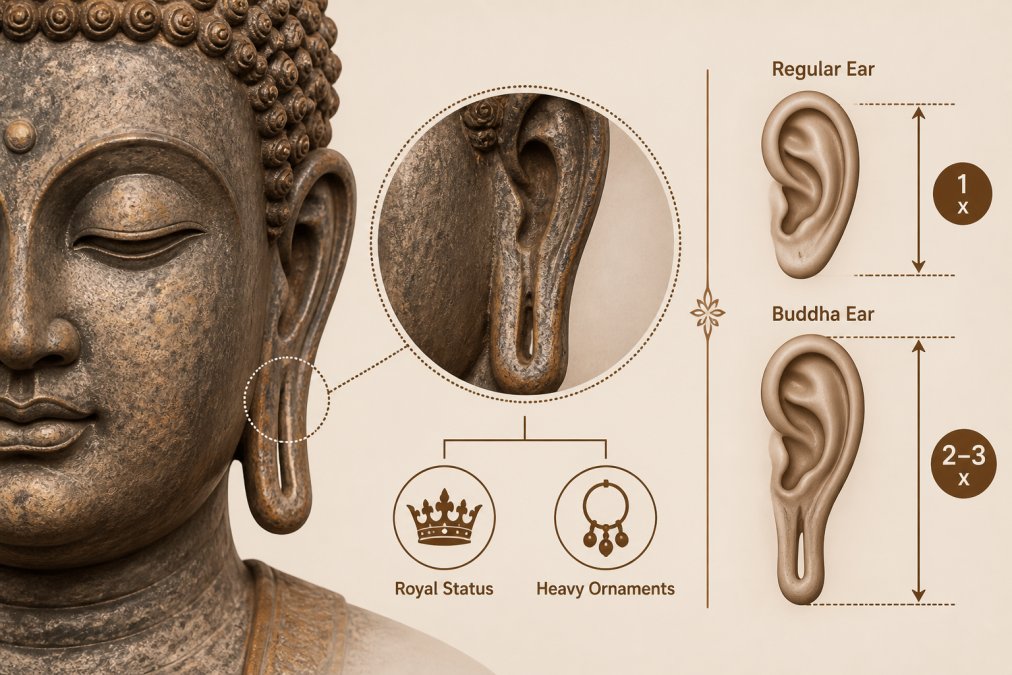
The Prince's Jewelry and Royal Status
In the kingdoms of northern India around the 5th century BCE, jewelry served as a primary visual marker of social rank. A prince of the Shakya kingdom would have worn substantial gold earrings, not merely for aesthetics, but as a declaration of power and wealth. Archaeological evidence describes pieces that could weigh several ounces each. Over time, wearing such heavy ornaments caused permanent stretching of the earlobes, a badge of honor proving the wearer had lived a life of such luxury that they could bear the weight of precious metals without discomfort.
For Prince Siddhartha, these earrings represented everything his life had been designed to be: comfort, power, sensory pleasure, and worldly authority. When he eventually removed these earrings as part of his renunciation, the physical damage remained. The stretched earlobes could not be restored to their original shape. This permanence became deeply meaningful, his body carried the marks of his former life even as his mind and spirit moved toward enlightenment.
The 32 Marks of a Great Man: Buddha's Physical Characteristics and Their Meaning
In Buddhist tradition, the Buddha is described as possessing 32 distinctive physical marks known as the Mahapurusha Lakshana, or the marks of a great man. These aren't arbitrary features; they're part of a comprehensive system of symbolism that communicates the Buddha's spiritual significance through his physical form. The elongated earlobes are one of these 32 marks, placing them in a framework of profound spiritual meaning.
According to Buddhist texts, these 32 marks distinguish a being of great spiritual attainment. Some relate directly to the Buddha's renunciation, marks that show what he gave up. Others represent qualities he cultivated through meditation and enlightenment. The elongated earlobes fall into the first category: they're a permanent record of princely luxury abandoned in pursuit of truth. Together with features like the wheel pattern on the palms and soles, the tuft of hair between the eyebrows, and the golden complexion of the skin, they create a visual language that communicates the Buddha's unique status as a being who transcended the ordinary human condition while remaining recognizably human.
Renunciation in Buddhism Symbolism: What Elongated Earlobes Represent
The concept of renunciation stands at the heart of Buddhist practice. To renounce means to consciously reject something, not out of hatred, but out of clear understanding of its true nature. When Prince Siddhartha renounced his princely life, he wasn't rejecting pleasure because it is evil. He was rejecting the illusion that pleasure could provide lasting satisfaction or spiritual fulfillment. His stretched earlobes became the physical embodiment of this renunciation.
In Buddhist teaching, renunciation isn't about self-denial for its own sake, it's about freedom. The Buddha taught that attachment to material things, sensory pleasures, and ego-driven desires creates suffering. By renouncing these attachments, a person becomes free. The earlobes stretched by years of wearing gold jewelry represent the weight of attachment. Removing the earrings and keeping the stretched lobes means acknowledging the past without being enslaved by it.
Detachment from the Physical World
The elongated earlobes symbolize detachment from the physical world in a specific way: they show that the Buddha once lived fully in that world, yet chose to transcend it. This is subtly different from never having engaged with worldly pleasures at all. The Buddha's path is unique because he experienced everything a prince could experience, every comfort, every pleasure, every form of sensory gratification, and then consciously chose to move beyond it.
For Buddhist practitioners, the elongated earlobes serve as a reminder that renunciation is possible. No matter how deeply embedded someone is in worldly attachments, transformation is achievable. The Buddha's journey from prince to enlightened being shows that even those born into the greatest privilege can awaken to deeper truth.
The Compassion and Listening Connection
Beyond renunciation, the elongated earlobes carry another layer of meaning connected to compassion and listening. In Buddhist iconography, large ears symbolize the capacity to listen deeply to the suffering of others. The Buddha, having renounced his own attachment to pleasure, developed profound compassion for all beings trapped in the cycle of suffering. His elongated earlobes become a visual representation of his attentiveness to the cries of the world.
This interpretation emerges from the Buddhist understanding of the Bodhisattva path, the path of one who seeks enlightenment not just for themselves, but for all beings. The Bodhisattva listens to suffering wherever it arises. This symbolism suggests that true spiritual development includes developing the capacity to hear and respond to the needs of others.
Buddhist Iconography Explained: How Long Earlobes Evolved Across Traditions and Regions
As Buddhism spread from India across Asia, it encountered different artistic traditions, materials, patron cultures, and theological interpretations. The way artists depicted Buddha's elongated earlobes evolved significantly across these regions, reflecting both local artistic preferences and varying theological emphases.
In early Indian Buddhist sculpture, particularly in the Gandhara region, Buddha statues show relatively subtle elongation of the earlobes. The Gandharan style, which developed under Greco-Roman influence, emphasized naturalistic proportions. As Buddhism traveled east along the Silk Road into Central Asia, China, Tibet, Southeast Asia, and Japan, artistic interpretations became more diverse.
Regional Artistic Variations in Sculpture
In Southeast Asian Buddhist art, particularly in Thailand, Cambodia, and Laos, Buddha statues often feature very pronounced elongated earlobes. These aren't subtle details; they're prominent features that immediately draw the viewer's attention. Khmer sculpture from Cambodia shows particularly striking examples, with earlobes extending nearly to the shoulders. This extreme elongation emphasizes the renunciation theme with visual intensity and demonstrates the technical skill of the sculptor.
Chinese Buddhist sculpture took a different approach. In the Tang Dynasty and later periods, Chinese artists sometimes depicted Buddha with less exaggerated earlobes, emphasizing instead other features like facial expression and hand gestures (mudras). This reflected a shift in how Chinese Buddhism understood Buddha's teaching, with less emphasis on physical renunciation and more emphasis on inner transformation.
Japanese Buddhist art shows yet another variation. In Japanese sculpture and painting, elongated earlobes appear consistently, but artists often combined this feature with other artistic conventions that emphasized grace, refinement, and spiritual purity. The earlobes become part of an overall aesthetic that communicates enlightenment through beauty and proportion.
The spread of Buddhism to Southeast Asia wasn't simply a matter of copying Indian models. It was a creative process of cultural translation. Local artists, working with local materials and influenced by local aesthetic traditions, reimagined Buddhist iconography in ways that spoke to their own communities. The elongated earlobes, originally a historical reference to Prince Siddhartha's jewelry, became a universal symbol that transcended any single cultural context.
Anatomical Reality vs. Artistic Representation in Buddha Statuary
A crucial distinction exists between what Buddha statues show and what the historical Buddha actually looked like. Buddhist statues aren't photographs or forensic reconstructions, they're theological statements expressed through artistic form.
The historical Buddha likely did have stretched earlobes from wearing heavy gold earrings as a prince. However, the degree of elongation shown in many Buddha statues far exceeds what would result from actual jewelry wear. Many statues show earlobes extending dramatically downward, sometimes nearly to the shoulders. This level of elongation is anatomically impossible from jewelry alone.
This exaggeration is intentional and meaningful. Buddhist artists weren't trying to create anatomically accurate portraits. They were creating visual symbols. The elongated earlobes in Buddha statues are stylized representations of renunciation and spiritual transformation. The more exaggerated the form, the more powerfully the symbol communicates. This principle applies to other features of Buddha statues as well, the body proportions are idealized rather than naturalistic, and the facial features often express a serene detachment that transcends individual personality.
The Deeper Symbolism: Wisdom, Longevity, and Spiritual Awakening
Beyond renunciation and compassionate listening, the elongated earlobes carry associations with wisdom and longevity in Buddhist and broader Asian spiritual traditions. In many Asian cultures, long ears are associated with wisdom and spiritual development. This symbolism predates Buddhism and appears in Hindu and other Asian traditions as well. The idea is that spiritual development literally extends and transforms the physical body. Long ears become a sign of inner development and accumulated wisdom.
The association between elongated earlobes and longevity also appears in Asian iconography. In Chinese and other East Asian traditions, long ears are considered auspicious signs connected to a long life and good fortune. When this symbolism merged with Buddhist iconography, the Buddha's elongated earlobes acquired additional layers of meaning. They signified not just renunciation and compassion, but also the timeless wisdom and eternal significance of Buddhist teaching.
The Buddha's journey toward spiritual awakening is often described in Buddhist texts as a process of "waking up," becoming conscious of what had previously been hidden or ignored. The elongated earlobes become a visual representation of this awakening. They show a being who has opened fully to the reality of existence, who listens deeply to all that arises, and who has transformed the raw material of his human experience into wisdom and compassion.
Choosing an Authentic Buddha Statue: What the Earlobes Tell You
If you're considering acquiring a Buddha statue for your home, meditation space, or collection, understanding the symbolism of the elongated earlobes can help you make a more informed choice. The quality and style of how the earlobes are depicted tells you something about the statue's authenticity, artistic tradition, and the sculptor's understanding of Buddhist symbolism.
Authentic Buddha statues from established Buddhist artistic traditions will consistently show elongated earlobes. This feature is so fundamental to Buddhist iconography that its absence should raise questions. The degree of elongation varies by artistic tradition and period. Southeast Asian statues, particularly from Thailand and Cambodia, tend to show more dramatic elongation than Chinese or Japanese pieces. Indian and Gandharan pieces show more subtle stretching. These regional variations are normal and don't indicate a lack of authenticity.
The material and craftsmanship evident in how the earlobes are carved also matters. In quality bronze or stone sculptures, the earlobes should be smoothly finished, with careful attention to proportion and balance. Poorly executed earlobes, rough, asymmetrical, or disproportionate, may indicate inferior craftsmanship or a modern reproduction made without understanding of traditional forms.
At HD Asian Art, we understand that choosing an authentic Buddha statue involves more than just aesthetic preference. It's about acquiring a piece that carries genuine spiritual significance and represents the artistic and theological traditions from which it emerged. Our carefully curated collection includes Buddha statues from multiple traditions and periods, each selected for authenticity, craftsmanship, and the integrity of its iconographic elements. Whether you're drawn to the dramatic elongation of Southeast Asian pieces or the more restrained style of East Asian sculpture, understanding what the earlobes represent helps you choose a statue that resonates with your own spiritual practice and aesthetic sensibility.
When you look at a Buddha statue, you're encountering centuries of artistic tradition and spiritual teaching condensed into a single form. The elongated earlobes represent one of the most profound teachings in Buddhism: that transformation is possible, that what we abandon can become a permanent record of our growth, and that true wisdom involves both letting go and remaining present to the world's suffering. HD Asian Art specializes in authentic Buddha statues that honor these traditions, pieces selected for their genuine craftsmanship, historical integrity, and the clarity with which they communicate Buddhist symbolism through their physical form.
Frequently Asked Questions
Did the historical Buddha actually have long earlobes?
The historical Buddha, Siddhartha Gautama, likely experienced some earlobe elongation from wearing heavy gold earrings during his princely years in ancient India. However, Buddhist statues exaggerate this feature for symbolic rather than anatomical accuracy. The stretched earlobes in iconography represent his renunciation of luxury and his spiritual journey, not a literal physical characteristic. Artists prioritized symbolic meaning over realistic representation.
What do long earlobes symbolize in Buddhist iconography?
Elongated earlobes in Buddha statues represent multiple interconnected meanings. They symbolize renunciation and detachment from the physical world, particularly the wealth and jewelry of his princely past. The earlobes also represent compassion and listening to the cries of the world, reflecting Buddha's empathy for human suffering. Additionally, they are counted among the 32 marks of a great man in Buddhist tradition, signifying enlightenment, wisdom, and spiritual awakening. Regional variations emphasize different aspects of this symbolism.
Are long earlobes one of the 32 marks of a great man in Buddhism?
Yes, elongated earlobes are included among the 32 auspicious marks (Mahapurusha lakshanas) that distinguish a great being in Buddhist tradition. These marks, detailed in ancient Buddhist texts from India, indicate spiritual attainment and enlightenment. The earlobes specifically symbolize wisdom and the capacity to listen deeply to the suffering of others. Different Buddhist traditions in Southeast Asia and beyond interpret and depict these marks with varying emphasis, but the earlobe remains a consistent and significant attribute across cultures.
Why do some Buddha statues have longer earlobes than others?
Variation in earlobe length reflects regional artistic traditions, the sculptor's interpretation of Buddhist symbolism, and the specific time period of creation. Thai, Cambodian, Laotian, and Indonesian Buddha statues each developed distinctive styles influenced by local aesthetics and spiritual emphasis. Some traditions elongate the earlobes more dramatically to emphasize compassion and listening, while others keep them more moderate to balance other attributes. Understanding these regional differences helps collectors appreciate authentic variations in Buddhist sculpture and iconography.
