



Museum-Quality Buddha Statue: Fine Art vs Mass-Produced
Museum-Quality Buddha Statue: Fine Art vs Mass-Produced
Most people buying their first Buddhist or Hindu sculpture online cannot tell the difference until the parcel arrives. The statue they ordered looked convincing in the product photo, but in person it feels flat, the face is blank in an unsettling way, and the surface has the cold uniformity of something made by a machine running the same programme ten thousand times.
That is not a minor aesthetic quibble. If you are a collector, a practitioner, or someone decorating a home altar with intention, the difference between a museum-quality Buddha statue and a mass-produced replica is the difference between an object that rewards years of looking and one that you quietly move to a shelf in the spare room. This article explains exactly what separates them, and how to buy right the first time.
Table of Contents
Quick Takeaways
|
Key Insight |
Explanation |
|---|---|
|
Presence is made, not accidental |
A museum-quality Buddha statue holds visual attention because proportions, facial angles, and surface finishing are deliberate choices, not outputs of a mould. |
|
Micro-variation is a sign of quality, not a flaw |
Slight asymmetry in hand-carved or hand-cast pieces changes how light and shadow animate the face. Absolute uniformity is what mass production looks like. |
|
Material choice signals longevity |
Bronze, hardwood, and natural stone develop patina and depth over decades. Resin composites do not age gracefully and often degrade under direct light. |
|
Iconographic accuracy is non-negotiable for serious collectors |
Wrong mudra (hand gesture), incorrect ushnisha (crown protrusion), or misrepresented regional style are common errors in mass-produced pieces that undermine authenticity. |
|
Provenance and sourcing transparency matter |
Reputable sellers of fine Asian art can tell you the country of origin, the tradition it belongs to, and the approximate period or style. Vague answers are a warning sign. |
|
Price per decade is a better metric than sticker price |
A quality Buddhist sculpture that holds its visual and material integrity for thirty years costs far less over time than replacing cheap pieces every few years. |
|
Regional style differences are real and significant |
A Burmese Buddha, a Thai Buddha, and a Cambodian Buddha have distinct stylistic conventions. A piece that blends them incoherently was not made with knowledge of the tradition. |
What Museum-Quality Actually Means
The phrase "museum-quality" gets used carelessly in online listings, so it is worth pinning down what it actually requires. In the context of fine Asian art, museum quality means three things simultaneously: material integrity, iconographic correctness, and aesthetic coherence within the tradition it represents.
Material integrity means the piece is made from the material it claims, finished in ways appropriate to that material, and constructed to last. A museum-quality bronze statue from Thailand is not a resin body with a bronze-effect spray paint. It is cast bronze, often with lost-wax casting that produces subtle surface variation, and finished by hand to bring out the warmth of the metal.
Iconographic correctness means the sculptor knew the tradition. Every attribute of a Buddhist or Hindu deity, from hand gestures to the arrangement of jewellery to the shape of the halo, carries specific meaning. Museums do not display pieces where those attributes are muddled or invented. A serious retailer of Buddhist and Hindu sculpture applies the same standard.
Aesthetic coherence means the piece looks like it belongs to a real tradition and a real place. Burmese lacquerware has a distinct palette and finish. Cambodian Khmer-style sculpture has a particular facial serenity and stone-like solidity even when cast in bronze. Chinese Tang-dynasty influenced pieces have heavier, more earthen proportions. These are not interchangeable.
Pro tip: When a seller lists a statue as simply "Asian Buddha" without specifying country of origin or stylistic tradition, that vagueness almost always reflects either ignorance or a product made without reference to any specific tradition. Ask directly. A specialist like HD Asian Art categorises its collection by country, which is the baseline you should expect from any serious source.
How Craftsmanship Creates Presence
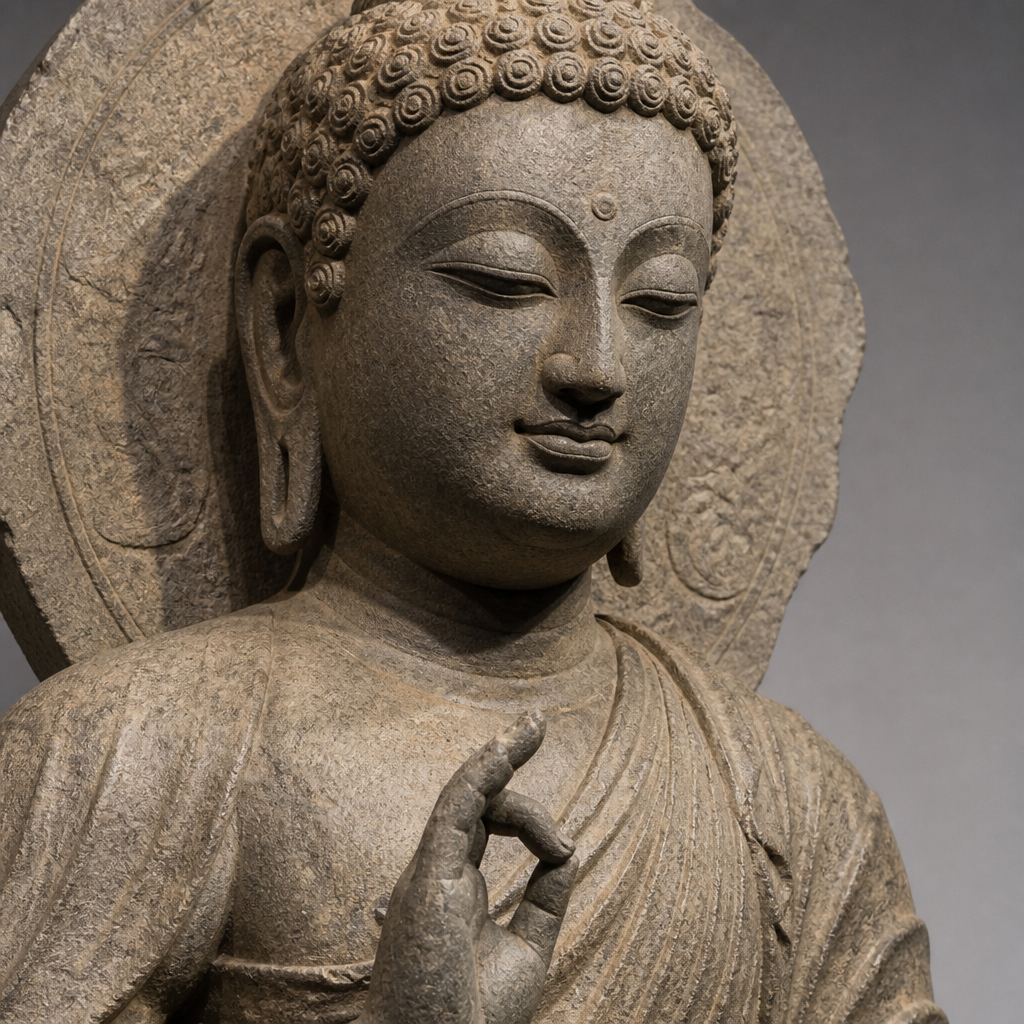
Collectors and practitioners often describe well-made Buddhist sculpture as having "presence." That is not mysticism. It is a measurable result of specific craft decisions.
Proportion and the Readability of the Face
A skilled sculptor designing a seated Buddha figure calculates the ratio of head to torso, the placement of the eyes relative to the midpoint of the face, and the angle at which the chin tilts downward to produce the appearance of eyes that are half-closed in meditative focus. These ratios follow conventions established over centuries in each regional tradition. When they are correct, the face reads as calm and present from three metres away and still rewards close inspection. When they are wrong, the statue looks either blank or faintly aggressive, depending on which proportions are off.
Mass-produced moulds are designed once, often by someone working from a photograph rather than from study of the tradition, and then replicated without adjustment. Any error in the original is permanently frozen into every copy.
The Role of Micro-Variation in Handmade Work
In hand-carving or hand-finishing, the maker is constantly making small corrections: adjusting the curve of an eyelid, deepening a robe fold to improve how shadow falls across it, slightly thickening the lower lip to add warmth to the expression. These micro-variations are not mistakes. They are the result of a maker who is looking at the object as a visual whole and responding to what they see.
When a maker constantly adjusts proportion, shadow, and surface across the entire piece, the result is an object that organises visual information into coherence. That coherence is what viewers experience as presence.
A common mistake buyers make is assuming that symmetry equals quality. In fact, slight asymmetry in a hand-finished face is one of the signs you are looking at genuine craft work. The face of a mass-produced statue is often more symmetrical than a museum-quality piece, and simultaneously less alive.
Finishing and How Light Behaves on the Surface
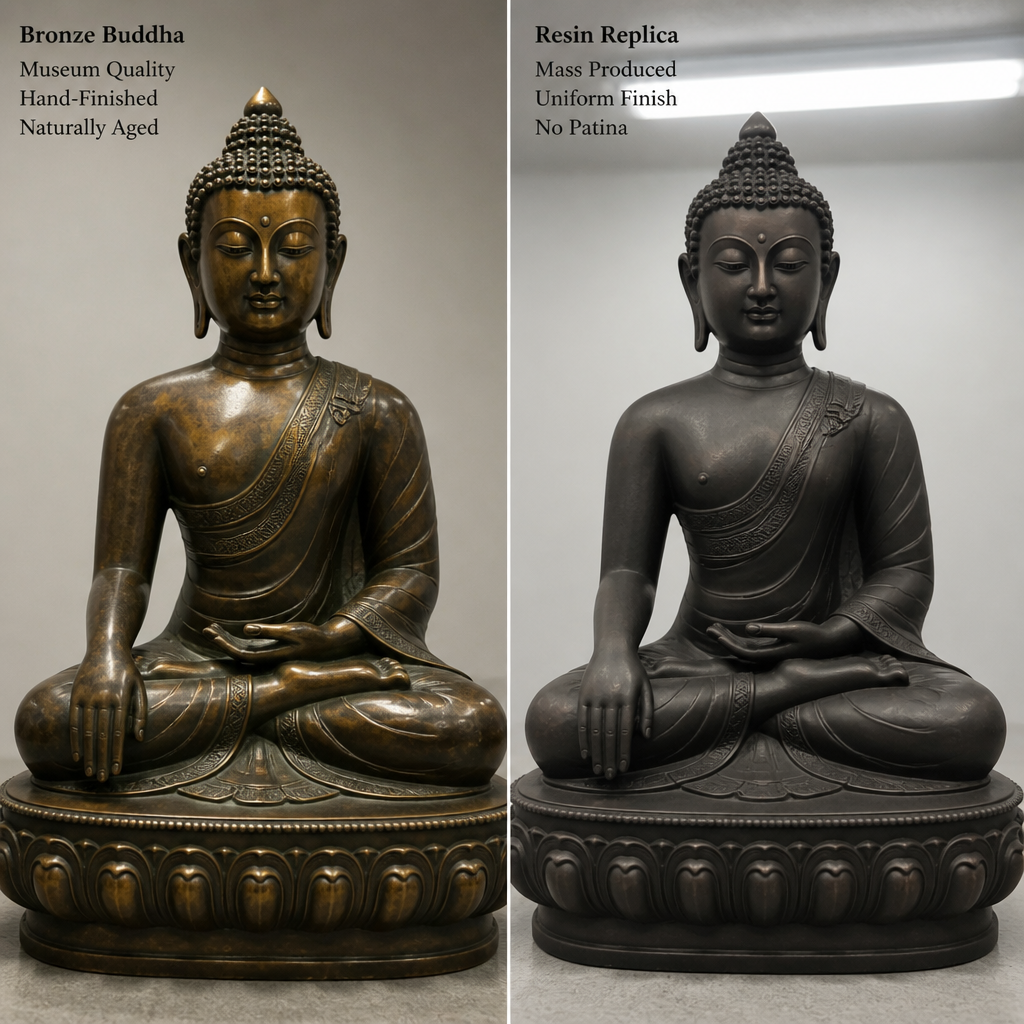
The final surface treatment of a sculpture determines how it looks in the actual light conditions of your home or altar space. Quality Buddhist sculpture uses finishing processes that create depth: gilding applied in layers, lacquer built up to produce a warm translucency, or patination on bronze that brings out the grain of the metal. These surfaces interact with directional light to produce shadow and highlight that change as you move around the piece.
Machine-polished or spray-finished surfaces reflect light uniformly. They look consistent under photography studio lighting and flat in a domestic room. This is one reason why mass-produced statues often look better in product photos than in person.
Materials and Why They Matter
Material choice in quality Buddhist sculpture is not purely aesthetic. It affects durability, how the piece ages, how it responds to the environment, and whether it remains visually compelling over years of daily viewing.
Bronze
Bronze is the most common material for museum-quality Asian sculpture, and for good reason. It is extraordinarily durable, takes fine detail well in casting, and develops a patina over time that deepens its visual character. Lost-wax casting, the method used for high-quality bronze work, allows for surface complexity that mould-cast resin cannot replicate. A bronze Buddha statue from Thailand or Cambodia, properly cared for, will outlast everything else in a collection.
Wood
Hardwood sculpture from Burma, Japan, and parts of Southeast Asia represents some of the finest carving traditions in the world. Good wood sculpture shows the grain of the material as part of the visual experience. It develops subtle tonal changes with age. Softwood or MDF used in cheap pieces splinters, warps with humidity changes, and does not hold fine carved detail.
Stone and Resin Composites
Genuine stone sculpture (sandstone, granite, schist) is heavy, cold to the touch, and chips rather than scratches. It is associated with monumental traditions, particularly Khmer and Indian sculpture. Resin composites sold as "stone-effect" are light, warm, and uniform. Tapping the base is a simple test: stone rings differently from hollow or solid resin.
Pro tip: Weight is one of the fastest reality checks when evaluating a piece. A genuinely bronze or stone sculpture of 30cm height will be heavier than most buyers expect. If a piece at that size feels light enough to lift with two fingers, the material is almost certainly not what is claimed.

Iconographic Accuracy: The Detail That Proves Knowledge
This is the area where the gap between fine Asian art and mass-produced replicas is most revealing, because it cannot be faked without knowledge. Buddhist and Hindu iconography is a precise visual language developed over more than two thousand years. Every detail carries meaning, and a sculptor working without that knowledge produces a piece that is visually incoherent to anyone who knows the tradition.
Mudras: Hand Gestures
Each mudra in Buddhist iconography identifies the Buddha's action or aspect. Bhumisparsha mudra (earth-touching) depicts the moment of enlightenment, with the right hand reaching toward the ground. Dhyana mudra (meditation) shows both hands resting in the lap, palms upward. Abhaya mudra (protection) raises the right hand with palm facing outward. In mass-produced pieces, these are often blurred or combined incorrectly, because the manufacturer is copying a visual without understanding its meaning. A museum-quality piece has the correct mudra for the specific Buddha type being depicted.
Regional Stylistic Conventions
A Sukhothai-period Thai Buddha has an elongated flame-shaped ushnisha, sinuous body proportions, and a walking posture convention found nowhere else. A Burmese Mandalay-style Buddha wears elaborate gilded regalia and has a more rounded facial type. A Sri Lankan Buddha typically sits in a more formal, symmetric posture with a simpler robe treatment. These distinctions are not minor variations. They are the result of distinct artistic traditions, each with its own canonical texts, workshop practices, and aesthetic values. Mixing them is the sculptural equivalent of putting the wrong words in a sentence.
Attributes of Hindu Deities
Hindu iconography is, if anything, more demanding than Buddhist iconography. Each deity has a specific number of arms, specific objects held in each hand, a specific vehicle (vahana), and specific colour and ornament conventions. Ganesha always has a specific form of trunk, specific modak sweet, and specific relationship between his large ears and small eyes. A Shiva Nataraja stands in a specific posture within a specific ring of flames with a specific dwarf figure beneath one foot. These are not decorative choices. A piece that gets them wrong is not a Nataraja. It is something else wearing Nataraja's costume.
Comparing Your Options: A Plain Buyer's Guide
There are three broad categories of Buddhist and Hindu sculpture in the market. Understanding what each actually delivers helps you spend money in the right place.
|
Category |
What You Get |
Suited For |
|---|---|---|
|
Mass-Produced Resin or Cold-Cast Statues |
Uniform finish, lightweight, low cost, often iconographically vague or mixed, no regional specificity, short visual lifespan as the surface degrades |
Temporary or introductory purchases where cost is the binding constraint; not suited for serious collections or long-term altar use |
|
Contemporary Craft Work from Regional Workshops |
Hand-finished in origin country, genuine material (bronze or wood), iconographically informed but varies by workshop quality, good regional authenticity when sourced well |
Collectors and practitioners who want genuine regional craft at accessible price points; the core of what a specialist retailer like HD Asian Art offers across Burma, Cambodia, Thailand, and beyond |
|
Antique and Antiquity-Grade Sculpture |
Genuine age, exceptional material quality, full iconographic authority, provenance documentation required, significantly higher price, legal and ethical sourcing requirements must be met |
Advanced collectors, institutional buyers, and those building a long-term art collection with investment as a secondary consideration |
The middle category, contemporary craft work sourced directly from regional workshops in Asia, is where most serious buyers operate. It is also where the difference between a knowledgeable specialist retailer and a generic marketplace becomes most visible. A specialist has relationships with specific workshops, knows which craftspeople are working to which standards, and can tell you exactly what you are buying and why it is priced as it is.
Red Flags When Shopping for Fine Asian Art
A few specific warning signs reliably indicate that a piece or a seller does not meet the standard required for genuine fine Asian art.
The listing says "hand-crafted" but cannot specify where or by whom. This phrase has no legal definition and is routinely applied to machine-produced pieces with minimal hand-finishing. Ask for the country of manufacture and the workshop or production method. A serious seller answers immediately.
The statue is described as "antique style" or "museum replica" without further explanation. These phrases are meaningless without specifics. Which museum? Which period? Which tradition? They are marketing language designed to suggest quality without committing to it.
The surface is uniformly smooth with no variation in depth or tone. In practice, genuine cast bronze or carved wood has areas of visual interest: shadows pooling in the folds of a robe, slight tonal differences across a face, texture variation between the primary figure and the base. Uniform gloss across every surface is a reliable indicator of spray-finishing over a cheap substrate.
The price is suspiciously low for the claimed material and size. A genuine bronze sculpture of 40cm or more cannot be produced, finished, and shipped profitably at a very low price point. If it sounds implausible, it is. The economics of real craft work set a floor below which the claimed quality is simply not possible.
The seller cannot explain the iconography. A common test: ask what mudra the Buddha is making and what it signifies. Any specialist in Buddhist sculpture answers this without hesitation. A reseller of generic manufactured goods often cannot.
HD Asian Art's collection spans Burma, Cambodia, China, India, Indonesia, Japan, Laos, Sri Lanka, and Thailand precisely because each of those traditions produces distinct sculpture with its own materials, conventions, and aesthetic history. That geographic and cultural specificity is itself a marker of a serious approach to the subject, and it is worth seeking the same specificity from any source you consider buying from.
Frequently Asked Questions
What does museum-quality mean when applied to a Buddha statue sold by a retailer?
It means the piece meets three standards simultaneously: it is made from the material claimed, finished to a standard that would survive expert scrutiny, and iconographically accurate to the tradition it represents. A museum-quality Buddha statue is not necessarily antique, but it is made with the same attention to material, proportion, and iconographic correctness that a museum curator would apply when evaluating a piece for acquisition.
How can I tell if a bronze Buddha statue is genuinely bronze or resin with a bronze finish?
Weight is the most reliable quick test. Genuine bronze is significantly heavier than resin for the same volume. A second test is temperature: bronze feels cold to the touch and equalises slowly, whereas resin warms quickly in your hand. If you can access the base, look for casting seams and slight surface irregularity, which are signs of genuine metal casting rather than mould-poured resin.
Does regional origin really matter, or is one Buddha statue much the same as another?
Regional origin matters enormously, both aesthetically and as a marker of authenticity. A Thai Sukhothai-style Buddha, a Burmese Mandalay-style Buddha, and a Sri Lankan seated Buddha are visually and iconographically distinct in ways that a knowledgeable collector or practitioner will immediately notice. A piece that blends conventions from multiple traditions incoherently was not made by someone with knowledge of any of them. For serious collectors, regional specificity is a primary criterion, not a secondary one.
Is it worth paying more for a hand-finished piece over a machine-produced one?
For any use beyond a purely temporary or decorative one, yes. Hand-finishing produces micro-variation in surface and proportion that creates visual depth and what collectors describe as presence. Machine-produced uniformity looks accurate in photographs and flat in a room. The difference becomes more obvious over time: quality Buddhist sculpture rewards daily looking for years, while mass-produced pieces tend to become visually unremarkable within months.
What should I look for in a specialist retailer of Asian religious art?
Look for geographic and stylistic specificity in how they describe their pieces. A serious specialist names the country of origin, the regional tradition, the approximate stylistic period, and the material. They can explain the iconography of each piece they sell. They source directly from regional workshops or have verifiable relationships with suppliers in the countries of origin. They do not use vague phrases like "Asian-inspired" or "hand-crafted artisan style" without further detail.
Are Hindu deity statues subject to the same quality differences as Buddha statues?
Yes, and in some respects the iconographic demands are even more exacting. Hindu deities each have specific attributes, postures, vehicles, and symbolic objects that must be rendered correctly for the piece to be iconographically valid. A Ganesha with the wrong trunk orientation, a Shiva Nataraja with incorrect foot placement, or a Lakshmi with the wrong hand gestures are not minor variations. They represent a fundamental failure to understand what is being made. Museum-quality Hindu sculpture gets these details right because the maker understood the tradition.
If you have experience comparing museum-quality Buddhist or Hindu sculpture with mass-produced pieces, share what you noticed first and what finally convinced you of the difference.
