



Hindu vs Buddhist Mudras: Key Differences Explained
Hindu vs Buddhist Mudras: Key Differences Explained
Table of Contents
- What Mudras Are and Why the Hindu-Buddhist Distinction Matters
- Shared Origins, Divergent Paths: Dharmic Traditions and Sacred Gestures
- The Meaning of Buddhist Hand Gestures in Iconography and Practice
- Common Hindu Mudras in Sculpture: Beyond the Meditative Pose
- Hindu vs Buddhist Mudras: A Side-by-Side Comparison
- How to Interpret Mudras in Art and Statuary
- Mudras in Meditation: From Gallery to Practice
- Conclusion
- Frequently Asked Questions
What Mudras Are and Why the Hindu-Buddhist Distinction Matters
A mudra is a symbolic hand gesture used in Hindu and Buddhist art and practice to express a specific spiritual meaning, and the study of Hindu Buddhist mudras begins with that shared foundation. The difference between Hindu and Buddhist mudras comes down to emphasis: Buddhist mudras tend to narrate the life and teaching of the Buddha, while Hindu mudras more often invoke a particular deity's power or presence.
Shared Origins, Divergent Paths: Dharmic Traditions and Sacred Gestures
Both traditions grew from the same soil. Hindu and Buddhist practice share roots in the Dharmic traditions of South Asia, and hand gestures appear in Vedic ritual long before they appear in Buddhist art.
The Meaning of Buddhist Hand Gestures in Iconography and Practice
The meaning of Buddhist hand gestures is largely narrative. Each position marks a moment from the Buddha's life or a quality of enlightenment, and the Smarthistory guide to mudras in Buddhist art traces how these gestures developed in sculpture from around the 3rd century CE.
The Five Dhyani Buddha Mudras
Five gestures appear again and again on Buddhist statues:
- Dhyana Mudra: hands resting in the lap, palms up, one over the other. Meditation and concentration.
- Abhaya Mudra: right hand raised, palm outward. Reassurance and protection.
- Bhumisparsha Mudra: right hand touching the earth. The moment of enlightenment, calling the earth as witness.
- Vitarka Mudra: thumb and index finger touching, other fingers extended. Teaching and discussion.
- Dharmachakra Mudra: both hands at chest height, fingers forming a wheel. The first sermon.
Common Hindu Mudras in Sculpture: Beyond the Meditative Pose
Common Hindu mudras in sculpture serve a different job. Rather than narrating a life story, they signal which deity is present and what that deity offers.
Hindu vs Buddhist Mudras: A Side-by-Side Comparison
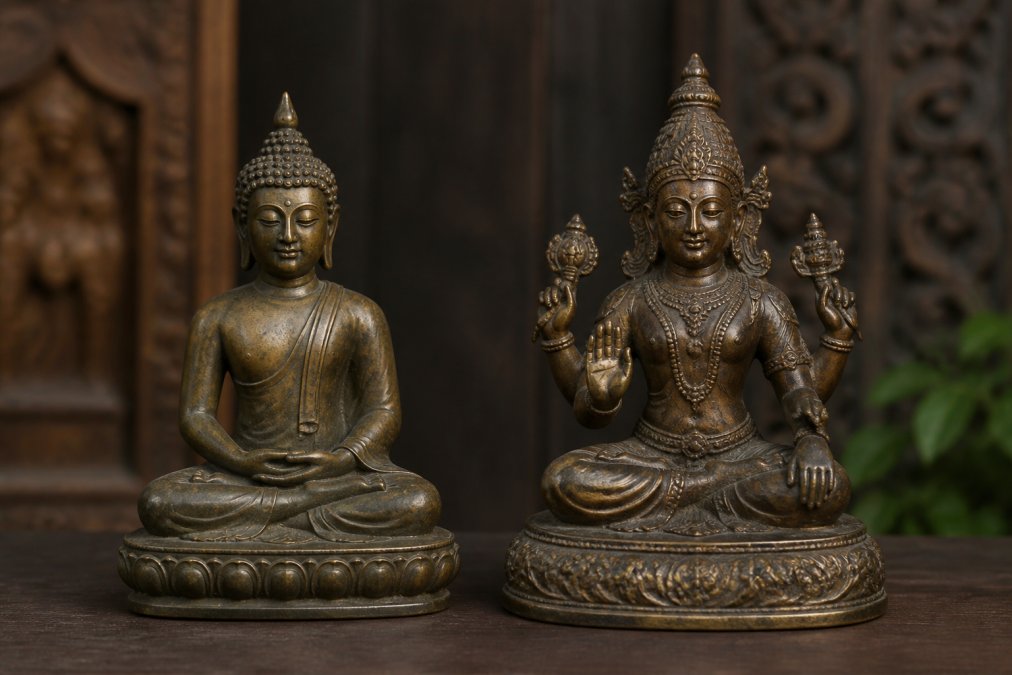
The clearest way to separate Hindu Buddhist mudras is to ask what the gesture is doing. Buddhist mudras usually tell a story about the Buddha. Hindu mudras usually identify a deity and express devotion. But the same hand shape can appear in both traditions with a different job, so the comparison only works if you look at the gesture, the figure, and the objects together.
| Feature | Hindu Mudras | Buddhist Mudras |
|---|---|---|
| Primary purpose | Invoke and identify a deity | Narrate the Buddha's life |
| Typical context | Ritual, devotion, temple worship | Meditation, teaching, iconography |
| Common examples | Anjali, Abhaya, deity-specific holds | Dhyana, Bhumisparsha, Dharmachakra |
| How to read them | Match gesture to deity attributes | Match gesture to a life event |
| Who makes the gesture | A named god or goddess | The Buddha, a bodhisattva, or a teacher |
| What the gesture points to | The deity's power, promise, or attribute | A specific moment in a sacred biography |
Shared Gestures, Different Jobs
The Abhaya Mudra is the clearest example. On a Buddha, the raised right hand with the palm outward marks reassurance and protection, a gesture tied to the Buddha's teaching. On a Hindu figure, the same raised palm often reads as a blessing granted to a devotee, and it may be paired with a second hand holding a specific object. Same shape, different sentence.
Gestures That Belong to One Tradition
Some positions do not cross over cleanly. The Bhumisparsha Mudra, the right hand reaching down to touch the earth, is overwhelmingly Buddhist. It marks the moment of enlightenment, when the Buddha called the earth as witness. You will rarely see it on a Hindu deity.
A Quick Visual Reading Order
When you cannot tell which tradition a piece belongs to, work in this order:
- Look at the figure. A seated figure with a serene, symmetrical face and a topknot is usually the Buddha. A figure with multiple arms, a third eye, or a specific animal mount is usually a Hindu deity.
- Look at the right hand. Raised palm outward is Abhaya in both traditions. Touching the earth is Bhumisparsha, which is Buddhist. Resting in the lap is Dhyana, which is common in both but far more common on Buddhist pieces.
- Look at the left hand and any held objects. A lotus, trident, drum, or conch narrows the identification to a specific Hindu deity. A wheel-shaped gesture at chest height points to the Dharmachakra, which is Buddhist.
- Look at the setting. A figure surrounded by attendants, animals, or a specific architectural frame is more likely Hindu. A figure seated alone under a bodhi tree or flanked by two standing attendants is more likely Buddhist.
How to Interpret Mudras in Art and Statuary
Learning how to interpret mudras in art starts with three checks, in order:
- Identify the figure first. Is it a Buddha, a bodhisattva, or a named Hindu deity?
- Read the right hand. Raised palm outward points to Abhaya; touching the earth points to Bhumisparsha.
- Check the left hand and any held objects. A lotus, trident, or drum narrows the identification fast.
Mudras in Meditation: From Gallery to Practice
Mudras are not only for looking at. In meditation, a hand position gives the body something specific to do, which many practitioners find steadies attention more than posture alone. That is the part most articles skip: they explain what a mudra means in art, but not what it does in a sitting practice.
Why a Hand Position Changes the Sit
The mechanism is straightforward. Your hands have a high density of nerve endings, and holding them in a deliberate, symmetrical position gives your attention a physical anchor. When the mind wanders, the hands are still there, a fixed reference point you can return to without opening your eyes. Most practitioners find that a defined hand position reduces the low-level restlessness that shows up in the first ten minutes of a sit.
A Step-by-Step Practice Guide
Here is a simple sequence you can use with any statue in your space. It takes about ten minutes and requires nothing beyond a cushion or a chair.
- Sit and settle. Find a position where your hips are slightly higher than your knees. Let your hands rest on your thighs, palms down, for one minute. This is the baseline, no mudra yet.
- Move into Dhyana Mudra. Bring your hands into your lap, palms up, right hand resting on top of the left, thumbs lightly touching. Let the hands rest there without gripping. Stay for three to five minutes.
- Notice the shift. Without changing anything, notice whether your attention feels different from the baseline minute. Most people report a slight drop in mental noise. If you do not notice anything, that is also useful information, keep going.
- Move into Anjali Mudra. Bring your palms together at the center of your chest, fingers pointing up, elbows relaxed. This is a natural opening or closing gesture. Stay for one minute.
- Return to Dhyana Mudra. Come back to the lap position for the final two to three minutes. Let the hands be still.
- Close. Release the gesture, rest the hands on the thighs, and take one slow breath before you open your eyes.
Using a Statue as a Visual Cue
A statue placed at eye level in a small corner is enough. The gesture on the statue becomes a visual cue each time you sit down, you see the Dhyana Mudra, and your hands move into it without a decision. That is the practical link between the art and the practice. The statue is not decoration in that moment; it is a reminder of the position.
What This Means for Choosing a Piece
If you are buying a statue for practice rather than display, prioritize a clear, unambiguous mudra over size or finish. A smaller piece with a crisp Dhyana or Abhaya Mudra will serve a meditation corner better than a larger piece with a gesture you have to squint at. The hands are the part you will look at every day.
Conclusion
The difference between Hindu and Buddhist mudras is less about the hands themselves and more about what the gesture is doing: telling a story or invoking a presence. Once you can read that, every statue in a collection becomes more legible.
Frequently Asked Questions
What are the fundamental differences between Hindu and Buddhist mudras?
Hindu mudras often serve ritual and devotional functions, invoking specific deities or channeling prana during worship. Buddhist mudras, particularly in Theravada and Mahayana traditions, emphasize teaching moments from the Buddha's life and support meditation practice. Both traditions share gestures like Anjali (palms together), but the intent and the deities associated with each gesture differ. Buddhist mudras tend to be more standardized across regions, while Hindu mudras vary widely by deity, region, and ritual context.
How do I identify the meaning of a Buddhist hand gesture on a statue?
Start with the hand position. The right hand raised with palm outward signals Abhaya mudra, meaning reassurance and protection. Both hands resting in the lap with palms up indicates Dhyana mudra, representing deep meditation. The right hand touching the earth represents Bhumisparsha mudra, calling the earth as witness to enlightenment. Cross-reference the gesture with the statue's posture, facial expression, and any objects held, since these details confirm which moment in the Buddha's life the sculpture depicts.
Do Hindu and Buddhist mudras share common origins?
Yes. Both traditions trace their use of symbolic hand gestures to shared Dharmic roots in the Vedic period, where ritual gestures accompanied chanting and offerings. As Buddhism developed in the 5th century BCE, it adopted and adapted existing gesture vocabulary. Over centuries, each tradition developed its own emphasis: Hindu mudras became closely tied to specific deities and tantric rituals, while Buddhist mudras centered on the Buddha's life events and meditative states. The overlap in basic gestures reflects this common heritage.
What is the significance of the Abhaya mudra in both traditions?
In Buddhism, Abhaya mudra represents the Buddha's gesture of reassurance, made after his enlightenment to calm a charging elephant and later used to dispel fear. In Hindu iconography, the same palm-outward gesture appears on deities like Shiva and Vishnu, signaling protection and the granting of refuge. The physical form is nearly identical, but the narrative context differs. When you see Abhaya on a Buddha statue, it recalls a specific life event; on a Hindu deity, it conveys an ongoing divine promise of safety.
