



Garuda Statue in Hindu and Buddhist Art: The Divine Eagle
Garuda Statue in Hindu and Buddhist Art: The Divine Eagle
A Garuda statue is one of the few Asian religious figures a visitor can recognize at a glance: a powerful winged being, sometimes a full bird with spread wings and sometimes a human figure with bird features. Yet the same image carries different meanings depending on whether it appears in a Hindu shrine or a Buddhist tantric setting. Collectors who treat every Garuda as interchangeable often end up with a piece that does not match the tradition they meant to honor. Here is how the divine eagle works across Asian cultures, and what to check before you bring one home.
Table of Contents
- Quick Takeaways
- Who Garuda Is Across Traditions
- Garuda in Hindu Art
- Garuda in Buddhist Art
- Regional Variations Across Asia
- Comparing Garuda Statue Types
- Displaying and Caring for a Garuda at Home
- Common Mistakes When Buying
- Frequently Asked Questions
- References
Quick Takeaways
|
Key Insight |
Explanation |
|---|---|
|
Hindu Garuda is read through Vishnu |
Garuda is primarily depicted as Vishnu’s mount, so a Hindu figure is usually understood through that devotional relationship. |
|
Buddhist Garuda is a protector form |
In Tantric Buddhism, Garuda is one form through which buddhas remove harm caused by nagas and poison. It is not a copy of the Hindu mount. |
|
There are two body types |
Zoomorphic figures show a full bird with partly open wings. Anthropomorphic figures show a winged human with bird features. Decide which you want before you compare prices. |
|
Read the posture first |
A figure grappling with a serpent tells a different story than a calm, composed bird. Posture is the fastest clue to tradition and intent. |
|
Poison has an inner meaning |
Buddhist sources describe the worst poisons as desire, hatred, and ignorance, so a Buddhist Garuda is also a reminder of inner afflictions. |
|
Ask about tradition, material, and age |
Lineage, carving or casting material, and age are the details that separate a documented piece from a generic listing. |
Who Garuda Is Across Traditions
Garuda is primarily depicted as the mount, or vahana, of the Hindu god Vishnu, and the figure also appears in Buddhist and Jain texts. Sources also give him the names Tarkshya and Vainateya. Before you can judge a statue, you need the basic family tree: Garuda is the son of the sage Kashyapa and Vinata, and the younger brother of Aruna, the charioteer of the Sun.
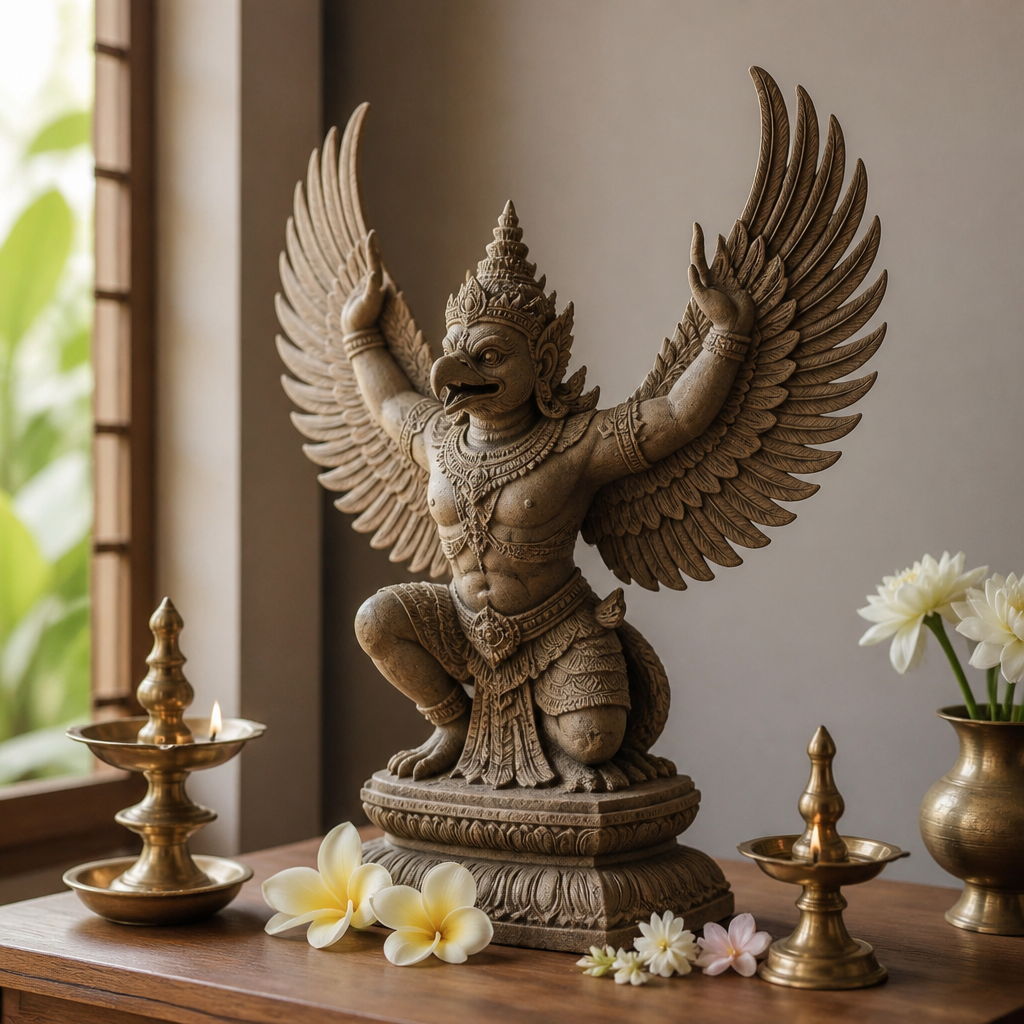
That genealogy matters more than it sounds. Garuda is a half-brother of the Nagas, the serpent beings, and he is generally portrayed as an enemy of every serpent. Almost every story about him turns on that opposition, so a Garuda in any tradition is usually shown as a force set against snakes and poison. When a seller calls a piece simply “Garuda,” the first question to ask is what the figure is doing with its wings and talons, because a figure gripping a serpent makes a different statement than a seated bird.
The bird itself is less exotic than the myth. Garuda is described as the king of birds and a kite-like figure, and the name is often linked to the greater adjutant stork, Leptoptilos dubius. That link helps explain why many sculptures show a large, powerful bird with a strong beak rather than a songbird. Garuda is also a state emblem in its own right. The figure appears in the state insignia of India, Indonesia, and Thailand, and both Indonesia and Thailand use Garuda as their coat of arms.
Pro tip: Note the posture before you read the label. A seated, hands-folded figure and a figure with wings spread over a serpent often come from different iconographic traditions, and the seller’s description should match what the sculpture is showing.
Garuda in Hindu Art
Vishnu’s Mount and Companion
In Hindu devotion, Garuda’s main identity is his service to Vishnu. He carries the god and stands as his loyal companion, which explains why many Hindu Garuda figures are made to be read alongside Vishnu rather than alone. Wikipedia’s overview of the figure stresses that Garuda is generally portrayed as a protector with the power to travel swiftly anywhere, ever vigilant. Those qualities are what a carver is trying to express when the wings are open and the head is raised.
Zoomorphic and Anthropomorphic Forms
Garuda appears in two main forms. The zoomorphic version is a giant bird with partially open wings, while the anthropomorphic version is a man with wings and some bird-like features. Both count as Garuda, but they feel very different on a shelf. A bird form emphasizes speed and raw power, whereas a human-bodied form puts more weight on devotion and the figure’s role as a servant of the god. When you compare pieces, decide which form you want before you look at price.
Garuda is the guardian who never sleeps, and a good statue should look as though it is listening for danger.
Hindu Garudas also have a life outside temples. The Indian Air Force named its special operations unit the Garud Commando Force, and the Indian Army uses the Garuda on its Guards Brigade Regimental Insignia. For a collector, those examples show how durable the image is. It is not an old motif that survives only in shrines. It remains a working symbol of strength and vigilance.
Garuda in Buddhist Art
Protector Against Nagas and Poison
In Buddhism, Garuda takes on a different job. In Tantric Buddhism he is one form in which various buddhas arise to remove disease and injury caused by nagas and by poisoning. That protective function sits at the core of most Buddhist depictions, which is why a Buddhist Garuda should not be sold as a decorative copy of the Hindu mount. The Himalayan Art Resources overview notes that the metaphorical worst poisons are desire, hatred, and ignorance. A Buddhist Garuda is therefore also a reminder of the inner afflictions a practitioner works to clear.
Dharmapala and Tantric Lineages
Wikipedia lists Garuda’s affiliation in Buddhism as Dharmapala, a protector of the dharma. In the Tibetan world, the figure is tied to two major tantric sources, the Chakrasamvara and Kalachakra Tantras, which are the main reference points for the Sarma lineages. Forms of Garuda are also found in the Nyingma tradition. Those lineage details matter, because a Nyingma piece and a Sarma piece may follow different iconographic habits. A seller who cannot say which one a sculpture belongs to is giving you less information than you need.
The Buddhist Door feature on the figure describes the bird as a symbol in traditional Buddhist teaching of the fundamental importance of compassion combined with wisdom. In practice, that means the bird is read as an emblem of two qualities rather than as a monster. When you hold a Buddhist Garuda, look for balanced features and a composed stance, not an aggressive one.
Regional Variations Across Asia
Himalayan and Bon Traditions
The Garuda story does not stop at the boundaries of Hindu and Buddhist India. The Himalayan Art Resources outline groups its material under topics that include the Vaishnava tradition, Nyingma and Sarma Buddhism, the Bon religion, and the Naxi religion. The Bon religion has a similar bird deity known as a kyung, a useful reminder that the bird-protector idea appears in several belief systems in the region. For a collector, a bird-protector figure from the Himalayan world may not be a Garuda in the strict sense, even when it looks close.
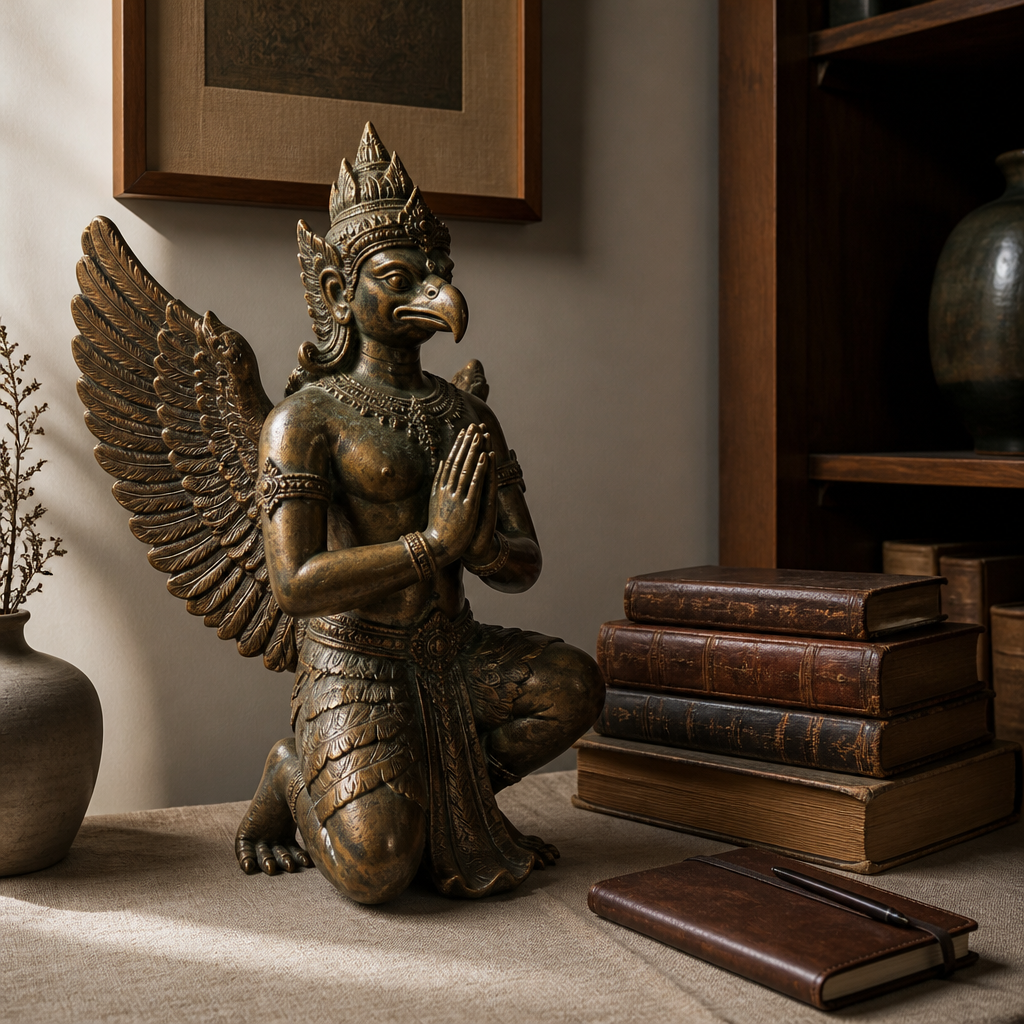
Pro tip: If a listing uses “bird deity” or “winged protector” without a name, ask whether the piece is Garuda, kyung, or another figure. The answer changes how it should be displayed and described.
National Emblems and Public Art
Garuda is part of the state insignia of India, Indonesia, and Thailand. Indonesia and Thailand both use Garuda as their coat of arms, and the figure’s presence on official seals and military badges means many people encounter Garuda first on public emblems. In practice, this has two consequences for buyers. A modern emblem-style Garuda is a different object from a devotional sculpture. Second, national associations can shape how a piece is received in a home, so decide early whether you want a devotional or decorative object.
Comparing Garuda Statue Types
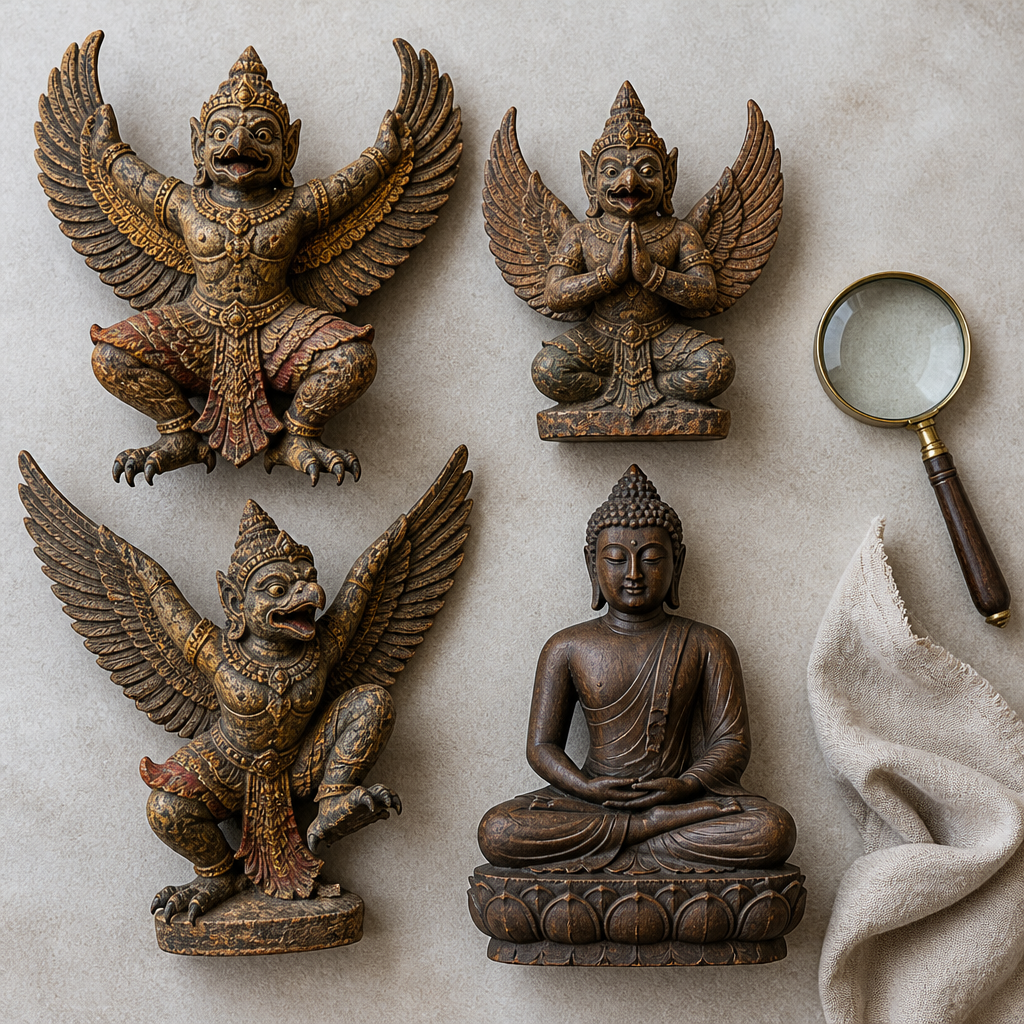
Three approaches cover most of what you will see when you shop for a Garuda statue. They differ in tradition, in visual cues, and in what a buyer should check before paying. The table below sets them side by side.
|
Type |
Usually Read As |
What to Check Before Buying |
|---|---|---|
|
Zoomorphic bird figure, with a full bird and partly open wings |
A Hindu Garuda tied to Vishnu, often displayed as a devotional or decorative piece |
Feather detail, beak and talon carving, and whether the base or mount is original to the figure |
|
Anthropomorphic winged figure, with a human body and bird features |
A devotional figure emphasizing service and devotion |
Join lines at the wings and arms, the balance between human and bird features, and consistency of carving |
|
Tantric Buddhist protector form |
A protective figure linked to Tantric practice and lineage |
Iconographic attributes, painted or gilded surfaces, and any inscriptions or consecration marks |
A common question is whether wood or metal is the better choice. The honest answer is that material should follow how you plan to use the piece. Wood suits a home altar where the figure will be placed carefully and kept away from heat, while metal tolerates routine handling better. Ask the seller to describe the material and any signs of age, and be wary of listings that say only “Garuda statue” with no further detail.
Displaying and Caring for a Garuda at Home
Placement on a Home Altar
A Garuda works best where its posture can be read. Give the figure a stable base and enough clear space around it, so the wings and beak are not crowded by other objects. Keep the figure at a height where its face is visible to the person who uses the altar, rather than tucked behind a candle or a vase.
Sort the altar by role. If the piece is Hindu, keep it with the devotional objects of your own practice. If it is Buddhist, place it with the protective figures you use. Mixing traditions on one shelf is a decision you should make on purpose, not one you drift into.
Materials and Care
Wood is the most sensitive material. Keep it out of direct sunlight and away from heating vents, since dry heat can open cracks in the grain. Metal figures need less protection but benefit from a soft brush or dry cloth, and they develop patina over time. Avoid polishing an aged piece with abrasives, because you may remove the surface that gives it character and value.
Gilded and painted surfaces should only be dusted. Damp cloths can lift pigment and gold, and once that happens, no amount of careful restoration brings back the original surface.
Common Mistakes When Buying
Confusing Garuda with Other Mythical Creatures
A common mistake is to call any winged or bird-headed figure a Garuda. Makara, a sea creature that often appears in Hindu and Buddhist decoration, is a different figure, and so are many bird-like deities from other traditions. Check the body, beak, wings, and posture before you accept a label. If a seller cannot explain why a figure is a Garuda rather than another creature, treat that as a warning sign.
Buying Without Provenance
Provenance is the weak point in most online listings. A short description that names the country and the tradition is more useful than a long story with no detail. Ask where the piece was carved or cast, whether it has been conserved, and what material it is made from. Serious collectors look for documentation, not just adjectives.
Pro tip: Ask for a close-up of the wings, beak, and base before you commit. Those three areas show the most about carving quality and whether the piece was assembled from parts.
If you want to compare pieces side by side, you can browse our Garuda range at HD Asian Art.
Frequently Asked Questions
Is Garuda a Hindu or a Buddhist deity?
Garuda is primarily a Hindu figure, depicted as the mount of Vishnu. He also appears in Buddhist art as a protector and in some Tantric forms, and he is mentioned in Jain texts as well.
What is the difference between a Hindu and a Buddhist Garuda statue?
A Hindu Garuda is usually understood through his devotional role with Vishnu. A Buddhist Garuda is typically a protective form tied to Tantric practice, associated with removing harm from nagas and poison. The posture, attributes, and lineage of the piece usually reveal which one you have.
Why is Garuda sometimes shown with a human body?
Garuda appears in both a zoomorphic form, as a giant bird with partly open wings, and an anthropomorphic form, as a man with wings and some bird-like features. The human-bodied version places more emphasis on devotion and service, while the bird form stresses speed and power.
Is Garuda an eagle?
Garuda is described as a kite-like figure and the king of birds, and the name is often associated with the greater adjutant stork. Most sculptures take the eagle-like form as a symbol rather than a precise portrait of any one species.
Which countries use Garuda as a national symbol?
Garuda appears in the state insignia of India, Indonesia, and Thailand. Indonesia and Thailand both use Garuda as their coat of arms, and the Indian Army uses the Garuda on its Guards Brigade Regimental Insignia.
How should I clean a Garuda statue without damaging it?
Dust regularly with a soft brush or dry cloth. Avoid abrasive polishes, especially on aged metal and wood, and never wipe gilded or painted surfaces with a damp cloth. Keep the piece away from direct sun and heat sources.
If you have lived with a Garuda figure, tell us in the comments what drew you to this divine eagle and how it has found its place in your home or collection.
References
-
Guide to Garuda in Tantric Buddhism, Nyingma, Sarma, and Bon traditions
-
Buddhist Door feature on the meaning of Garuda in Buddhist teaching
