



Ganesha Statue: Symbolism, Styles & How to Choose
Ganesha Statue: Symbolism, Styles & How to Choose
Most people pick a Ganesha statue based on looks alone, then wonder why it feels wrong in their space. That approach ignores centuries of iconographic tradition that makes each detail of a Ganesha statue functionally meaningful, not merely decorative.
Whether you are a collector building a serious Hindu deity statue collection, a spiritual practitioner setting up a home altar, or an interior decorator looking for depth beyond aesthetics, understanding what each element means changes everything about how you choose and place one.
Table of Contents
Quick Takeaways
|
Key Insight |
Explanation |
|---|---|
|
The trunk direction carries specific meaning |
A trunk curling left signals worldly blessings and is easier to propitiate. A trunk curling right represents the path of spiritual power and requires strict ritual observance. |
|
The number of arms indicates iconographic lineage |
Two-armed Ganesha forms are typically older and simpler; four-armed and eight-armed forms reflect later Puranic elaboration and carry more symbolic attributes. |
|
Regional origin shapes the visual vocabulary |
South Indian Ganesha sculptures differ sharply from Balinese, Cambodian, and North Indian forms in posture, facial proportion, and accompanying motifs. |
|
Material affects both longevity and ritual appropriateness |
Stone and bronze statues are preferred for permanent altars. Resin reproductions are not suitable for consecrated use by serious practitioners. |
|
The vahana (vehicle) identifies specific Ganesha aspects |
The mouse vahana represents the ego subdued by wisdom. Its presence or absence changes what the sculpture communicates iconographically. |
|
Seated versus dancing postures serve different intentions |
The seated form (Sukhasana) conveys stability and grounding. The dancing form (Nritya Ganapati) reflects joy, creativity, and dynamic energy. |
|
Provenance matters for collectors and practitioners alike |
Museum-quality pieces from established dealers document regional origin and age, which affects both value and authenticity for serious buyers. |
Who Is Ganesha and Why Does He Matter
Ganesha is the elephant-headed son of Shiva and Parvati in the Hindu tradition, and he holds a role that no other deity in the pantheon occupies. He is invoked first, before any other god, at the start of rituals, business ventures, travel, artistic projects, and educational pursuits. This position as the remover of obstacles and the lord of beginnings is not a folk tradition. It is codified in texts including the Rigveda and the Ganapati Atharvasirsha Upanishad.
For collectors at HD Asian Art, Ganesha represents one of the most iconographically rich subjects in all of Hindu art. Each sculpture is a visual theology, not just an object. That is precisely why buying one requires more than a glance at shape and price.
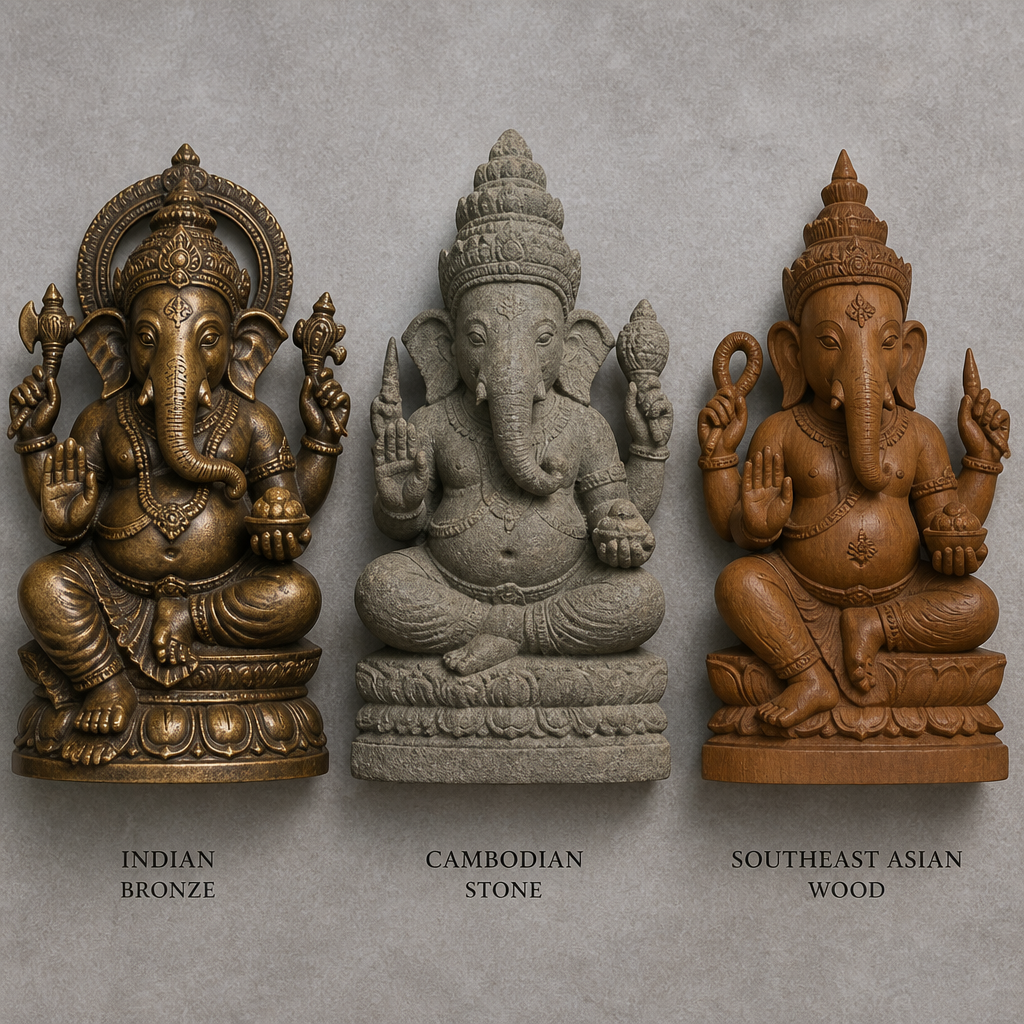
The worship of Ganesha spread beyond India into Southeast Asia, particularly through the Khmer Empire in Cambodia and through Hindu-Buddhist syncretism in Bali, Java, and Thailand. This geographical spread produced genuinely distinct artistic traditions, all representing the same deity but through radically different visual languages. A collector who understands this difference can build a collection with real intellectual coherence.
Ganesh Sculpture Meaning: Decoding Every Iconographic Detail
Every element of a Ganesha sculpture carries deliberate meaning rooted in Sanskrit texts and devotional tradition. Understanding these elements is not academic pedantry. It is the difference between a statue that serves its purpose and one that is simply decorative.
The Elephant Head
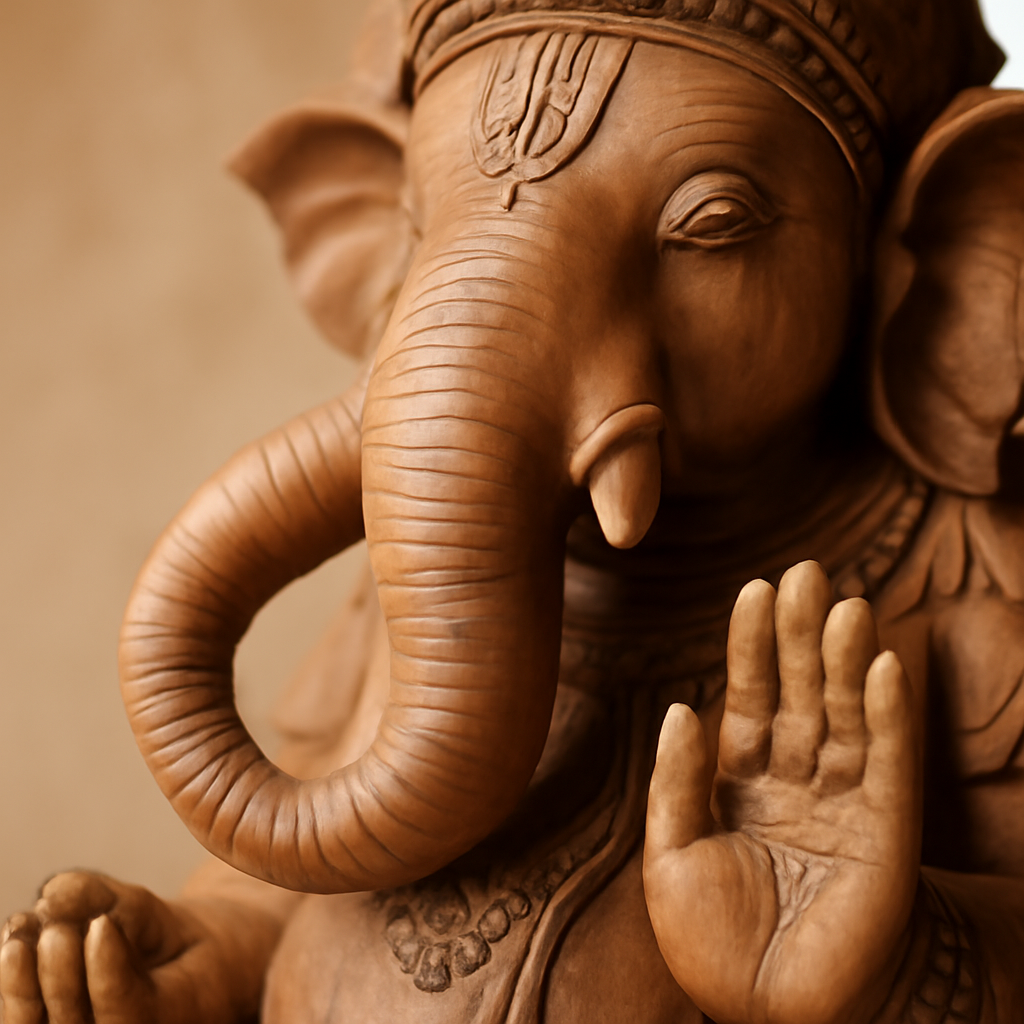
The elephant head is the most obvious feature, but its meaning is layered. The large ears symbolize the capacity to listen and discriminate between truth and noise. The single tusk, which appears in most iconographic traditions, refers to the story in which Ganesha broke off his own tusk to use as a writing instrument when transcribing the Mahabharata. This detail signals his role as patron of writing, intellect, and learning.
The broken tusk also teaches that true wisdom sometimes requires sacrifice. In practice, a sculpture with both tusks intact may represent an earlier or regional variant, or simply a different artistic choice. Collectors should note this variation because it affects iconographic accuracy.
The Trunk Direction
This is the detail most buyers overlook, and it is arguably the most functionally significant. A trunk curling to the left (from the statue's perspective) is called Vamamukhi and represents the ida nadi, the lunar channel associated with cooling, worldly blessings, and accessibility. This form is considered appropriate for homes and general worship without demanding strict ritual protocol.
A trunk curling to the right is Dakshinamukhi and is associated with the pingala nadi, the solar channel. This form is considered more powerful and is generally reserved for temples and practitioners following strict sadhana. Placing a right-trunk Ganesha in a casual home setting without proper ritual observance is considered inauspicious in traditional Hindu practice. Most of the Ganesha statues appropriate for home altar decorators and spiritual practitioners lean left for this reason.
The Four Hands and Their Attributes
The four-armed Ganesha, the most common form, typically holds a goad (ankusha) to drive the mind forward, a noose (pasha) to restrain attachments, a modaka sweet symbolizing the sweetness of spiritual achievement, and offers the gesture of abhaya mudra, which signals protection and blessing. Variations exist across different Ganesha aspects, with some forms holding a lotus, a manuscript, or musical instruments.
"Ganesha's form is a complete philosophical statement. Every attribute he carries is a teaching, not a decoration. To ignore the iconography is to miss the entire conversation the sculpture is trying to have with you." - Dr. T.A. Gopinatha Rao, Elements of Hindu Iconography
The Mouse and the Modaka
The mouse, Mushika, serves as Ganesha's vahana or vehicle. The symbolism is deliberate and somewhat subversive: the lord of wisdom rides a creature associated with the gnawing of desire and ego. In high-quality sculptural traditions, Mushika appears at Ganesha's feet, often looking up with a modaka sweet in front of him. Sculptures that omit the mouse are not incorrect, but they lose one of the most psychologically rich elements of the iconography.
Pro tip: When evaluating a Ganesha statue for a home altar, check whether the modaka (the round sweet) is present in one hand. Its absence in a devotional piece is worth asking about, because some regional traditions substitute other attributes, while mass-produced pieces simply omit it for ease of casting.
Regional Styles of Ganesha Statues Across Asia
This is where the subject becomes genuinely fascinating for collectors. Ganesha traveled across Asia with Hinduism and Buddhism, and each regional tradition absorbed and transformed the iconography in ways that are now distinct artistic vocabularies.
South Indian Ganesha
The South Indian tradition, shaped largely by the Chola, Pallava, and Vijayanagara empires, produced some of the most refined bronze Ganesha sculptures ever made. These pieces typically feature an elongated trunk, a rounded and full body, and a strong emphasis on jewelry and ornamentation. The Chola bronze tradition in particular is considered a benchmark of Hindu religious art. South Indian Ganeshas often sit in Sukhasana (relaxed seated posture) with a visible potbelly, which in Hindu iconography represents both abundance and the containment of the universe.
North Indian Ganesha
North Indian styles, including those from Rajasthan, Gujarat, and the Deccan, tend toward more geometric, angular compositions. Marble Ganesha sculptures from Rajasthan are immediately recognizable by the fine inlay work and the whiter stone. Many North Indian forms are more vertical in their composition, with elaborate crowns and multi-armed configurations becoming more common from the medieval period onward.
Balinese and Javanese Ganesha
In Bali and Java, Ganesha statues reflect the Hindu-Buddhist syncretism that characterized Indonesian religious culture from roughly the 7th century onward. Balinese Ganeshas often feature more aggressive facial expressions, a wider range of accompanying motifs drawn from local cosmology, and distinctive volcanic stone (paras stone) as a material. The Javanese tradition produced some remarkable stone Ganeshas during the Majapahit period, where the deity is sometimes depicted seated on a throne of skulls, reflecting Shaivite tantric influences.
Cambodian and Thai Ganesha
Cambodian Ganesha sculptures from the Khmer period, particularly from the 9th to 12th centuries, are among the most sought-after by serious collectors. These pieces often show Ganesha in a standing posture, with a more slender body and distinctly Khmer facial features: wide, flat faces, slightly upturned lips, and elaborate headdresses. Thai Ganesha (Phra Phikanet) absorbed additional Buddhist visual elements and is widely venerated as a deity of the arts and commerce, making him a common presence in Thai commercial establishments.
Materials and Craftsmanship: What Separates Museum Quality from Mass Production
The materials question is not about snobbery. It is about what actually holds up, what is ritually appropriate, and what has genuine long-term value for collectors.
Bronze and Brass
Lost-wax cast bronze (cire perdue) is the premier medium for Hindu deity statues with a serious pedigree. Traditional bronze casting using the Panchaloha alloy (five metals including gold, silver, copper, iron, and zinc) remains the standard in South India for consecrated temple sculptures. Museum-quality bronze Ganesha statues retain natural patina that develops over decades and cannot be replicated artificially without expert examination. Brass, while similar in appearance, is a simpler copper-zinc alloy and is more common in contemporary production pieces.
A common mistake buyers make is confusing machine-cast brass with hand-finished bronze. The tells are in the detail sharpness around the fingers, the quality of surface treatment in recessed areas, and the weight consistency. Authentic lost-wax castings show subtle asymmetries because each mold is destroyed during the process.
Stone
Granite, schist, sandstone, and marble each have regional associations in Ganesha sculpture. Khmer period Cambodian pieces used local sandstone. South Indian temple Ganeshas favored granite. Rajasthani pieces used marble. Stone statues are excellent for permanent outdoor shrines or garden placement, provided the stone is appropriate to the climate. Sandstone is more vulnerable to moisture damage than granite or marble.
Why Resin and Polystone Are Not Comparable
Mass-produced resin or polystone Ganesha statues serve a decorative purpose, but they should not be confused with museum-quality Hindu deity statues. Beyond the obvious differences in material value, traditionally observant practitioners consider non-natural materials inappropriate for consecrated use. For serious collectors and practitioners, the material authenticity of a piece is inseparable from its meaning and value.
Pro tip: When purchasing a stone Ganesha statue online, always request a weight specification and images of the base and underside. Natural stone has weight and texture variation that resin composites cannot replicate. Any dealer who cannot provide these details is not selling what they claim to sell.
Choosing the Right Ganesha Statue for Your Space and Purpose
The right Ganesha statue depends on three factors that should be determined before you look at a single piece: your primary purpose (devotional, collectible, or decorative), your available space and placement options, and your regional or stylistic preference.
For Spiritual Practitioners and Altar Decorators
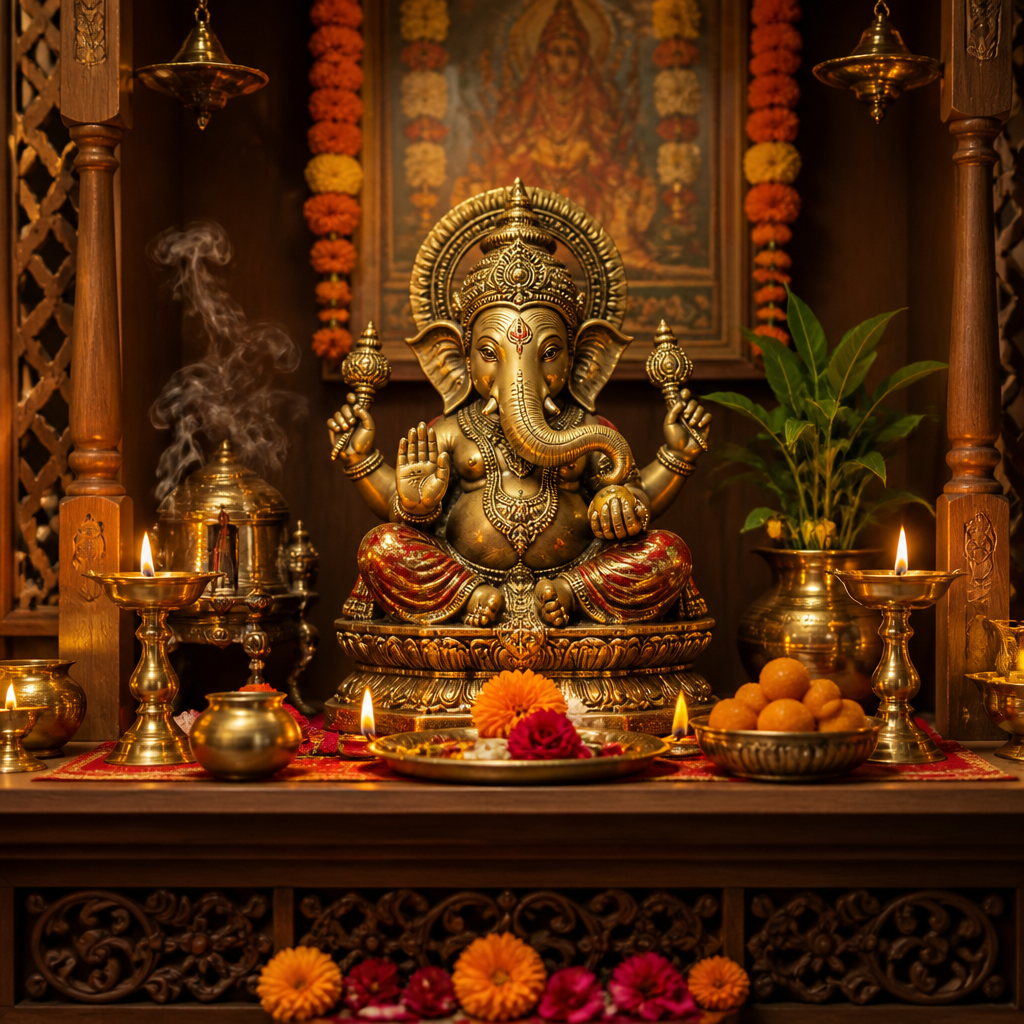
If you are setting up a home altar or puja room, the seated Ganesha with a left-curling trunk is the most appropriate choice for a non-specialist practitioner. The size should be proportional to the altar space: a four-inch statue on a large altar looks incorrect, just as a twelve-inch statue on a small shelf overwhelms the space. The general guidance in devotional practice is that the deity statue should be the visual focal point of the space without competing with surrounding objects.
The material matters here more than in a decorative context. A stone or bronze statue from HD Asian Art's Hindu deity statue collection brings both visual weight and material authenticity that resin pieces simply cannot match. Practitioners who engage in regular puja will notice the difference in how the space feels, even if they cannot always articulate why.
For Art Collectors and Antiquities Enthusiasts
Collectors should focus on regional specificity and iconographic completeness. A Khmer Ganesha with documented provenance is categorically different from a contemporary Indian reproduction, even if both are technically well-made. Look for pieces where the iconographic details are internally consistent with their stated regional and period origin. Mixing iconographic elements from different traditions (a South Indian body with a Balinese headdress, for example) is a reliable indicator of a reproduction aimed at uninformed buyers.
HD Asian Art sources pieces from Burma, Cambodia, China, India, Indonesia, Japan, Laos, Sri Lanka, and Thailand, which provides a genuine range for collectors building a geographically coherent collection of Hindu and Buddhist sculpture.
For Home Decorators
Decorative placement should still respect the basic iconographic logic. A Ganesha statue near an entrance honors the tradition of invoking Ganesha first, and it also works visually because entrance areas benefit from a clearly defined focal sculpture. The Dancing Ganesha (Nritya Ganapati) form works particularly well in creative spaces, studios, and home libraries, given his role as patron of the arts and intellect.
Placement and Direction: Where to Actually Put Your Statue
Placement guidance in Hindu tradition is not arbitrary. The Vastu Shastra texts, which inform traditional Indian architectural and spatial practice, give specific direction on where deities should be positioned.
Ganesha is most commonly placed facing north or east, which are considered auspicious directions in Vastu practice. The northeast corner of a room is particularly recommended for a puja altar. Placing a Ganesha statue in a bedroom is considered inappropriate in strict traditional practice, though many modern practitioners make pragmatic exceptions. Bathrooms and kitchens near cooking flames are consistently identified as unsuitable locations.
For collectors displaying pieces in a living room or study, the primary concern should be sight-line: the statue should be visible from the main seating area without being obscured. Placing a museum-quality piece in a corner or behind furniture defeats its purpose as an object meant to be engaged with visually.
Height matters too. In devotional practice, the deity should never be placed at floor level unless it is in a purpose-built base or shrine. Eye level or slightly above is the standard. For collectors, elevating a piece on a dedicated plinth or shelf communicates its importance relative to surrounding objects.
Comparing Three Major Ganesha Statue Styles
|
Style |
Best For |
Key Distinguishing Features |
|---|---|---|
|
South Indian Bronze (Chola tradition) |
Devotional altar use and serious collectors of Indian religious art |
Lost-wax cast, Panchaloha alloy tradition, rounded seated posture, rich ornamentation, natural patina. High iconographic fidelity. Most appropriate for consecrated puja. |
|
Khmer Stone (Cambodian, 9th to 12th century) |
Advanced collectors focused on Southeast Asian antiquities |
Sandstone or schist, standing posture common, flatter Khmer facial features, elaborate headdress, strong scholarly documentation. Museum-grade collectible category. |
|
Balinese Stone or Wood (Contemporary) |
Home decorators and practitioners interested in Hindu-Buddhist syncretism |
Volcanic paras stone or carved wood, more expressive facial character, local cosmological motifs, wider range of finishes. Excellent for outdoor garden placement in mild climates. |
Frequently Asked Questions
What does a Ganesha statue with a broken tusk mean?
The single broken tusk is one of Ganesha's most consistent iconographic features and refers to the story of Ganesha using his own tusk to transcribe the Mahabharata when his pen broke. It signals his role as a patron of writing and learning, and also represents the Hindu philosophical teaching that sacrifice accompanies wisdom. Most traditional Ganesha sculptures intentionally depict one full tusk and one broken one. A statue with both tusks intact is not incorrect, but it represents a different regional or historical variant rather than the most common iconographic convention.
Is it acceptable to place a Ganesha statue in a non-Hindu home?
Yes, and this is widely practiced across the world. Ganesha has been venerated outside India for over a thousand years, from Cambodia to Japan, within traditions that were not strictly Hindu. The key consideration is respect: treating the statue as a meaningful object rather than a novelty. Placing it thoughtfully, at an appropriate height, in a clean and respectful space, is the practical standard that most practitioners, both Hindu and non-Hindu, would endorse.
What size Ganesha statue is appropriate for a home altar?
The traditional guideline is that a home puja statue should be no larger than the span of your hand (roughly 4 to 8 inches for most adults). This comes from Agama Shastra texts that distinguish between domestic and temple scale. In practice, most home altar decorators find that a 6 to 10 inch statue provides enough visual presence without dominating a small altar space. For a dedicated puja room rather than a shelf altar, statues up to 12 to 18 inches are appropriate and proportionate.
Does the material of a Ganesha statue affect its suitability for worship?
In traditional Hindu practice, yes. Natural materials including stone, bronze, brass, copper, wood, and clay are considered appropriate for deity statues used in puja. Synthetic materials such as resin, plastic, and polystone are generally considered inappropriate for consecrated worship by observant practitioners, though they are widely used in decorative contexts. If your primary purpose is devotional rather than decorative, investing in a stone or bronze statue from a reputable source is the correct choice, not an extravagance.
What is the difference between Ganesh and Ganapati?
Ganesh, Ganesha, and Ganapati all refer to the same deity. Ganapati is a Sanskrit compound meaning lord (pati) of the ganas, the divine attendants of Shiva. Ganesha is a compound meaning lord (isha) of the ganas. Ganesh is the most common Hindi and colloquial form of the name. The name used in any given context often reflects the regional language and devotional tradition of the speaker rather than a meaningful theological distinction between different deities or aspects.
How do I identify a high-quality Ganesha statue versus a mass-produced replica?
Three indicators are reliable regardless of material. First, look at the detail quality in small areas: fingers, the mouse at the feet, the jewelry, the texture of the dhoti fabric. Mass-produced pieces blur these details. Second, check for internal iconographic consistency: the attributes held should be appropriate to the regional style and period claimed. Third, ask for provenance information. A reputable specialist dealer sourcing pieces from verified regions in Asia will be able to tell you the origin country and approximate age of what they are selling. Vague answers to direct provenance questions are a warning sign.
We would love to hear from you: do you display a Ganesha statue in your home or on an altar, and did the iconographic meaning influence your choice?
