



Burmese Lacquerware: History, Craft & Collecting Guide
Burmese Lacquerware: History, Craft & Collecting Guide
Few decorative art forms carry the weight of history quite like Burmese lacquerware. A single well-made Bagan bowl can represent twelve or more layers of lacquer applied over months, hand-engraved by an artisan working in a craft tradition that dates back over a thousand years.
Yet most collectors walk past these pieces at markets or online shops without knowing what separates a genuinely fine example from a mass-produced imitation. This guide covers the full picture: the history, the techniques, the regional styles, and the practical steps for building a collection worth owning.
Table of Contents
Quick Takeaways
|
Key Insight |
Explanation |
|---|---|
|
Bagan is the historic epicentre of production |
The city of Bagan in central Myanmar has been producing lacquerware for over a millennium and remains the benchmark for quality today. |
|
Layer count signals quality |
Museum-grade pieces typically have 9 to 18 layers of thitsi sap lacquer. Budget items rarely exceed 3 to 5 layers and crack far sooner. |
|
Horsehair and bamboo distinguish fine work |
Premium Burmese lacquerware uses a woven horsehair and bamboo core, which gives it enough flexibility to survive drops that would shatter ceramic. |
|
Yun engraving is the highest-skill technique |
Yun is a hand-incised engraving method filled with coloured lacquer. It requires years of training and commands a significant price premium over painted finishes. |
|
Condition matters more than age |
A mid-20th-century piece in perfect condition consistently outperforms a 19th-century example with flaking or repairs in both aesthetic and resale value. |
|
Buddhist iconography drives thematic value |
Pieces depicting the Jataka tales, the life of Buddha, or Hindu deities carry deeper cultural context and attract both spiritual collectors and art buyers. |
|
Specialist retailers offer provenance confidence |
Purchasing from a specialist in Asian religious and decorative art gives you access to sourcing transparency that general auction houses rarely provide. |
A Brief History of Burmese Lacquerware
The craft of applying lacquer sap to woven forms in Burma stretches back to at least the 11th century, with strong evidence tying its early development to the Bagan dynasty under King Anawrahta. Some scholars place the origins even earlier, pointing to trade connections with China's own lacquer traditions during the first millennium CE. What makes Myanmar's development distinctive is how quickly the craft adapted Buddhist narrative art into its decorative vocabulary.
By the Konbaung dynasty period (1752 to 1885), lacquerware had become both an important luxury export and an integral part of temple life. Monks' offering bowls, royal betel boxes, and manuscript covers were all produced in lacquer. The British colonial annexation of Upper Burma in 1885 disrupted royal patronage but paradoxically opened Western markets, creating a new export demand that kept workshops in Bagan active.
Through the 20th century, the craft survived socialist-era economic isolation largely because it required minimal industrial infrastructure. The workshops of Bagan passed knowledge between generations through apprenticeship, a system still functioning today. UNESCO recognised the cultural significance of this tradition by including it in regional intangible heritage documentation efforts, and Burma's lacquerware remains one of the most internationally traded categories of traditional Burmese art.
"The lacquer arts of Bagan represent one of Southeast Asia's most continuous and technically demanding craft traditions, comparable in complexity to Chinese cloisonné and Japanese urushi work." - Victoria and Albert Museum, Southeast Asian Decorative Arts catalogue notes
Understanding this history is not academic indulgence. It directly affects what you pay and what you get. Pieces made for temple use carry a different weight, literally and symbolically, than those made for the export market. Knowing the difference is the first skill any serious collector must develop.
The Craftsmanship: How Traditional Myanmar Lacquerware Is Made
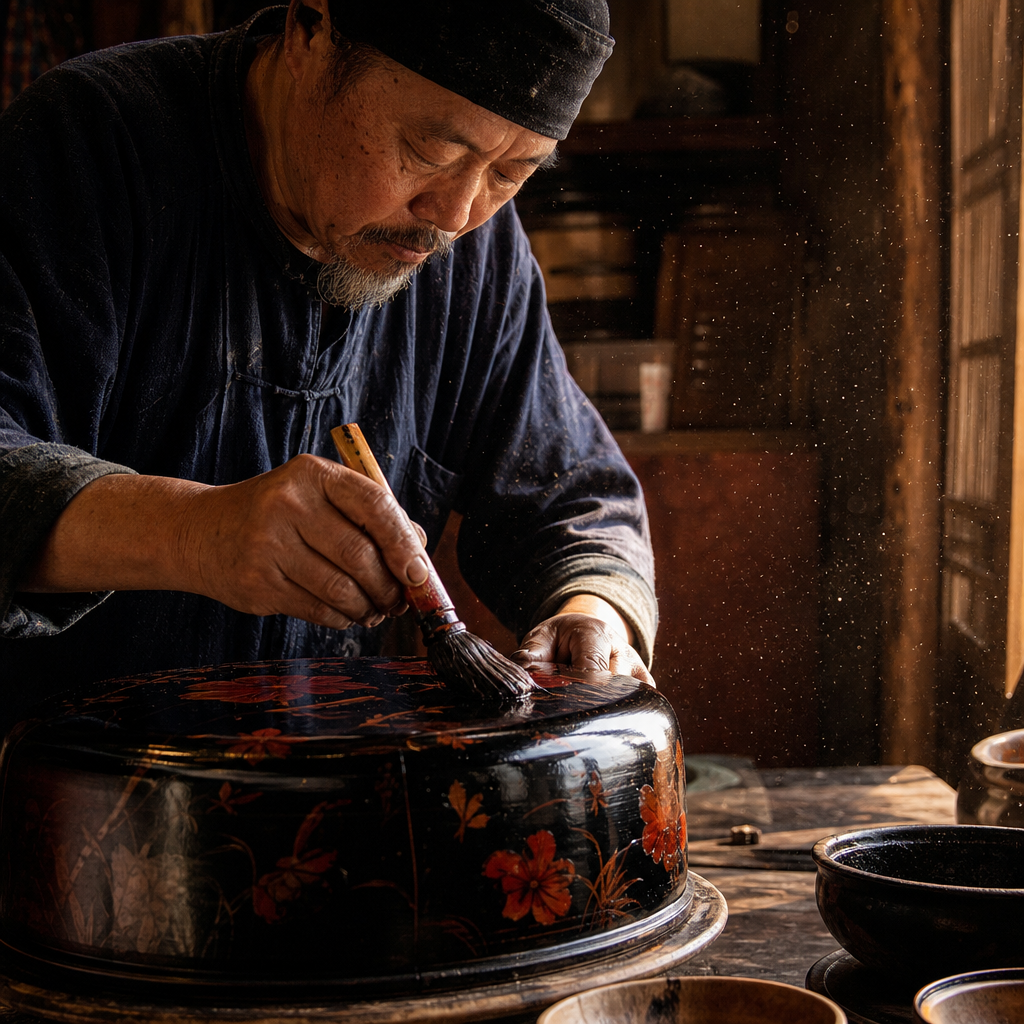
Making authentic Myanmar lacquerware is a process that demands patience most modern production schedules cannot accommodate. The raw material is thitsi, the sap of the Melanorrhoea usitata tree found across mainland Southeast Asia. It is harvested, filtered, and applied in thin coats to a woven core. Each coat must dry in a humid underground cellar for several days before the next is applied. Rush the process, and the layers separate. There is no shortcut that works.
Core Construction: Bamboo, Horsehair, and Wood
The quality of a lacquer piece begins with its core. Low-end items use a solid wood base, which is both heavier and more prone to cracking as wood expands and contracts with humidity changes. Mid-range pieces use tightly woven bamboo strips. The finest Bagan work, however, uses a combination of bamboo and woven horsehair, a technique called yun-de construction. This composite core is remarkably light and flexible, qualities that allow a well-made bowl to bend slightly under pressure without the lacquer surface cracking.
In practice, you can test this yourself at a reputable shop. A high-quality lacquered bowl should feel almost lightweight relative to its size. Press gently on the sides. A horsehair-core piece will yield very slightly. A wood-core piece will not. This single test eliminates a large portion of imitations.
The Yun Engraving Technique
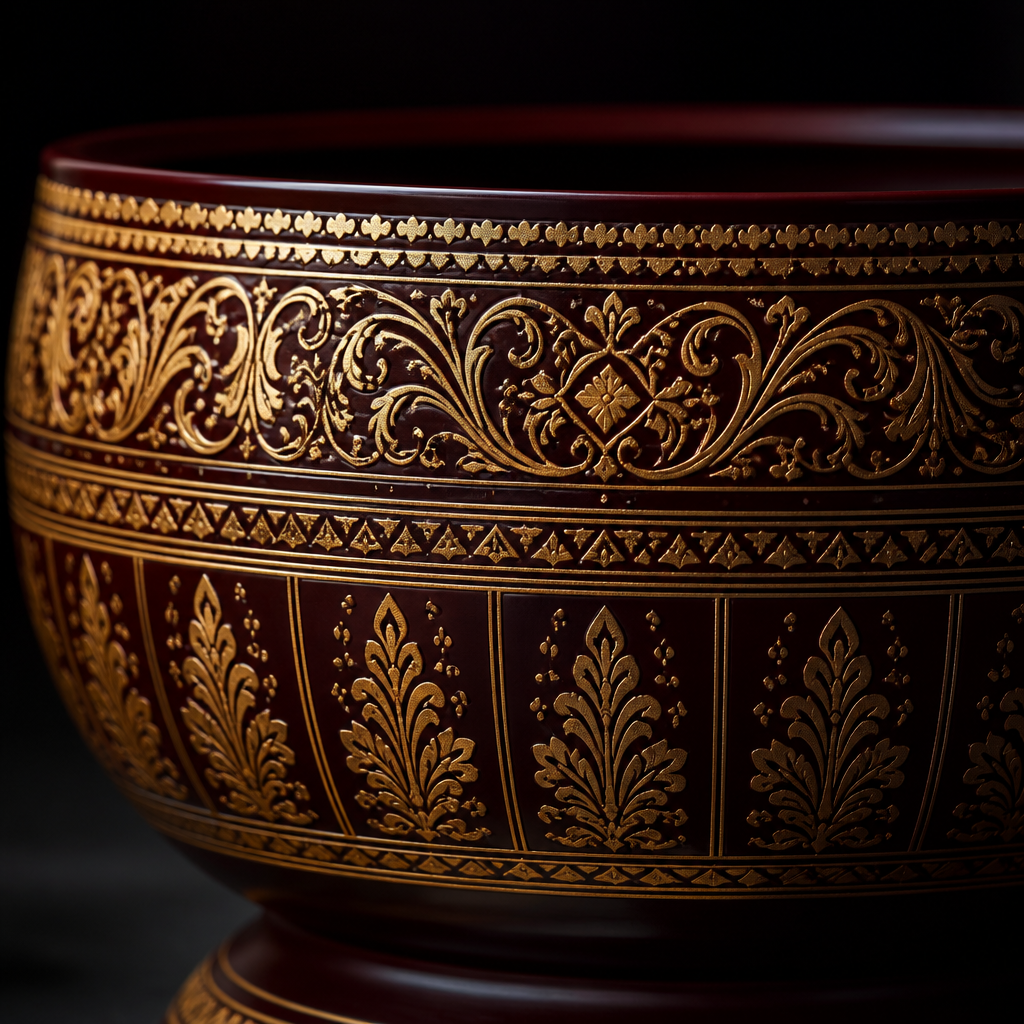
Yun is the technique that separates decorative lacquerware from fine art. After the base layers of lacquer are built up and the piece is sanded smooth, the artisan draws a design freehand and then incises it using a sharp stylus. Coloured lacquer, typically red, green, yellow, or black, is then worked into the incised lines. Each colour requires its own drying cycle. A piece with four colours will go through at minimum four separate engraving and filling stages. The result is a design with crisp, inlaid colour that cannot peel off the surface because it sits within the lacquer body itself, not on top of it.
Painted finishes, by contrast, sit on the surface and will eventually show wear. They are easier to produce, cost less, and are entirely appropriate for decorative use. But they are not yun. A common mistake among new collectors is paying yun prices for a painted piece simply because the colours are vivid.
Pro tip: Examine the edge of any coloured motif under good light. In genuine yun work, the colour is slightly recessed into the lacquer surface. In painted work, the colour sits proud of the surface and you can often feel a slight ridge with your fingernail.
Regional Styles and What Makes Each One Distinct
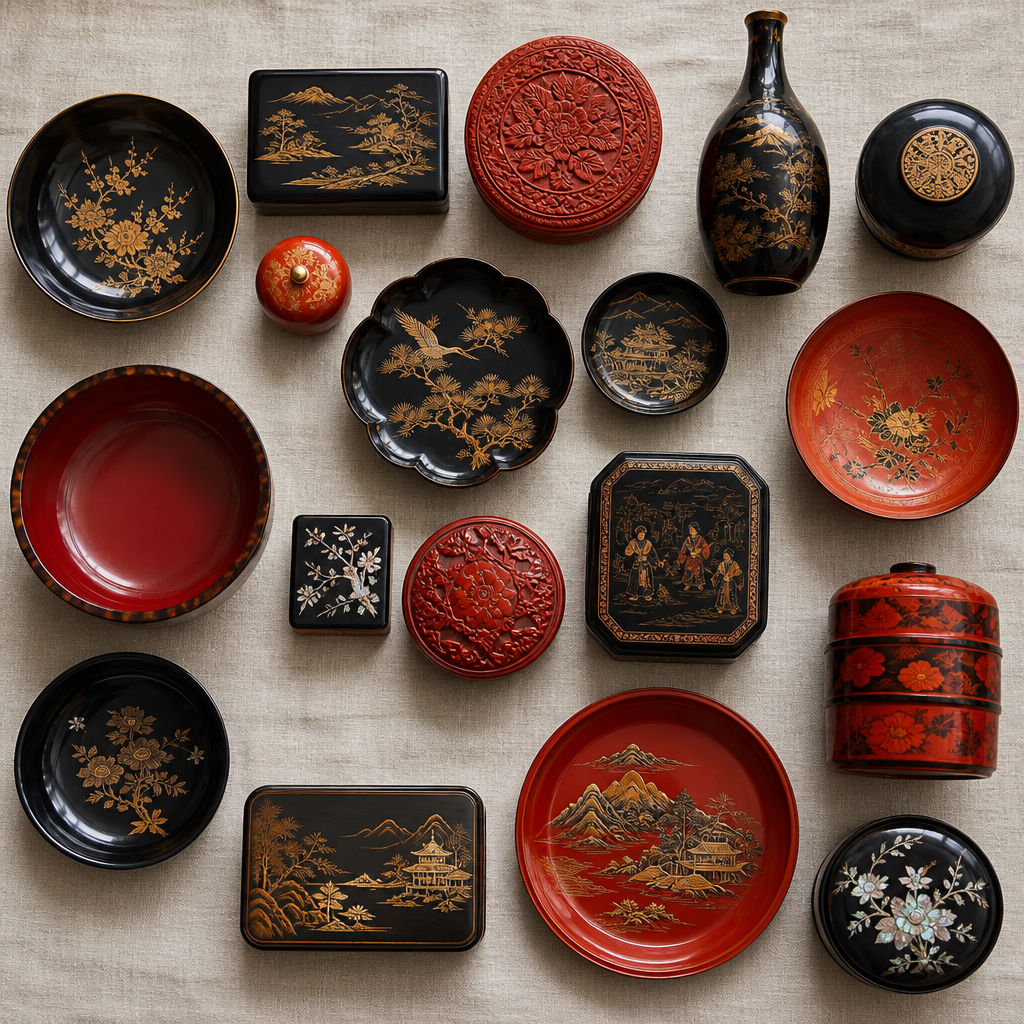
Burma's lacquerware tradition is not monolithic. Geography, patronage, and local artistic conventions created genuinely distinct regional styles, each of which occupies a different position in the collector market.
Bagan: The Prestige Standard
Bagan dominates the market for high-quality traditional work. The city's workshops have the longest unbroken production history and the deepest pool of skilled yun engravers. Iconography tends toward Buddhist narrative scenes from the Jataka tales and images from the life of Gautama Buddha. Colour palettes are traditionally restrained: red, black, and yellow dominate classical pieces, with green becoming more common in 20th-century work. If you are serious about Asian lacquerware collection building, Bagan pieces should anchor it.
Kengtung and Shan State: A Different Aesthetic
Shan-style lacquerware from the eastern highlands uses broader, bolder decorative motifs and a slightly different lacquer formulation. The colour application tends to be less intricate than Bagan yun but the forms, including tall tapered boxes and offering stands, are architecturally striking. Shan pieces work particularly well in interior design contexts because their scale is more dramatic.
Royal Mandalay Pieces
Pre-1885 Mandalay-period lacquerware produced for royal and aristocratic patrons represents the peak of the form. These pieces often incorporate gilding alongside lacquer and feature extraordinarily fine detail work. They are rare in the open market. When they appear, expect prices that reflect their historical status. Verified Mandalay royal-period pieces belong in the same conversation as other major Southeast Asian decorative arts at auction.
Authenticating Quality: What to Look for Before You Buy
Authentication in the lacquerware market is primarily a matter of informed observation rather than scientific testing, at least at the collector level. The markers of quality are visible to anyone who knows what to look for.
First, assess weight and flexibility as described above. Second, examine the surface finish. Authentic thitsi lacquer has a depth of colour that synthetic lacquers do not replicate well. Hold the piece at an angle to a light source. Genuine lacquer shows a subtle translucency in the surface layers, as if the colour is lit from within. Synthetic finishes look flat by comparison.
Third, look at the interior of the piece. On high-quality work, the interior is finished with the same care as the exterior. Budget pieces often have rough, unfinished or crudely lacquered interiors because that surface is less visible. Fourth, study the iconographic accuracy of any Buddhist or Hindu imagery. A workshop producing pieces quickly for the tourist market will frequently distort figures or simplify mudras (hand gestures). A workshop with genuine craft tradition and Buddhist knowledge gets the iconography right because it matters to the artisans themselves.
Pro tip: When buying Burmese lacquerware online, always ask the seller for photographs of the interior base, the rim in close-up, and at least one detail shot of the decorative motifs. Any reputable specialist will provide these without hesitation. Reluctance to provide detail images is itself diagnostic.
Comparison of Collecting Approaches
|
Collecting Approach |
Best For |
Key Considerations |
|---|---|---|
|
Thematic Collection (Buddhist Iconography Focus) |
Spiritual practitioners, altar decorators, and collectors who want pieces that carry cultural and religious meaning |
Requires knowledge of Buddhist narrative art to assess iconographic quality. Pairs naturally with Buddha statues and Hindu deity figures from the same regional tradition. HD Asian Art's existing religious sculpture inventory creates a natural pairing context. |
|
Form-Based Collection (Bowls, Boxes, Trays) |
Interior designers and decorators seeking cohesive Asian decorative art displays |
Focuses on shape, scale, and visual harmony rather than iconographic depth. Easier to build quickly. Risk is assembling visually similar pieces that lack diversity of technique or period. |
|
Technique-Focused Collection (Yun Engraving Specialists) |
Serious art collectors and antiquities enthusiasts interested in craft mastery |
Narrower acquisition criteria produces a more coherent collection but limits options. Premium pricing is consistent. Long-term value retention is strongest in this category because yun skills are genuinely declining in availability. |
How to Start Your Burmese Lacquerware Collection
The single most common mistake new collectors make is starting with price rather than education. Spending less before you know what you are looking at almost guarantees buying pieces you will later want to replace. A more effective approach: buy one genuinely excellent piece at a fair price and use it as your reference standard for everything that follows.
Set a Clear Thematic Focus Before You Buy Anything
A collection without a theme is just an accumulation of objects. Decide early whether you want a thematic focus on Buddhist narrative art, a focus on a specific form like offering bowls or betel boxes, or a technique-based collection centred on yun engraving. This decision will make every subsequent purchase easier and produce a collection that has visual and intellectual coherence.
For collectors who already own Buddha statues or Hindu deity figures, the natural starting point is lacquerware that complements that existing collection. A Burmese Buddha figure displayed alongside a Bagan lacquerware offering bowl from the same regional tradition creates context that neither piece has alone. This is how serious collectors think about Asian decorative art as a whole rather than as isolated categories.
Source From Specialists, Not General Markets
General antique markets and non-specialist online platforms are where the majority of problematic pieces circulate. A seller who moves furniture, ceramics, and lacquerware with equal confidence is almost certainly not the person who can tell you which Bagan workshop produced a piece or what period its iconographic style suggests.
Specialist retailers in Asian religious and cultural art occupy a fundamentally different position. Their sourcing is deliberate, their staff knowledge is specific, and their reputational risk from selling misattributed pieces is real. When you buy Burmese lacquerware from a specialist like HD Asian Art, you are also buying access to the knowledge base that went into selecting that piece in the first place. That knowledge is not reflected in the price tag alone, but it is present in the curation.
Budget Allocation for a Starting Collection
A reasonable starting budget for a focused collection of three to five quality pieces sits between £200 and £800 at current market pricing for authenticated, hand-crafted traditional work. Allocate your largest single spend to the first piece, which should be your quality benchmark. Subsequent pieces can vary in price as you develop the confidence to assess quality independently.
Be skeptical of any piece marketed as antique Burmese lacquerware priced below £50. Genuine antique pieces require provenance documentation that few sellers at that price point can provide. At the other end of the scale, five-figure pricing for lacquerware requires the same due diligence you would apply to any significant art acquisition, including condition reports and, where possible, independent expert assessment.
Caring for Your Asian Lacquerware Collection
Thitsi lacquer is robust by historical standards but has specific vulnerabilities that collectors must understand. The two primary enemies of lacquerware are direct sunlight and very low humidity. UV exposure bleaches traditional lacquer colours over years of display. A piece displayed in a south-facing window that receives direct afternoon sun will show measurable colour change within a decade.
Low humidity causes the woven core to contract at a different rate than the lacquer layers applied to it, eventually producing hairline cracks in the surface. In heated interiors during winter months, a humidifier near your display area is not excessive, particularly for pieces with thin lacquer walls like bowls and trays.
Cleaning is straightforward: a soft, barely damp cloth is sufficient for dust removal. Never use alcohol-based cleaners, acetone, or any solvent product on lacquerware. These strip the surface lacquer rapidly and the damage is irreversible. For significant dirt accumulation on a valuable piece, consult a conservator who has experience with Asian lacquer before attempting cleaning yourself.
Storage for pieces not on display should use acid-free tissue for wrapping, never bubble wrap in direct contact with the lacquer surface, which can leave permanent impressions. Store vertically where possible to avoid pressure deformation of thin-walled pieces.
Pro tip: When displaying lacquerware alongside other objects, avoid grouping it with ceramic pieces that might shift and chip the lacquer surface. Lacquer is harder than it looks but is not impact-resistant in the way fired ceramic is. Give lacquer pieces space on the display shelf.
Frequently Asked Questions
What is the difference between Burmese lacquerware and Chinese or Japanese lacquerware?
The core material differs significantly. Burmese lacquerware uses thitsi sap from Melanorrhoea usitata, while Japanese urushi lacquer comes from a different tree species entirely. Chinese lacquerware often uses carved lacquer techniques that build up many layers specifically to enable three-dimensional carving, a method not traditional to Burma. Burmese yun engraving works with the surface of a built-up lacquer body rather than through it, producing a different visual character. The Buddhist narrative iconography that dominates Burmese decorative programmes is also distinctly Theravada in character, separating it from Mahayana-influenced East Asian lacquer arts.
How many layers of lacquer should a quality piece have?
For everyday-use pieces such as bowls and trays intended for actual food service or general decorative use, seven to nine layers is considered solid quality. For collector-grade or display pieces, nine to eighteen layers is the range associated with fine traditional work. Each layer requires several days of drying in a specific humidity-controlled environment, so the layer count directly reflects the time investment. Pieces with fewer than five layers are unlikely to maintain surface integrity over decades of display, particularly in environments with seasonal humidity variation.
Is it ethical to collect Burmese lacquerware given Myanmar's current political situation?
This is a question serious collectors ask and should ask. The clearest ethical position is to purchase from sources that can demonstrate their pieces were sourced before the 2021 crisis or through channels that demonstrably support artisan communities rather than military-connected export enterprises. Established specialist retailers in Asian art who have maintained sourcing relationships over years are better positioned to provide this transparency than opportunistic market sellers who entered the Myanmar category recently. Supporting documented artisan tradition is categorically different from funding political actors.
Can Burmese lacquerware hold food and liquid?
Traditional thitsi lacquer was developed specifically as a food-safe coating and was used throughout Southeast Asian Buddhist communities for exactly this purpose, including for monks' alms bowls. High-quality, fully cured traditional lacquerware is food-safe, heat-resistant to moderate temperatures, and waterproof. However, most collector-grade pieces are best kept for display rather than active use because practical use accelerates wear to the decorative surface and reduces long-term value. If you specifically want functional lacquerware for use, purchase display-grade pieces separately from your collection pieces.
How do I know if a piece described as antique is genuinely old?
Without laboratory thermoluminescence testing, which is rarely economical for lacquerware relative to its price, you are relying on physical evidence and seller credibility. Genuine age shows in the evenness of surface patina, the depth of colour oxidation, and minor wear at contact points like the base and rim. These wear patterns are very difficult to fake convincingly. A common indicator of artificially aged pieces is inconsistent wear: heavy oxidation on the surface combined with a suspiciously clean interior base, or wear marks that do not correspond to how the object would actually have been handled. Purchase from sellers who can provide provenance documentation and who have a track record in the field.
What forms of Burmese lacquerware are most popular with collectors?
Offering bowls in various sizes consistently attract the broadest collector interest because they connect directly to Buddhist practice and display well in both dedicated altar settings and general interior design contexts. Betel boxes, which were produced for aristocratic use and often feature the finest yun work, attract connoisseur-level collectors willing to pay premiums for quality. Manuscript covers and ceremonial trays are rarer and attract specialist buyers. For new collectors, starting with a well-made offering bowl or a covered storage box gives you a piece with both practical display appeal and genuine craft content.
If you have a question about a specific piece you are considering, or if you have your own experience buying or collecting traditional Asian lacquerware, share your thoughts in the comments below.
We would love your feedback and any insights you would share with others. What perspective would you add?
References
-
Victoria and Albert Museum - Southeast Asian decorative arts research and collection documentation
-
Encyclopaedia Britannica - historical and technical overview of lacquerware traditions across Asia
