



Burmese Lacquerware: History, Craft & Authenticity
Burmese Lacquerware: History, Craft & Authenticity
Most buyers handle a piece of Burmese lacquerware, admire the gleam and the fine engraved patterns, and have no reliable way to tell whether they are holding a century-old treasure from Bagan or a factory reproduction finished last month. That gap between appreciation and knowledge costs collectors real money and erodes trust in Myanmar traditional art as a whole.
This guide exists to close that gap. We will move through the complete story of Burmese lacquerware, from its earliest documented origins, through the specific craft techniques that define quality, to the practical tests any buyer can apply before making a purchase decision.
Table of Contents
Quick Takeaways
|
Key Insight |
Explanation |
|---|---|
|
Horsehair weave is the mark of fine quality |
Top-tier authentic lacquerware uses a coiled horsehair or bamboo core that flexes without cracking, unlike rigid factory molds. |
|
Authentic pieces require months to complete |
A single high-quality bowl can take three to six months due to repeated lacquer applications, each requiring a full drying and curing cycle. |
|
Bagan remains the primary production center |
Bagan workshops have produced lacquerware continuously since at least the 13th century, making provenance from this region especially significant. |
|
The flexibility test is your best quick check |
Genuine thayo-worked pieces show slight flex without fracture; rigid, brittle pieces almost always indicate modern resin composites. |
|
Engraving depth signals hand work |
Hand-engraved motifs have variable line depths and slight irregularities. Machine-stamped patterns show perfectly uniform depth throughout. |
|
Color range reveals age and technique |
Traditional lacquerware uses mineral-based pigments producing muted reds, blacks, and greens. Bright synthetic colors point to post-1970s production at the earliest. |
|
Myanmar traditional art carries export documentation |
Legitimate antique lacquerware pieces exported after 2014 should carry export permits under Myanmar's Protection and Preservation of Cultural Heritage Regions Law. |
Origins and History of Burmese Lacquerware
The first confirmed evidence of lacquerware production in Burma dates to the Bagan period, roughly 1044 to 1287 CE, when artisans produced ceremonial vessels and offering bowls for Buddhist temples. The craft almost certainly predates this period, with scholars pointing to trade connections with Yunnan province in China as a likely earlier source of both the technique and the raw material, thitsi, the sap of the Melanorrhoea usitata tree native to mainland Southeast Asia.
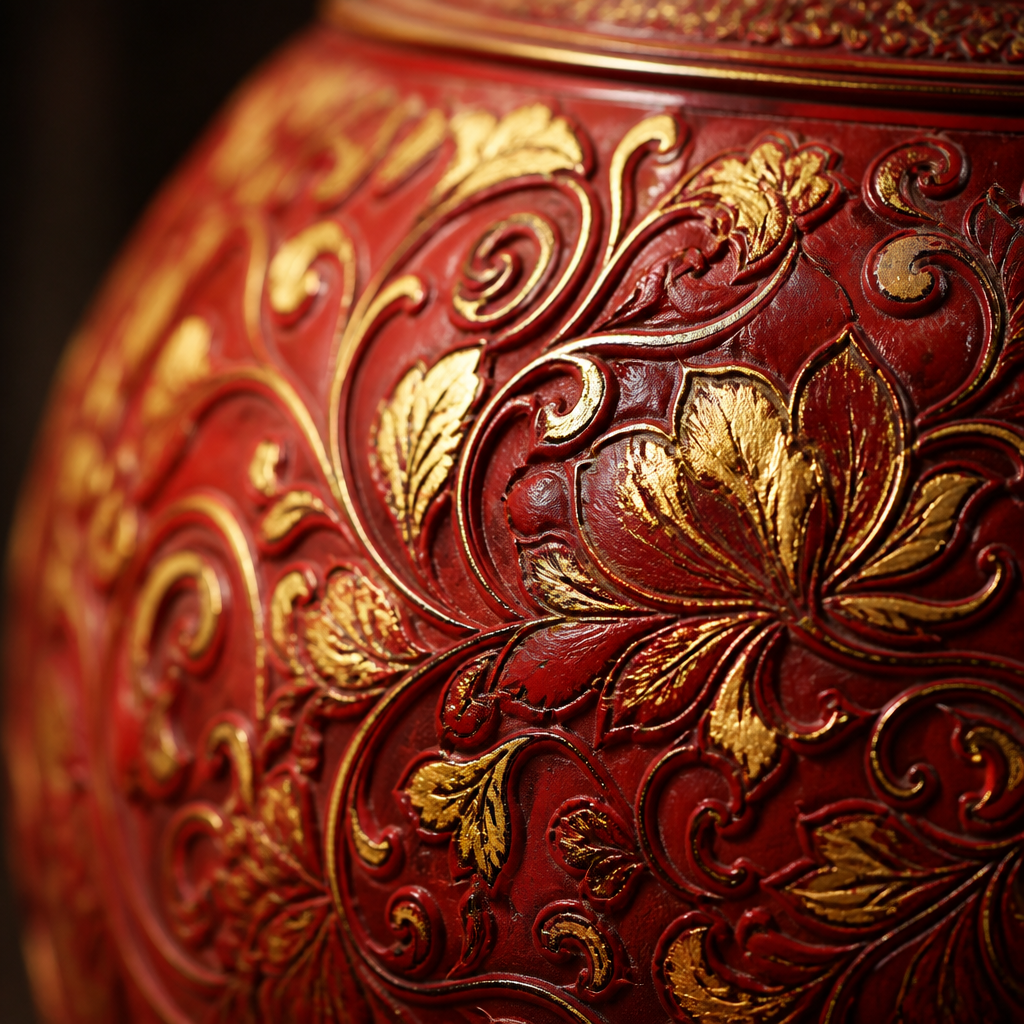
What makes the Burmese tradition distinct from Chinese or Japanese lacquerware is the development of a specific local material culture around thitsi rather than urushi, the Japanese lac tree sap. Thitsi cures differently, producing a darker base with greater opacity, and it responds well to the engraving and incising techniques that became the signature of Bagan craft. By the 17th century, royal patronage under the Taungoo and later Konbaung dynasties had elevated lacquerware from functional ware to courtly art, with detailed narrative scenes from the Jataka tales covering entire ceremonial bowls.
The British colonial period from 1885 onward disrupted royal patronage but simultaneously opened export markets, which pushed artisans toward producing decorative rather than purely ceremonial work. This shift had lasting consequences: it broadened the visual vocabulary of Myanmar traditional art to include secular subjects while also introducing the first pressure toward faster, cheaper production for tourist trade. Understanding this historical fork matters practically, because pieces produced before approximately 1885 are almost entirely ceremonial or royal, while later pieces occupy a wide quality spectrum from master craft to souvenir.
Traditional Craftsmanship: How Authentic Pieces Are Made
Understanding the production process is not academic background reading. It is the single most reliable tool for identifying authentic lacquerware, because every shortcut in the workshop leaves a visible trace on the finished piece.
Building the Core
Authentic Bagan lacquerware begins with a woven core of bamboo strips or, in the finest examples, coiled horsehair. The horsehair core allows a finished bowl to flex significantly, sometimes nearly flat, without cracking the lacquer surface. Workshops producing lower-quality work substitute pressed bamboo pulp or clay molds, which create rigid forms that cannot pass the flex test. The core is woven by hand on a wooden template, removed, and shaped before any lacquer is applied.
Lacquer Application and Curing
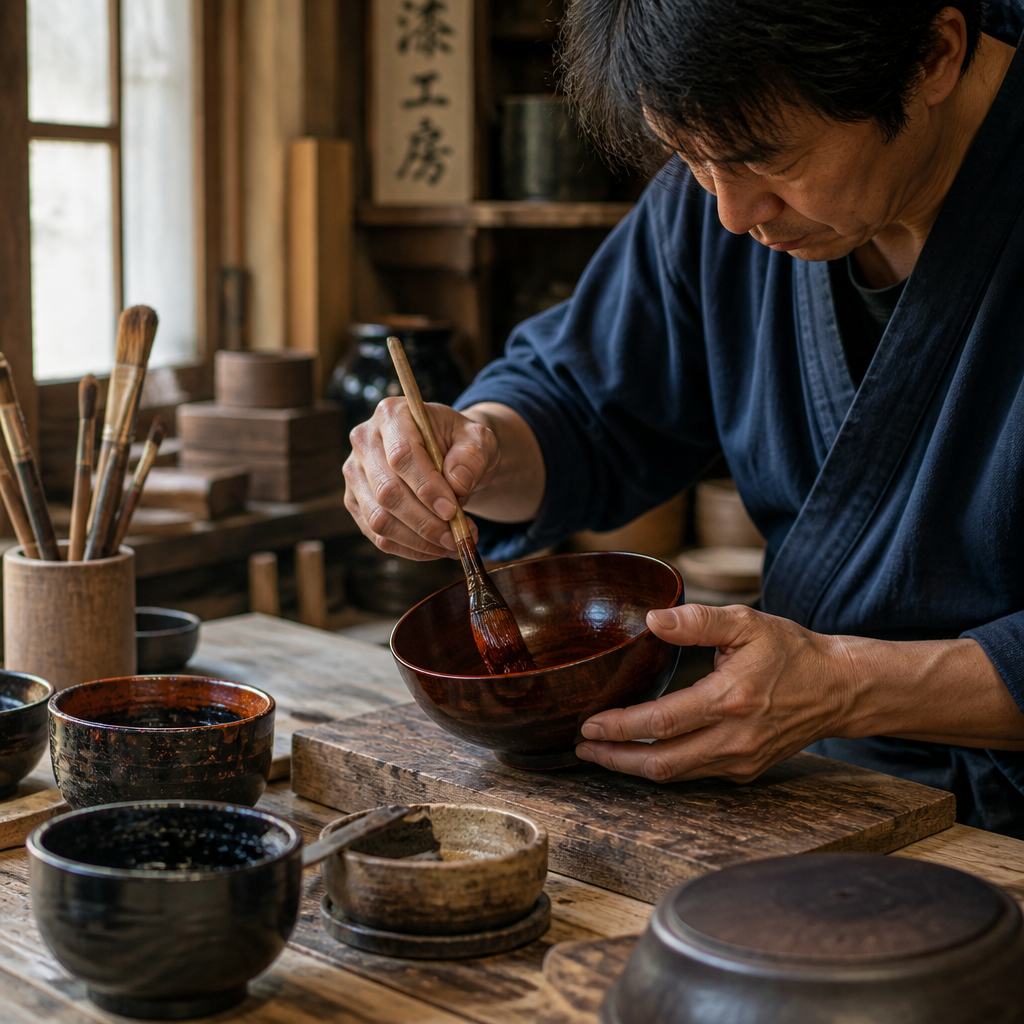
Raw thitsi sap is strained, mixed with ash to improve adhesion, and applied to the core in thin coats. Each coat requires drying in a humid underground pit, because thitsi, unlike most varnishes, cures through oxidation in the presence of moisture rather than through evaporation. A single application and cure cycle takes between one and three days. A finished piece of genuine quality will have received between seven and fifteen separate lacquer applications. This is not an exaggeration for effect. In practice, running your fingernail lightly across a thick, chip-resistant surface and noting the depth of build is one of the fastest ways to assess investment in labor.
Engraving and Inlay
Once the base coats are complete, the surface is engraved using steel styluses called kauk-sein. The artisan draws the pattern freehand directly onto the lacquer surface and then incises it to varying depths depending on the level of detail required. Colored lacquer or dry pigment is then packed into the engraved channels. The piece is sanded back so that color remains only in the incised lines. This process, called yun in Burmese craft terminology, produces the crisp, multicolored figural work that defines the best Bagan pieces.
Pro tip: Turn a suspected authentic piece toward raking light at a low angle. Hand-engraved lines will show slight variations in depth and width even within a single motif. Stamped or molded decoration will show perfectly consistent depth, a mechanical uniformity that no skilled hand-engraver actually produces.
Regional Styles Within Myanmar
Bagan dominates the export market, but it is not the only production center, and knowing the regional differences helps both in identification and in building a meaningful collection of Myanmar traditional art.
Bagan Style
Bagan work is characterized by dense, all-over engraved patterns, typically on a black ground, with red, green, yellow, and occasionally white inlaid colors. Subject matter draws heavily on Buddhist iconography: Jataka stories, flame and lotus motifs, royal court scenes. The finest Bagan pieces are produced by a small number of family workshops that have maintained continuous production across generations, and these workshops are identifiable by subtle stylistic signatures in how they render faces and foliage.
Kengtung and Shan State Styles
Shan State lacquerware from workshops around Kengtung tends toward bolder, less densely packed designs with stronger color contrast and a preference for geometric borders. The coiling technique used here sometimes incorporates rattan alongside bamboo, producing a slightly different surface texture. Shan pieces are less widely exported and therefore less familiar to Western collectors, which creates genuine opportunity for collectors who take the time to learn the style.
Mandalay Court Ware
Mandalay produced highly gilded ceremonial lacquerware for the Konbaung court, incorporating shwezawa, a gilding technique using gold leaf applied over a tacky lacquer base. Surviving Mandalay court pieces are rare and command significant prices. The gilded surface oxidizes distinctively over time, producing a warm rather than bright gold tone that is difficult to fake convincingly on genuinely old pieces.
How to Identify Authentic Lacquerware
A common mistake among first-time buyers is focusing entirely on visual appearance. Skilled forgers know how to make a new piece look old through artificial darkening and surface abrasion. The tests that actually work engage physical properties that are harder to fake.
The Flexibility Test
As described under the craftsmanship section, a horsehair or fine bamboo-woven core produces measurable flex. Hold the rim of a bowl between both hands and apply gentle, even pressure inward. A genuine piece will give slightly without cracking. A rigid piece that feels like hard plastic under pressure almost certainly has a molded or pulp core covered with synthetic lacquer rather than thitsi.
Surface Texture Under Magnification
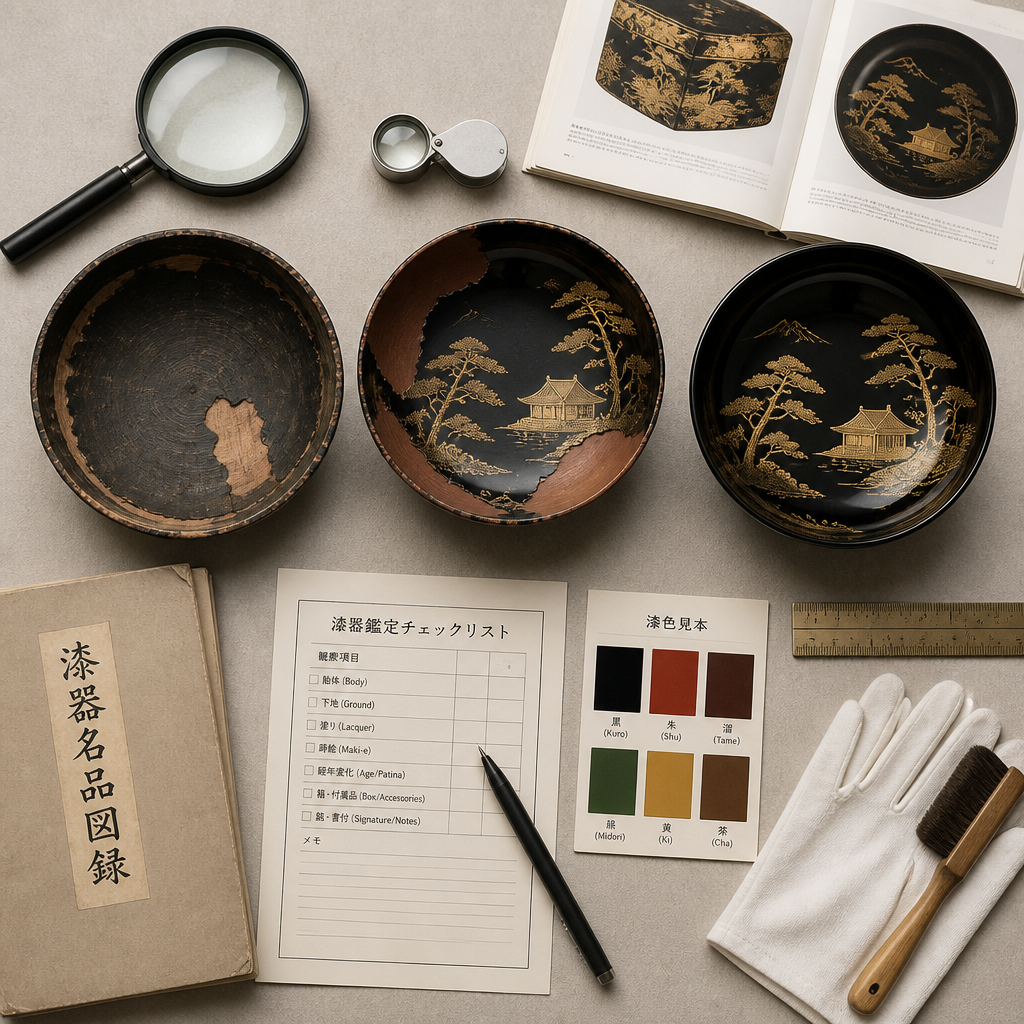
A 10x jeweler's loupe is sufficient. Authentic thitsi lacquer under magnification shows a slightly organic surface, with very fine crazing or texture that develops during the multi-layer curing process. Synthetic resin coatings tend to look glassy and perfectly smooth, occasionally with tiny air bubbles visible at the surface. The engraved channels in authentic yun work will show tool marks and slight irregularity at the edges. Molded decoration has clean, machine-perfect channel walls.
Smell and Solvent Response
This test requires care and should only be applied to an inconspicuous spot. Thitsi lacquer is highly resistant to most solvents once cured, including acetone and ethanol. Synthetic lacquers and paints will show visible surface reaction to a small drop of acetone on a cotton swab. If the surface softens, dissolves, or changes color, the coating is not traditional thitsi. In practice, most reputable sellers will permit this test on request.
Provenance and Documentation
For pieces claimed to be antique, meaning more than one hundred years old, documentation matters both for authenticity and for legal compliance. Myanmar's Protection and Preservation of Cultural Heritage Regions Law of 2014 regulates the export of antiques. Legitimate pieces exported after that date should carry documentation. Sellers unable to provide any export record for supposedly antique pieces should be questioned closely. The absence of documentation does not automatically indicate forgery, but its presence provides meaningful reassurance.
Pro tip: Cross-reference the claimed provenance against the visual style. A piece described as Bagan origin but showing Shan State geometric style is either misattributed or misrepresented. Learning to recognize regional styles is worth the investment because it makes inconsistencies immediately obvious.
Comparison of Quality Tiers in Burmese Lacquerware
|
Quality Tier |
Production Characteristics |
What to Expect as a Buyer |
|---|---|---|
|
Master Grade (Yun) |
Horsehair or fine bamboo woven core, 10 or more lacquer layers, hand-engraved yun decoration, mineral pigments, thitsi base coat throughout, takes three to six months per piece |
Investment-grade pieces suitable for serious collections. Passes all physical tests. Carries workshop attribution. Price reflects genuine labor and material cost. |
|
Traditional Craft Grade |
Bamboo woven core, five to ten lacquer layers, hand-engraved decoration, may use some synthetic pigments, thitsi-based but potentially with synthetic topcoat, takes four to ten weeks per piece |
Good quality decorative and functional pieces. Passes flexibility test. Hand engraving visible under loupe. Appropriate for home altars and serious decorators who are not building investment collections. |
|
Commercial Tourist Grade |
Pressed pulp or resin mold core, synthetic lacquer, stamped or machine-applied decoration, acrylic or enamel paint, completed in days to one week |
Purely decorative pieces with no investment value. Will not pass flexibility or solvent tests. Sold at souvenir pricing. Legitimate as inexpensive decorative objects but should not be sold or purchased as authentic traditional lacquerware. |
Collecting and Caring for Burmese Lacquerware
Burmese lacquerware is more resilient than most buyers expect, but it has specific vulnerabilities. Direct sunlight causes the thitsi layer to become brittle and crack over time, and prolonged exposure to very low humidity produces similar results. The ideal display environment maintains relative humidity between 45 and 55 percent, which is also the standard recommendation for Buddhist and Hindu sculptures in natural organic media.
Cleaning Without Damage
Wipe surfaces with a barely damp soft cloth. Never use furniture polish, oil-based cleaners, or any solvent-based product on authentic thitsi lacquerware. Oil will penetrate the pigment channels in yun work and permanently alter the colors. A common mistake among new collectors is treating lacquerware like wooden furniture, applying beeswax or linseed oil-based products that cause irreversible damage within a few months.
Building a Coherent Collection
The most compelling collections focus on a specific regional style, period, or functional type rather than accumulating miscellaneous pieces. A focused collection of Bagan offering bowls, for instance, tells a coherent story and makes the distinguishing characteristics of individual pieces more apparent. At HD Asian Art, our Burmese lacquerware selection is curated with exactly this kind of focused collecting in mind, sourcing pieces that represent genuine workshop traditions rather than the undifferentiated tourist market.
Collectors who are also building Buddhist or Hindu altar spaces often find that lacquerware offering vessels create a particularly cohesive visual and spiritual environment when paired with period-appropriate statuary. A Bagan-style lacquer offering bowl alongside a Burmese Buddha statue from the same region creates an altar composition grounded in genuine cultural continuity rather than decorative eclecticism.
"Lacquerware is the art form in which Burma has most clearly expressed its individual genius. The best Bagan work of the eighteenth and nineteenth centuries stands comparison with the finest decorative arts produced anywhere in Asia during the same period." - Sylvia Fraser-Lu, author of Burmese Lacquerware, the most authoritative English-language academic study of the tradition.
Frequently Asked Questions
What is Thitsi and why does it matter for identifying authentic Burmese lacquerware?
Thitsi is the sap of the Melanorrhoea usitata tree, the traditional lacquer base used in Myanmar craft production for at least a thousand years. It matters for identification because cured thitsi has specific physical properties, solvent resistance, a characteristic surface texture under magnification, and flexibility when applied over a woven core, that synthetic alternatives do not replicate. Any piece claiming to be authentic traditional Burmese lacquerware should test positively for these thitsi properties.
How long does a genuine high-quality piece of Burmese lacquerware take to produce?
A master-grade yun piece from a Bagan workshop takes between three and six months from core weaving to final polishing. This timeline is driven by the curing requirements of thitsi lacquer, which requires humid-pit curing for each of its seven to fifteen application layers. Any seller claiming a piece is both master-grade and produced in a matter of weeks is describing a contradiction in terms.
Is all Burmese lacquerware produced in Bagan?
No. Bagan is the dominant and most internationally recognized production center, but significant workshop traditions exist in Shan State around Kengtung and in the Mandalay region. Each tradition has distinct stylistic signatures in terms of motif density, color palette, and decorative subject matter. Shan State work tends toward bolder geometric designs, while Mandalay historically produced gilded court ware. Knowing these regional differences helps both in authentication and in building a collection with real depth.
Are there legal restrictions on buying and importing antique Burmese lacquerware?
Yes. Myanmar's Protection and Preservation of Cultural Heritage Regions Law of 2014 controls the export of cultural heritage objects, which includes antique lacquerware. Importing such pieces into the United Kingdom and European Union also requires compliance with cultural property import regulations. For pieces dated before 1900, buyers should request documentation of legal export. Reputable specialist dealers including HD Asian Art source pieces through compliant channels and can provide appropriate documentation on request.
Can Burmese lacquerware be repaired if the surface chips or cracks?
Yes, but repair requires traditional thitsi lacquer and appropriate skills. A skilled lacquerware conservator can fill chips with fresh thitsi mixed with ash, re-engrave the affected area to match the original pattern, and inlay pigment to restore color continuity. Attempting repair with commercial varnish, epoxy, or acrylic paint causes additional damage and significantly reduces the piece's value. For significant pieces, contact a specialist in Asian decorative arts conservation rather than attempting self-repair.
What is the difference between Burmese yun lacquerware and plain lacquered ware?
Yun refers specifically to the engraved and color-inlaid decoration technique that defines the finest Bagan lacquerware. In yun work, patterns are incised through the lacquer surface using steel styluses, colored lacquer or pigment is packed into the incisions, and the surface is sanded back to leave color only within the engraved lines. Plain lacquered ware uses the same thitsi base and multi-layer application process but relies on painted surface decoration rather than engraving and inlay. Yun work requires greater skill and more labor, which is reflected in both quality and price.
Have you purchased Burmese lacquerware before, and what method did you use to verify its authenticity? Share your experience in the comments below.
References
-
British Museum collection and research resources on Southeast Asian decorative arts
-
UNESCO intangible cultural heritage documentation on traditional lacquerware crafts of Asia
-
Victoria and Albert Museum Asian art collection and scholarly resources on Burmese material culture
-
Smithsonian Magazine coverage of Asian traditional arts and craft preservation
-
Getty Conservation Institute resources on the care and preservation of lacquerware objects
