



Buddha Statues Antique: How to Identify, Value and Care
Buddha Statues Antique: How to Identify, Value and Care
You're standing at an auction preview with a catalogue in one hand and a torch in the other. The statue looks convincingly old, the dealer's description says “antique Buddha”, and everyone nearby seems more interested in the face than the paperwork. That's precisely when a buyer needs to slow down. Surface age is not a buying decision. Identification, provenance, condition and lawful title are.
The phrase buddha statues antique covers objects made across different regions, materials, religious settings and historical periods. A UK buyer who treats a sixth-century Chinese limestone figure and an eighteenth-century Burmese wooden image as variations of one style is already asking the wrong questions. The museums provide a better model: study the object, test the story behind it, and only then discuss value.
Table of Contents
- Why Careful Identification Matters Before You Buy
- Reading the Object Itself for Age and Authenticity
- Regional Styles You Can Recognise at a Glance
- Provenance, Lawful Title and the 1970 Cut-Off
- Export Licensing and UK-Specific Paperwork
- Care, Conservation and Safe Display in a UK Home
- Putting It Together and Shipping with Care
Why Careful Identification Matters Before You Buy
A family inheritance can create the same problem as an auction. Someone hands you a seated figure that has been in a relative's house for decades, and the only explanation is that it came from “an old collection”. The statue may be attractive and old, but those facts don't tell you whether it is Chinese, Burmese, Thai, Khmer or a later devotional object made in an earlier style.
The Victoria and Albert Museum records a seated limestone Buddha from northern China dated to approximately 550–577 CE, during the Northern Qi dynasty. In the same body of records, it holds a Burmese teak, lacquered and gilded standing Buddha made in Moulmein during the eighteenth century, under the Konbaung Dynasty, which lasted from 1752 to 1885. Those objects are both antique Buddhist sculptures, but the correct examination is entirely different for each. The V&A's collection records show why “antique” is a period description, not a style.
Age changes the questions
With the Chinese limestone figure, I'd want to understand the stone, traces of gesso, paint and gilding, sculptural conventions and the attribution history. With the Burmese figure, I'd focus on teak construction, lacquer layers, gilding, decorative moulding, glass inlay and the documented connection with Moulmein.
Function matters as well. A temple image, a household devotional figure and a sculpture made for display may have different wear patterns, repairs and documentation. A polished surface might indicate later intervention rather than centuries of respectful handling. A missing element might be historic, or it might be the result of careless restoration.
Dealer's rule: Never pay for the word “antique”. Pay for a convincing object supported by evidence.
Misidentification carries a practical cost. It can distort insurance descriptions, weaken resale confidence and make conservation decisions more dangerous. A statue that has been incorrectly called bronze may be lacquered wood. A supposed early figure may be a later copy with an artificially darkened surface. Once that error enters an invoice or insurance schedule, it becomes harder to correct.
Before money changes hands, ask four basic questions: What is it made from? Where was it made? When was it made, or how securely can it be dated? What is its ownership history? If the seller can answer only the first question, you're looking at an object, not yet a well-documented acquisition.
Reading the Object Itself for Age and Authenticity
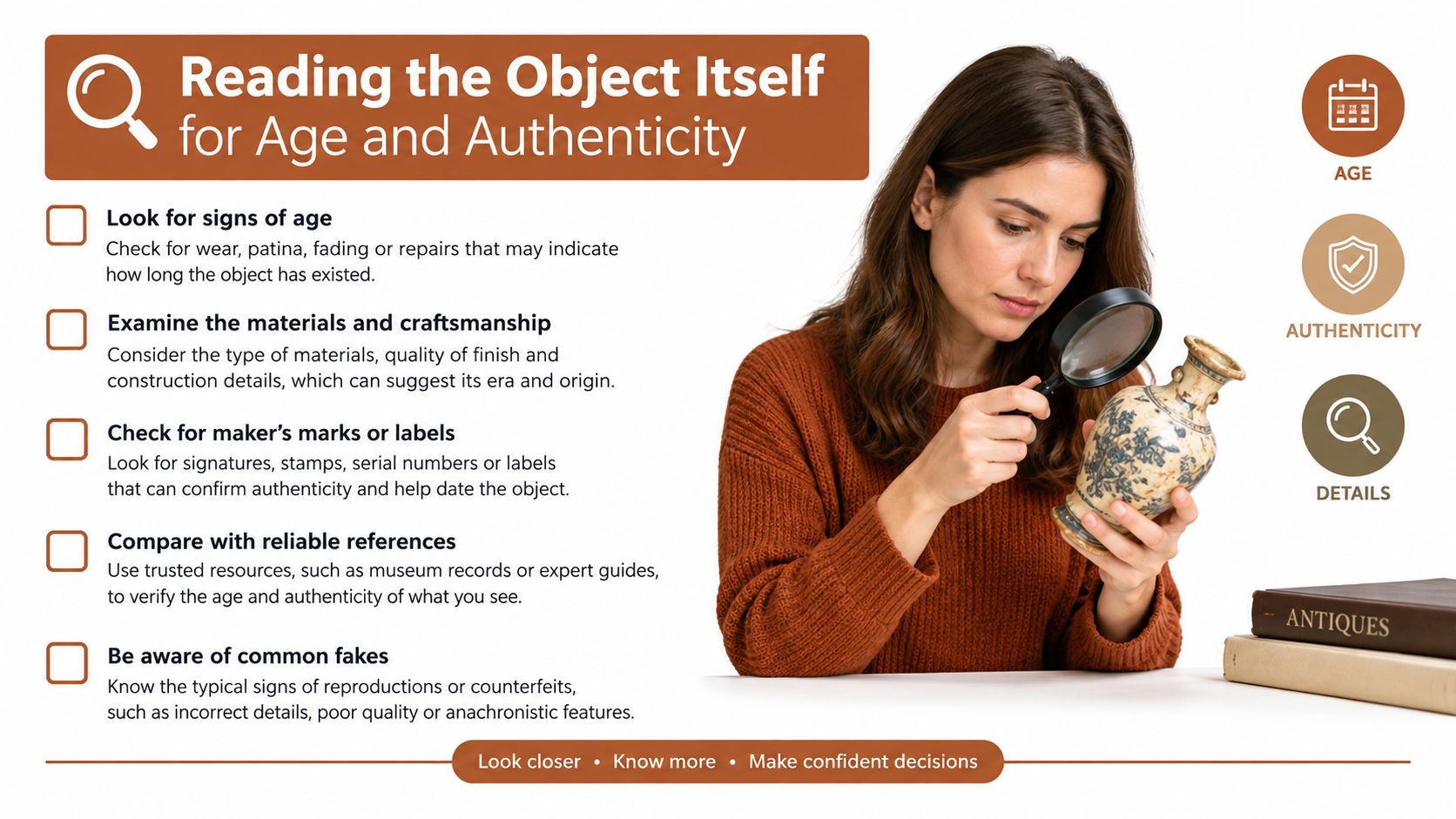
A dealer should begin with the statue, not the seller's adjective. Set it on a stable surface under even light. Record its dimensions, weight, materials, joins, inscriptions, losses, cracks, repairs and signs of repainting. If you have not made those observations, you have not completed the basic inspection.
Start with material and construction
Inspect the back, underside and points where separate parts meet. On stone, assess tool marks, surface alteration, old breaks and later fills. On wood, check grain, shrinkage, insect damage and joints, then examine how the carved body relates to its lacquer and gilding. On metal, inspect casting, chasing, seams, repairs and corrosion.
The V&A's Chinese figure shows why a catalogue record matters. It identifies limestone with traces of gesso, paint and gilding, places the sculpture in the Northern Qi period at approximately 550–577 AD, and records that Katherine Tsiang Mino's 2007 opinion reinforced the attribution. The proposed original site is North Xiangtangshan. Read the V&A record for the Chinese Buddha. Material evidence, stylistic analysis and a named scholarly opinion carry far more weight than a claim that “the patina looks right”.
Construction often exposes a false account of an object's history. In examinations of trafficked Afghan Buddhist sculptures, CT scanning revealed a two-layer clay construction: coarse clay inside, covered by finer, more compact material. Pigment analysis identified iron-rich mineral colours. The British Museum's investigations, discussed in the provenance section below, demonstrate why technical examination can answer questions that eyesight cannot.
Record the evidence before paying
Use this checklist with a dealer:
- Photograph all sides: Include the front, rear, underside, top, joins, cracks, losses, inscriptions, corrosion, pigment and old repairs.
- Measure and weigh it: Record height, width, depth and weight, and store those details with the photographs.
- Describe materials precisely: Note whether it appears to be limestone, another stone, teak, lacquered wood, bronze, clay or a combination.
- Mark uncertainty: Keep visible observations separate from the seller's claims.
- Preserve the paperwork: Save the catalogue entry, invoice, correspondence, condition report and every image supplied before purchase.
| Region | Typical materials | Construction clue |
|---|---|---|
| Northern China | Limestone with possible gesso, paint and gilding | Carving, pigment traces and qualified attribution need to agree |
| Burma | Teak, lacquer, gilding and glass inlay | Layered surface decoration over a carved wooden structure |
| Thailand | Bronze and other cast materials | Inspect casting, chasing and finished seams |
| Khmer regions | Sandstone | Study the relationship between stone, carving and drapery folds |
The face attracts attention, but the hands, feet, base and back often reveal more. Use this specialist checklist of the areas experts inspect first on a Buddha statue before accepting an attribution. A convincing purchase rests on observations you can document, not on the word “antique”.
Regional Styles You Can Recognise at a Glance
Regional recognition is valuable, but only if you use it to form questions rather than jump to a verdict. Surface decoration can be copied. Construction is harder to fake convincingly across the entire object.
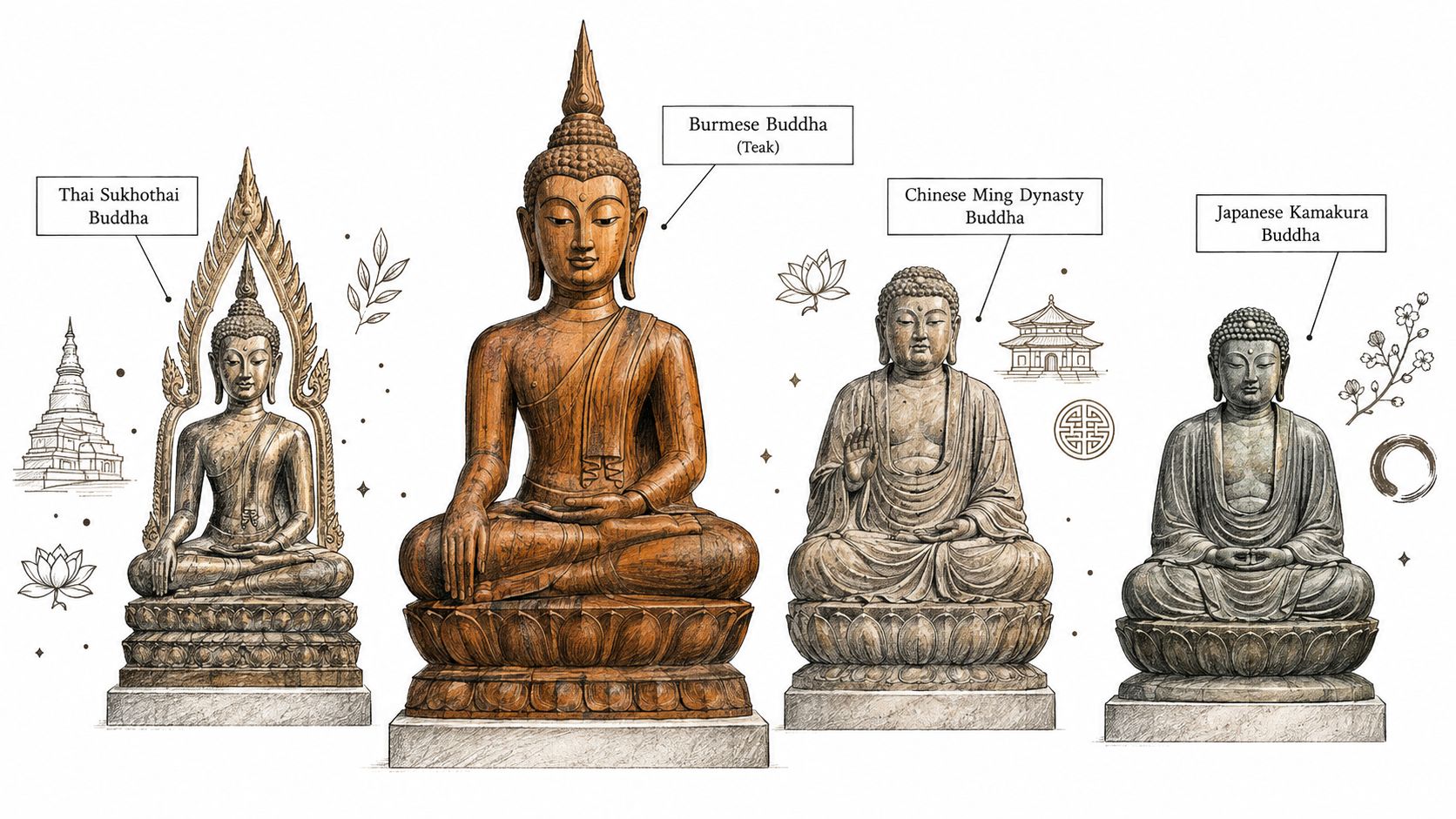
Burmese teak and lacquer
The V&A's standing figure is a strong reference point. It is made from teak, coated with black thitsi lacquer and gilded. The surface includes relief-moulded thayo decoration and glass inlay in the hman-zi shwei-cha technique. The museum attributes it to the Konbaung Dynasty, dates it to the late eighteenth or early nineteenth century, and associates it with Moulmein in Lower Burma. Consult the V&A record for the standing Buddha.
That combination matters. Don't identify a Burmese figure because it is gilded or has a serene expression. Check whether the wood, lacquer layers, decorative relief and inlay belong together. Look for areas where later gilding has covered old wear, and inspect whether the construction behaves like carved wood rather than cast metal or moulded composite.
Chinese limestone
Chinese stone figures can retain traces of gesso, paint and gilding, as the V&A's Northern Qi example demonstrates. Limestone gives you a different examination from wood. Tool marks, breaks, surface erosion and later fills deserve close attention, especially around the base, hands and projecting details.
Khmer sandstone
Khmer sculpture is often recognised through dense sandstone and carved drapery folds. The important question isn't whether the folds look “old”. Study how the fabric is cut into the stone, how the body is constructed, and whether the treatment of the torso, face and base is internally consistent. A dealer should be able to explain the regional comparison, not merely point to a darkened surface.
Thai bronze
Thai bronzes need a metalworker's eye. Look for casting logic, seams, chasing and repairs rather than relying on a general impression of elegance. A convincing surface can be produced later, but the relationship between the cast form and the finishing work is much more revealing.
Construction tells you how an object came into being. Decoration only tells you what someone wanted you to notice.
Use regional style as a map. It helps you decide where to look, what comparisons to make and which specialist to consult. It isn't a substitute for provenance or independent examination.
Provenance, Lawful Title and the 1970 Cut-Off
A dealer offers you a rare Buddha statue with an attractive surface and a story about an old European collection. Before discussing price, ask where the object came from, when it left its country of origin, and how it moved through any intermediate countries. A statue can be old and visually convincing while still carrying serious acquisition risk if those questions have no documentary answers.
The British Museum's published account of trafficking investigations shows the standard serious research can require. Police seizure information was combined with curatorial identification, conservation analysis, CT scanning and pigment analysis. The Museum reports that it has helped return 2,345 objects to Afghanistan, Iraq and Uzbekistan since 2009. Its published account of the work demonstrates that provenance research belongs at the centre of an object's assessment, not as a catalogue footnote.
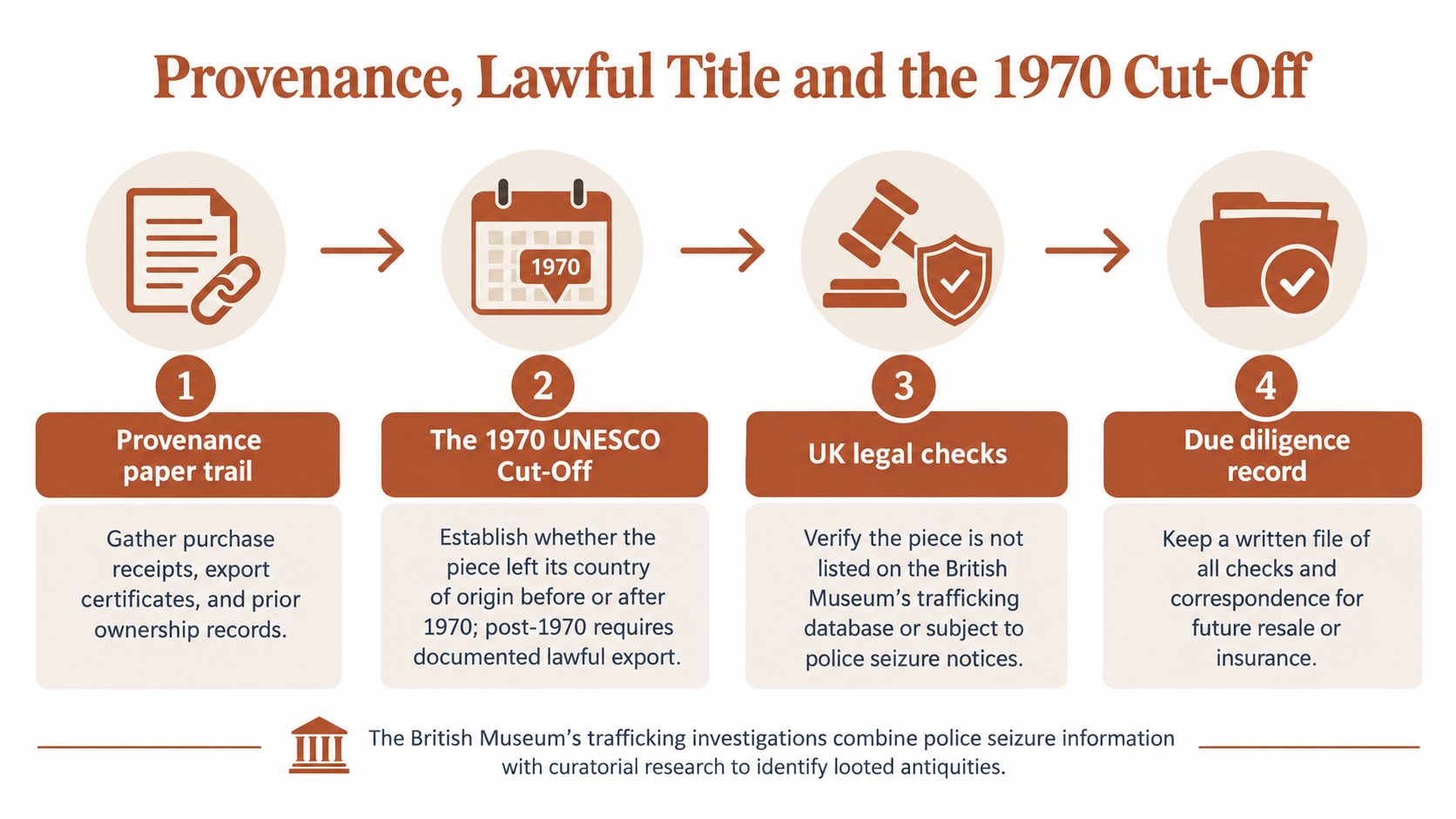
Request a complete paper trail
An invoice records a transaction. A useful file records ownership, movement and the seller's right to transfer the statue. Ask the dealer for:
- Prior ownership records: Names or collection references, dates and locations where available.
- Movement documents: Import or export paperwork for border crossings.
- Old images and catalogues: Auction entries, museum records, collection photographs or exhibition references.
- Object-specific description: Materials, dimensions, inscriptions, repairs and condition must match the statue offered.
- Written title statement: Confirmation that the seller has the right to sell and has checked relevant cultural-property restrictions.
A provenance record names owners, dates and locations; a title statement confirms the right to sell. An old-house story and an authentic-looking surface provide neither. UK cultural-property guidance treats provenance as an object's recorded ownership history and recognises legal and ethical duties for public and commercial organisations. Government due-diligence guidance also asks buyers to establish origin, departure date and transit history. For a practical workflow, consult provenance research for Asian antique sculpture.
Why 1970 changes the conversation
The 1970 UNESCO Convention provides a practical dividing line for due diligence. When a major object entered the UK or another country after 1970 without documentary provenance, missing evidence or a vendor affidavit can give a museum sufficient reason to refuse acquisition or borrowing. A pre-1970 object still needs a credible history, while a later object demands closer documentation when its record is incomplete.
My recommendation is direct: a less expensive statue with transparent, limited provenance is often safer than a rarer-looking piece with a vague story. If the dealer avoids written questions about ownership, movement or title, walk away. Surface appeal does not repair a missing paper trail.
Export Licensing and UK-Specific Paperwork
A UK owner planning to send an antique Buddha statue outside Great Britain should deal with export paperwork before arranging transport. Don't wait until the crate is built or the overseas buyer has paid a deposit.
UK government guidance identifies works of art, antiques and manuscripts more than 50 years old as potentially requiring licensing. Applications are administered by Arts Council England, and the issued licence must be attached to the export declaration submitted to HMRC through the Customs Declaration Service. The government's export guidance sets out the framework.
Treat the age threshold as a starting point
Most objects a collector would describe as antique are likely to fall inside the relevant framework. The practical question is rarely “does this need a licence?” It is “can I document the object well enough for the correct licensing route?”
The answer depends on factors including the statue's age, classification, destination and cultural interest. The Waverley criteria may become relevant, especially where the object has artistic, historic or scholarly importance. A seller or buyer shouldn't assume that an old-looking surface settles the matter.
Assemble the evidence early
Prepare a file containing:
- prior ownership and acquisition dates
- import records and export paperwork where relevant
- old photographs
- auction catalogues
- museum or collection references
- dimensions, materials and photographs
- a clear account of any gaps in the ownership history
A UK government research report explains that provenance may help establish whether an object entered the UK less than 50 years ago, whether it meets Waverley cultural-interest criteria and whether its export could breach laws concerning illicitly handled cultural objects. Where records contain gaps, the exporter should describe the due diligence carried out, identify the documents located and confirm whether other relevant evidence is known. Read the government report on export licensing and provenance.
Keep copies of the licence, declarations, correspondence and supporting evidence. International shipping companies can move a crate, but they can't manufacture a credible history after the fact.
Care, Conservation and Safe Display in a UK Home
The first conservation decision is where you put the statue. A radiator, fireplace, sunny window, damp external wall or unstable shelf creates avoidable risk. Large or top-heavy figures need a load-rated plinth and should be secured against tipping, especially in a busy hallway or home with children and pets.
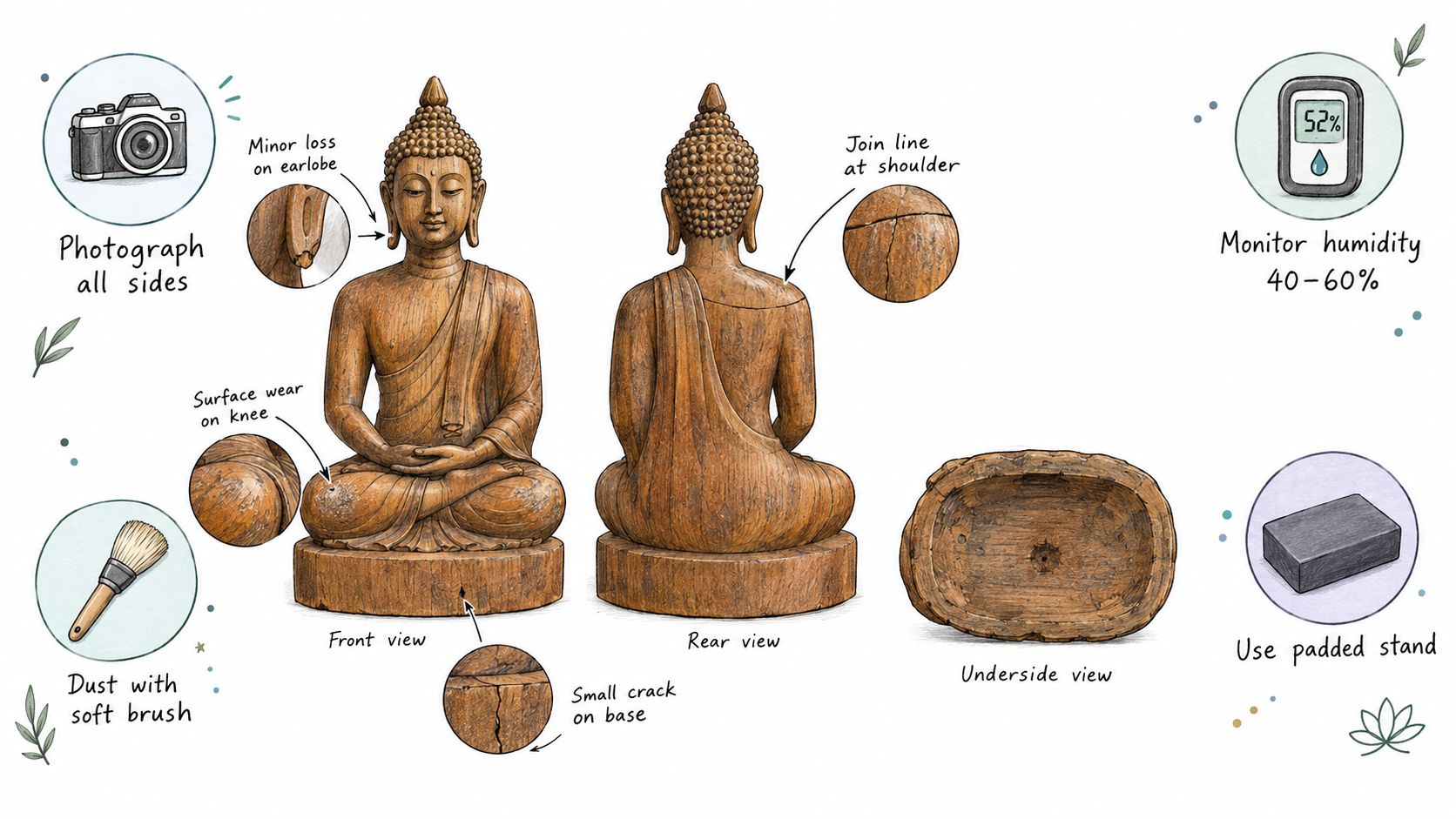
Create a condition baseline
Photograph the front, rear, underside, joins, losses, cracks, corrosion, pigment and old repairs under consistent lighting. Measure and weigh the object, identify vulnerable materials and repeat the inspection after transport and periodically thereafter. Those records help distinguish old damage from transit damage and give an insurer, conservator or future buyer something reliable to assess.
British Museum catalogue records for South Asian Buddhist sculpture document conservation treatments in 1992, 1994, 2007 and 2023 for different objects. The catalogue record illustrates an important principle: conservation is ongoing, not a one-time restoration event.
Avoid aggressive cleaning, polishing, repainting, solvent testing and removal of ritual deposits unless a qualified conservator has advised you. Historic wear can be more valuable than a bright, over-restored finish. For general background on gentle treatment of wooden furniture, how to clean antique wood pieces offers useful handling context, but an unusual lacquered or devotional sculpture still deserves object-specific advice.
Keep the environment stable
Use a stable indoor location away from rapid temperature and humidity changes. Don't place wood beside a heat source, and don't use household cleaning products on lacquer, gilding, pigment or stone. Avoid lifting a large statue by projecting hands, crowns or other fragile elements.
For broader guidance on protecting bronze and stone objects, consult how to care for bronze and stone Asian sculptures. For an older or valuable figure, commission a UK-accredited or appropriately qualified conservator to write a condition report before shipping, after delivery and before treatment. The British Museum's conservation policy supports preventive care, documented treatment and stable materials that don't compromise authenticity or future examination.
Putting It Together and Shipping with Care
Take this checklist to the dealer, auction house or shipping company:
- documented dimensions, weight and materials
- photographs of every side under consistent lighting
- written provenance with dates, locations and prior owners
- a written statement of lawful title
- a condition report for older or higher-value pieces
- confirmation of export licensing for a statue over 50 years old moving outside Great Britain
The 2004 joint acquisition by the British Museum and V&A shows the level of seriousness that important Buddhist sculpture can command. The Buddha, dating from around 600 CE, was acquired for £850,000, including £560,000 from the Heritage Lottery Fund and £100,000 from the National Art Collections Fund, with planned alternating display between the two museums. The acquisition and restoration account is a useful reminder that value rests on cultural importance and evidence, not appearance alone.
For transport, insist on custom-fit internal packing, immobilised components, climate-stable wrapping and clear unpacking instructions. A practical guide to art transport dos and don'ts can help with general packing decisions, but fragile Buddhist sculpture should be assessed piece by piece. The confident purchase is the one where the documents match the object, not the one where the surface is the most persuasive thing in the room.
HD Asian Art offers region-organised Buddhist and Hindu sculpture, including antique-style Thai, Khmer, Chinese, Burmese and other Asian pieces, alongside buyer-focused knowledge resources. If you want to compare a statue against a specialist catalogue and ask practical questions about materials, provenance or display, visit HD Asian Art before committing to a purchase.
