



What Does Amitabha Buddha Represent in Buddhism?
What Does Amitabha Buddha Represent in Buddhism?
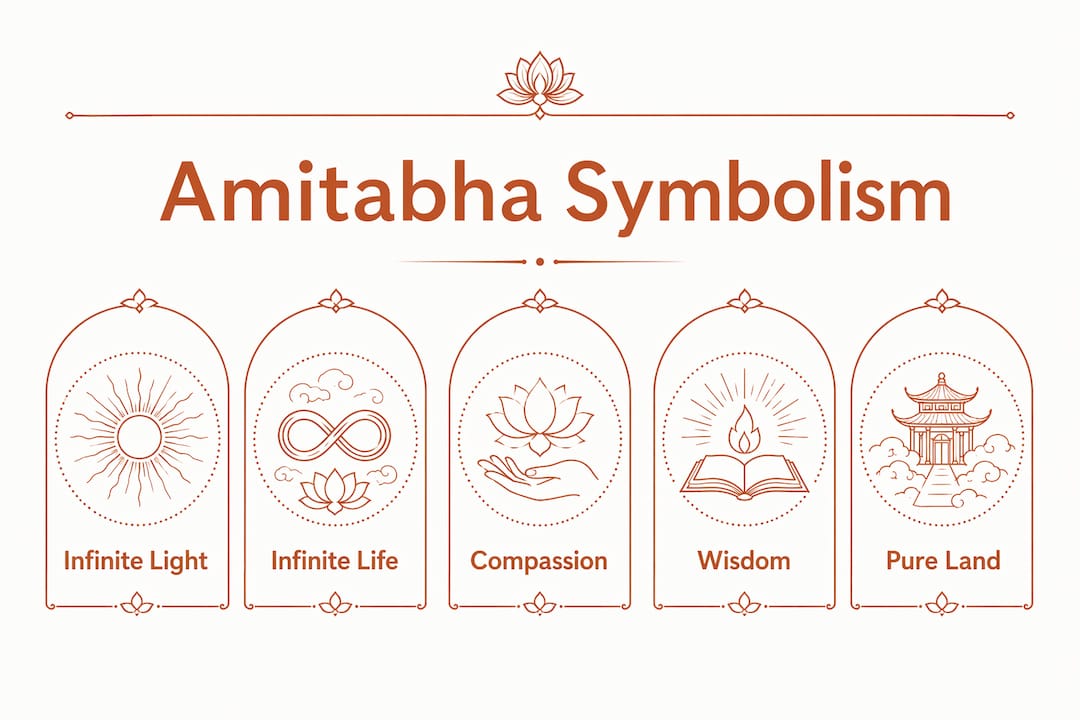
Amitabha Buddha is defined as the celestial Buddha of Infinite Light and Infinite Life, presiding over the Western Pure Land of Sukhavati. In Mahayana Buddhism, he stands as one of the most widely venerated figures across East Asia, Tibet, and Southeast Asia.
Understanding what does Amitabha Buddha represent means grasping a core Buddhist teaching: that wisdom and compassion are not separate qualities but one unified reality. His very name encodes this union. Light stands for wisdom that illuminates all things. Life stands for compassion that sustains all beings without limit.
What does Amitabha Buddha represent through his names and vows?
Amitabha Buddha carries two Sanskrit names, and each one reveals a distinct dimension of his nature. “Amitabha” translates as infinite light. “Amitayus” translates as infinite life. These are not two separate Buddhas but two aspects of the same enlightened being, with Amitayus used more often in Tibetan longevity rituals and Amitabha favored in East Asian Pure Land traditions.
The meaning of Amitabha Buddha deepens considerably when you examine his origin story. Before becoming a Buddha, he existed as a bodhisattva named Dharmakara. Dharmakara made 48 vows, each one a commitment to create the perfect conditions for the liberation of all beings. The 18th vow is the most significant. It promises rebirth in the Pure Land to any being who sincerely recites Amitabha’s name with genuine faith, even as few as ten times.
This vow is the foundation of Pure Land Buddhism. It shifts the path to liberation from individual effort to what practitioners call “Other-Power.” You do not need years of rigorous meditation or perfect moral conduct. You need sincere faith and a sincere call to Amitabha. That accessibility is not a compromise of the teachings. It is the teaching.
Key points about Amitabha’s vows:
- Dharmakara made 48 vows before attaining Buddhahood
- The 18th vow guarantees Pure Land rebirth for sincere name-reciters
- The vows collectively create Sukhavati, a realm free from obstacles to enlightenment
- Other-Power practice relies on Amitabha’s accumulated merit, not the practitioner’s own
Pro Tip: When you encounter the phrase “Namo Amitabha” or “Namo Amituofo” in Chinese Buddhist practice, you are hearing the 18th vow in action. The recitation is not a prayer to an external deity. It is a direct connection to the Buddha’s vow.
How is Amitabha Buddha depicted in Buddhist art and iconography?
Amitabha Buddha’s visual symbolism follows consistent patterns across centuries of Buddhist art. Recognizing these patterns helps you identify him in statues, thangka paintings, and temple reliefs from Cambodia to Japan. The iconographic features include a specific mudra, monastic robes, and radiant light imagery that signal his identity and qualities.
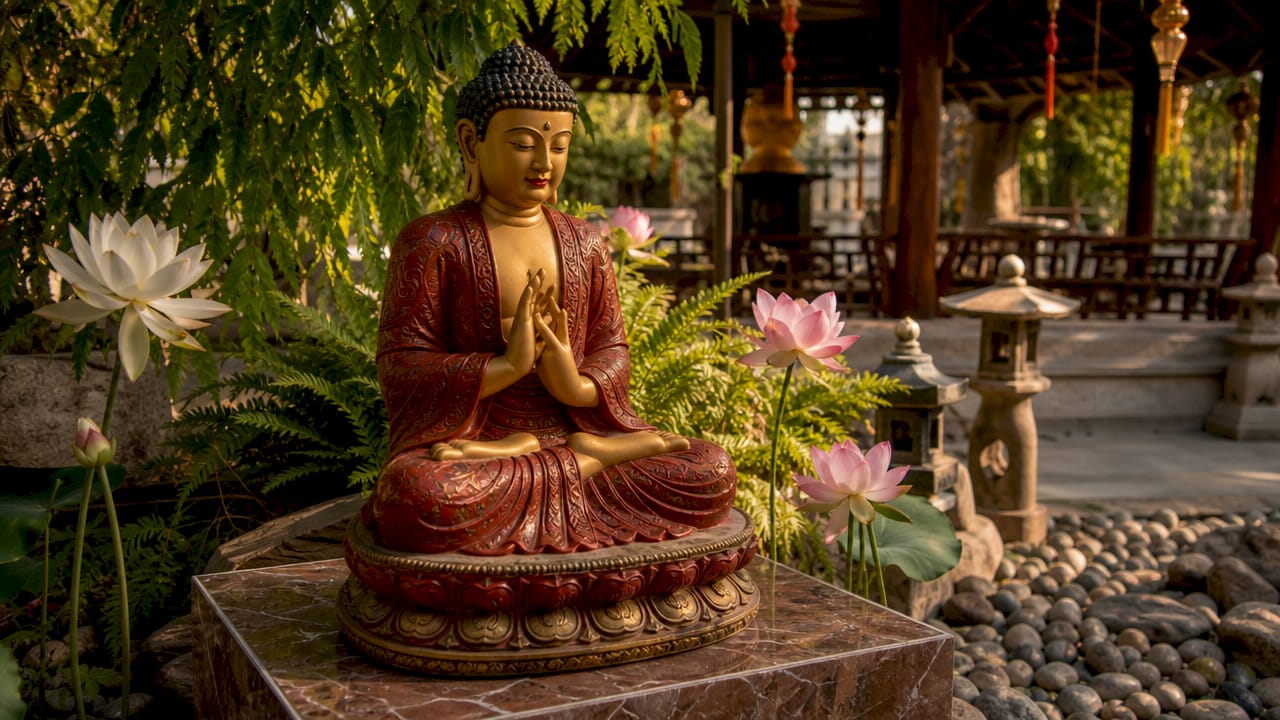
His most common mudra shows the thumb and index finger touching, forming a circle that represents the perfection of wisdom. He is typically seated in meditation posture on a lotus throne. His robes are simple monk’s robes, reflecting his accessible nature rather than royal ornamentation. A halo or full-body radiance surrounds him, representing the infinite light his name describes.
The symbolism and meaning of Buddha statues varies by tradition, but Amitabha’s color is consistently red or golden red in Tibetan iconography, associated with the western direction and the element of fire. In East Asian art, he often appears golden, seated or standing, sometimes flanked by the bodhisattvas Avalokiteshvara and Mahasthamaprapta.
Distinguishing Amitabha from related figures matters for collectors and practitioners alike:
| Figure | Key visual marker | Primary function |
|---|---|---|
| Amitabha | Meditation mudra, monk’s robe, red or golden halo | Pure Land presiding Buddha |
| Amitayus | Crown and jewels, holds a vase of nectar | Longevity rituals in Tibetan practice |
| Avalokiteshvara | Multiple arms or heads, lotus, Amitabha in crown | Compassion bodhisattva, Amitabha’s emanation |
The Mahayana Buddhism art tradition places Amitabha at the center of an entire visual cosmology. Sukhavati scenes show him surrounded by bodhisattvas, lotus ponds, and jeweled trees, all representing the qualities of an enlightened mind made visible.
Pro Tip: If a statue shows a Buddha wearing a crown and holding a vase, it is almost certainly Amitayus rather than Amitabha. The crown indicates the longevity aspect. The vase contains the nectar of immortality.
Why does Amitabha hold special significance in Pure Land practice?
Amitabha’s significance in Pure Land Buddhism rests on a clear distinction. Gautama Buddha, the historical teacher, walked the earth and taught through direct example. Amitabha is a transcendent Buddha, accessible not through historical encounter but through faith and devotion. This distinction matters enormously for how practitioners relate to him.
Pure Land Buddhism developed in part as a response to a Buddhist concept called the “degenerate age,” a period when human capacity for rigorous spiritual practice is considered diminished. Amitabha’s path addresses this directly. His Other-Power practice gives ordinary people a viable route to liberation without requiring mastery of complex meditation techniques.
The practice centers on four elements:
- Faith in Amitabha’s vows and his Pure Land as real and attainable
- Vow to be reborn in Sukhavati and continue practice there
- Recitation of Amitabha’s name, known as Nianfo in Chinese and Nembutsu in Japanese
- Sincerity as the quality that activates the connection between practitioner and Buddha
Reciting Amitabha’s name is not symbolic repetition. The Name embodies all his virtues including wisdom, compassion, fearlessness, and power. Practitioners describe it as plugging into a source of merit that already exists, fully formed, waiting to be accessed. The significance of Buddha statues in practice reflects this same logic: the physical form is a point of contact with a reality that transcends the physical.
Amitabha’s Pure Land, Sukhavati, is described as a realm free from worldly obstacles where beings can attain enlightenment without the distractions and suffering of ordinary existence. Rebirth there is not the final goal. It is the ideal starting point for completing the path to full Buddhahood.
What are the deeper philosophical meanings of Amitabha’s symbolism?
Amitabha’s symbolism extends beyond devotional practice into philosophical territory that rewards careful attention. His infinite light and infinite life are not metaphors for nice qualities. They represent the full dimensions of reality itself. Light that has no boundary cannot leave anything in darkness. Life that has no end cannot exclude any being from its reach. Amitabha is, in this reading, the universe’s own nature made personal and accessible.
Pure Land scholars emphasize that sincere faith aligned with understanding Amitabha’s absolute reality is what makes the practice transformative. Faith without understanding can become mechanical. Understanding without faith can become intellectual. The combination is what Pure Land teachers describe as the complete practice.
“The Name of Amitabha is not a label or a chant. It is the living embodiment of the Buddha’s total virtue and power. When a practitioner recites it with sincerity, they are not calling out to a distant figure. They are activating a direct connection to the accumulated merit of countless lifetimes of compassionate action.” Pure Land teaching, as summarized by Buddhistdoor Global
In Tibetan Buddhism, Amitabha’s significance takes a different but complementary form. He is associated with Phowa, a yogic death practice in which a practitioner transfers consciousness directly into the Pure Land at the moment of death. This requires years of preparation and is considered one of the most advanced practices in the Vajrayana tradition. The contrast with East Asian name recitation is striking. Both traditions reach the same destination through very different routes.
Amitabha also appears in Tibetan longevity rituals through his Amitayus aspect. These rituals use his image, mantra, and visualization to extend life and accumulate merit. The role of Avalokiteshvara in Buddhist art connects directly here, since Avalokiteshvara is considered Amitabha’s primary emanation, the active compassion of Amitabha moving through the world.
Key Takeaways
Amitabha Buddha represents the union of infinite wisdom and infinite compassion, offering liberation through faith-based devotion to all beings regardless of their spiritual capacity.
| Point | Details |
|---|---|
| Core identity | Amitabha is the celestial Buddha of Infinite Light and Life, presiding over the Pure Land of Sukhavati. |
| The 18th vow | This vow guarantees Pure Land rebirth for any being who recites Amitabha’s name with sincere faith. |
| Iconographic markers | Meditation mudra, monk’s robe, and radiant halo identify Amitabha in statues and paintings across traditions. |
| Other-Power practice | Pure Land Buddhism relies on Amitabha’s merit rather than the practitioner’s own effort, making it widely accessible. |
| Philosophical depth | Amitabha’s name is considered the living embodiment of his total virtue, not a symbolic label. |
Why Amitabha’s symbolism still speaks clearly today
What strikes me most about Amitabha, after years of working with Buddhist art and iconography, is how precisely his symbolism addresses a real human problem. Most spiritual paths ask you to become something you are not yet. Amitabha’s path asks you to trust something that already exists. That is a genuinely different proposition, and it explains why Pure Land Buddhism became the most widely practiced form of Buddhism in East Asia.
The integration of wisdom and compassion in a single figure is not unique to Amitabha, but the way his tradition makes that integration usable is remarkable. You do not need to understand the philosophy to benefit from the practice. You do not need to master the practice to access the philosophy. They reinforce each other at every level.
Collectors who bring an Amitabha statue into their home are not just acquiring a beautiful object. They are placing a visual argument for a specific view of reality: that wisdom and compassion are not scarce resources requiring heroic effort to obtain, but the fundamental nature of existence, available to anyone who turns toward them.
— James, HDAsianArt.com
Amitabha Buddha statues and Buddhist art at HDAsianArt
Amitabha’s iconography has inspired some of the finest Buddhist sculpture produced across Asia over fifteen centuries. HDAsianArt carries a curated selection of authentic Buddhist and bodhisattva statues that reflect this tradition directly.
The collection includes bronze, stone, and wood pieces from Cambodia, Thailand, Indonesia, and beyond, each individually researched and described by specialists. An Avalokiteshvara bodhisattva statue from the Javanese tradition represents Amitabha’s compassion made tangible in museum-quality form. Every piece ships worldwide with insured DHL delivery. Browse the full HDAsianArt collection to find works that connect spiritual meaning with lasting craftsmanship.
FAQ
Who is Amitabha Buddha in simple terms?
Amitabha Buddha is a celestial Buddha in Mahayana Buddhism who presides over the Western Pure Land of Sukhavati. He represents infinite wisdom through light and infinite compassion through life.
What is the difference between Amitabha and Amitayus?
Amitabha and Amitayus are two aspects of the same Buddha. Amitabha emphasizes infinite light and is central to Pure Land recitation practice, while Amitayus emphasizes infinite life and appears in Tibetan longevity rituals, typically depicted with a crown and a vase of nectar.
What does reciting Amitabha’s name actually do?
Reciting Amitabha’s name is considered a direct connection to his accumulated virtue and power, not a symbolic act. The 18th vow promises that sincere recitation with faith leads to rebirth in the Pure Land.
How do I identify Amitabha Buddha in a statue?
Look for a seated Buddha in meditation posture with the thumb and index finger touching, wearing simple monk’s robes, and surrounded by a radiant halo. In Tibetan art, his color is typically red or golden red.
What is the Pure Land of Sukhavati?
Sukhavati is a transcendent realm created by Amitabha’s vows where beings can attain enlightenment free from the obstacles of ordinary existence. It is not considered a final destination but an ideal environment for completing the path to Buddhahood.
