



Theravada Buddhist Sculpture Explained for Art Scholars
Theravada Buddhist Sculpture Explained for Art Scholars
Theravada Buddhist sculpture explained properly is far more complex than most introductory art history courses suggest. These works are not idols waiting for blind devotion. They are carefully constructed symbolic systems, encoding Buddhist doctrine, regional identity, and centuries of artistic evolution into stone, bronze, and wood. For scholars and serious collectors, understanding Theravada sculpture means moving past surface impressions and into the specific visual grammar these artists developed over more than a millennium across Sri Lanka, Thailand, Cambodia, and beyond.
Table of Contents
- Key takeaways
- Theravada Buddhist sculpture explained: from symbols to images
- Symbolic meaning behind Theravada sculptures
- Artistic characteristics of Theravada sculpture
- Contemporary relevance and ongoing discovery
- My perspective on what most people miss
- Explore Theravada sculpture at Hdasianart
- FAQ
Key takeaways
| Point | Details |
|---|---|
| Not idol worship | Theravada sculptures are devotional aids and teaching tools, not objects of literal worship. |
| Aniconic origins | Early Buddhist art used symbols like footprints and wheels before human imagery emerged. |
| Regional variation | Local cultures, materials, and aesthetics shaped distinct Theravada sculptural styles across Southeast Asia. |
| Symbolic offering system | Candles, incense, and flowers each carry specific doctrinal meanings in puja practice. |
| Ongoing discovery | Archaeological finds continue to expand the documented history of Theravada sculptural traditions. |
Theravada Buddhist sculpture explained: from symbols to images
The history of Buddhist art begins with absence, not presence. For several centuries after the Buddha’s death, artists and communities deliberately avoided depicting him in human form. The Buddha’s transcendence was considered too profound to capture in a body. Instead, practitioners used aniconic symbols: a wheel representing the Dharma, a pair of footprints indicating his passage, an empty throne suggesting his presence without claiming to contain it.
This was not artistic limitation. It was a theological statement. The aniconic phase of Buddhist art reflects complex spiritual ideas about representation, impermanence, and the nature of enlightenment. When you see the empty throne carved at Sanchi, you are looking at a deliberate choice to invoke the Buddha’s presence through what is not shown.
The transition to anthropomorphic imagery happened gradually and unevenly across regions. Key developments include the following:
- The Gandhara school in present-day Pakistan and Afghanistan, influenced by Hellenistic contact, produced some of the earliest figural Buddha images.
- The Mathura school in India developed a parallel figural tradition drawing on indigenous artistic conventions.
- As Buddhism spread into Southeast Asia, local artists did not simply copy Indian models. Visual language evolved according to cultural priorities and available materials in each region.
- In Sri Lanka, Thailand, Burma, and Cambodia, distinct Theravada sculptural styles emerged that reflected both shared doctrine and local aesthetic sensibilities.
The table below summarizes the major periods in Theravada sculptural development:
| Period | Key Feature | Region |
|---|---|---|
| Aniconic (3rd–1st century BCE) | Footprints, wheels, empty thrones | India |
| Early figural (1st–3rd century CE) | First anthropomorphic Buddha images | Gandhara, Mathura |
| Regional Theravada (5th–12th century CE) | Localized styles, bronze and stone works | Sri Lanka, Southeast Asia |
| Mature Theravada (12th–18th century CE) | Distinct national styles, large temple programs | Thailand, Burma, Cambodia |
Archaeological finds continue to refine this timeline. Stone sculptures with Chola-style features discovered at Vedaranyam in Tamil Nadu illustrate how regional variations persist and how many significant works still exist outside museum collections entirely.
Symbolic meaning behind Theravada sculptures
Understanding Theravada sculpture requires understanding puja, the devotional practice organized around these works. Theravada tradition distinguishes) between two categories of offerings: amisa-puja, or material offerings, and patipatti-puja, meaning practice offerings like meditation and moral conduct. Practitioners consider the latter superior, but both are integral to how sculptures function in religious life.
Material offerings are not arbitrary. Each item carries a precise doctrinal meaning:
- Candles represent wisdom, the light of understanding cutting through ignorance.
- Incense represents morality, the fragrance of ethical conduct spreading in all directions.
- Flowers represent impermanence. Their brief beauty and inevitable decay mirror core Buddhist teaching on the transient nature of all phenomena.
- Food and water are offered as symbolic representations of the nectar of Dharma.
“Traditional chants accompany these offerings, reinforcing contemplation on impermanence and devotion.” — Pūjā (Buddhism))
This framework directly addresses one of the most persistent misconceptions about Theravada Buddhist sculpture. When a practitioner places flowers before a Buddha image, the gesture is not idol worship in any theistic sense. It is a structured practice of moral and spiritual reflection using the sculpture as a focal point. The Buddha image does not receive the offering; the practitioner cultivates the mindset the offering symbolizes.
Pro Tip: When studying a Theravada temple sculpture in context, look first at what surrounds it: the offerings, the spatial arrangement, the posture of practitioners. These elements reveal the sculpture’s living function far more than its formal features alone.
For lay Theravada communities, sculptures actively reinforce moral values and cultural identity rather than serving as objects of passive display. The sculpture does not replace the teacher; it extends the teaching into daily life.
Artistic characteristics of Theravada sculpture
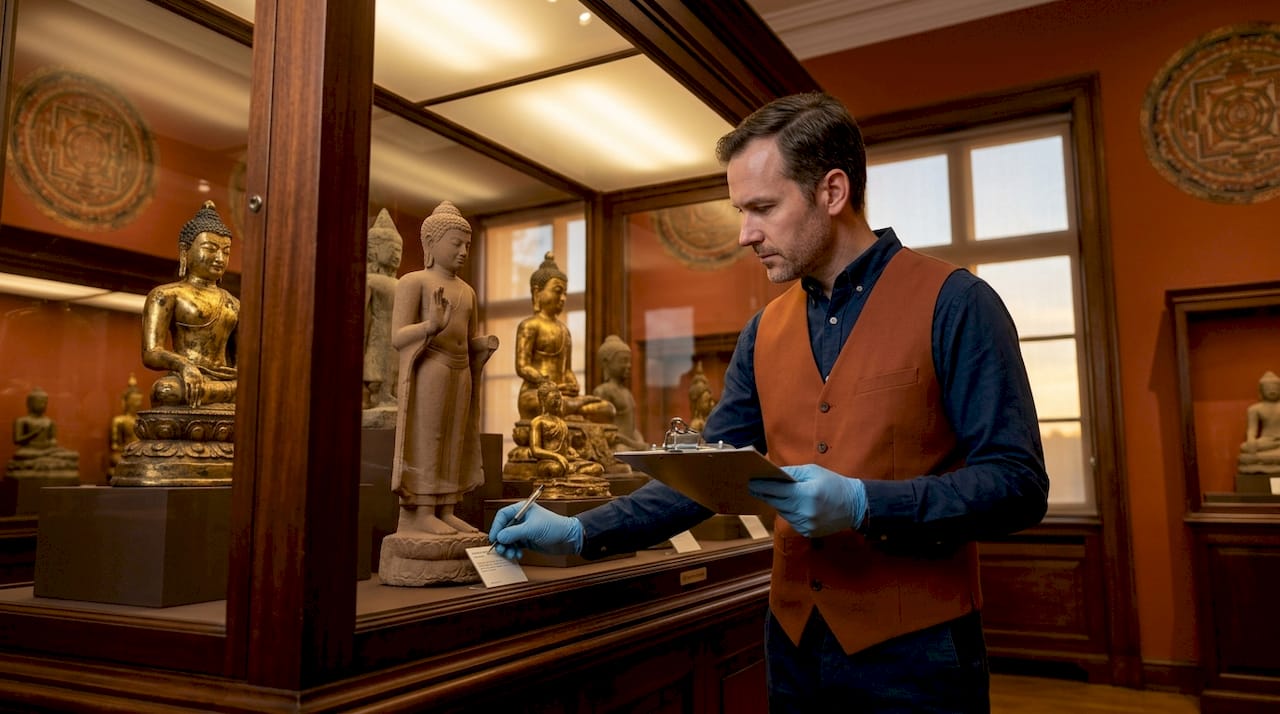
Theravada Buddhist art has a distinct visual vocabulary that scholars learn to read as precisely as written text. Recognizing these features transforms how you engage with any piece.
Iconographic markers
The ushnisha, a protuberance at the crown of the head, indicates the Buddha’s supreme wisdom. Elongated earlobes reference his princely past, when heavy jewels stretched them, before he renounced material wealth. The urna, a spiral or dot between the eyebrows, marks a secondary site of enlightened perception. These are not decorative choices. They are a codified system called the thirty-two marks of a Great Being, drawn from Pali canonical texts.
Mudras, or hand gestures, communicate specific meaning with equal precision. The bhumisparsha mudra, where the right hand touches the earth, depicts the moment of the Buddha’s enlightenment and his calling the earth to witness. The dhyana mudra, both hands resting in the lap, signals deep meditation. The abhaya mudra, with palm raised outward, conveys protection and fearlessness.
Materials and regional styles
| Region | Preferred Material | Distinctive Style Feature |
|---|---|---|
| Sri Lanka | Stone, gilded bronze | Serene expression, upright posture |
| Thailand | Bronze, gilded lacquer | Flame ushnisha, elongated fingers |
| Burma (Myanmar) | Alabaster, white marble | Smooth surface, elaborate robes |
| Cambodia | Sandstone, bronze | Archaic smile, Angkor-period headdress |
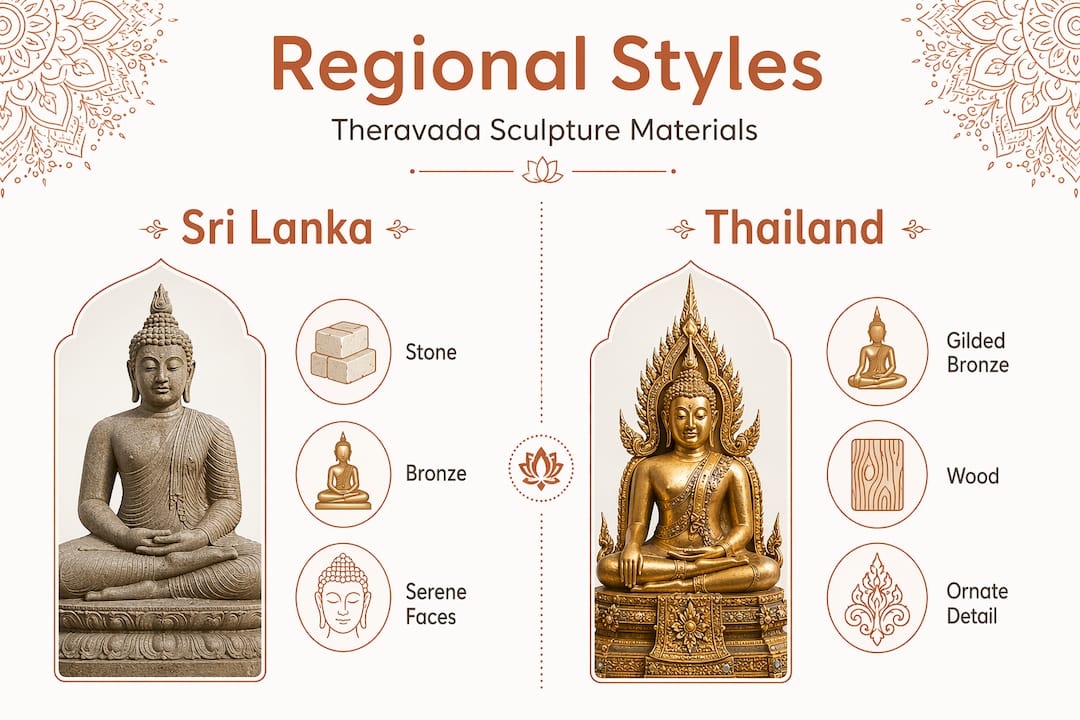
Buddhist art across regions reflects transformation and adaptation rather than imitation. Thai bronze casting traditions, for example, developed distinctive technical refinements in alloy composition and surface gilding that produced the luminous quality characteristic of Sukhothai-period work. Burmese alabaster carving prioritized the tactile purity of white stone in ways that stone carving in Cambodia never emphasized.
Buddhist cave sites like Sanchi and Ajanta show how architecture, narrative sculpture, and ritual movement were designed as a unified spiritual experience. The sculptures were not placed in rooms; they were integrated into spatial programs where the act of moving through space was itself devotional. Photographic documentation of early Buddhist caves has clarified how this spatial and sculptural design reinforces sacred intent in ways that isolated museum display cannot replicate.
Pro Tip: When examining a bronze Theravada sculpture, check the casting seams and surface patina. Authentic antique pieces show consistent oxidation across all surfaces, including recessed areas. Uneven or localized patina is a common indicator of artificial aging.
Contemporary relevance and ongoing discovery
Theravada Buddhist sculptural art is not a closed chapter. New discoveries continue to reframe existing historical understanding with regularity.
The recent identification of Theravada sculptures in non-museum settings across Tamil Nadu illustrates how much of this tradition still exists outside formal scholarly catalogs. A 3-foot stone Buddha with clear Chola-period stylistic features found at a village temple at Vedaranyam required cross-referencing local oral history, epigraphic evidence, and art historical comparison to establish its context. This is the standard process for many significant finds.
The implications for understanding Theravada sculpture are considerable:
- Known museum collections represent a fraction of surviving works. Many pieces remain in active use at village temples, rural shrines, and private collections.
- Regional variations documented through field research challenge earlier assumptions that Theravada art developed uniformly from Sri Lankan or Thai centers.
- Works subject to weathering and ritual use carry different forms of evidence than museum-preserved pieces. Surface wear patterns, votive deposits, and ritual modifications all carry historical information.
- Temples and sculptures in Southeast Asia continue to function as centers for preserving national identity, moral education, and community cohesion. The sculptures are not relics of a past practice; they are active participants in living communities.
The legacy of Theravada sculptural art is not static. Each generation of practitioners and communities reinterprets and extends it, while scholars work to document the full scope of what has been created across more than two thousand years.
My perspective on what most people miss
I’ve spent years looking closely at Theravada Buddhist sculpture, reading the scholarly literature, and examining pieces from Sri Lanka, Thailand, Cambodia, and Burma. The single biggest mistake I’ve seen in both popular writing and academic introductions is treating these works as products of a single, coherent tradition that trickled out of India and arrived unchanged in Southeast Asia.
What I’ve found is something far more interesting. Buddhist art history is a continuous process of transformation and local adaptation. The Sukhothai Buddha in Thailand is not a simplified copy of anything Indian. It is the result of Thai artists solving specific doctrinal, aesthetic, and material problems in their own terms. That distinction matters enormously for how you read these works.
My other strong view is that understanding Theravada sculpture without understanding puja practice produces fundamentally incomplete analysis. You can describe every iconographic feature correctly and still miss what the object actually does in the world. The sculpture exists within a system of practice, spatial arrangement, and community use. Strip it from that context and you have the form without the content.
For scholars approaching this field, I’d recommend starting with the offering system before the iconography. Once you understand why flowers are placed before a Buddha image, the formal features start to read as extensions of the same doctrinal logic rather than as a separate decorative vocabulary.
— James, HDAsianArt.com
Explore Theravada sculpture at Hdasianart
Hdasianart specializes in authenticated antique Buddhist and Hindu sculptures from across Southeast Asia, with particular depth in bronze, stone, and wood works from Cambodia, Thailand, Sri Lanka, and Burma. Each piece in the collection has been individually researched and documented by specialists with direct field knowledge of regional styles and periods.
For collectors and scholars looking to move from study to acquisition, the HDAsianArt collection offers museum-quality works with detailed provenance documentation, high-resolution photography, and worldwide insured shipping. Whether your interest is in understanding Theravada sculpture through direct engagement with original objects or building a focused collection, HDAsianArt provides the expertise and access to support that goal at every level.
FAQ
What is the difference between Theravada and Mahayana Buddhist sculpture?
Theravada sculpture centers on the historical Shakyamuni Buddha and a defined set of iconographic markers drawn from Pali canonical texts. Mahayana and Vajrayana traditions incorporate a much larger pantheon of bodhisattvas and deities, producing greater iconographic variety.
Are Theravada Buddhists worshipping idols when they use sculptures?
No. Theravada doctrine distinguishes clearly between material and practice offerings), with sculptures serving as focal points for moral reflection rather than as recipients of devotion in any theistic sense.
What materials are most common in Theravada Buddhist sculpture?
Bronze, stone, and wood are the primary materials, with significant regional variation. Thailand favors gilded bronze, Burma is known for alabaster and white marble, and Cambodia produced major works in sandstone.
How do scholars identify authentic Theravada sculptures?
Authentication combines iconographic analysis, material testing, surface patina assessment, and cross-referencing with regional stylistic records. Archaeological finds in non-museum settings also require local historical and epigraphic corroboration.
What do the hand gestures on Buddha sculptures mean?
Each mudra communicates a specific moment or quality. The bhumisparsha mudra depicts enlightenment, the dhyana mudra signals meditation, and the abhaya mudra conveys protection. These are standardized across Theravada Buddhist art forms throughout Southeast Asia.
