



The Role of Ushnisha in Buddha Statues Explained
The Role of Ushnisha in Buddha Statues Explained
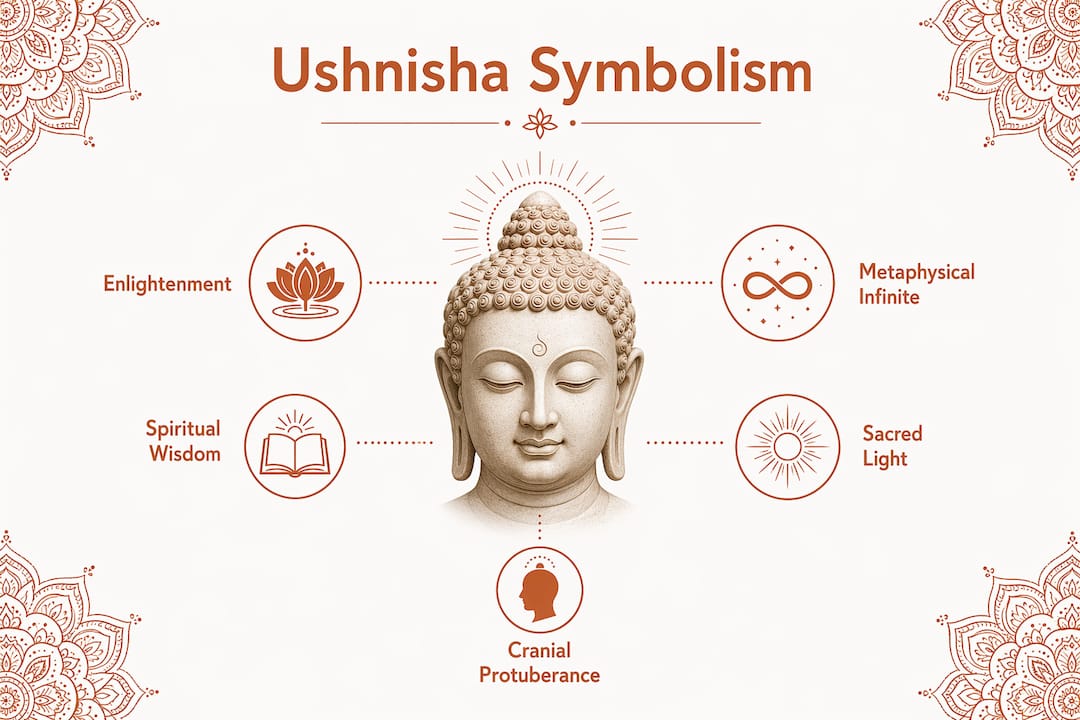
The ushnisha is defined as the cranial protuberance atop a Buddha statue’s head, representing the crown of Enlightenment and supreme spiritual attainment. Recognized as the 32nd major mark of a Buddha, it stands as the final and most highly valued of the 32 physical attributes described in Buddhist canon.
The role of ushnisha in Buddha statues goes far beyond decoration. It signals the Buddha’s transcendence of ordinary human existence and his unique status as a fully awakened being. Art historians, enthusiasts, and students who understand this feature gain a direct window into Buddhist theology, regional artistic traditions, and the evolution of sacred iconography across Asia.
What is the historical origin of the ushnisha in Buddhist art?
The word “ushnisha” derives from Sanskrit and means “turban” or “topknot.” That etymology tells you something important: the feature began as a realistic detail before it became a theological statement.
In the earliest Buddhist sculptures, particularly those from Gandharan art of the 1st century CE, the ushnisha appears as a princely hair-knot. Gandhara, located in present-day Pakistan and Afghanistan, produced sculptures heavily influenced by Hellenistic artistic conventions. Sculptors there depicted the Buddha with wavy, naturalistic hair swept upward into a visible topknot. The feature looked like something a nobleman might actually wear.
The shift from realistic topknot to supernatural cranial protuberance happened gradually as Buddhist theology deepened. Sculptors stopped depicting a hairstyle and started depicting a physical transformation of the skull itself. This change reflects the theological move from historical Siddhartha Gautama, the prince who renounced his throne, to the cosmic Buddha, a being whose body manifests spiritual perfection. The ushnisha’s evolution from topknot to cranial dome marks one of the clearest transitions in Buddhist art history.
- Gandharan school (1st–5th century CE): Wavy hair conceals the ushnisha, maintaining a naturalistic, princely appearance.
- Mathura school (India, 2nd–5th century CE): The ushnisha becomes a distinct dome, often shown with tight curls or a smooth surface.
- Tamrashatiya school (Sri Lanka): Depicts a bald head with an immeasurable, endless ushnisha, emphasizing its metaphysical rather than physical nature.
- Southeast Asian traditions (Thailand, Cambodia, Indonesia): The ushnisha transforms into a flame-shaped or pointed finial, reflecting local cosmological beliefs.
Pro Tip: When dating a Buddhist sculpture, the ushnisha’s form is one of the most reliable stylistic markers. A wavy-hair topknot points toward Gandharan influence, while a smooth dome with tight curls suggests Mathura or later Indian conventions.
How does the ushnisha function symbolically in Buddhist tradition?
The ushnisha carries more doctrinal weight than any other single physical feature on a Buddha statue. As one of the 32 major marks, it signals that the being depicted has achieved complete Enlightenment and possesses wisdom beyond ordinary comprehension.
Buddhist canonical texts describe the 32 marks as physical signs that appear on the body of a being who has perfected virtue and wisdom across countless lifetimes. The ushnisha is listed last among these marks, but that position reflects culmination, not lesser importance. The Ratnamegha Sūtra describes the ushnisha as superior to all marks except the Buddha’s voice. That ranking places it above the wheel-marked feet, the elongated earlobes, and even the urna, the dot between the eyebrows.
“Literary traditions describe bodhisattvas unable to reach the top of the ushnisha even using supernatural powers. This concept, known as anavalokitamūrdhatā, means ‘the top of the head is not looked upon.’ The ushnisha is not merely tall. It is infinite.”
The concept of anavalokitamūrdhatā transforms the ushnisha from a sculptural feature into a metaphysical statement. No matter how high a bodhisattva flies, the crown of the Buddha remains beyond reach. That idea cannot be shown literally in stone or bronze, so artists encoded it through scale, elevation, and the flame or jewel finials that extend the ushnisha upward.
The ushnisha also functions as a dynamic sacred element in Buddhist ritual literature. Certain sutras describe light emitting from the Buddha’s mouth and returning to the ushnisha as a signal of prophecy, specifically the announcement of future Buddhahood for a disciple. The ushnisha becomes an active participant in dharma transmission, not just a passive symbol of status.
What are the regional and stylistic variations in ushnisha depictions?
Buddhist iconography of the ushnisha is flexible, shaped by regional culture, theology, and artistic tradition rather than a single fixed rule. Different Buddhist schools interpret the feature differently, and those differences carry real theological meaning.
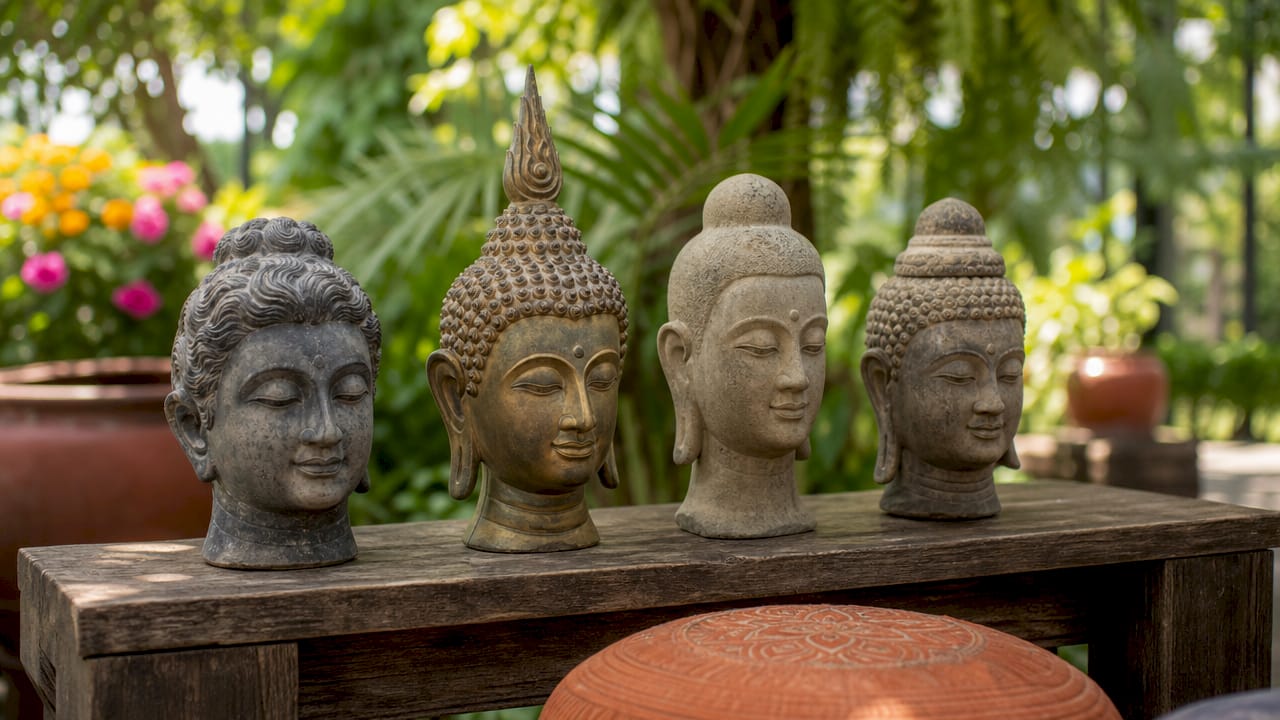
The table below maps the major regional traditions against their characteristic ushnisha forms.
| Region / School | Ushnisha Form | Key Characteristic |
|---|---|---|
| Gandhara (Pakistan/Afghanistan) | Wavy hair topknot | Naturalistic, princely, Hellenistic influence |
| Mathura (India) | Smooth or curled dome | Distinct protuberance, tight spiral curls |
| Tamrashatiya (Sri Lanka) | Bald head, immeasurable crown | Endless ushnisha, Theravada theological emphasis |
| Thailand (Sukhothai period) | Flame-shaped finial | Pointed flame rising from the crown |
| Cambodia (Khmer) | Lotus bud or conical form | Compact, jeweled, or lotus-shaped |
| Java (Indonesia) | Rounded dome with ornament | Often topped with a jewel or stupa motif |
The variations in size, shape, and surrounding elements correspond directly to theological emphasis and local culture. Thai Sukhothai sculptors added a flame finial to express the Buddha’s radiant energy. Sri Lankan Theravada sculptors rejected hair entirely to emphasize the ushnisha as a purely supernatural feature. Khmer artists in Cambodia compressed the form into a lotus bud, connecting the crown to the symbol of spiritual purity.
Pro Tip: When examining a Theravada Buddhist sculpture, look for the absence of hair as a deliberate theological choice, not a stylistic omission. A bald head with a prominent crown dome is the Tamrashatiya school’s way of stating that the ushnisha has no physical limit.
How can you recognize and interpret the ushnisha in Buddha statues?
Identifying the ushnisha correctly requires separating it from three features that beginners often confuse with it: decorative crowns, ornamental headdresses, and natural hairstyles. The ushnisha is always part of the skull itself, not an object placed on top of the head.
-
Locate the cranial protuberance. The ushnisha rises directly from the top of the skull. It is not a separate crown or headdress. On statues where the Buddha wears a crown, the ushnisha typically still appears beneath or above the crown’s base.
-
Check the relationship with the urna. The urna is the dot or spiral between the eyebrows. Both the urna and the ushnisha are among the 32 major marks. When both features are present and correctly proportioned, the statue follows canonical iconographic conventions. Their co-presence is a strong indicator of an authentic, doctrinally informed sculpture.
-
Read the hair treatment. Tight spiral curls covering the ushnisha indicate Indian or Southeast Asian conventions. Wavy naturalistic hair points to Gandharan influence. A smooth, bald head with a distinct dome signals Sri Lankan or certain Theravada traditions. The hair treatment is a regional fingerprint.
-
Assess the finial or topping. A flame rising from the ushnisha is characteristic of Thai Sukhothai and Ayutthaya periods. A jewel or stupa finial appears frequently in Javanese and Cambodian work. No finial at all is common in early Indian and Gandharan pieces.
-
Cross-reference with mudras and facial expression. The ushnisha does not exist in isolation. A statue’s hand gesture, or mudra, and facial expression provide context for the iconographic program as a whole. A meditation mudra paired with a smooth ushnisha dome suggests a contemplative, transcendent depiction. An earth-touching mudra with a flame finial is characteristic of Thai Enlightenment imagery.
A common misconception is that any statue with a raised head feature depicts the Buddha. Bodhisattvas and Hindu deities also wear elaborate crowns and headdresses. The ushnisha specifically marks a fully enlightened Buddha, not a bodhisattva still on the path. Knowing the different Buddha statues and their iconographic programs helps you make that distinction reliably.
Key Takeaways
The ushnisha is the single most theologically loaded feature on a Buddha statue, encoding Enlightenment, metaphysical infinity, and regional doctrinal identity in one sculptural element.
| Point | Details |
|---|---|
| Canonical status | The ushnisha is the 32nd and final major mark, signaling complete Enlightenment. |
| Historical evolution | It shifted from a realistic Gandharan topknot to a supernatural cranial dome across centuries. |
| Metaphysical meaning | The concept of anavalokitamūrdhatā defines the ushnisha as infinite and beyond reach. |
| Regional variation | Thai, Khmer, Sri Lankan, and Indian schools each depict the ushnisha differently based on local theology. |
| Identification method | Cross-reference skull position, hair treatment, finial form, and co-presence of the urna to identify correctly. |
What the ushnisha keeps teaching me after years with Buddhist art
I have spent years handling, researching, and cataloging Buddhist sculptures from across Asia, and the ushnisha still surprises me. Most people look at a Buddha statue and see serenity. I look at the crown of the head first.
What strikes me most is how the ushnisha exposes the tension between realism and theology in Buddhist art. The Gandharan sculptors were trying to show a real person, a prince who became enlightened. Their ushnisha looks like hair. The Sri Lankan Theravada tradition rejected that entirely. They wanted to show something no human being could possess. Their ushnisha has no top. That is not a stylistic choice. It is a doctrinal argument carved in stone.
Collectors and art historians often underestimate how much the ushnisha reveals about provenance and dating. I have seen pieces misattributed by decades because the buyer focused on the face and ignored the crown. The flame finial on a Thai piece, the lotus bud on a Khmer piece, the tight spiral curls on an Indian piece: these are not decorative variations. They are regional signatures.
The other thing I find underappreciated is the ushnisha’s role in light symbolism. Most people know it as a physical mark. Fewer know that Buddhist ritual texts describe light returning to the ushnisha as a signal of prophetic transmission. That makes the crown of the head an active element in the Buddha’s communication of dharma, not just a passive indicator of status. When you understand that, a statue stops being an object and starts being a theological statement.
— James, HDAsianArt.com
Authentic Buddha statues with expertly documented iconography at HDAsianArt
HDAsianArt sources and documents authentic Buddhist sculptures from Cambodia, Thailand, Indonesia, Sri Lanka, and beyond, with each piece individually researched for iconographic accuracy, including ushnisha form and regional style.
For collectors and scholars who want to study ushnisha variations firsthand, the HDAsianArt collection includes pieces ranging from Javanese bronze bodhisattvas to Theravada stone Buddhas. Each listing describes the iconographic program in detail. The Javanese Avalokiteshvara bodhisattva is one strong example of Southeast Asian crown iconography documented to museum standards. Browse the full HDAsianArt collection to find pieces that reflect the full range of Buddhist artistic traditions.
FAQ
What does the ushnisha represent on a Buddha statue?
The ushnisha represents Enlightenment, spiritual wisdom, and the Buddha’s transcendence of ordinary human existence. It is the 32nd and final major mark of a fully awakened Buddha.
How is the ushnisha different from a crown or headdress?
The ushnisha is part of the skull itself, not a separate object placed on the head. A crown or headdress sits on top of the head and can be removed; the ushnisha cannot.
Why does the ushnisha look different across Buddhist cultures?
Regional theological emphasis and local artistic traditions shape the ushnisha’s form. Thai sculptures use a flame finial, Sri Lankan Theravada pieces show a bald head with an immeasurable dome, and Gandharan art depicts wavy hair concealing a topknot.
What is anavalokitamūrdhatā?
Anavalokitamūrdhatā means “the top of the head is not looked upon.” It describes the ushnisha as metaphysically infinite, a crown so high that even bodhisattvas with supernatural powers cannot reach its top.
Can the ushnisha help date or authenticate a Buddhist sculpture?
Yes. The ushnisha’s form, including hair treatment, shape, and finial type, is one of the most reliable stylistic markers for identifying a sculpture’s regional origin and historical period.
