



How to Date Antique Thai Buddha Images: Collector's Guide
How to Date Antique Thai Buddha Images: Collector's Guide
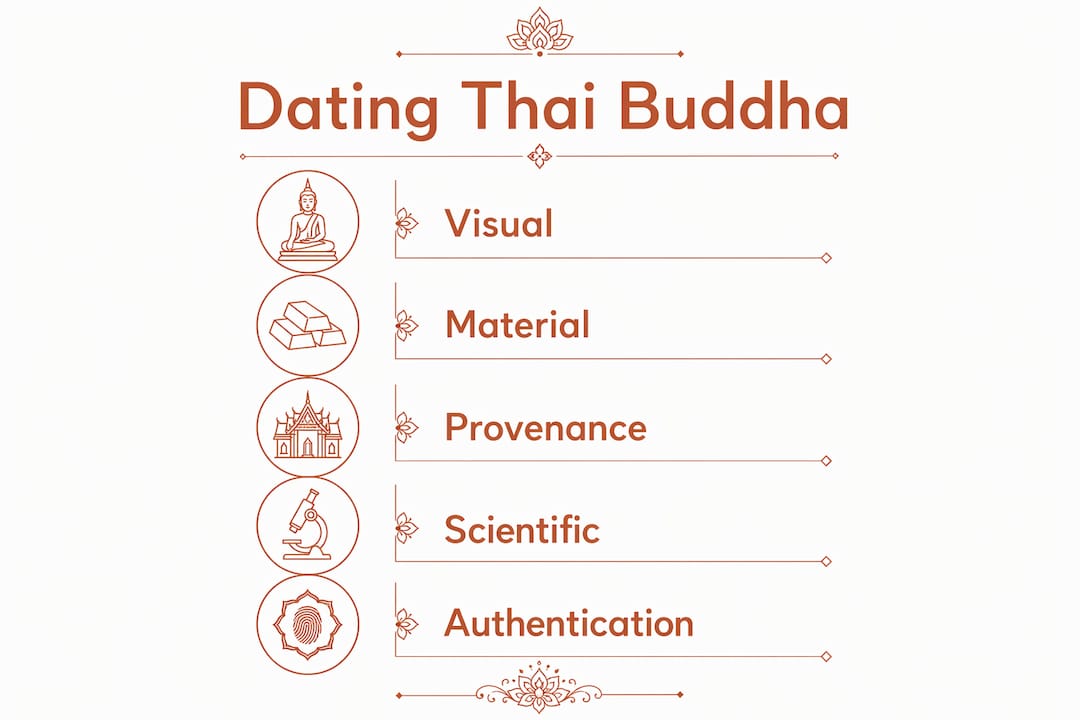
Dating an antique Thai Buddha image is achieved through combining stylistic analysis, material examination, provenance research, and professional authentication. Collectors and scholars use the term iconometric dating to describe this systematic process, though the practical work spans art history, materials science, and archival research.
Recognized historical periods including Sukhothai (13th–15th century), Lanna, Ayutthaya, and Rattanakosin each produced distinct visual and material signatures. Thailand’s Fine Arts Department serves as the official authentication authority, and its involvement in high-profile cases confirms that accurate dating demands more than a trained eye alone.
How to date antique Thai Buddha images by stylistic period
Style is the first and most accessible dating tool for any collector. Each major Thai artistic period produced Buddha images with features specific enough to narrow a date range to within a century or less.
The four primary periods and their defining characteristics:
- Sukhothai (13th–15th century): Flame-shaped ushnisha (cranial protuberance), elongated oval face, arched eyebrows meeting at the nose bridge, and a walking posture (Phra Lila) unique to this school. Robes are thin and close-fitting, with a distinctive flap over the left shoulder.
- Lanna (13th–18th century, northern Thailand): Broader facial features, a more pronounced ushnisha, and seated postures with elaborate decorative thrones. Lanna images frequently show Burmese stylistic influence due to geographic proximity.
- Ayutthaya (14th–18th century): Crowned Buddha images appear here, reflecting royal patronage. Facial features become more stylized, with almond-shaped eyes and a slight smile. Robes show greater surface decoration.
- Rattanakosin (18th century–present): Highly ornate gilded images with elaborate crowns and jewelry. Proportions become more rigid and formal. Monks and experts attribute statues found in temple stupas to the early Rattanakosin period based precisely on these artistic markers and material composition. This confirms that stylistic reading remains a primary dating method even for professional appraisers.
Beyond period, posture (mudra) carries dating information. The Bhumisparsha mudra (earth-touching gesture) dominates Sukhothai output, while the Dhyana mudra (meditation gesture) appears more frequently in Lanna and Ayutthaya work. Robe treatment is equally telling: thick, sculptural robes suggest Lanna or early Ayutthaya, while paper-thin drapery points to Sukhothai.
Pro Tip: Regional imitation complicates dating. Northern Thai workshops copied Sukhothai models well into the Ayutthaya period. Cross-reference the Thai Buddha styles guide at HDAsianArt to compare regional variants side by side before committing to a period attribution.
How do materials and production techniques help date a statue?
Material composition is the second pillar of dating. The alloys, casting methods, and surface treatments used in Thai Buddhist sculpture changed measurably across centuries.
Key material indicators by era:
- Bronze: The dominant medium from Sukhothai through Ayutthaya. Early Sukhothai bronzes show high copper content with relatively low tin, producing a warm reddish tone. Ayutthaya bronzes tend toward a cooler, darker patina.
- Brass and silver: Rattanakosin era statues found underground showed usage of brass and silver with distinct craftsmanship, marking a clear material shift from earlier bronze-dominant production. This shift is a reliable period marker.
- Wood: Carved wood images are common in Lanna and northern traditions. Teak and jackfruit wood were preferred. Older carvings show deep grain checking, insect channels, and surface oxidation that modern reproductions cannot replicate convincingly.
- Lacquer and gilding: Successive layers of lacquer and gold leaf accumulate over centuries. Cross-section analysis of these layers, when available, can indicate the number of restoration cycles and approximate age.
The lost-wax casting (cire-perdue) method was standard for bronze production across all periods. However, the quality of the wax model, the thickness of the cast walls, and the finishing work differ by era. Sukhothai bronzes often show finer surface detail and thinner walls than later Rattanakosin pieces, which prioritized scale and decorative impact over technical refinement.
Scientific methods available to serious collectors include X-ray fluorescence (XRF) for alloy composition, thermoluminescence (TL) testing for fired clay cores inside bronze castings, and dendrochronology for wooden images. These tests require specialist laboratories and add cost, but they produce objective date ranges that no visual assessment can match.
Pro Tip: Natural patina on bronze forms over decades and shows specific mineral deposits (malachite green, azurite blue, cuprite red) that are chemically distinct from artificially aged surfaces. A jeweler’s loupe at 10x magnification reveals whether patina sits inside surface pores or sits on top of them. Genuine age patina is always subsurface.
What research tools and resources are available for collectors?
Accurate dating requires more than physical examination. The following resources provide the documentary and comparative framework collectors need.
| Resource Type | Examples | Access | Reliability |
|---|---|---|---|
| Museum collections | Bangkok National Museum, Chiang Mai National Museum | Public, free | High |
| Academic catalogs | Thai Buddhist Art (Piriya Krairiksh), The Arts of Thailand (Stratton & Scott) | Purchase or library | High |
| Official registries | Thailand Fine Arts Department database | Government, restricted | Authoritative |
| Digital repositories | 3D virtual object repositories for Lan Xang Buddhist art | Online, academic | Growing |
| Auction house records | Christie’s, Sotheby’s, Bonhams past sale catalogs | Online archives | Moderate to high |
The Bangkok National Museum holds the most comprehensive reference collection of dated Thai Buddha images in the world. Spending time with its Sukhothai and Ayutthaya galleries calibrates your eye faster than any book. The Fine Arts Department’s registry documents legally registered antiques and provides provenance chains that are legally recognized in Thailand and internationally.
Digital tools are expanding access. 3D virtual repositories developed for Lan Xang Buddhist art enable high-resolution comparative study without physical access to the objects. This technology is increasingly applied to Thai collections and represents the future of remote authentication support.
Step-by-step process to date and verify a Thai Buddha statue
A structured approach prevents the most common collector errors and produces a defensible date attribution.
- Initial visual assessment. Identify the period style using posture, facial features, robe treatment, and iconographic attributes. Note any anomalies that suggest restoration or mixed-period elements.
- Material identification. Determine the primary medium (bronze, brass, wood, stone) and examine surface condition, patina, and casting or carving quality under magnification.
- Provenance research. Gather all available documentation: purchase receipts, export licenses, auction records, prior ownership history, and any published references to the piece.
- Comparative analysis. Match the image against dated reference examples in museum catalogs, auction archives, or the HDAsianArt rare Buddhist reliquary examples resource for comparable pieces.
- Expert consultation. Engage a certified art historian specializing in Southeast Asian sculpture or contact a reputable gallery with documented expertise. Thailand’s Fine Arts Department provides official dating and origin reports in formal cases, and its involvement is standard practice for high-value acquisitions.
- Scientific testing. For high-value pieces, commission XRF alloy analysis or TL testing through a university laboratory or specialist firm. Results should align with your visual and historical assessment.
- Documentation and registration. Record all findings, test results, and expert opinions. Register the piece with the Fine Arts Department if it meets the threshold for official antique status under Thai law.
| Step | Purpose |
|---|---|
| Visual assessment | Establish period attribution and flag anomalies |
| Material identification | Confirm medium and surface authenticity |
| Provenance research | Build documentary chain of ownership |
| Comparative analysis | Validate attribution against dated reference pieces |
| Expert consultation | Obtain professional opinion for high-stakes decisions |
| Scientific testing | Produce objective, laboratory-verified date range |
| Documentation | Create permanent record for insurance and resale |
What are common challenges when dating antique Thai Buddha images?
Even experienced collectors make attribution errors. Understanding the most frequent mistakes reduces risk significantly.
- Reproduction misidentification. Modern Thai workshops produce high-quality bronze images using traditional lost-wax methods. Without patina analysis and provenance, these pieces are difficult to distinguish from genuine antiques. Police involvement with stolen Buddha heads highlights how misattribution creates legal as well as financial risk.
- Regional imitation confusion. Northern Thai workshops copied Sukhothai models for centuries. A Lanna image made in 1700 can display Sukhothai stylistic features, misleading collectors into an earlier date attribution.
- Restoration masking. Extensive regilding, lacquer reapplication, or structural repairs obscure original surface evidence. A heavily restored Ayutthaya image may read as Rattanakosin to an untrained eye.
- Missing provenance. The majority of antique Thai Buddha images in private collections lack complete documentation. Absence of provenance does not mean a piece is inauthentic, but it removes one of the most reliable dating tools.
- Cross-cultural influence. The Amaravati tradition from South India influenced early Thai Buddhist sculpture, and pieces showing these features are sometimes misdated as Indian rather than Thai. Recognizing cross-cultural borrowing is a skill that develops through sustained comparative study.
“In 2026, the Thailand Fine Arts Department was officially called upon to determine the age and origin of a Buddha head discovered underwater, illustrating that professional evaluation is necessary for accurate dating and authenticity checks even in straightforward-seeming cases.”
The clearest lesson from that case: when provenance is absent and the piece is significant, professional authentication is not optional.
Key takeaways
Accurate dating of a Thai Buddha image requires stylistic analysis, material examination, provenance research, and professional verification working together, not independently.
| Point | Details |
|---|---|
| Style identifies the period | Sukhothai, Lanna, Ayutthaya, and Rattanakosin each have distinct posture, facial, and robe features. |
| Materials confirm the era | Bronze alloy composition, brass use, and lacquer layers provide objective material dating evidence. |
| Provenance anchors authenticity | Documentation from Thailand’s Fine Arts Department is the most legally reliable authentication source. |
| Scientific testing resolves disputes | XRF and thermoluminescence testing produce laboratory-verified date ranges for high-value pieces. |
| Expert consultation is non-negotiable | For acquisitions above moderate value, certified specialist review prevents costly misattribution. |
Why the methodical approach matters more than intuition
After years of working with Thai Buddhist sculpture, the single most consistent pattern I observe is collectors overweighting visual style and underweighting material evidence. Style can be copied. Alloy composition and subsurface patina cannot be faked at scale without significant cost that exceeds the reproduction’s market value.
The market for vintage Thai Buddha statues has grown considerably, and with it, the sophistication of reproduction. I have handled pieces where the stylistic reading pointed clearly to Sukhothai, but XRF analysis revealed a zinc content in the bronze that was not commercially available until the 20th century. That one data point collapsed a confident attribution entirely.
The other underappreciated factor is cross-cultural influence. Collectors focused on Thai antique sculptures sometimes miss that a piece showing Amaravati stylistic features is not necessarily Indian. Early Thai Buddhist art absorbed South Indian iconographic conventions directly, and pieces from the 3rd to 5th century AD can display both traditions simultaneously. Understanding cultural symbolism in artifact dating across different Asian traditions builds the comparative framework that makes this kind of nuanced reading possible.
My practical advice: build your reference library before you build your collection. Spend time with the Bangkok National Museum’s permanent collection. Commission at least one scientific test on a piece you are confident about, just to calibrate what the results look like for a genuine antique. That baseline makes every subsequent assessment more reliable.
— James, HDAsianArt.com
Explore authenticated Thai Buddha statues at HDAsianArt
HDAsianArt sources and individually researches each piece in its collection of antique Thai Buddha statues, with detailed period attributions, material descriptions, and provenance notes prepared by specialists. Every listing includes high-resolution photography that supports your own stylistic assessment before purchase. The collection spans Sukhothai, Lanna, Ayutthaya, and Rattanakosin periods in bronze, wood, and stone.
Worldwide insured DHL shipping and expert guidance on authentication documentation are standard with every acquisition. For collectors seeking museum-quality historical Buddha images with verified provenance, HDAsianArt provides the curatorial depth the market demands.
FAQ
How do I identify the period of a Thai Buddha image?
Identify the period by examining posture, facial features, robe treatment, and iconographic attributes specific to Sukhothai, Lanna, Ayutthaya, or Rattanakosin conventions. Cross-reference against dated museum examples or published catalogs for confirmation.
What materials are most common in antique Thai Buddha art?
Bronze is the dominant material across all major periods, with brass and silver appearing more frequently in Rattanakosin-era pieces. Wood carvings are characteristic of the Lanna tradition in northern Thailand.
When is scientific testing necessary to date a Buddha statue?
Scientific testing such as XRF alloy analysis or thermoluminescence dating is necessary when visual and provenance evidence is inconclusive or when the acquisition value justifies the cost. It produces objective date ranges that no visual method can replicate.
What role does Thailand’s Fine Arts Department play in authentication?
Thailand’s Fine Arts Department provides official dating and origin reports for antique Buddha images and maintains the legal registry for registered antiques. Its certification is the most authoritative authentication available for Thai Buddhist sculpture.
How can I store a dated antique Buddha image correctly?
Proper storage prevents deterioration that can obscure dating evidence. HDAsianArt’s guide on storing antique stone sculpture covers humidity control, light exposure, and handling protocols specific to Buddhist sculpture materials.
