



Aureole in Buddhist Statues: Symbolism and Meaning
Aureole in Buddhist Statues: Symbolism and Meaning
The aureole in Buddhist statues is defined as the luminous halo or mandorla encircling the entire body of a sacred figure to signify enlightened presence, spiritual power, and divine protection. Distinct from the nimbu, which encircles only the head to emphasize spiritual authority, the aureole encompasses the full figure and represents boundless spiritual energy radiating outward.
The role of aureole in Buddhist statues goes well beyond decoration. It is a theological statement rendered in stone, bronze, or wood, communicating the dual nature of the enlightened mind through color, form, and flame. Understanding this iconographic device gives scholars and collectors a sharper lens for reading Buddhist sculpture across every tradition.
What does the aureole symbolize in Buddhist statues?
The aureole is presence made visible, not a stylistic flourish. Gold and blue are its two dominant colors, and each carries a precise doctrinal meaning. Gold represents universal compassion and the warmth of the midday sun. Blue reflects inner stillness and the healing nature of emptiness, known in Sanskrit as Sunyata.
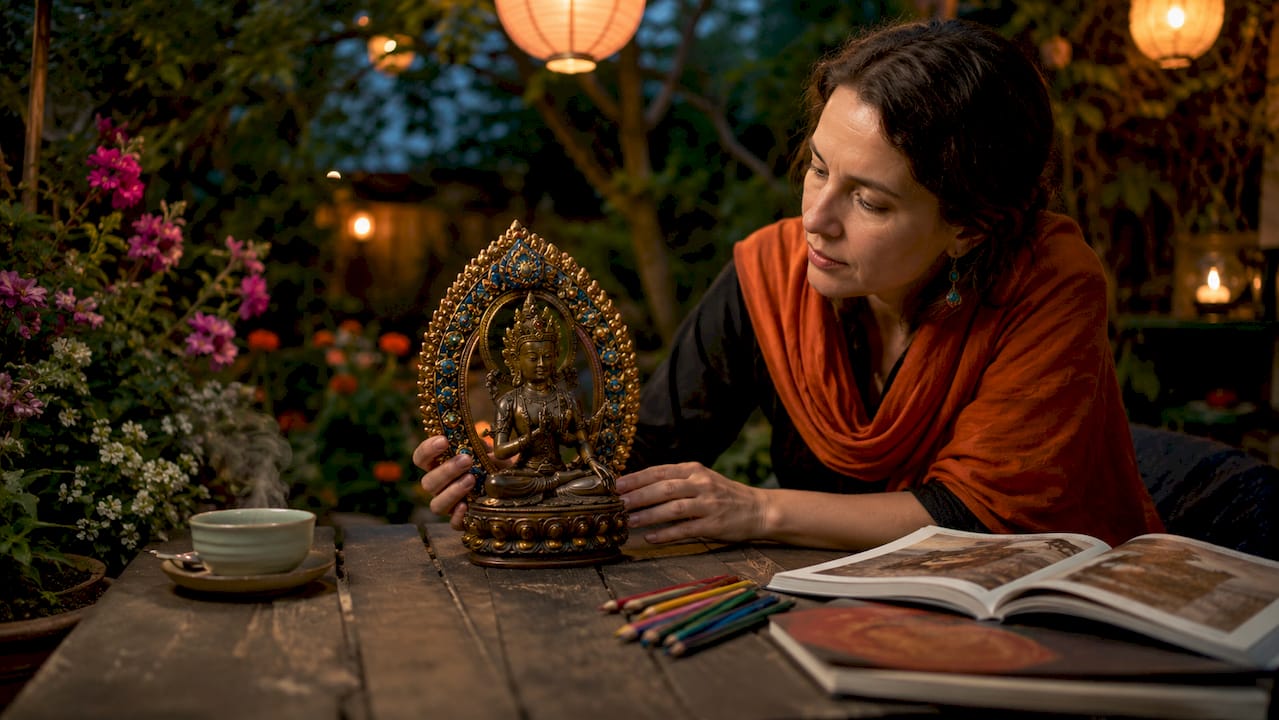
These two colors are visual metaphors for the duality of the enlightened mind. Compassion and wisdom are the twin pillars of Mahayana Buddhist philosophy, and the aureole makes that pairing visible to anyone standing before the statue. The gold of Amitabha Buddha’s aureole carries particular weight. Amitabha’s name translates as “Immeasurable Light,” and his golden aureole embodies wisdom as an active, all-encompassing force rather than a passive quality.
Pro Tip: When studying a Buddhist statue, look at the aureole color before the face. The color tells you which aspect of enlightenment the sculptor prioritized: compassion (gold) or transcendent stillness (blue).
Flames appear frequently in aureoles, especially around wrathful deities in Tibetan Buddhist art. Observers often read these flames as anger, but that interpretation is incorrect. Flame-filled mandorlas symbolize the transformative power of wisdom and the fire of pristine awareness, designed to destroy ignorance and protect sentient beings. The fire does not express aggression. It deflects negativity and converts harmful energy into protection.
Key symbolic elements found in Buddhist aureoles:
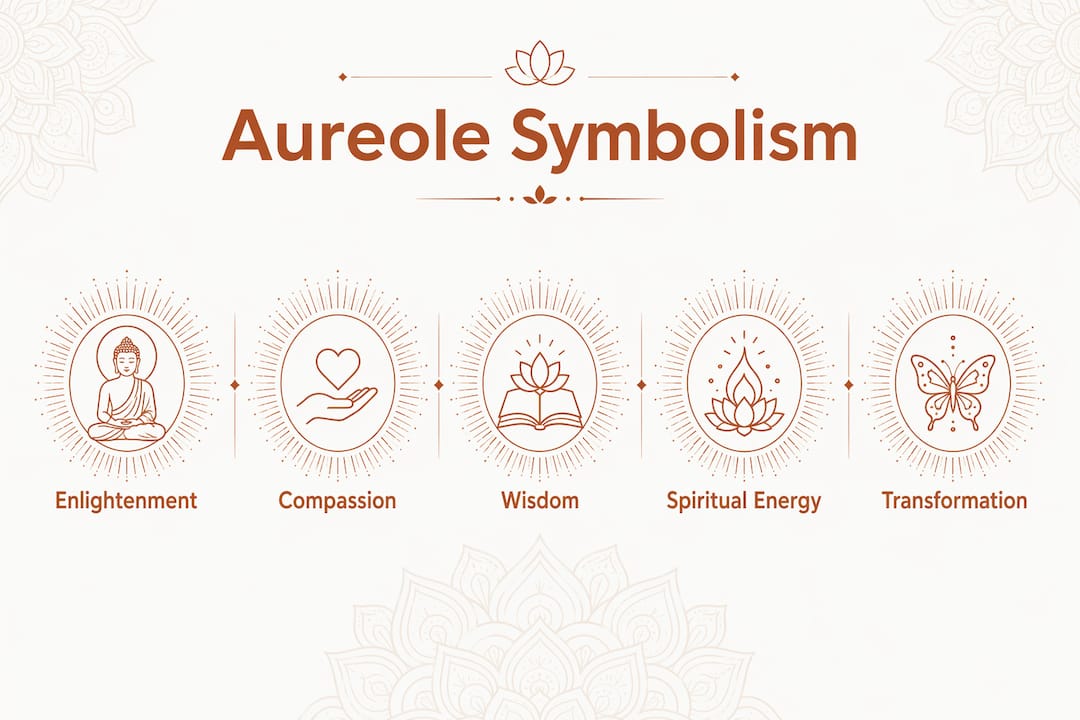
- Gold color: Universal compassion, warmth, and the radiance of Amitabha’s immeasurable light
- Blue color: Inner stillness, Sunyata (emptiness), and the healing nature of the enlightened mind
- Flames: Transformative wisdom, destruction of ignorance, and active protection
- Radiating sunbeams: Solar power and the Buddha’s transcendental presence, common in Gandharan art
- Lotus petal borders: Purity and the unfolding of spiritual realization
How do emanated Buddhas appear within aureoles?
The depiction of small emanated Buddhas within the aureole surrounding a larger central figure is a recurrent visual tradition in East Asian Buddhist art. Each miniature Buddha represents the central figure’s infinite compassion and its capacity to manifest across countless realms simultaneously. This motif appears at prominent Buddhist sites across India, Central Asia, and China.
The theological basis for this convention comes from Mahayana doctrine. The Buddha is not understood as a single historical person but as a transcendental presence capable of infinite emanation. Placing dozens of small Buddhas inside the aureole makes that doctrine visible without a single word of text. A viewer standing before such a statue in a Dunhuang cave or a Tang dynasty temple immediately grasps the idea of boundless, multiplying compassion.
| Region | Aureole Feature | Doctrinal Emphasis |
|---|---|---|
| India (Mathura, Gandhara) | Solar disk with radiating sunbeams | Buddha as cosmic light source |
| Central Asia (Dunhuang) | Multiple emanated Buddhas in mandorla | Infinite transcendental presence |
| China (Tang dynasty) | Dense rows of small Buddhas in flame border | Compassion multiplied across realms |
| Tibet | Flame mandorla on wrathful deities | Transformative wisdom and protection |
| Southeast Asia (Thailand, Cambodia) | Pointed flame finial above head | Royal and spiritual authority combined |
The visual impact of emanated Buddhas is cumulative. The more miniature figures a sculptor includes, the more the viewer senses the impossibility of counting them, which is precisely the point. Infinity cannot be depicted literally, but a sculptor can gesture toward it by filling every available space in the aureole with repeating forms. This technique connects Buddhist iconography and aureoles to a broader visual theology of abundance and compassion.
What regional variations exist in Buddhist aureole design?
Aureole design varies significantly by region, and those differences reflect distinct theological priorities rather than mere artistic preference. Indian and Gandharan art feature solar disk motifs with radiating sunbeams, connecting the Buddha to solar cosmology and universal illumination. East Asian art integrates multiple emanated Buddhas inside the aureole, shifting the emphasis from cosmic light to infinite compassionate presence.
Tibetan Buddhist art takes the most dramatic approach. Wrathful figures like Mahakala or Yamantaka stand within dense flame mandorlas. These wrathful figures wear anger’s costume to transform negative qualities into protection and care, combining fearlessness with love. The flame aureole signals that the deity is actively engaged in burning away the viewer’s delusions, not threatening them.
Southeast Asian traditions, particularly those of Thailand, Cambodia, and Indonesia, blend Indian solar symbolism with local royal iconography. Thai Buddha statues often feature a pointed flame finial rising from the ushnisha (the cranial protuberance), which functions as a compressed aureole directing spiritual energy upward. Cambodian Khmer sculpture from the Angkor period frequently shows a flattened, disk-shaped aureole behind the head that merges the nimbu and the full body mandorla into a single architectural element. The spiritual energy these regional forms project is consistent even when the visual vocabulary differs sharply.
Historical period also shapes aureole design. Early Buddhist art from the Maurya and Shunga periods (3rd–1st centuries BCE) avoided direct depictions of the Buddha altogether, using the aureole as a stand-in for the figure itself. By the Kushan period (1st–3rd centuries CE), Gandharan sculptors began combining Hellenistic halo conventions with Indian solar disk traditions, producing the hybrid forms that influenced Central Asian and Chinese Buddhist art for centuries.
How does the aureole function as a spiritual and artistic device?
Aureoles in Buddhist statues are not mere decoration but sustained arguments rendered in pigment and stone, visually expressing the dual nature of the enlightened mind and the union of wisdom and compassion. This is the core function: the aureole makes an abstract theological claim concrete and immediate for the viewer.
The spiritual functions of the aureole operate on several levels simultaneously:
- Meditation support: The circular or oval form of the aureole creates a visual focal point that draws the meditator’s gaze inward toward the statue’s face and posture.
- Devotional warmth: Gold aureoles generate a sense of being held within a field of compassion, which supports devotional practice and prayer.
- Protective boundary: The aureole marks the sacred space around the figure, signaling that the deity’s power extends outward to encompass and protect the worshipper.
- Doctrinal teaching: Color, flame, and emanated figures communicate specific Mahayana or Vajrayana teachings without requiring literacy or textual knowledge.
- Emotional calibration: The scale and intensity of the aureole signals whether the figure is peaceful (soft gold disk) or wrathful (dense flame mandorla), preparing the viewer for the appropriate devotional response.
The aureole also works in concert with other statue elements. Facial expression and hand gesture (mudra) communicate the figure’s specific teaching or vow, while the aureole amplifies the overall spiritual register. A serene face paired with a gold aureole produces a unified message of accessible compassion. A fierce face paired with a flame mandorla produces an equally unified message of protective power. Neither element works as well in isolation.
Pro Tip: Study the aureole and the mudra together, not separately. The hand gesture names the specific teaching or vow; the aureole tells you the spiritual intensity and quality of the figure’s enlightened state.
Key Takeaways
Aureoles in Buddhist statues are theological arguments in visual form, communicating enlightened presence, compassion, and wisdom through color, flame, and iconographic convention.
| Point | Details |
|---|---|
| Aureole vs. nimbu | The aureole encircles the full body; the nimbu encircles only the head, marking a distinct level of spiritual emphasis. |
| Color symbolism | Gold signals universal compassion; blue signals inner stillness and Sunyata, the emptiness at the heart of enlightened mind. |
| Flame mandorlas | Flames represent transformative wisdom, not anger; they appear on wrathful deities to signal active protection of sentient beings. |
| Emanated Buddhas | Small Buddhas within the aureole illustrate infinite compassion and the Buddha’s transcendental presence across all realms. |
| Regional variation | Indian, East Asian, Tibetan, and Southeast Asian traditions each adapt aureole design to reflect distinct doctrinal priorities. |
What I’ve learned from years of studying aureoles in Buddhist sculpture
The most common mistake I see among new collectors and students is treating the aureole as background. They focus on the face, the mudra, the throne, and the crown, then glance at the halo as an afterthought. That sequence inverts the actual logic of Buddhist iconographic design. The aureole is the first thing a devotee in a temple would have registered, because it defines the spiritual field the figure inhabits.
The second misreading I encounter constantly is the anger interpretation of flame mandorlas. Visitors to Tibetan galleries often feel unsettled by wrathful figures and assume the flames confirm hostility. The Rubin Museum’s scholarship on wrathful imagery makes the corrective case clearly: these figures combine fearlessness with love. The flames burn delusion, not the viewer. Once you internalize that, the entire visual register of Tibetan Buddhist art shifts from threatening to protective.
What I find most compelling about aureoles is their efficiency. A sculptor working in bronze or stone cannot write a philosophical treatise on the surface of a statue. The aureole solves that problem. Gold or blue, flame or sunbeam, dense with emanated Buddhas or clean and simple: each choice encodes a specific doctrinal position that a trained viewer reads instantly. The Bodhisattva Avalokiteshvara, for example, carries an aureole that signals compassion as its defining quality, distinguishing it from wisdom-focused figures at a glance. That kind of visual precision is the real achievement of Buddhist iconographic tradition, and the aureole is its primary instrument.
— James, HDAsianArt.com
Authentic Buddhist statues with traditional aureole designs
HDAsianArt curates antique and traditional Buddhist statues from Cambodia, Thailand, Indonesia, Sri Lanka, and beyond, with each piece individually researched and described by specialists in Asian religious art.
The collection includes bronze Bodhisattva figures and seated Buddha statues that display traditional aureole conventions, from gold disk mandorlas to flame-bordered designs. The Javanese Avalokiteshvara Bodhisattva and the Javanese preaching Buddha are strong examples of how Southeast Asian sculptors integrated aureole symbolism into bronze casting. All pieces ship worldwide with insured DHL delivery.
FAQ
What is the difference between an aureole and a nimbus in Buddhist art?
The aureole encircles the entire body of a sacred figure, representing boundless spiritual energy. The nimbus (or nimbu) encircles only the head to emphasize spiritual authority, making it a more focused symbol of divine power.
What do flames in a Buddhist aureole mean?
Flames in a Buddhist aureole symbolize the transformative power of wisdom and pristine awareness. They appear most often on wrathful deities in Tibetan Buddhist art and signal active protection of sentient beings, not aggression.
Why do some Buddhist aureoles contain many small Buddha figures?
Small emanated Buddhas within an aureole illustrate the central figure’s infinite compassion and transcendental presence across all realms. This convention is especially prominent in East Asian Buddhist art from India, Central Asia, and China.
How does aureole color vary across Buddhist traditions?
Gold is the most universal aureole color, linked to compassion and the radiance of Amitabha Buddha. Blue signals inner stillness and Sunyata. Regional traditions also incorporate red, green, and white to reference specific Buddhas or doctrinal qualities.
Is the aureole purely decorative in Buddhist statues?
The aureole is not decorative. It functions as a visual theological statement, communicating the enlightened mind’s dual nature of wisdom and compassion, supporting meditation and devotion, and marking the sacred field of the figure’s spiritual power.
