



How to Create a Zen Meditation Space at Home
How to Create a Zen Meditation Space at Home
Table of Contents
- Start With a Space Audit and Location Check
- Meditation Room Essentials: What You Actually Need
- How to Set Up a Home Altar With Intention
- Minimalist Meditation Space Design: Less Visual Clutter
- Managing Sound and Ergonomics in Your Zen Meditation Space
- Creating a Digital-Free Zone and Seasonal Rotation
- Conclusion
- Frequently Asked Questions
Last Updated: September 10, 2026
Start With a Space Audit and Location Check
A zen meditation space is a dedicated area at home designed to support mindfulness practice through minimal visual clutter, controlled light, comfortable seating, and intentional objects.
The most common mistake is claiming a corner and never measuring it. Before you move anything, answer three questions: how much floor area can you spare, where does daylight land during practice hours, and what noise bleeds in?
Measuring Your Available Square Footage
You do not need a spare bedroom. Many practitioners work with a corner roughly 1.2 by 1.8 meters, enough for a cushion, a low table, and a small statue. Measure your cushion first, then add about 60 centimeters of clearance on each side. A nook of 2 square meters is workable; anything smaller feels cramped during longer sits (the NIH).
Assessing Light, Sound, and Foot Traffic
Watch the space at the hour you plan to practice. Morning light through an east-facing window creates a natural cue for waking sessions. A hallway corner that doubles as a walkway will never feel like a sanctuary. If sound carries from a television or shared wall, note it now, knowing the problem early shapes where you place the room.
Meditation Room Essentials: What You Actually Need
The essentials for a meditation room are a stable seat, one or two sensory anchors, and a focal object. Everything else is optional. A room with twelve objects competes for your attention instead of settling it.
Seating, Cushions, and Support
Your seat determines whether you can sit for twenty minutes or two. A zafu cushion raises the hips above the knees, tilting the pelvis forward and reducing lower-back strain (PubMed). A zabuton mat underneath protects knees and ankles from hard flooring. If cross-legged sitting aggravates your hips, a meditation bench lets you kneel with the spine upright and no ankle pressure.
Sensory Tools: Incense, Oils, and Sound
One scent, one sound, used consistently, becomes a signal that practice is starting. A single stick of incense or a few drops of essential oils in a diffuser does that job; for sound, a small singing bowl or a recorded soundscape both work. What matters is repetition, not quantity, rotating five scents a week weakens the association.
How to Set Up a Home Altar With Intention
A home altar is a raised surface holding a focal object and a few meaningful items arranged deliberately, a visual anchor for attention, not a storage shelf. Keep the surface sparse enough that each object reads clearly from your seat.
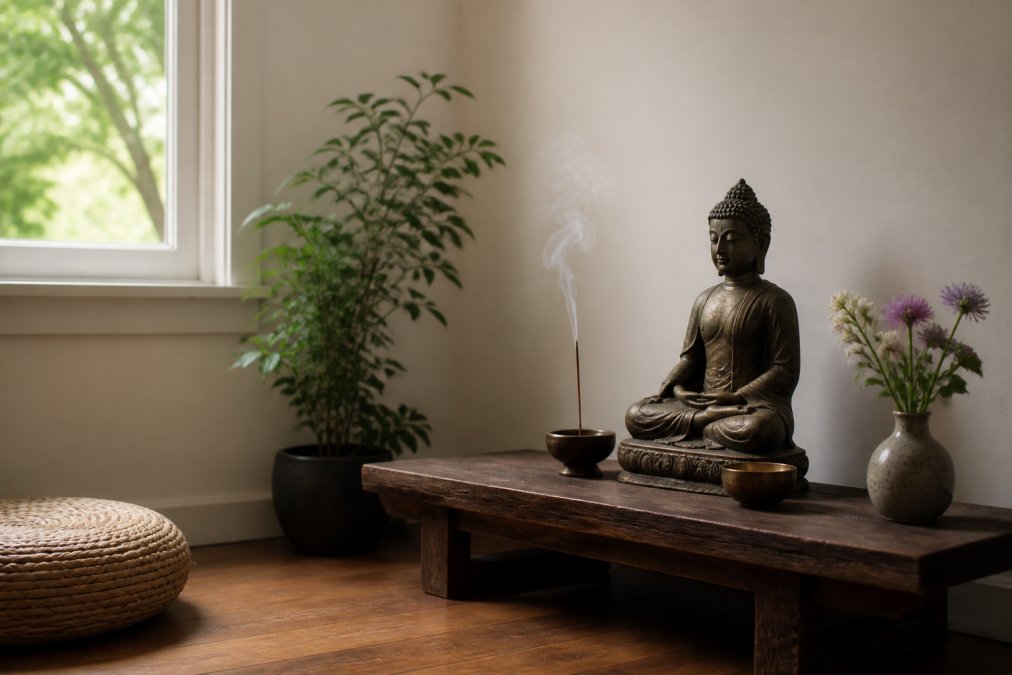
Choosing a Focal Statue or Object
The centerpiece should hold your attention without demanding it. A Buddha or Hindu statue works for many practitioners because the proportions and posture carry a stillness photographs rarely capture. Provenance matters: a piece with documented history and visible craftsmanship reads differently in person than a mass-produced casting. HD Asian Art curates Buddhist and Hindu statues alongside Khmer and Southeast Asian sculptures for this role.
Height matters as much as style. Place the statue so its eyes sit slightly above your own when seated. Too low and it disappears behind your cushion; too high and you crane your neck.
Arranging Offerings and Meaningful Items
Work in odd numbers and leave gaps. A typical arrangement: the focal statue centered, a small bowl or vase to one side, a candle or lamp to the other, and one personal object such as a stone from a place that matters. Resist filling the remaining space, empty surface is part of the composition.
Minimalist Meditation Space Design: Less Visual Clutter
Minimalist meditation space design means removing anything that pulls your eyes toward a task, a memory, or a mess. Visual clutter is the fastest way to break a sit. Laundry on a chair, unopened mail, a stack of books you meant to read: each one is a small hook.
Start with the walls. Neutral tones in warm off-white, soft clay, or muted gray keep the room from competing with your focal object. If you want color, bring it in through one item, a cushion, a textile, a single artwork, rather than repainting.
Then clear the floor. Store anything that does not belong to the practice in a closed cabinet or another room. If the space must double as a home office, use a screen or folding divider so the work surface disappears during practice, that single change does more for tranquility than any decorative purchase.
Managing Sound and Ergonomics in Your Zen Meditation Space
Two problems sink more home practice rooms than any other: noise and discomfort. Most guides skip both because they are not photogenic, yet they decide whether you actually use the room six months from now. Treat this as the engineering layer, the part you set once and then stop thinking about.
Acoustic Treatment for Meditation
Sound bounces off bare walls, hard floors, and glass. You do not need studio-grade treatment, but you do need to break up those reflective surfaces, think absorption, diffusion, and masking, in that order.
Absorption. Soft, porous materials convert sound energy to heat instead of reflecting it. A thick rug under your seat, floor-length curtains, an upholstered bench, and a bookshelf with books will noticeably reduce echo. Thicker, denser material absorbs lower frequencies, a wool rug outperforms a thin cotton mat. Cover at least two of the three hard planes (floor, opposing walls, ceiling) and you will hear the difference.
Diffusion. Irregular surfaces scatter sound in many directions rather than bouncing it straight back. A bookshelf with books of varying heights, a slatted screen, or a textured wall hanging all act as diffusers, keeping a room from sounding like a tunnel even after you add soft furnishings.
Masking. If outside noise is the issue, a white noise machine or steady rain soundscape masks intermittent sound better than silence does, because the brain stops tracking each disturbance. The key word is steady: a fan, an air purifier on low, or a dedicated white noise machine all produce constant, broadband sound that hides a passing truck or a neighbor's door. Intermittent noise, a dishwasher cycle, a footstep overhead, is harder to sit through than constant background sound, because each event pulls attention toward it.
A practical sequence: start with a rug and curtains, add a bookshelf or screen if echo persists, and only then introduce masking sound. Masking covers what absorption cannot reach; it does not replace it. holistic spa experience.
Ergonomics for Long-Duration Sitting
Long sits fail at the hips, knees, and lower back, in that order. The fix is almost always seat geometry, not willpower.
Seat height. Set your seat so your knees rest at or below hip level. If your knees sit higher than your hips, add height under your cushion, a folded blanket, a second zafu, or a firm wedge. A pelvis tilting slightly forward keeps the lower back's natural curve; tilting backward rounds the spine and loads the lumbar discs.
Seat type by body. Cross-legged sitting on a zafu suits most people with mobile hips. A meditation bench lets you kneel with the spine upright and no ankle pressure, helping anyone with tight hips or knee sensitivity. A firm chair with a flat seat and no armrests works for back or knee limitations, sit toward the front edge so the pelvis can tilt forward. There is no single correct seat; only the one that lets you sit twenty minutes without shifting.
Alignment cues. Stack the head over the shoulders and the shoulders over the hips. Rest your hands on your thighs rather than clasping them in your lap, which rounds the shoulders forward over time. Let the chin tuck slightly rather than lifting. Eyes can be closed or softly downcast as long as the neck stays long.
Warning signs. Numbness in your feet within ten minutes means your seat is too low or too soft (mayoclinic.org). Lower back ache before your timer ends means your pelvis is tilting backward. Knee pain means you are forcing a cross-legged position your hips are not ready for, switch to a bench or chair. Change the setup, not your tolerance.
Progression. Alternate between cross-legged sitting and a bench or chair across the week to avoid loading the same joints every session. Build duration gradually: a consistent twenty minutes beats an occasional forty. For longer sessions, stand and walk slowly for a minute between blocks to restore circulation.
Putting the Two Together
Sound and posture interact. A noisy room makes you tense, and tension shows up first in the shoulders and lower back. A seat that hurts makes you restless, and restlessness makes every background sound noticeable. Fix the seat first, it is cheaper and faster, then work through absorption, diffusion, and masking until the room is quiet enough that you stop hearing it.
Creating a Digital-Free Zone and Seasonal Rotation
A digital-free zone means no phone, tablet, watch, or laptop inside the practice area, and it is the single hardest rule to keep. Devices are the loudest objects in any room, even face down and silenced. The problem is not the screen, it is the pull: a phone within arm's reach keeps a background process running in your attention, and it does not stop just because the screen is dark.
Physically Separating Practice From Work
Willpower is a weak design tool. Build the separation into the room instead.
Distance beats discipline. Leave your phone in another room, not on a shelf across the space, the extra ten seconds to retrieve it often breaks the reflex. If you use a phone for a timer or guided soundscape, put it in airplane mode, place it behind you, and set it before you sit so you never touch it during practice.
One surface, one purpose. If the space must double as a home office, use a screen or folding divider so the work surface disappears during practice. A three-panel folding screen is simplest; a tension rod with a heavy curtain works in a corner that cannot take a freestanding divider. The goal is a physical change the body registers, the desk is gone, the practice begins.
Cable and charger discipline. Chargers, cables, and docks are visual noise even when nothing is plugged in. Route them into a closed cabinet or lidded basket and unplug at the end of the workday; a power strip on a switch makes this a single motion.
A landing zone outside the door. Put a small tray or hook just outside the practice area for phone, watch, and keys. Setting them down becomes the transition ritual, a physical cue that the workday is ending and the sit is beginning.
Notifications, not just silence. Airplane mode stops calls and messages, but a smartwatch still buzzes on the wrist, take it off. If a device must stay in the room for safety, set it to do-not-disturb and place it face down, out of sight from your seat.
Seasonal Rotation
Seasonal rotation keeps the space from going stale and matches it to how the room behaves through the year. It is also a maintenance habit: handling every object is how you notice dust, damage, or a statue that has shifted.
In winter, move your seat toward available daylight and add a heavier textile underfoot, cold floors pull heat from the feet and legs, and a thicker rug or wool cushion cover makes long sits easier. In summer, shift away from direct sun, swap in lighter fabrics, and open the window during early sessions. If your space sits near a heating vent or a window that bakes in July, rotate the whole setup rather than enduring it, a seat comfortable in January can be unusable in July.
| Season | Seat Position | Textiles | Sensory Adjustment |
|---|---|---|---|
| Winter | Toward daylight | Heavy rug, wool cushion cover | Warm-toned lamp, cedar or sandalwood incense |
| Spring | Near open window | Medium-weight mat | Floral oils, lighter soundscape |
| Summer | Away from direct sun | Cotton covers, thin mat | Cool scents, fan or white noise |
| Fall | Back toward daylight | Layered rugs return | Amber or frankincense, warmer lighting |
A rotation takes about fifteen minutes. Do it on a fixed date each season, the first weekend of the month works well, so it becomes a habit rather than a project. While you rotate, wipe the altar surface, check textiles for wear, and confirm the focal object still sits at the height you set. Small drift accumulates quietly; the seasonal pass is when you correct it.
Conclusion
Building a room you actually sit in comes down to measurement, restraint, and attention to the unglamorous details: sound, posture, and the absence of your phone. Get those right and the space holds up for years.
When the focal point matters most, HD Asian Art offers carefully curated Buddhist and Hindu statues and Southeast Asian sculptures, each handpicked for collectors who want real provenance behind the piece. Free shipping and a curated selection make it straightforward to find an authentic centerpiece for a small corner or a full meditation room. Browse the collection and give your practice the anchor it deserves. Browse the collection and give your practice the anchor it deserves.
Frequently Asked Questions
How can I create a Zen space at home?
Start by choosing a quiet corner with minimal foot traffic. Clear the area completely, then add a comfortable cushion or bench, a small focal object like a statue or plant, and soft lighting. Keep surfaces mostly empty to reduce visual clutter. Use neutral tones and natural materials to support a calm, grounded feeling. The goal is a space that signals 'stillness' the moment you enter it.
What are the key elements of a zen room?
A zen room typically includes a comfortable seat, a focal point such as an altar or statue, soft ambient lighting, and natural elements like plants or stones. Sound management matters too, so consider rugs or curtains to absorb echo. Keep the palette neutral and avoid digital devices. These elements work together to create a sensory experience that supports breathwork and focus.
How do I choose the right decor for a meditation area?
Choose decor that feels meaningful rather than decorative. A single well-crafted statue, a simple incense holder, or a small tray for stones can anchor the space. Avoid filling shelves with many small items, which creates visual clutter. Neutral tones and soft textures help maintain tranquility. If you collect Asian art, rotate pieces seasonally to keep the space intentional and fresh.
Can I set up a zen meditation space in a small apartment?
Yes. Even a 3-foot by 3-foot corner works. Use a folding screen or curtain to define the area, choose a compact cushion, and mount a small shelf for a statue or candle. Vertical space helps in small rooms. The key is consistency: use the same spot daily so your brain associates that corner with calm and focus.
The challenge with any meditation space is that it only works if you keep returning to it, and that depends on having a centerpiece worth sitting down in front of.
HD Asian Art specializes in carefully curated Buddhist and Hindu statues and Khmer and Southeast Asian sculptures, with free shipping and a collection built for collectors who care about provenance. Browse the collection at HD Asian Art and find the piece that turns a corner into a sanctuary.
