



Ganesha Statue Size for Small Spaces: A Guide
Ganesha Statue Size for Small Spaces: A Guide
Table of Contents
- Why Ganesha Statue Size Matters in Small Spaces
- Measuring Your Space: A Step-by-Step Approach
- Ganesha Statue Placement for Home: Direction and Flow
- Best Materials for Ganesha Statues in Compact Rooms
- Visual Weight vs. Physical Size: The Balance Rule
- Weight-to-Surface Ratio: Protecting Delicate Furniture
- Common Mistakes to Avoid When Sizing a Ganesha Statue
- Frequently Asked Questions
Why Ganesha Statue Size Matters in Small Spaces
Choosing the right ganesha statue size for small spaces is less about finding the biggest piece you can afford and more about matching the statue to the room it will live in. This guide from HD Asian Art walks through the measurements, materials, and placement rules that keep a compact space feeling calm instead of crowded.
A statue that overwhelms a shelf or disappears into a corner never feels right, no matter how fine the carving. Scale decides whether a murti reads as a sacred focal point or as clutter. Get the proportions right and everything else, from daily worship to the visual balance of the room, falls into place.
Measuring Your Space: A Step-by-Step Approach
Sizing a Ganesha statue starts with the surface, not the statue. Measure first, then shop. This three-step method takes about 20 minutes and saves you from a return.
Step 1: Measure Your Surface and Clearance
Measure the width and depth of your shelf, altar, or table. Then measure the clearance above it. If the statue sits under a cabinet or on a bookshelf, that headroom is your hard ceiling.
- Note the surface width and depth in inches
- Note the vertical clearance above the surface
- Leave at least 2 inches of open space on every side
- Check that the base is stable and level
Step 2: Calculate the Ideal Height Range
A common rule is to keep the statue between one-third and one-half the height of the surrounding space. On a 36-inch shelf unit, aim for a statue roughly 8 to 14 inches tall.
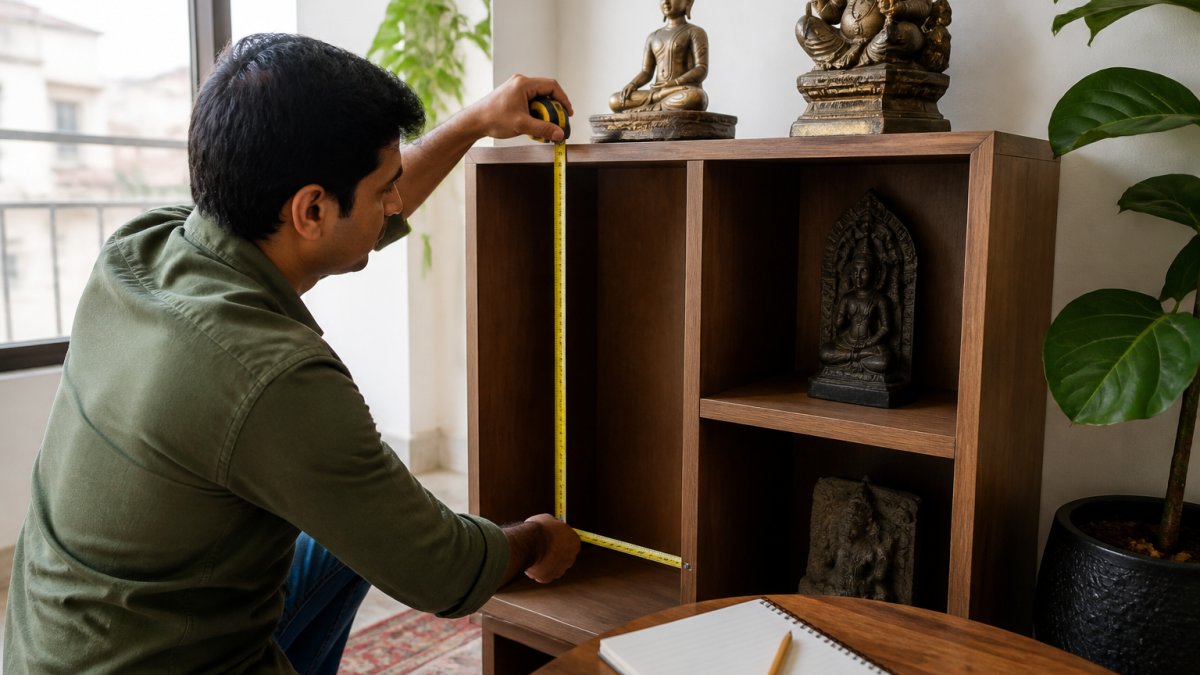
Step 3: Test with a Mockup Before You Buy
Cut a piece of cardboard to the statue's listed height and width. Set it on the surface for a day. This cheap test shows you the real visual footprint before you commit.
Ganesha Statue Placement for Home: Direction and Flow
Ganesha statue placement for home follows a few simple conventions. Vastu Shastra, the traditional Indian system of spatial design, points to the north-east corner as the most auspicious spot for a shrine. The north and east directions are also considered favorable. Vastu Shastra overview from the Encyclopedia Britannica
In a compact space, direction often bends to reality. A studio apartment may only have one clear corner. In that case, keep the statue facing the room's entrance if you can, and keep the area around it clutter-free.
Best Materials for Ganesha Statues in Compact Rooms
The best materials for Ganesha statues in small rooms are the ones that match your light, your cleaning habits, and the surface the statue will sit on. Resin, brass, marble, and wood each behave differently in tight quarters, and the differences show up in ways a product photo never captures.
Resin, Brass, Marble, and Wood: What Works Where
| Material | Look and Feel | Best For | Watch Out For |
|---|---|---|---|
| Resin | Light, detailed, matte or painted | Small shelves, travel altars, desks | Can look flat in dim light; painted finishes can chip at the base |
| Brass | Warm, reflective, weighty | Desks, compact altars, low-traffic shelves | Shows fingerprints and water spots; needs occasional polishing |
| Marble | Cool, pale, substantial | Bright, airy rooms, solid surfaces | Heavy for thin shelves; porous and stains if oil or water sits |
| Wood | Warm, matte, mid-weight | Shelves, bedside altars, multi-functional rooms | Swells in humid rooms; can crack near heat sources |
Resin suits a desk companion or a travel altar because it stays light, most resin murtis under 8 inches weigh well under a pound, so almost any shelf handles them. Brass brings warmth and holds detail well in a small shrine, but a solid brass piece at 8 inches can weigh several pounds, which matters on a glass shelf.
How Finish Changes the Feel of a Small Room
Finish matters as much as material. A polished brass or glossy resin statue reflects light and pulls the eye, which makes it read larger than it is. A matte resin, brushed brass, or unfinished wood finish absorbs light and recedes, which lets a slightly bigger piece sit comfortably in a small room.
- Bright, sunlit room: matte finishes stay calm; polished finishes can glare
- Dim room or north-facing corner: a warm brass or lightly polished finish adds presence
- Busy room with patterned walls: a simple matte silhouette reads cleaner
- Minimal room: a single polished accent works as the focal point
Cleaning and Maintenance in Confined Spaces
Most guides stop at buying. In a small apartment, the harder problem is keeping the statue clean without turning the altar into a project. Dust settles faster on statues placed near windows, kitchens, or air vents, and a tight shelf leaves little room to maneuver.
A workable routine for a compact space:
- Keep a soft makeup brush or dry paintbrush within arm's reach of the altar, a 30-second weekly dusting beats a monthly deep clean
- Use a microfiber cloth for brass and marble; avoid paper towels, which can leave lint and micro-scratches
- Never spray cleaner directly on the statue, spray the cloth, then wipe, so liquid does not run into crevices or the base
- For resin, a barely damp cloth is enough; skip alcohol and solvents, which dull painted finishes
- Lift the statue only when necessary, and set it on a folded towel while you clean the shelf underneath
Material durability matters most in multi-functional rooms where the statue gets moved. Resin and wood tolerate frequent handling best; brass and marble prefer to stay put once placed.
Visual Weight vs. Physical Size: The Balance Rule
A statue's visual weight is how heavy it looks, not how much it weighs. A dark, ornate, high-contrast figure pulls the eye and can shrink a small room. A pale, simple form recedes and lets the space breathe.
Use this balance rule when you compare options:
- Dark or highly detailed statue: choose a smaller size
- Light or minimal statue: you can go slightly larger
- Busy room: favor a calmer, simpler silhouette
- Empty corner: a taller piece adds presence without clutter
That explains the theory. In practice, most people overshoot on detail, not height.
Weight-to-Surface Ratio: Protecting Delicate Furniture
A statue's weight can crack a glass shelf or bow a thin floating shelf over time. This is the part most sizing guides skip. Check the load rating of your shelf or table before you place anything heavy on it.
- Glass shelves: keep loads light and centered
- Thin floating shelves: avoid dense stone pieces
- Solid wood or stone surfaces: safest for brass and marble
- Add a felt pad to spread weight and prevent scratches
Common Mistakes to Avoid When Sizing a Ganesha Statue
The biggest mistake is buying for the room's height instead of the surface. A statue that towers over its shelf throws off the whole space, no matter how fine the carving. The second most common mistake is treating trunk direction and posture as an afterthought, they change how a statue reads in a small room, and they carry symbolic weight that most sizing guides skip entirely.
Mistake 1: Sizing to the Room, Not the Surface
A 24-inch statue can look right in a 10-foot room and completely wrong on a 30-inch bookshelf. Size to the surface first, then check the room. As a rule of thumb, keep the statue between one-third and one-half the height of the shelf or niche it sits in, and leave at least 2 inches of open space on every side.
Mistake 2: Forgetting Clearance Above the Head
The statue's height is not the only number that matters. If it sits under a cabinet, a shelf above, or a wall-mounted light, that headroom is your hard ceiling. Measure from the surface to the nearest obstruction, then subtract at least 2 inches. A crown, an umbrella, or a raised trunk can add an inch or more beyond the listed height.
Mistake 3: Ignoring Trunk Direction
Trunk direction is one of the most overlooked sizing decisions. A trunk curving to the left (from the viewer's perspective) is the most common form and is often linked with prosperity and calm. A trunk curving to the right is rarer and carries its own meaning. In a small space, the practical difference is visual: a left-curving trunk creates a softer, more open silhouette, while a right-curving trunk tends to read as more compact and contained.
Mistake 4: Overlooking Posture
Posture changes the footprint as much as the height. A seated Ganesha in Lalitasana (one leg folded, one relaxed) spreads wider at the base than a standing figure of the same height. A standing figure is taller but narrower. On a narrow shelf, a standing posture often fits better; on a deep desk or altar, a seated posture reads as more grounded.
- Narrow shelf: favor a standing or compact seated form
- Deep surface: a Lalitasana seated form fills the space gracefully
- Low clearance: a seated form with a modest crown fits under shelves a standing figure cannot
Mistake 5: Leaving No Room for Offerings
A statue that fills its surface edge to edge leaves nowhere for a small lamp, a bowl, or a fresh flower. In a compact altar, plan for at least 3 to 4 inches of open surface in front of the statue for offerings, and keep that zone clear of other decor. Maintaining this intentional breathing room around your deity allows for a more balanced aesthetic, which remains a fundamental principle of refined decor for small spaces.
Mistake 6: Skipping the Mockup
Cut a piece of cardboard to the statue's listed height and width, set it on the surface, and leave it there for a day. This cheap test shows you the real visual footprint, including the clearance above the head, before you commit. Most people find the mockup reveals the statue is bigger than they pictured.
A few more traps to dodge:
- Letting the statue compete with heavy decor nearby
- Choosing a size that leaves no room for offerings
- Ignoring how a dark or ornate finish shrinks a small room
- Placing a heavy piece on a surface that was never rated for it
Frequently Asked Questions
What size Ganesha statue is ideal for a small home altar?
For a small home altar, a statue between 4 and 8 inches tall usually works best. This range fits on most shelves and tables without overwhelming the space. Measure your altar's height and width first, then leave at least 2 inches of clearance above the statue. A 6-inch Ganesha statue is a common middle ground for compact setups. If your altar is very narrow, a 4-inch murti keeps the space clutter-free while still serving as a clear focal point for daily worship.
How do I balance statue size with limited shelf space?
Start by measuring the shelf's usable depth and width, then subtract 2 inches from each side for breathing room. Choose a Ganesha statue size that fills no more than one-third of the shelf's width. This keeps the visual balance intact and prevents the statue from looking cramped. For a 12-inch-wide shelf, a 4-inch statue is a good fit. If the shelf is 18 inches wide, you can comfortably place a 6-inch statue with room for small offerings.
Does the size of a Ganesha statue affect its placement in a small room?
Yes, size directly affects placement. A larger statue needs a dedicated surface and clear sightlines, which can be hard in a small room. A smaller statue, by contrast, can sit on a desk, a wall shelf, or a corner altar without blocking movement. In compact spaces, a statue under 8 inches gives you more flexibility to follow Vastu guidelines, such as placing it in the north-east corner, without rearranging furniture. Match the statue to the spot, not the other way around.
What are the best materials for small Ganesha statues?
Wood, brass, and stone are the most practical choices for small spaces. Wood is lightweight, so it works on floating shelves and thin tables. Brass offers a traditional look and moderate weight, making it suitable for sturdy wood surfaces. Stone feels substantial but can be heavy, so use it on solid furniture only. For a travel altar or a desk companion, wood is the easiest to move. Each material carries a different visual weight, so consider how it will read in your room.
Sizing a Ganesha statue for a small space comes down to measuring first and letting the room set the limits. If you'd rather not guess, HD Asian Art offers a curated collection of handpicked statues with free shipping and pieces built for altars, meditation spaces, and refined spiritual interiors. Browse the collection and find a murti that fits your space and your practice.
