



What Does the Asian Art Wellness Connection Mean?
What Does the Asian Art Wellness Connection Mean?
The Asian art wellness connection describes how antique Buddhist and Hindu statues function as focal points for meditation, devotion, and everyday household calm. A carved wooden Buddha or a bronze Ganesha does this work through three channels: it anchors wandering attention, it cues the body into a settled posture, and it shapes the sensory feel of a room through light, texture, and scale.
For collectors and designers, that matters because the object is not decoration first and meaning second. Research on contemplative architecture links sacred geometry and deliberate lighting to self-reported increases in relaxation and emotional clarity of 30 to 40 percent. A gallery like HDAsianArt sources statues with that function built into the sculpture itself, not added afterward.
Three things worth knowing before you place a statue anywhere in your home:
- A statue’s posture and gaze direct where your attention settles, which is why seated meditation figures behave differently than standing guardian figures.
- Lighting, sound, and materials around the object change how “usable” it is for daily ritual.
- Provenance and condition determine whether a piece can carry that spiritual weight authentically, rather than as a prop.
Key Takeaways
Antique Buddhist and Hindu statues support household wellbeing by anchoring attention, cueing ritual posture, and shaping the sensory design of a room.
| Point | Details |
|---|---|
| Mechanism first | Statues work through attention anchoring, posture cues, and sensory room design, not symbolism alone. |
| Iconography guides use | Mudra, expression, and posture tell you whether a statue suits meditation, protection, or ambient display. |
| Placement determines effect | A controlled-light, low-noise focal point outperforms a cluttered shelf for restorative use. |
| Provenance protects authenticity | Demand condition reports, sourcing history, and high-resolution photos before buying antique pieces. |
| HDAsianArt as a sourcing path | HDAsianArt provides expert-researched provenance, condition reporting, and insured worldwide shipping for antique statues suited to meditative and devotional use. |
Table of Contents
How Statues Support Wellbeing Through Attention and Environment
Statues support wellbeing by anchoring attention, cueing ritual posture, and shaping the sensory environment around them. None of that requires belief in anything specific. It requires a fixed point the eye and mind can return to, repeatedly, without effort.
Environmental psychology backs this up more directly than you might expect. Contemplative-architecture studies find that lighting modulation, acoustic balance, and material tactility directly affect sensory comfort and meditative focus. A bronze figure catching low, warm light reads differently than the same figure under a fluorescent ceiling fixture. Zen-inspired restorative spaces, built around simplicity and natural harmony, produce stress reduction of roughly 22 to 35 percent in design studies, which is the same logic that makes a quiet corner with one well-chosen statue more restorative than a cluttered shelf of souvenirs.
The embodied piece is just as real. Kneeling, sitting cross-legged, or simply standing still in front of a statue changes posture, breath, and muscle tension. Art historians describe this as a kind of total-body realignment: the viewer’s physical relationship to the image moves contemplation past pure thought into habit. That is one reason devotional images across traditions, Christian icons included, have functioned as attention-training tools for centuries, not just symbolic decoration.
Research callout: Mixed-methods research on sacred geometry and mindfulness-oriented design ties structured spatial layouts, not just individual objects, to measurable gains in relaxation through art. The statue matters, but so does the room around it.
- Attention anchoring: a fixed visual point reduces mental drift during short practice sessions.
- Postural cueing: sitting or kneeling near a statue physically signals “settle down” to the nervous system.
- Sensory shaping: light, texture, and quiet around the object determine how often you actually use it.
Which Statue Features Matter Most for Meditative Use?
Prioritize iconography, facial expression, scale, posture, material, and provenance, in roughly that order. A statue’s mudra, or hand gesture, tells you its intended function before anything else does. A dhyana mudra (hands resting in the lap, palms up) signals meditation. Abhaya mudra, the raised open palm, signals protection and reassurance. These aren’t decorative flourishes. They’re instructions.
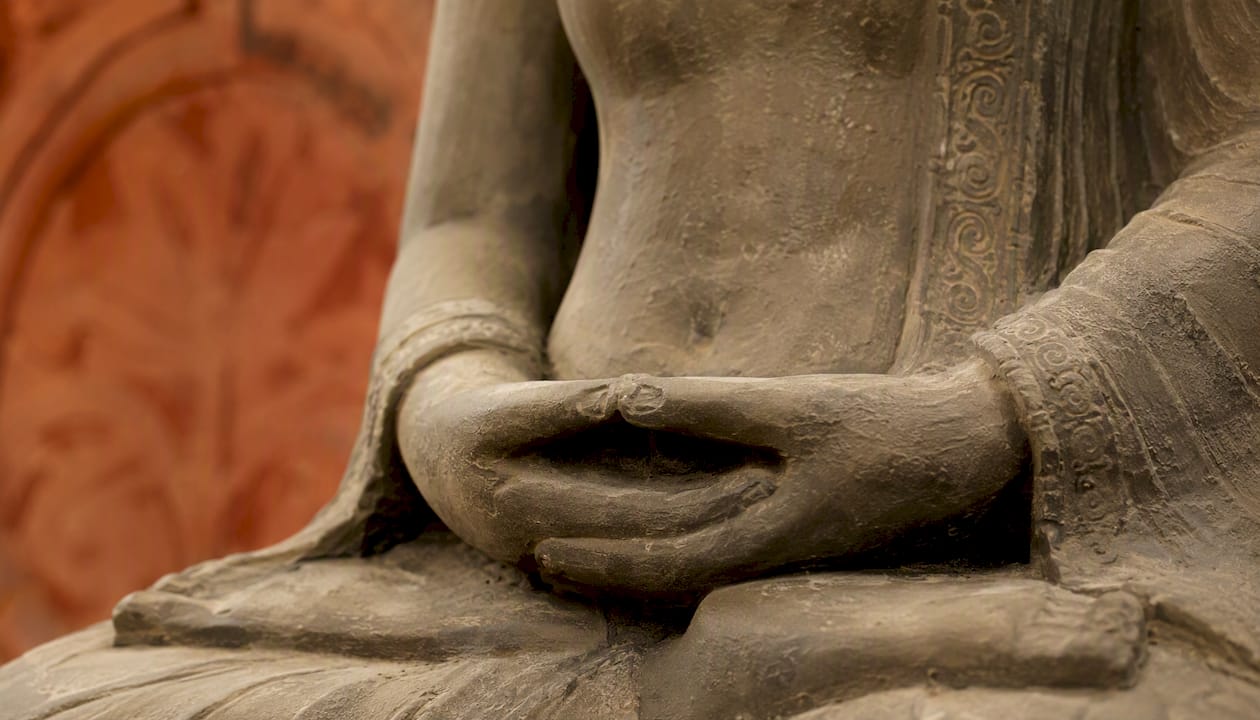
Expression matters almost as much. A seated meditation Buddha with downcast eyes and a faint smile invites inward focus. A standing guardian figure with an alert gaze does the opposite. Neither is better. They serve different rooms and different intentions.
Materials shape the experience through the senses, not just the eyes:
- Bronze carries a cool weight and subtle resonance when tapped, and it ages into a patina that deepens with handling and time.
- Wood feels warm underfoot and to the touch, with grain that shows the sculptor’s hand more directly than bronze allows.
- Stone holds temperature and silence, well suited to spaces that want stillness over warmth.
- Lacquer, common in Burmese pieces, adds a lustrous surface that reflects candlelight in a way plain wood cannot.
Pro Tip: Measure the sightline from your usual seated or standing position before buying. A 12-inch statue on a low shelf reads very differently than the same figure at eye level on a pedestal.
Where Should You Place a Statue for Restorative Effect?
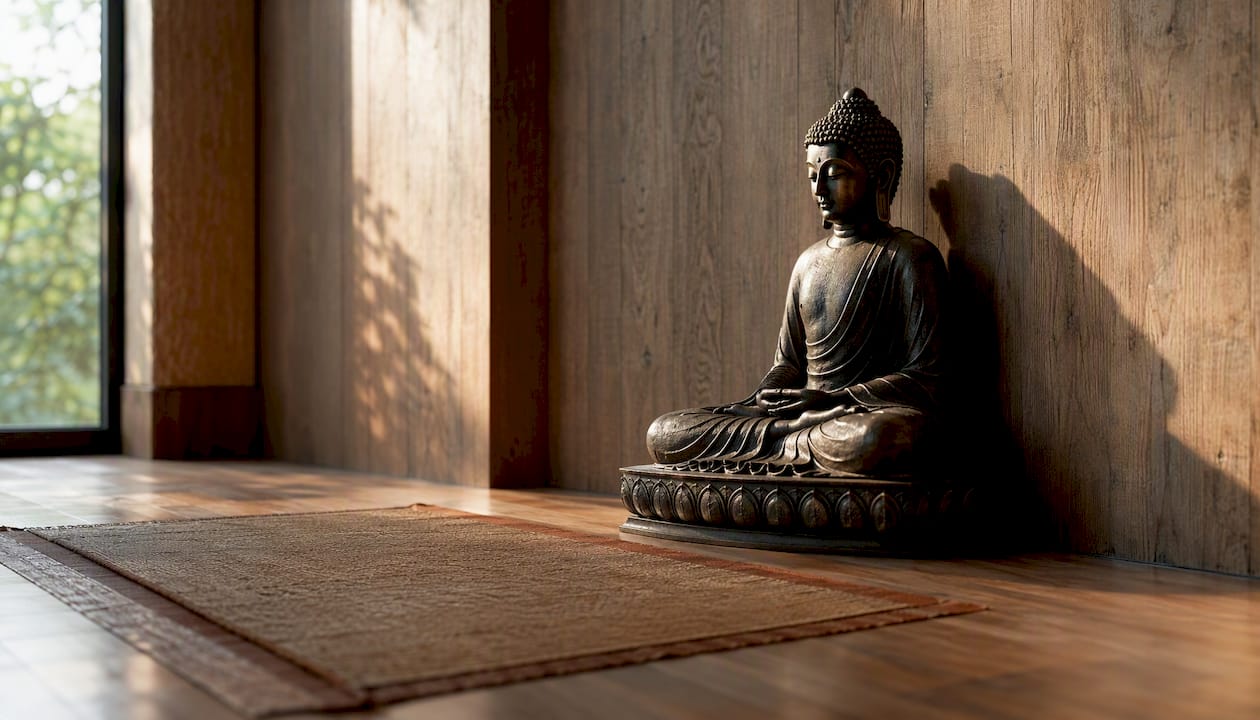
Choose a dedicated focal point, either a proper altar niche or a clearly framed spot in a living space, with controlled light and minimal background noise. Vague placement, a shelf crowded with other objects, produces a vague effect.
Run through this before you commit to a spot:
- Sightline: the statue should be visible from where you actually sit or stand, not just from the doorway.
- Scale: match statue size to room proportions; oversized in a small room competes for attention.
- Lighting: diffused, warm, circadian-aware light works better than direct sun or harsh overhead fixtures.
- Acoustic quiet: a spot away from traffic noise or appliance hum supports longer, calmer viewing.
- Biophilic elements: a small plant or shallow water feature nearby echoes the natural-harmony principle behind Zen-inspired restorative design.
Formal altar placement suits private devotional practice, offerings, and daily ritual. Integrated decor placement, where a statue sits within a broader room design rather than a separate shrine, suits ambient wellbeing goals more than active worship. Interior designers often borrow altar logic for meditation corners even in secular homes, using a single statue as the room’s calm-down anchor.
Practitioner research on meditation-center design recommends a gradual entry sequence: a transitional zone before the main focal point, mimicking how temple approaches prime visitors before they reach the main shrine.
Pro Tip: Back the statue against a plain wall or textile rather than a busy bookshelf. Visual clutter behind the object competes with the very focus it’s meant to provide.
How Do You Use a Statue Respectfully in Daily Practice?
Short, repeated rituals anchor daily attention far more reliably than occasional long sessions. A five-minute habit practiced daily outperforms a rare hour-long sit, mostly because consistency trains the nervous system to associate the object with settling down.
A simple daily practice:
- Sit or kneel at eye level with the statue, close enough to see facial detail.
- Take three slow breaths, letting your gaze rest on the hands or face.
- Hold silent attention on one detail, the mudra, the expression, for one to two minutes.
- Close with a brief acknowledgment, a nod or quiet word, before rising.
- Repeat at the same time each day to build habit strength.
Basic etiquette matters here. Never place a statue directly on the floor or in a bathroom; traditional convention treats floor-level placement as disrespectful. Learn the iconographic basics of your specific piece before adding offerings like flowers or incense, since conventions differ between Buddhist and Hindu traditions. When uncertain, ask a knowledgeable seller rather than guessing.
A nonsectarian option worth trying: Visio Divina–style looking, slow, wordless observation of visual detail, which faith writers describe as training sustained attention regardless of belief system.
Pro Tip: Keep the ritual under five minutes at first. Longer sessions often collapse under their own ambition and get abandoned within a week.
What Should You Verify Before Buying an Authentic Statue?
Demand documented provenance, detailed condition photographs, and clear shipping and return policies before you buy anything described as antique. Vague sourcing is the single biggest authenticity red flag in this category.
A practical checklist:
- Provenance chain: where the piece came from, how it left its country of origin, and who has owned it since.
- Condition report: documented wear, repairs, and structural stability, not just a general “good condition” claim.
- High-resolution photography: images sharp enough to show tool marks, patina, and joinery, the kind museum-quality photography provides.
- Material consistency: patina, wear patterns, and material aging that match the claimed age and origin.
- Shipping and insurance terms: insured worldwide shipping and a stated return window protect you if the piece arrives damaged or misdescribed.
Red flags include inconsistent patina (shiny in spots that should show age), missing condition images, and sellers who can’t answer basic questions about acquisition history. When something feels off, ask directly whether a conservator has examined the piece, and expect a straight answer.
How do I know a Buddhist or Hindu statue is genuinely antique rather than a reproduction? Look for wear patterns consistent with age and handling, material aging (oxidation on bronze, natural checking on wood), and a documented provenance chain. Reproductions often show uniform “aged” finishes applied deliberately rather than developed over decades.
What documentation should a reputable gallery provide? Expect a condition report, sourcing history, high-resolution photography, and clear insured shipping terms as standard practice, not premium add-ons.
How Do You Care for Wood, Bronze, Stone, and Lacquer Statues?
Keep humidity and temperature stable, keep the piece out of direct sun, dust gently, and never use household cleaning products on an antique.
- Bronze: avoid abrasive polishes, which strip protective patina built up over decades.
- Wood: avoid rapid humidity swings, which cause cracking and warping over time.
- Stone: dust with a soft brush; avoid water unless you know the stone type.
- Lacquer: never use solvents; lacquer surfaces react badly to alcohol-based cleaners.
Call a conservator if you see flaking finish, active corrosion (green bronze powder, not stable patina), or structural instability like a loose base. A gallery that provides a detailed condition report at purchase gives you a baseline to compare against later, which is exactly the kind of documentation HDAsianArt builds into every listing.
A Curator’s Take on Why These Objects Still Matter
A well-placed statue does more practical work for household calm than most people expect from a single object. I’ve watched a single seated Buddha, moved from a crowded shelf to a bare wall with better light, change how a whole room gets used, quietly, without anyone announcing it. Before you buy, ask where the piece has actually been and who has cared for it. Respect for that history is part of what makes the object work.
Where to Find Statues Built for This Purpose
HDAsianArt curates antique Buddhist and Hindu statues specifically because the sculpture’s original function, meditation, devotion, protection, still matters to how it performs in a modern room. Every piece comes with expert-researched provenance, detailed condition reporting, and museum-quality photography, so you’re not guessing about age or authenticity.
If a seated bronze Buddha fits your meditation corner, browse the antique Javanese Buddha statue currently available, or explore the full gallery collection for pieces suited to altar or living-space placement. Every order ships worldwide with DHL insurance and a clear return policy, so you can evaluate the piece in your own space before committing long-term.
Frequently Asked Questions
What does the Asian art wellness connection actually mean in practice? It means an antique Buddhist or Hindu statue can function as a focal point that supports meditation, ritual habit, and household calm through attention, posture, and sensory design, not through decoration alone.
Do I need a religious background to benefit from a statue’s contemplative use? No. Nonsectarian practices like slow, sustained looking work regardless of belief, though respectful handling of the object’s original meaning still matters.
How large should a meditation statue be for a home altar? Size should match sightline and room scale; a piece visible clearly from your usual seated position matters more than any fixed dimension.
Can a statue lose its spiritual function if placed incorrectly? Poor placement, low on the floor, cluttered surroundings, harsh lighting, won’t damage the object but does reduce its practical usefulness as a focal point.
Sources
- Architectural strategies for enhancing mental well-being and spiritual engagement: a multidisciplinary approach to mindfulness-oriented design | City, Territory and Architecture | Springer Nature Link
- Transcultural Zen design frameworks for enhancing mental health through restorative spaces and user experience | Scientific Reports
- Buildings: design practices for meditation centres (UCL discovery)
- Christian visual arts overview (SAET)
- How can sacred art help us to pray? (Catholic Exchange)
