



Buddha Heads for the Garden: A UK Buying and Care Guide
Buddha Heads for the Garden: A UK Buying and Care Guide
You've found a Buddha head you like, photographed the corner where it'll sit, and you're ready to pay. That's exactly the point to pause. Outdoors in Britain, Buddha heads for the garden aren't just accents. They're stone, bronze or resin objects that'll take rain, frost, theft risk and, at a listed home, planning controls. Check material, size, provenance and the base before money changes hands, and you'll avoid the cracks, consent problems and lifting injuries that cost far more later.
Table of Contents
- Which Material Survives a UK Garden
- How to Check Size, Condition and Provenance
- Checking Listed Buildings and Planning Rules
- Placing the Head Respectfully and for Wildlife
- Shipping and Installing the Head Safely
- Seasonal Care That Protects Porous Stone
- Confirm the Site and Paperwork Before You Buy
Which Material Survives a UK Garden
For an open lawn or exposed border, dense natural stone or granite will outlast most options, and bronze handles exposure well too. Well-made cast stone earns its place only in a sheltered spot, because its porous surface takes on water and crazes in hard frost. Match the material to how wet and windy your corner is, not how it looks in June.
| Material | Outdoor durability | Main risk | Upkeep |
|---|---|---|---|
| Cast or reconstituted stone | Good in sheltered sites; surface is porous | Crazing and water ingress in hard frost | Soft brush and water; keep off soil |
| Natural sandstone | Good if dense and well drained | Water absorption and spalling after freeze-thaw | Free-draining plinth; annual inspection |
| Granite | Excellent | Heavy and costly to move; can still stain | Rinse; check joins each season |
| Bronze | Very good; sheds rain well | Green patina; corrosion at fixings | Leave to patinate or wax; use stainless fixings |
| Resin or fibreglass | Fair; fades under strong sun | Surface damage; easy to remove | Mild soap only; avoid abrasive pads |
| Antique carved stone | Variable; depends on condition | Cracks, old repairs, unclear provenance | Conservator assessment before outdoor use |
What the trade-offs mean in practice
Cast or reconstituted stone holds detail well and is easier to replace, but it stays porous for life. Trapped water freezes, expands and opens a network of fine cracks across the face. In a hard winter that damage shows fast, so a porch, wall recess or courtyard is its real home, never a puddle-prone lawn.
Natural sandstone has real character and colour variation, yet it absorbs water readily. It needs a free-draining plinth and air around the base, or you'll get spalling after repeated freeze-thaw cycles. Granite is the opposite problem. Dense and low in absorption, it shrugs off an exposed lawn position, but it's heavy, costly to move and you'll think twice before repositioning it.
Bronze sheds rain, resists frost and develops a green patina many buyers want. Use stainless fixings so corrosion doesn't stain the neck or plinth, then either leave the patina alone or wax it deliberately. Switching between the two leaves a blotchy finish.
Resin or fibreglass is light, cheap to move and fine under a porch. It fades under UV, marks easily and won't take a wire brush. Antique carved stone carries the highest value and the least tolerance for experiments. I wouldn't put one outdoors without a conservator's view first.
Our guide to the best materials for outdoor Buddha garden statues works through exposure in more detail, and the same logic applies to adjoining structures. If the head will sit beside a garden room, choosing timber cladding for garden rooms is worth reading alongside, because splashback and shade from cladding change how wet the stone stays.
A head under a porch or in a sheltered courtyard widens your options. A fully exposed lawn position narrows them to dense stone or bronze.
How to Check Size, Condition and Provenance
A seller's photograph with no dimensions tells you almost nothing about presence, weight or risk. Run these checks on the listing page or in person, before you pay.
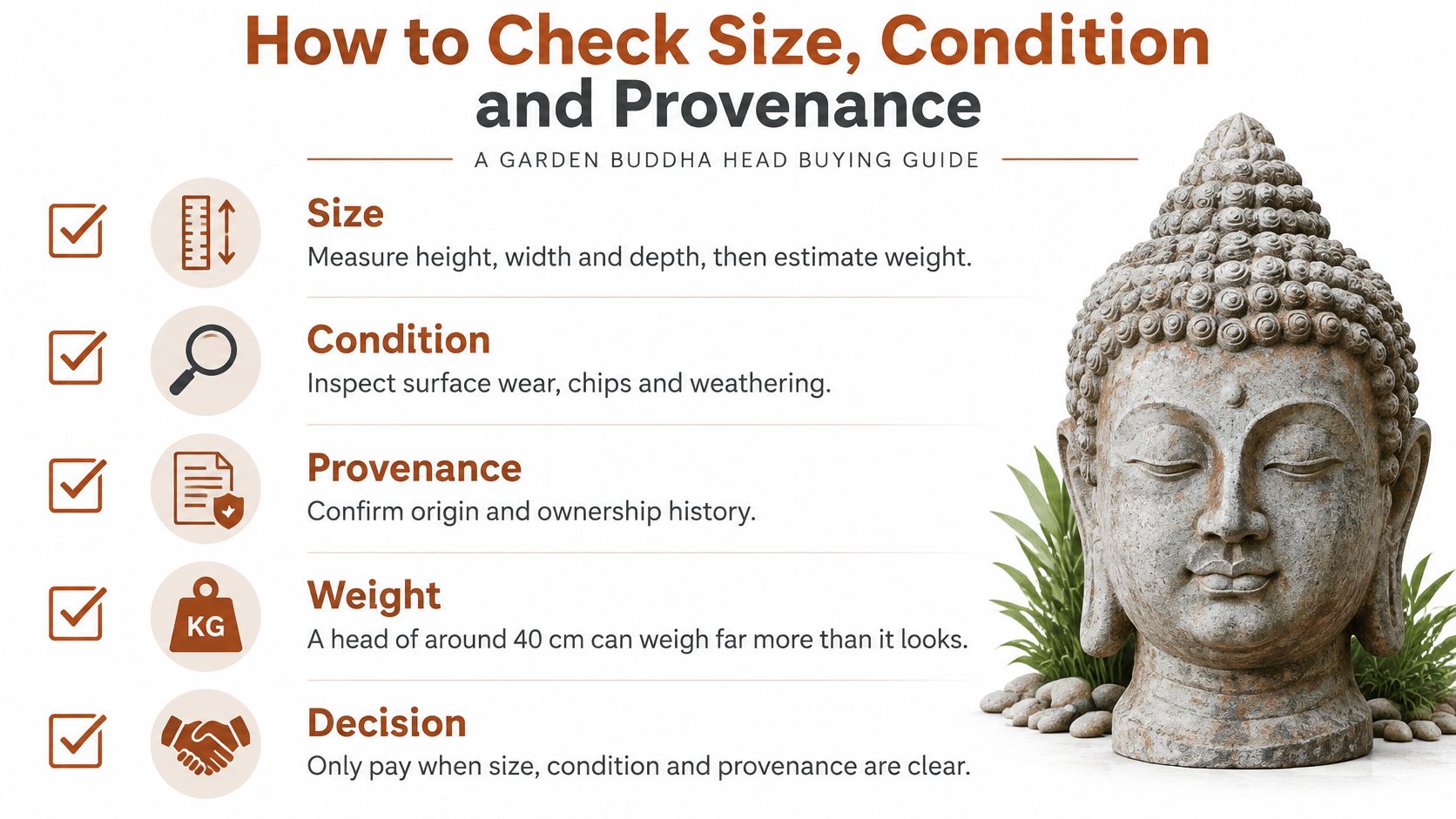
The buying checklist
- Measure footprint and height. Record height, width and depth, then mark the footprint on the plinth with tape so you can judge the head's true scale against planting and sightlines.
- Confirm weight and moving method. A head of around 40 cm can weigh far more than expected, so plan for two people or a sack truck.
- Inspect joins, cracks and hollows. Look for hairline cracks, neck joins and recesses that trap water, using raking light from a torch so repairs show.
- Ask for origin and documents. Ask age, place of origin, previous owners, restoration history and any paperwork.
- Decide sheltered or exposed. Match the answer to the material you've chosen, not the other way round.
- Photograph on arrival. Date the images for insurance and future condition comparison.
That 40 cm scale is a practical benchmark for a substantial outdoor piece, though heads from different periods and regions vary widely in size. Use it to plan weight, footing and fixings rather than as a target every head will meet.
An old-looking head isn't automatically a safer buy. It may need stronger documentation, and UK rules on importing or exporting cultural objects can apply, so vague answers about origin should stop the sale. The Victoria and Albert Museum record for a Buddha head from Sultanganj describes a head made from fine-grained mica-schist and dated to the 7th or 8th century, reportedly excavated in 1862 and acquired by the V&A in 1949 for £40. Those specifics, material, date, findspot and acquisition, are what provenance looks like when it's documented.
For hands-on detail, our notes on evaluating the condition of antique stone statues cover surface wear and old repairs.
Verdict: A modern cast or dense stone head suits an open garden. An antique head belongs in a sheltered spot, with documented provenance and advice before it goes outside.
Checking Listed Buildings and Planning Rules
A head you can carry into the garden can still need consent at a listed home. Buyers assume that because they can lift it, no permission applies. Then they set a plinth in mortar, lay paving and fix it down, and the job becomes work on a listed property.
In England, the Royal Borough of Greenwich guidance on permission for works to listed buildings states that structures within the curtilage or grounds, including statues and fixed garden ornaments, may require Listed Building Consent when the work affects the character or appearance of the listed asset. For structures built before 1 July 1948, protection can extend through curtilage listing, so a separate-looking garden feature may be treated as part of the listed property. Unauthorised works affecting a listed building can constitute a criminal offence under the Planning (Listed Buildings and Conservation Areas) Act 1990.
The penalty is the part to remember. Consent turns on the building and its grounds, whatever the head weighs.
Treat the base as part of the proposal
Hard landscaping changes the picture. The Buckinghamshire Council heritage guidance on work within the grounds of a listed building says large areas of new hard landscaping may require planning permission, and hard landscaping directly next to the walls of a listed building may also require Listed Building Consent. Treat the plinth, paving, excavation and drainage as one proposal.
Four steps before groundwork
- Check the listing. Confirm whether the property or garden structures appear on the council register.
- Ask for written advice. Put the head, plinth and any paving to the planning officer in a single enquiry so the whole scheme gets assessed together.
- Record the proposal. Note dimensions and fixing method, with dated photographs of the exact location.
- Wait for confirmation. Hold off on groundwork until the reply arrives in writing.
A permanent anchor or new plinth changes the position even when the head itself could be moved by hand. On a listed site, settle consent before you buy; a stone head that arrives ahead of the paperwork can sit in the garage for months.
Placing the Head Respectfully and for Wildlife
A 30 cm head at the end of a shady border, on a low plinth among foxgloves and ferns, facing a bench. That single placement does three jobs at once: a focal point you can see from a seat, plants that feed pollinators, and cover left intact at ground level. The alternative, a bare paved corner with raked gravel, gives you none of these.

Posture, height and respect
Choose the posture before the spot. Buddha postures and hand gestures, or mudras, cover meditation, teaching, protection, or blessing, and each reads differently outdoors. Meditation suits a bench or quiet seating area where you sit with the piece. Teaching or blessing suits a path end or entrance, where the gesture meets you as you approach.
We recommend a Buddha statue be kept clean, raised from the floor, and away from bathrooms, cluttered areas, or places where it may be treated casually. Outdoors that translates as off bare soil, clear of bins, drains and stacked pots, and at seated eye level where possible. A head tucked into a bin corner or crowded onto an ornament shelf reads as casual décor, however good the carving is. Our guidance on how to respectfully display religious Buddhist art sets out the reasoning.
Leave room for habitat
Gardens already carry real habitat weight, providing cover, food and nesting sites for many bird species and much of the other wildlife people see day to day. A stone head on a modest plinth displaces almost none of that. Spread paving, built platforms and cleared borders displace far more.
Keep hedgehog gaps open at fence level. Don't block ponds, nesting cover or pollinator borders with a new platform, and keep cleaning runoff out of planting and water. Position matters for the stone as well. A head set directly under a perch, feeder or overhanging branch collects droppings and leaf litter, and both stain porous stone and wear the surface over time. Give the carving clear air above it.
Apply three tests before you fix anything. Visible from a seat. Dry at the base. Room left for wildlife. If one fails, change the position before you change the planting.
Shipping and Installing the Head Safely
Packing decides whether the head arrives intact, so start before you order. Ask how the piece is packed: cushioned on all sides, braced inside the box and unable to rattle against the walls. A customer described the parcel as extremely well packaged, with the contents arranged inside the box to keep the statue safe. That is the standard to request in writing, especially for a carved head where ears, nose and ushnisha take the knocks.
Photograph the head on arrival, before fully unpacking, and report damage at once while the packaging is still as delivered. Keep the crate and padding until the piece is sited; a return or claim is far harder once materials have been discarded.

Installation in order
- Prepare the move. Confirm weight, route and numbers, and use a trolley for anything heavy. Clear gates, steps and gravel edges first.
- Build the plinth. Make it level, compacted and free-draining, sized so the head cannot tip. A wider base beats a taller one.
- Set the head. Lift from the base, never the neck or ears, using padded straps. Dry-fit the position before final bedding so a heavy piece is not shifted twice.
- Anchor discreetly. Use a concealed fixing or a stable plinth. Gravel fill as a theft deterrent suits only hollow pieces where the base drains, because trapped water harms porous stone. Don't drill fragile sculpture or use tight restraints that concentrate stress.
- Check sightlines. Keep the head visible from a window and cut back vegetation behind it. A clear view helps security and lets the carving read from the house.
- Time the work. Choose a day when ground is neither frozen nor waterlogged, then check level again after the first heavy rain.
Security is part of siting. The Tetbury Town Council crime-prevention advice on sheds and garages recommends securing outdoor ornaments in position or filling them with heavy gravel so they cannot be carried away easily, and maintaining clear sightlines by cutting back vegetation. An isolated head behind dense planting fails both points.
Base construction matters as much as the stone above it. For a broad look at how stone choices carry load and shed water in hard landscaping, compare stone materials for Austin patios, then detail the plinth for UK frost, rain and a level, free-draining base.
Seasonal Care That Protects Porous Stone
Protect porous stone from trapped water and abrasion, not by sealing it shut. A coating that looks protective in October can hold moisture against the surface all winter, and that's when damage happens.
| When | Check | Action |
|---|---|---|
| Autumn, before winter | Leaf litter, algae, blocked drainage holes | Clear by hand and soft brush; check the plinth drains |
| After each severe frost | Flaking, spalling, hairline cracks | Photograph; call a stone conservator if cracks are active |
| After heavy rain or strong wind | Tilt; water pooling in recesses | Re-level the plinth; empty hollows |
| Every 12 to 24 months | Salt crystals, failed joints, rust from ties | Full inspection; log any change |
| Spring | Lichen and moss | Gentle clean; avoid pressure washing |
Actions the schedule does not cover
- Clean gently in autumn. Clear leaf litter and algae with a soft brush and water, never a pressure washer. The jet cuts fine detail and drives water deeper.
- Skip plastic wrap. It traps condensation. If winter cover is needed, use a breathable, insulating cover ventilated at the base.
- Never tie with wire. Wire and tight straps abrade the surface and can rust. Secure covers without rubbing contact.
- Keep drainage clear. Check holes and the plinth after rain so the base doesn't sit saturated.
- Photograph after frost. Record flaking or detached fragments before you touch them, so change is measurable.
The science behind this is straightforward. The English Heritage guidance on protecting outdoor sculpture reports that wet stone combined with freezing temperatures can cause freeze-thaw damage and found insulated, vapour-permeable protection gave good control of freezing cycles and relatively stable humidity in testing. The same guidance supports inspecting outdoor stone every 12 to 24 months, checking for biological growth, salt crystallisation, freeze-thaw spalling, failed joints, and rust jacking.
Non-breathable coatings work against that principle. They slow drying, so the stone stays wet longer between frosts. I would leave a sound porous surface uncoated and spend the effort on drainage instead.
Frost timing affects the lawn around the plinth too. When you're deciding whether to cross the garden to inspect the head on a frosty morning, the advice on when to keep carts off frosted grass is a useful reminder that frozen ground and turf damage easily, so use paths and boards rather than dragging a trolley over it.
Active cracking, flaking or detached fragments go to a stone conservator. Don't fill or cement them on site to make them look finished.
Confirm the Site and Paperwork Before You Buy
Three gates decide whether a purchase is sound.
Gate one, material suits site. Dense stone or bronze for open lawns. A sheltered spot for cast stone, resin or any antique piece.
Gate two, permissions settled. If the property is listed, get written advice covering the head, plinth and paving before anything is fixed.
Gate three, base ready. A level, free-draining plinth, clear sightlines, and a delivery plan that covers packing, route and lifting.
By situation, the verdict is simple. A sheltered courtyard with a documented antique head is workable. An exposed lawn calls for dense stone or bronze. A listed property needs written advice first, however movable the head looks. Our Collector's Journal publishes articles on identifying antique Buddha statues, choosing mantras, and placing Buddha statues in gardens, which helps with the identification side of gate one.
For your next action, put the seller's answers on provenance and condition beside your site notes and photographs. Keep both together. That single file is what you'll need if the head is moved, insured or sold, and it's far easier to assemble now than to reconstruct later.
Browse antique and contemporary Buddha heads by region, material and style at HD Asian Art, where each piece is selected for collectors, institutions and private settings. Use the size, condition and provenance checklist above as you compare, and contact us before you commit if a sheltered or exposed garden site is still undecided.
